- Home
- /
- Sundial Encyclopaedia
- /
- Dials: Unusual
Dials: Unusual
March 2023
Page 10
Page 10
A summary of the 51 new finds added to the Fixed Dial Register in 2022, increasing the record count to 7,781. Highlights include a Falklands memorial dial, a French Noon Cannon, two Francis Barker instruments, and the largest vertical dial (Piers Nicholson’s in Fleet Street).
Dials: Analemmatic, Dials: Unusual, Historical Dials
March 2023
Page 25
Page 25
Compares two armillary dials seen during a NASS conference tour. The first, at the Governor’s Residence, is exquisite and highly symbolic. The second, at Vanderbilt University, uses a unique method where a spot of light shines through the equatorial ring onto an analemma plate to indicate the time.
Dials: Armillary Sphere, Dials: Equatorial, Dials: Unusual, Equation of Time
June 2023
Page 7
Page 7
Presents photographs of 'The Light of Enlightenment' statue and fountain located in the Tang dynasty-style Nan Lian Garden in Kowloon, Hong Kong. This sculpture, designed by Simone Bartolini in 2006, is built on an octagonal base, one panel of which depicts a map of China.
Dials: Unusual, The BSS and Members
June 2023
Page 24
Page 24
Investigates a distinctive group of early stone horizontal sundials in the former county of Flintshire, North Wales, dating from 1588 to 1637. These dials are characterised by having hour lines carved directly into the surface of the stone pillar (likely Gwespyr stone) and may be derived from cut-down churchyard crosses.
Dials: Horizontal, Dials: Unusual, Historical Dials
June 2023
Page 30
Page 30
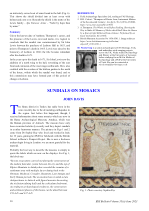
Examines 3rd and 4th-century Roman mosaics from the Hatay Archaeological Museum, Antakya, which humorously depict public sundials. The scenes show caricaturised guests rushing to dinner or attempting to vandalize the dial for being late, confirming both the Roman use of public dials and the existence of early vandalism.
Dials: Unusual, Historical Dials
September 2023
Page 9
Page 9
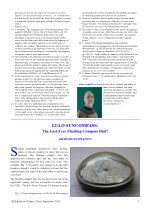
Examines the Li-Lo Suncompass, a floating compass dial made in Great Britain in the mid-1940s, possibly the last of iteration of its type. It discusses its plastic construction, dual time scales (Winter Time and Summer Time), the Li-Lo brand's history (owned by P.B. Cow & Co.), and its origin as the German 'Rüter Uhr' developed in 1945.
Dials: Portable, Dials: Unusual, Historical Dials
September 2023
Page 18
Page 18
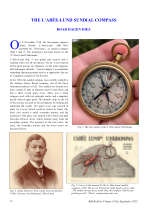
Details the history, design, and use of the Norwegian L’Abée-Lund Uhrkompas, patented in 1914. This brass, portable instrument was marketed using the figure of a red ant and includes scales for determining time based on solar azimuth, corrected for magnetic declination, longitude (8¾° east), and Equation of Time for a design latitude of 60° north.
Dials: Portable, Dials: Unusual, Historical Dials
September 2023
Page 35
Page 35
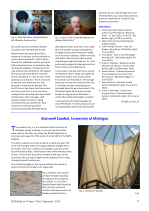
Describes a cylindrical sundial (Dial 1085 in the NASS Registry) located in a stairwell of the University of Michigan Energy Institute, seen during the NASS Conference bus tour. The nodus is formed by the centre of the eight radial arms supporting the skylight, and the markings include a toposcope.
Dials: Cylindrical, Dials: Unusual, Sundial Design & Layout
December 2023
Page 10
Page 10
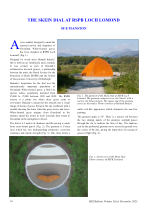
A report on a 6.3-metre diameter horizontal sundial/art installation at RSPB Loch Lomond, designed by Hannah Imlach, which marks the migration windows of Greenland White-fronted geese. The gnomon is formed by the slit between two sheets of Corten steel with piercings that give the impression of migrating geese in flight, and coloured bands mark the Autumn and Spring arrival/departure periods.
Construction Projects, Dials: Horizontal, Dials: Unusual, Sundial Design & Layout
December 2023
Page 17
Page 17
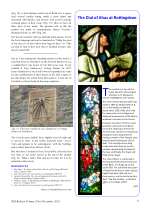
This note examines a stained-glass window in St Margaret’s Church, Rottingdean, designed by Edward Burne-Jones (1897), which depicts King Hezekiah holding the ‘Dial of Ahaz’, referenced in II Kings 20:11 and Isaiah 38:8.
Dials: Unusual, Historical Dials
December 2023
Page 28
Page 28
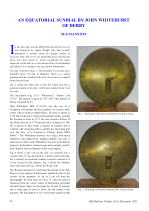
Describes an interesting and possibly unique equatorial sundial acquired by Annie Wright, signed "Whitehurst" "Derby" and "1761" (Lat: 53D: 00M). The dial features two centres of delineation, hour lines marked from 4 am to 8 pm, solstice lines on the gnomon, and some engraving errors.
Dials: Equatorial, Dials: Portable, Dials: Unusual, Historical Dials, Sundial Design & Layout
December 2023
Page 32
Page 32
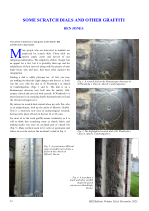
Examines scratch dials in the context of general historic graffiti found on church walls. The article discusses how displaced dials can offer dating evidence and explores unusual dial-like markings (like hexafoils and asterisk symbols) that may or may not be scratch dials, encouraging members to report finds.
Dials: Mass Dials, Dials: Unusual
March 2022
Page 2
Page 2
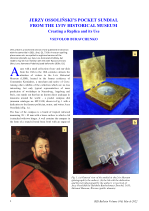
An analysis of a unique 17th-century pocket compass dial (MT-1838) from the Lviv Historical Museum, dedicated to Jerzy Ossoliński and designed by Oswald Krüger in 1644. It features both horizontal and azimuthal scales. The author and associates created two functional replicas for customers in Ukraine, adapting the design for modern latitudes.
Construction Projects, Dials: Portable, Dials: Unusual, Historical Dials
March 2022
Page 11
Page 11
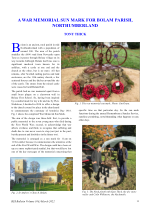
Details the design and construction of a war memorial sun mark installed in Bolam Parish churchyard. The memorial, created using rusty iron shepherd's hut wheels, is designed to precisely mark 11 am on 11 November by focusing a spot of light through an aperture onto a poppy medallion.
Construction Projects, Dials: Unusual, Sundial Design & Layout
June 2022
Page 2
Page 2
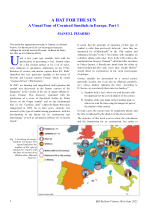
This article explores cornice or 'hat' sundials found across Europe, focusing on their unique design where time is indicated by the shadow of a curved cornice or set of styles. It details several examples, locations, construction dates, and conservation recommendations for these historically interesting and unusual dials.
Dials: Unusual, Historical Dials, Sundial Design & Layout
June 2022
Page 16
Page 16
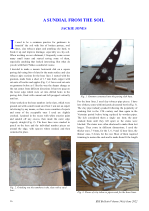
This describes a DIY horizontal mosaic sundial constructed on a paving slab using found materials, specifically slate for the surface and pieces of clay tobacco pipe stems for the hour lines. The piece features a copper gnomon with decorative cut-outs and was successfully tested as a moon dial in the garden.
Construction Projects, DIY Sundial Projects, Dials: Horizontal, Dials: Unusual
June 2022
Page 26
Page 26
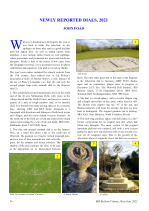
This section presents a selection of over 30 new reports added to the Register in 2021. Noteworthy entries include several 17th-century church verticals, three newly identified makers, a large azimuth dial, and examples featuring advanced concepts like 'Plane’s Longitude' or unusual shapes like sliced spheres.
Dials: Unusual, Historical Dials
September 2022
Page 20
Page 20
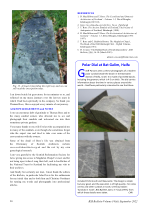
Describes a modern, high-quality polar sundial located beside the beach in Haifa, Israel. The dial is made of polished basalt and carries time information for various global locations, including Portsmouth and Newcastle.
Dials: Polar, Dials: Unusual
September 2022
Page 21
Page 21
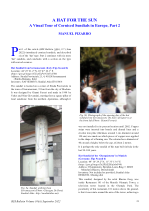
Continues a visual tour of European corniced sundials, detailing six more ‘hat’ types, such as the Serramazzoni dial (Italy) and the Marian Column (Germany). Also introduces dials with curved cornices, highlighted by the enormous Castillon Dam sundial (France), the largest dial in the world.
Construction Projects, Dials: Unusual, Historical Dials, Sundial Design & Layout
December 2022
Page 16
Page 16
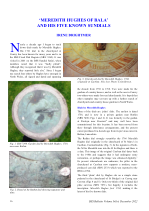
Research into the 18th-century Welsh dial maker, Meredith Hughes, a land surveyor and scientist. Describes his five known dials, including two complex ones incorporating the Equation of Time and geographical features, possibly outsourced for engraving.
Dials: Horizontal, Dials: Unusual, Equation of Time, Historical Dials
December 2022
Page 22
Page 22
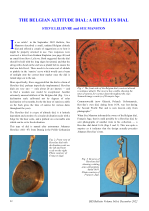
Follow-up article suggesting the previously discussed small Belgian altitude dial is a rare Hevelius dial, possibly a unique wooden example using the time of sunrise as a proxy for solar declination. Analysis shows deliberate geometric simplification in its layout.
Dials: Portable, Dials: Unusual, Historical Dials, Sundial Design & Layout
December 2022
Page 30
Page 30
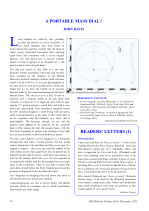
Examines a rare lead disc found by a metal detectorist, which is 78mm in diameter. The design, featuring equi-angular spots, suggests it may be a portable unequal-hour mass dial designed for a rod gnomon.
Dials: Mass Dials, Dials: Portable, Dials: Unusual, Historical Dials
December 2022
Page 35
Page 35
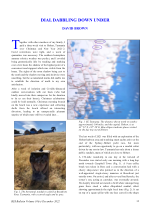
Account of a three-week sundial safari in Hobart, Tasmania. Examines several dials including the Transit of Venus commemorative dial and a complex mechanism at UTAS. Ends with discovery of the 'Sundial Sea Shell'.
Dials: Horizontal, Dials: Unusual, Historical Dials, The BSS and Members
December 2022
Page 40
Page 40
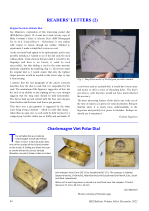
Commentary on the Belgian Portable Altitude Dial, suggesting that using the time of sunrise as a proxy for declination is an interesting, layperson-friendly feature.
Dials: Vertical, Dials: Portable, Dials: Unusual
March 2021
Page 8
Page 8
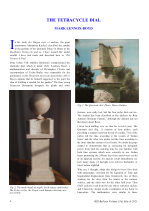
Description of a model sundial inspired by the Meridiana Tetracycla in Rome. It features four niches with analemmas, designed to read GMT throughout the year using corrections for the Equation of Time and longitudinal displacement. The model stands 62 cm high and is made of maple, birch veneer, and bronze.
Construction Projects, Dials: Unusual, Equation of Time, Sundial Design & Layout
March 2021
Page 23
Page 23
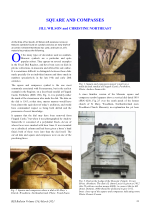
An analysis of various Masonic symbols found decorating sundials, building upon material left by the late Jill Wilson. It describes the use of the square and compasses, the Eye of Providence, pillars, and other emblems on dials, ranging from ancient mason's marks to later 'antique' and custom-made pieces.
Dials: Unusual, Historical Dials, Mottoes, The BSS and Members
June 2021
Page 7
Page 7
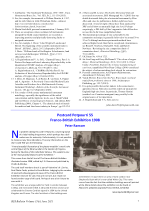
Discusses a specific postcard from the 1908 Franco-British Exhibition in London, featuring a floral sundial in the Garden of Progress. The dial includes a prominent statue of a lady holding the gnomon. The exhibition celebrated the Entente Cordiale.
Dials: Horizontal, Dials: Unusual, Historical Dials
June 2021
Page 20
Page 20
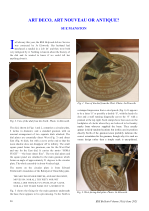
Analyzes a highly unusual circular sundial featuring separate curved direct West and East dials. The investigation, based on numerals and a foundry mark, suggests it might be a custom-made dial by Francis Barker & Son, possibly derived from their 'Antique' model (c. 1907). Concludes the dial incorporates elements of both Art Deco and Art Nouveau styles.
Dials: Vertical, Dials: Unusual, Sundial Design & Layout, Historical Dials
June 2021
Page 44
Page 44
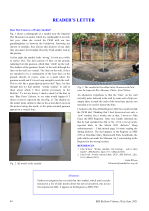
A reader discusses an unusual sundial near the Imperial War Museum, featuring hour lines on the ground that continue vertically up a wall. The author models the dial, hypothesizing that it functions like a giant diptych pocket dial or that the vertical markings are merely endpoints for the hour lines, noting its history in the Fixed Dial Register.
Dials: Portable, Dials: Unusual, How Sundials Work, Sundial Design & Layout
September 2021
Page 17
Page 17
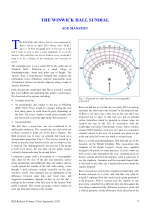
Details the project to convert a 30-foot telegraph pole at Winwick Hall into a large, highly visible outdoor sundial. The final design employs the vertical pole's shadow to cast time on 18-metre radius winter and summer arcs, prioritising fun and visibility over high accuracy for walkers.
Construction Projects, Dials: Unusual, Dials: Vertical
March 2020
Page 9
Page 9
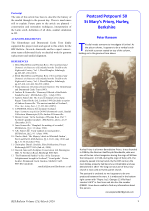
Describes a postcard of a vertical south dial at St Mary’s Priory, Hurley, Berkshire. The dial appears to feature a person seated on top of the column holding the gnomon. The author notes the need for further investigation into this dial and provides historical context about the priory.
Dials: Unusual, Dials: Vertical, Historical Dials
March 2020
Page 26
Page 26
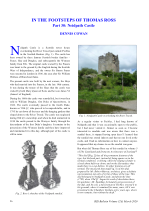
Focuses on the lectern-type sundial originally from Neidpath Castle. The article recounts the dial's history, noting it was saved by a gardener in 1795 and eventually returned to the castle in 1961. The dial is unusual as it is oblong and features a sloping hemi-cylinder ending halfway down with a cup-hollow underneath. It includes descriptions of the multiple faces, incorporating sunken, reclining, and proclining dials.
Dials: Multi Faced, Dials: Scaphe, Dials: Unusual, Historical Dials
March 2020
Page 33
Page 33
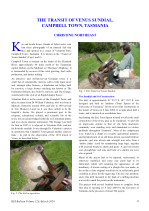
Describes an unusual agricultural-themed sundial designed and built by Anthony Sprent in 2004 to commemorate Campbell Town's role in observing the 1874 transit of Venus. The device, made mostly from old farm machinery parts, is a heliochronometer that uses a nodus (aperture) to project light onto an engraved analemma on a bronze plough disc.
Construction Projects, Dials: Heliochronometer, Dials: Unusual, Equation of Time
March 2020
Page 38
Page 38
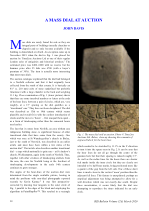
Examines a rare 8½-inch stone cube mass dial (13th or 14th century) sold at auction, originating from South Norfolk. Analysis shows it qualifies as a 'transitional dial' with roughly 15° spacing between lines, possibly reflecting the early use of unequal or equal hours related to clocks. Its existence, along with others in Norfolk, suggests the county was prominent in timekeeping developments in the early 14th century.
Dials: Cube, Dials: Mass Dials, Dials: Unusual, Historical Dials
June 2020
Page 7
Page 7
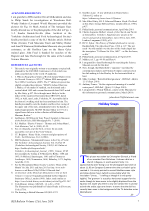
This short article presents a picture of a west-facing sundial on a church in Ragusa, Sicily. The dial is painted in normal Mediterranean style, shows Italian hours, and is notable for its gnomon which acts as a horizontal support for the nodus.
Dials: Vertical, Dials: Unusual, How Sundials Work
June 2020
Page 24
Page 24
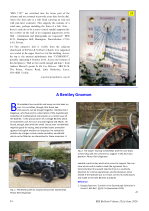
This short piece highlights a unique modification made to a vintage Bentley: a custom-made central stay for a secondary windshield, designed to function visually like a gnomon for a horizontal dial.
Dials: Horizontal, Dials: Unusual, Sundial Design & Layout
September 2020
Page 5
Page 5
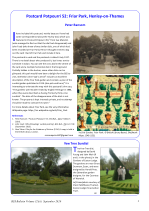
A postcard, postmarked 1917, is presented showing the Ye Dial Garden at Friar Park, which contains a cross dial and a multiple horizontal dial. The gardens were described in 1984 as having formerly contained thirty-nine sundials, though their disappearance date is unknown.
Dials: Horizontal, Dials: Multi Faced, Dials: Unusual, Historical Dials
September 2020
Page 9
Page 9
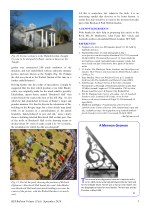
Describes an unusual 18th-century horizontal dial, signed Edward Hunter Fecit, which features a pierced gnomon depicting a merman. Hunter is identified as an Irish maker.
Dials: Horizontal, Dials: Unusual, Historical Dials
September 2020
Page 15
Page 15
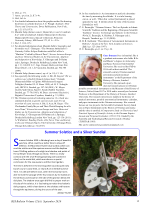
Details the performance of the Macmillan Hunter dual sundial, Dihelion, during the Summer Solstice 2020 in Edinburgh. The metal dial has a silver finish and features a horizontal rod that marks the passage of the four seasons by its shadow on a curved scale.
Dials: Horizontal, Dials: Unusual, How Sundials Work
September 2020
Page 35
Page 35
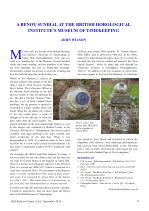
Describes an unusual Benoy dial (SRN 4074) at Upton Hall, invented by W. Gordon Benoy, that uses a liquid-filled glass cylinder to focus a light beam onto the dial face instead of a shadow. Notes the dial is in need of refurbishment and mentions a second, missing Benoy dial.
Dials: Reflected, Dials: Unusual, Historical Dials
September 2020
Page 38
Page 38
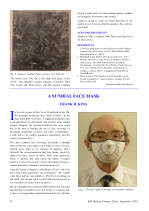
Describes the author's personal DIY project of printing a working stereographic sundial, calculated for his latitude, onto a face mask. Details the construction of a gnomon using a ball-point pen refill and a push pin, and the complexities of reading the time while wearing it.
DIY Sundial Projects, Dials: Portable, Dials: Unusual, Sundial Design & Layout
December 2020
Page 13
Page 13
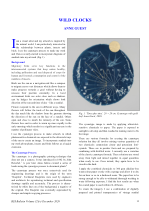
A visual artist describes her artwork inspired by the relationship between nature, the sun, and time. She uses the cyanotype process (a non-camera photographic technique creating white lines on a blue background, similar to blueprints) to incorporate diagrams of properly delineated sundials alongside plants, insects, and birds. Gold leaf is often added to represent the sun.
Dials: Unusual, Sundial Design & Layout
December 2020
Page 37
Page 37
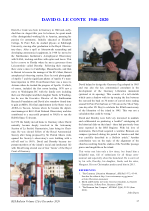
Obituary for David O. Le Conte, an astronomer who spent much of his distinguished career tracking satellites for NASA and working on the Hubble Space Telescope. He was a key figure in Guernsey's astronomical and social life, designing the Guernsey Liberation monument and collaborating on a booklet cataloguing the island’s historical sundials.
Dials: Unusual, Historical Dials
June 2019
Page 7
Page 7
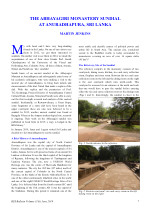
Investigates an ancient horizontal stone sundial (made of quartzofeldspathic gneiss) found at the Abhayagiri Monastery refectory (latitude 8° 24′ N). The dial, now in a museum, has 32 segments, but was likely primarily used to check time (around solar noon) for the monks' daily meal schedule according to Buddhist discipline.
Dials: Unusual, Historical Dials, Sundial Design & Layout
September 2019
Page 21
Page 21
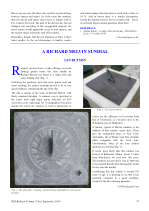
A description of a recently recovered slate sundial by Richard Melvin, typical of his finely engraved work. The dial includes an EoT correction scale, a compass rose, 70 geographical locations, and four smaller corner dials indicating times in New York, Alexandria, Isle of Borneo, and New Zealand.
Dials: Unusual, Equation of Time, Historical Dials
September 2019
Page 27
Page 27
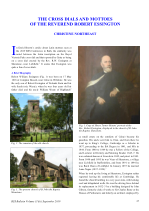
A detailed analysis of the Reverend R.W. Essington (1818–1907) and his enthusiasm for cross dials. It documents the three cross dials he erected at Shenstone and Newquay, discussing their mottoes and inscriptions, and provides strong evidence linking him to the design or erection of the cross dial in the Royal Victoria Park Botanical Gardens in Bath.
Dials: Unusual, Historical Dials, Mottoes
December 2019
Page 10
Page 10
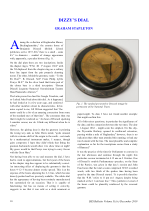
Analysis of a small, peculiar sundial presented to Benjamin Disraeli in 1862 by Philip Lybbe Powys. The article discusses its Latin motto and strange configuration (reversed gnomon). It concludes the dial was likely a customised desk ornament rather than a functional timepiece, relating its creation to Powys's attempts to curry favour during his troubled years.
Dials: Portable, Dials: Unusual, Historical Dials, Mottoes
December 2019
Page 17
Page 17
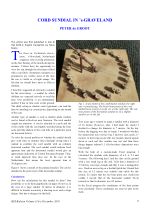
Description of the design and construction of a large, interactive combination sundial located at the ’s-Graveland observatory in the Netherlands. The 5.5-metre dial combines a cord sundial, indicating local apparent time, with a horizontal sundial, showing Central European Summer Time. The article details the mathematical calculations, material choices (Robinia wood), and implementation steps for this educational project.
Construction Projects, DIY Sundial Projects, Dials: Horizontal, Dials: Unusual
December 2019
Page 24
Page 24
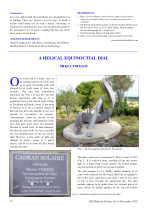
Description of a recently constructed, large helical equinoctial dial located in Fouzilhon, France. Made of Vosges granite, the dial features a gnomon with a unique helical slot that projects a strip of light onto the hour scale engraved inside the helical chapter ring. The design also incorporates zodiac signs and information on Equation of Time corrections.
Dials: Equatorial, Dials: Unusual, Sundial Design & Layout, Construction Projects
December 2019
Page 32
Page 32
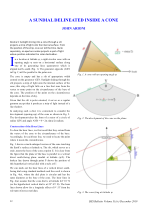
A technical article detailing the design and mathematics of a sundial delineated inside a right circular cone. Sunlight passing through a polar-oriented slit projects a time-telling strip of light onto the interior surface. An aperture nodus simultaneously projects a spot indicating the solar declination. The article includes formulae for deriving hour lines and the characteristic closed-curve calendar lines.
Dials: Unusual, How Sundials Work, Mathematics of Dialling, Sundial Design & Layout
December 2019
Page 37
Page 37
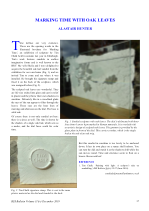
A description of an oak leaf sundial sculpture acquired from an exhibition by Tim Chalk. The piece features life-size oak leaves etched into glass and cast in plaster, creating the hour lines using their shadows. A single oak bud acts as a nodus to show solar time, making it both an artistic and scientific piece.
Construction Projects, Dials: Unusual, Sundial Design & Layout
March 2018
Page 21
Page 21
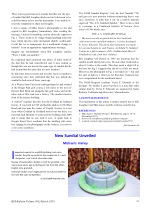
A short, humorous piece detailing the author's 80th birthday 'sundial', actually a chocolate cake in the shape of a sundial. The cake was dedicated by his granddaughter, whom he hopes might make an entry for a BSS cake competition.
Dials: Unusual, The BSS and Members
June 2018
Page 2
Page 2
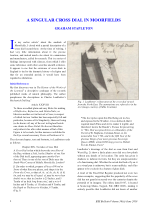
Investigates a rare 1706 cross dial in Moorfields, London, made by Robert Trevitt, a painter, as a parish boundary marker and memorial to the Battle of Ramillies. The article explores why cross dials were uncommon in England, suggesting their imagery was historically considered idolatrous due to religious connotations.
Dials: Polar, Dials: Unusual, Historical Dials, Mottoes
June 2018
Page 12
Page 12
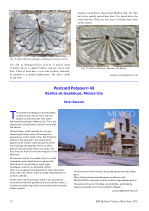
Features a postcard of the bell tower at the Basilica de Guadalupe, which integrates various time-telling devices. The tower includes a direct south-facing sundial (reclining), an analogue clock, an Aztec calendar representation, and an astronomical clock showing the sun, moon, and Zodiac symbols.
Dials: Unusual, Dials: Vertical, Historical Dials
June 2018
Page 28
Page 28
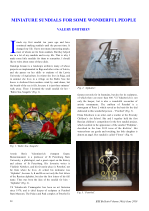
The author describes creating seven miniature sundials as gifts for people who assisted him in his life or gnomonic projects. Examples include 'Peterhof' for an art historian, 'The Swallow' for a supportive official, and 'White Angel', a copy of the dial at his parents' grave.
Construction Projects, Dials: Portable, Dials: Unusual
September 2018
Page 32
Page 32
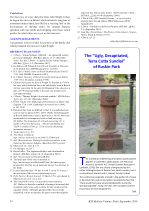
A short piece noting the unflattering description of the Grade II Listed terra cotta sundial in Ruskin Park, South London, quoted from a 1979 historical account. The dial, which is now missing, was originally erected in a Denmark Hill garden to commemorate the house where Mendelssohn wrote the Spring Song in 1842.
Dials: Unusual, Dials: Vertical, Historical Dials
December 2018
Page 19
Page 19
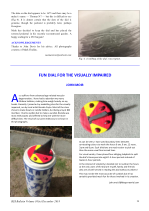
Describes a functional horizontal sundial made in a clay modelling class for the visually impaired. It uses boundary lines between contrasting colours and ladybirds marking 1.5-hour intervals, prioritizing visibility and simplicity over high accuracy for its users.
Construction Projects, Dials: Unusual, Sundial Design & Layout
December 2018
Page 30
Page 30
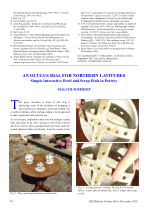
Describes creating miniature equatorial ‘oculus’ or ‘finger’ dials in pottery, inspired by ancient spherical dials. These interactive dials are read by blocking the sun hole with a finger to align the light spot on the vertical datum line, suitable for educational use.
Construction Projects, Dials: Portable, Dials: Scaphe, Dials: Unusual
March 2017
Page 8
Page 8
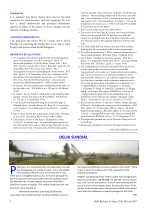
A large sundial in Delhi is reported to be one of the largest scientifically accurate sundials in the world, although the author expresses doubt regarding this claim. Access to the site is difficult due to its location in a complex of flyovers, and poor air quality often means the dial rarely sees the sun.
Dials: Horizontal, Dials: Unusual
March 2017
Page 20
Page 20
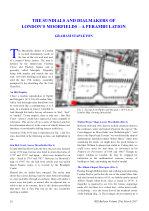
A historical survey of five sundial-related sites in the Moorfields district of London. Sites include Sun Dial Court (possibly an inn), Walter Hayes’ instrument-making shop, a vertical dial at Albion Chapel, an Astrological Physician’s house sign with a dial, and a unique 1706 Cross Dial.
Dials: Unusual, Dials: Vertical, Historical Dials
March 2017
Page 32
Page 32
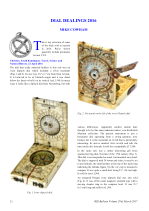
A selection of notable dials sold at auction in 2016. Highlights include a Flemish ivory diptych dial with a silver nocturnal (1590, sold for £17,500), a standing ring dial, a noon gun, an inclining dial by Benjamin Martin, and a silver Butterfield dial featuring Napoleon on the reverse.
Dials: Nocturnals, Dials: Portable, Dials: Unusual, Historical Dials
June 2017
Page 2
Page 2
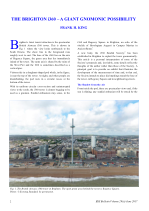
This article explores the irresistible temptation to use Brighton's vertical i360 tower as the gnomon for an azimuthal sundial. It details the i360 Sundial Society's proposals to mark time paths and date paths on the built-up, sloping ground of Regency Square using specially-made bricks.
Construction Projects, Dials: Unusual, Sundial Design & Layout
June 2017
Page 15
Page 15
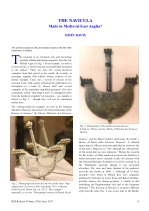
This article examines the navicula, a rare portable altitude dial from the late Middle Ages. It suggests the dial is uniquely English and likely originated in East Anglia, based on geographical links to known examples and associated English manuscripts.
Dials: Portable, Dials: Unusual, Historical Dials
June 2017
Page 24
Page 24
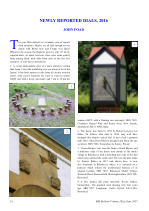
This report lists 47 newly reported dials added to the BSS Register in 2016. Descriptions include an analemmatic dial in New Lanark, a simple vertical dial designed for a Robert Lutyens house, a Dollond dial in London, and a vertical limestone monolith gnomon dial in Lancashire.
Dials: Analemmatic, Dials: Unusual, Dials: Vertical, Historical Dials
June 2017
Page 34
Page 34
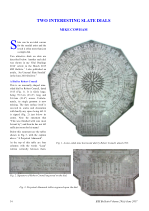
The article details two large slate horizontal dials. The first is Robert Connell's nine-sided 1815 dial featuring a perpetual almanac and a global time ring. The second is Richard Melville's 1848 square dial, which displays eight subsidiary dials for various world locations.
Dials: Horizontal, Dials: Unusual, Historical Dials
June 2017
Page 37
Page 37
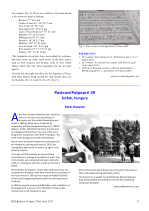
This entry features a postcard image of a sundial made in 1962 by abstract sculptor Barta Lajos in Siófok, Hungary, on the shore of Lake Balaton. Although the dial has since disappeared, it was considered one of the most progressive sculptures of its time in Hungary.
Dials: Unusual, Historical Dials
September 2017
Page 17
Page 17
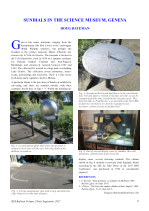
This visits the Geneva Science Museum, which displays instruments related to astronomy and surveying. External exhibits include a conventional globe dial, a large analemmatic dial, and an unusual horizontal altitude dial. Indoor displays feature quadrants, altitude dials, and a navicula portable dial purchased in 1993.
Dials: Analemmatic, Dials: Portable, Dials: Unusual, Historical Dials
September 2017
Page 41
Page 41
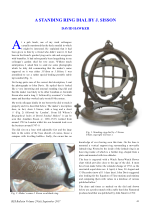
This reports on a rare portable standing ring dial by 'J. Sisson, London', likely Jonathan Sisson (c. 1690–1747). The high-quality brass dial includes latitude and hour rings, alidades, and a Watch Faster/Slower chart on the base. The chart's data matches John Flamsteed's 1702 tables, suggesting the dial was made before the 1730s.
Dials: Portable, Dials: Unusual, Equation of Time, Historical Dials
September 2017
Page 44
Page 44
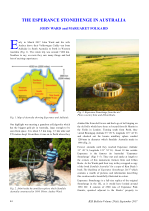
This article details the visit to the Esperance Stonehenge, a full-size replica of the UK original, built in 2011 using 2500 tons of local granite. The massive structure is aligned to the Summer Solstice sunrise and Winter Solstice sunset for its Australian latitude. The authors strongly recommend this construction to BSS visitors.
Construction Projects, Dials: Unusual
December 2017
Page 12
Page 12
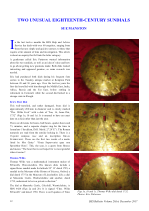
Investigates two antique dials: a damaged brass horizontal dial signed by Thomas Wilks and dated 1732, featuring a Jerusalem time ring and Horace motto; and an unsigned, rare, early 18th-century horizontal dial believed to be part of a declinatory instrument.
Dialling Tools, Dials: Horizontal, Dials: Unusual, Historical Dials
December 2017
Page 18
Page 18
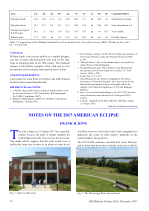
A report on the observation of the total solar eclipse of 21 August 2017, held during the NASS conference at Jefferson Barracks, Missouri. Methods of observation, including a kitchen strainer, a reflection instrument, and Bill Gottesman's ingenious Eclipse Sundial, telling the time by the angle of the line between the sun's horns, are described.
Dials: Unusual, The BSS and Members
December 2017
Page 34
Page 34
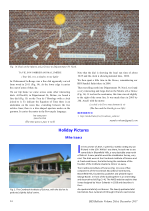
Presents two unusual sundials seen in Bloomfield Hills, USA: an equatorial dial of cast bronze at the Cranbrook Institute of Science with an analemma; and a horizontal dial at Cranbrook House designed in the shape of a swan, where the tail serves as the gnomon.
Dials: Equatorial, Dials: Horizontal, Dials: Unusual, Equation of Time
December 2017
Page 37
Page 37
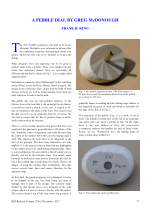
Describes a single-sided equatorial sundial, made from a pebble, that was given to delegates at the 2017 NASS Conference. The gnomon features a crescent cut-out as a memento of the solar eclipse, and time is read from the leading edge shadow falling on sandblasted alternate gaps.
Dials: Equatorial, Dials: Portable, Dials: Unusual, The BSS and Members
March 2016
Page 2
Page 2
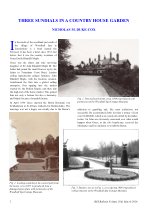
An investigation into three historical sundials located at Petwood, a country house in Lincolnshire. The article details the garden's history, designed by William Goldring and later Harold Peto, and describes the ‘little boy’ dial, the classical baluster dial, and an unusual pillar dial supported by four Atlases.
Dials: Unusual, Historical Dials
March 2016
Page 12
Page 12
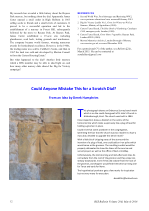
A short discussion hypothesizing that a blemish on an Ordnance Survey bench mark at St John’s Church, Hildenborough, might be an attempt by a ‘prankster’ to create a scratch dial. The resulting lines, however, would be highly inaccurate for tracking church services.
Dials: Mass Dials, Dials: Unusual
March 2016
Page 18
Page 18
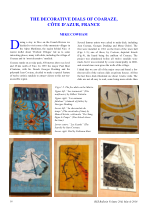
A report on the artistic sundials of the village of Coaraze, initiated in 1959 by the mayor and artists, including Jean Cocteau, to attract tourism. The dials, often made of painted tiles, are noted for being more artistic and decorative than practical timekeepers.
Dials: Unusual, Dials: Vertical, Historical Dials
March 2016
Page 29
Page 29
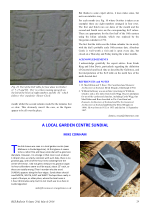
A humorous critique of a poorly laid out slate horizontal dial seen in a Cambridgeshire garden centre. The dial incorrectly shows equal 15° hour calibrations, lacks a gnomon gap, and displays noon at 1:40 pm, rendering it useless as a timekeeper.
Dials: Horizontal, Dials: Unusual
June 2016
Page 7
Page 7
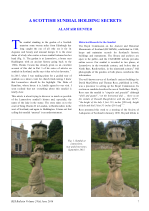
Research into the elegant, unusual sundial at Lennoxlove, featuring a statue of a lady carrying the multi-faced dial on her head. Although dated 1679 (DMG) and previously located at North Barr, the author suggests the statue was added later (19th century) by the Blantyre family, possibly modelled on the wax effigy of Frances Theresa Stewart, Duchess of Richmond and Lennox.
Dials: Multi Faced, Dials: Unusual, Historical Dials
June 2016
Page 15
Page 15
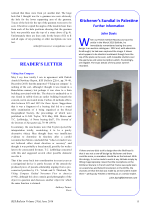
Provides further details on the East–West sundial presented by Kitchener (previously covered in the March 2016 issue). The author notes a similar dial appeared in an auction catalogue, suggesting it wasn't a unique design by Kitchener himself. The dial works at any latitude by tilting and was likely made by a French instrument maker.
Dials: Unusual, Historical Dials
June 2016
Page 34
Page 34
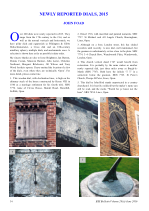
A list of over 200 sundials newly reported to the BSS Register in 2015, ranging from the 17th to 21st centuries. Examples include a 1540 wooden dial, a 1799 horizontal dial by Liverpool clockmaker Thomas Harrison, an exquisite square dial installed for Queen Victoria’s Diamond Jubilee, and a modern spiral analemmatic dial.
Dials: Heliochronometer, Dials: Horizontal, Dials: Multi Faced, Dials: Unusual, Dials: Vertical, Historical Dials, The BSS and Members
September 2016
Page 7
Page 7
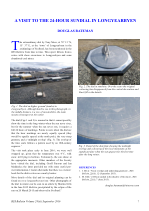
A report on a visit to the unusual 24-hour sundial designed by Tony Moss in Longyearbyen, Svalbard (78° N). Key features noted include the steep gnomon, nearly equally spaced hour lines, and a ‘midnight overlap’.
Dials: Horizontal, Dials: Unusual, Historical Dials
September 2016
Page 11
Page 11
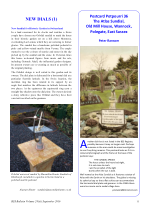
Description of the installation of an Orbdial universal sundial, made by Macmillan Hunter Sundials, in a historic garden above Montreux, Switzerland. The design features a meridian ring that was rotated to compensate for the difference in latitude between its Scottish delineation and its final Swiss location.
Construction Projects, Dials: Unusual, Sundial Design & Layout
September 2016
Page 21
Page 21
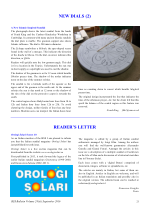
Describes a new 500 mm marble horizontal sundial designed with Islamic influences for a tropical location. Features include a low gnomon angle, a Mihrab-inspired carved Ω shape showing Qibla (direction to Mecca), and Babylonian/Italian hour lines to help Muslim users determine prayer times (Dhuhur and Maghrib).
Construction Projects, Dials: Horizontal, Dials: Unusual, Sundial Design & Layout
September 2016
Page 24
Page 24
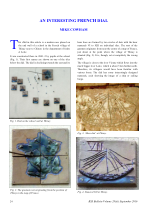
Analysis of a modern, east-declining vertical dial mounted on a school wall in Thizay, France, constructed in 2001–2 by pupils. The hour numerals feature artistic images of sailing barges copied from 15th-century graffiti found on nearby church walls, although the gnomon is incorrectly set.
Dials: Unusual, Dials: Vertical
December 2016
Page 2
Page 2
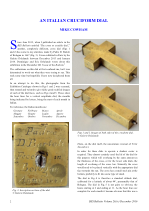
Analysis of a 1667 cruciform dial by Padre D. Bartoli of Bologna, calibrated for latitude 44°. The author deciphered its complex deliniations, concluding it displays equal hours, unequal hours, Italian hours, and Babylonian hours. It functions as a standard altitude dial, likely using the lid or cross bars as a shadow caster.
Dials: Portable, Dials: Unusual, Historical Dials, How Sundials Work
December 2016
Page 42
Page 42
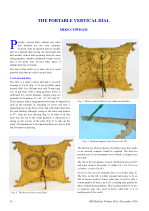
Examines two unusual portable vertical dials. The first is a c. 1600 gilt brass south dial calibrated for five latitudes, featuring a string gnomon and lunar time calculations on the reverse. The second is a small square pillar dial (c. 1567, likely Ulrich Schniep) showing two declining vertical dials and planetary hour tables.
Dials: Portable, Dials: Unusual, Historical Dials
March 2015
Page 2
Page 2
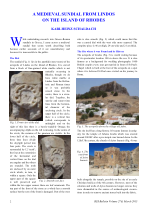
Analysis of a medieval sundial, inaccessible to the public, found in the store-room of the acropolis of Lindos on Rhodes. Carved from white marble, the dial features a circular design with three time lines dividing daylight into four parts. Based on similarity to English examples and the four-division structure unique to Latin Europe, the article suggests Frankish influence and dates its creation to the 14th century for use by the Hospitallers.
Dials: Unusual, Dials: Vertical, Historical Dials
March 2015
Page 18
Page 18
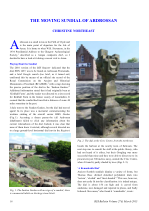
A detailed history and examination of a unique Scottish polyhedral sundial, made by Robert Weir for the Kirkhall estate in 1795. The massive sandstone dial, which originally featured complex adjustable metal apparatus, was moved multiple times by the local council, first to the Sunken Garden and subsequently to the Civic Centre.
Dials: Multi Faced, Dials: Unusual, Historical Dials
March 2015
Page 28
Page 28
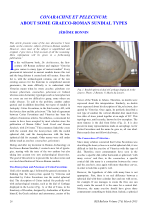
A specialized study proposing a revised classification of Graeco-Roman sundial types based on literary sources (Vitruvius, Cetius Faventinus) and archaeological evidence, including newly identified examples.
Dials: Unusual, Sundial Design & Layout, Historical Dials, Dials: Scaphe
March 2015
Page 38
Page 38
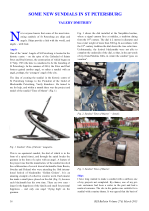
A description of three contemporary sundials installed in or around St Petersburg in 2014. These include the equatorial 'Time of Master' dial, constructed by multiple blacksmiths and featuring an angel on a spire; the 'Sailing vessel' dial based on the frigate Standart; and the 'Dandelion or nothing is forever' dial, designed by a 12-year-old following a children's competition.
Construction Projects, Dials: Equatorial, Dials: Unusual, Sundial Design & Layout
March 2015
Page 45
Page 45
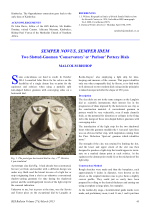
An article detailing the construction of two prototype horizontal pottery dials using a tent-shaped hollow gnomon with a slot. The design is inspired by the rare 18th-century Langlois dial, using a traversing light strip for time measurement during obscured hours and for seasonal indication relative to a fixed datum point. The dials are deemed successful, despite the material's crudity.
Construction Projects, DIY Sundial Projects, Dials: Horizontal, Dials: Unusual
March 2015
Page 51
Page 51
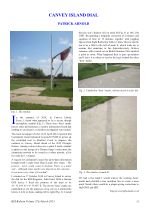
An investigation into an incomplete modern sundial/sculpture located in Canvey Island, Essex, found to have unlabelled 'hour' marks. The piece was part of an ambitious 2012 project intended to be a giant 8-metre sculpture resembling a Thames barge mast. It was never fully completed, and its accuracy is questioned, suggesting the need for professional restoration.
Construction Projects, Dials: Unusual
June 2015
Page 7
Page 7
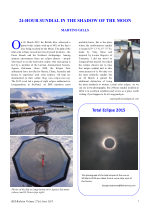
This reports on a 24-hour sundial located in Longyearbyen, Svalbard (the northernmost sundial), gaining the distinction of being the most northerly to witness the total solar eclipse on 20 March 2015.
Dials: Equatorial, Dials: Unusual
June 2015
Page 17
Page 17
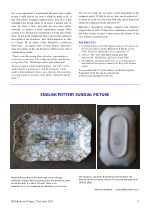
This is a brief note describing a dish decorated with a picture including a sundial. The dish is 160 x 110 mm, numbered on the back, and identified as being made by Lancaster & Sandland of Hanley, Stoke-on-Trent.
Dials: Unusual
June 2015
Page 22
Page 22
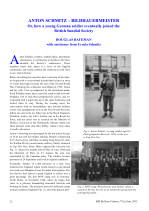
A biographical account of Anton Schmitz (b. 1926), a German sculptor and master stonemason (Bildhauermeister), who became a POW in England after D-Day. He studied under Heinz Schumacher and later became renowned for making over 100 sundials, specializing in globe dials.
Dials: Multi Faced, Dials: Unusual, Construction Projects
June 2015
Page 31
Page 31
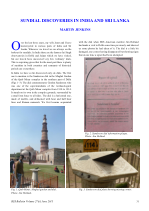
A report on sundials discovered during travels in India and Sri Lanka over three years. Finds include the Sanderson horizontal marble dial in Delhi, a Shimla bronze dial listing railway time, an analemmatic dial in Leh, and an unusual modern dial in Sri Lanka.
Dials: Analemmatic, Dials: Horizontal, Dials: Unusual, Historical Dials
June 2015
Page 38
Page 38
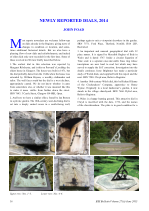
Summarizes new entries to the Register reported in 2014, including historical dials across the UK (Glasgow, Norfolk, Wales, Yorkshire, Scotland), a Campbell–Stokes sunshine recorder in Madeira, and modern commemorative dials.
Dials: Unusual, Historical Dials
September 2015
Page 7
Page 7
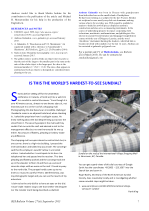
An account of the author's difficult and adventurous attempt to photograph a 40-metre-wide sundial located on the roof of the International Village Shopping Mall in Vancouver, BC, Canada. Few people, including local residents and staff, are aware of the dial's existence.
Dials: Unusual
September 2015
Page 13
Page 13
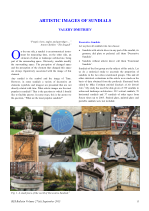
A statistical study analysing the popularity of artistic images (Earth, Sun, Man, God, Water, Air, Fire) used as decorative elements on 339 British sundials. It categorises sundials into 'Decorative' and 'Functional', and discusses trends between 'old' (pre-1900) and 'modern' designs.
Dials: Unusual, Historical Dials, Sundial Design & Layout
September 2015
Page 17
Page 17
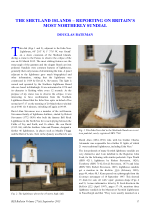
Report on the discovery and registration (SRN 7704) of a lighthouse sundial adjacent to the Esha Ness Lighthouse (60° 29.3′ N). It discusses the dial's distinctive fluted cast iron pedestal and its link to the famous Stevenson family of lighthouse builders.
Dials: Horizontal, Dials: Unusual, Historical Dials
September 2015
Page 30
Page 30
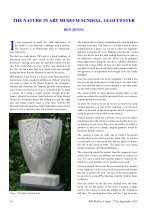
Details the complex design and construction process of a large, conical, declining and reclining sundial made from local Forest of Dean stone for Wallsworth Hall, Gloucester. Describes the challenges of working on an uneven surface and using horizontal dials to establish alignment.
Construction Projects, Dials: Unusual, Sundial Design & Layout
December 2015
Page 2
Page 2
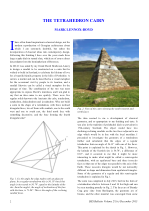
Describes the design and construction of a 9–10 foot high tetrahedron-shaped cairn in Perthshire, Scotland, commissioned by David Heathcoat-Amory. It incorporates two declining reclining sundials and aligns its north edge and gnomons with the Earth's axis.
Construction Projects, Dials: Multi Faced, Dials: Unusual, Sundial Design & Layout
December 2015
Page 5
Page 5
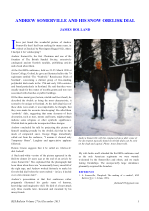
Recounts the life of Andrew Somerville, first Chairman of the BSS, known for cataloguing ancient Scottish polyhedral dials. It describes his talk on "symbolic" dials and the humorous anecdote surrounding the temporary snow obelisk dial he constructed.
Dials: Multi Faced, Dials: Unusual, Historical Dials, The BSS and Members
December 2015
Page 27
Page 27
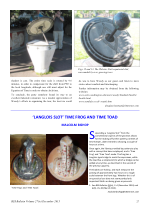
Describes the creation of pottery time-keepers shaped like a frog and a toad. These novel, hollow pieces incorporate a ‘Langlois Slot’ or bridge to mark the equinoxes, measuring the passing of approximately two hours on a rough scale.
DIY Sundial Projects, Dials: Unusual
December 2015
Page 37
Page 37
A report on the annual BSS Newbury meeting featuring various talks and exhibits. Highlights include Irene Brightmer’s discovery of a globe dial within a stone sphere, Martin Jenkins' DIY garden projects, and Frank King's demonstration of an umbrella as an astronomical instrument.
DIY Sundial Projects, Dials: Hemispherical, Dials: Unusual, The BSS and Members
March 2014
Page 2
Page 2
This paper analyses two ancient Greek conical sundials (3156 and 3157) recovered from the Dionysus Theatre. Since their gnomons are lost, geometric characteristics are used, alongside an assumed obliquity of the ecliptic, to calculate their geographical latitude and gnomon length. The calculated design latitudes (33° to 36°) suggest they may have been looted from other Mediterranean regions, rather than being built specifically for Athens (37° 58΄).
Dials: Scaphe, Dials: Unusual, Historical Dials, Mathematics of Dialling
March 2014
Page 18
Page 18
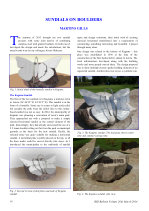
This piece details two stainless steel and granite sundial projects in Latvia. The Kegums Sundial (56°44' N) is a nodus-based butterfly design, inclined at 40 degrees, which displays winter time and summer savings time. The Marsneni Sundial (57°25' N) is an equatorial dial supported by three stones, using dots for hour notation and incorporating Latvian ethnographic signs.
Construction Projects, Dials: Equatorial, Dials: Unusual, Sundial Design & Layout
June 2014
Page 7
Page 7
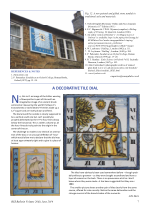
Describes a 12-inch square decorative tile dial featuring an imaginative image of an ancient Greek astronomer (possibly Eratosthenes or Archimedes). Although intended as a vertical south dial, the delineation appears incorrect due to hour lines drooping below the horizontal, leading to a challenge for readers to find a valid orientation.
Dials: Unusual, Dials: Vertical, Historical Dials, Sundial Design & Layout
June 2014
Page 32
Page 32
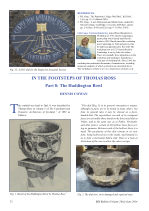
Details the rediscovery of the Haddington Bowl, a unique 17th-century facet-headed dial described by Thomas Ross in 1892. It is a vase-form dial hollowed out to form an internal horizontal dial, featuring cup-hollows (scaphes) and faces acting as gnomons, despite suffering severe damage.
Dials: Scaphe, Dials: Unusual, Historical Dials, Restoration projects
June 2014
Page 34
Page 34
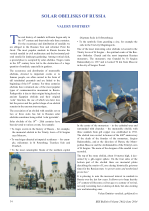
Reviews the history and distribution of sundials in Russia since Peter the Great's reforms. It focuses specifically on solar obelisks, which are tall tetrahedral pyramids used as commemorative monuments, such as the memorable example established in the Trinity Lavra of St Sergius in 1792.
Dials: Multi Faced, Dials: Unusual, Historical Dials
June 2014
Page 43
Page 43
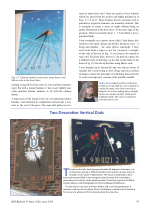
Images and descriptions of two decorated vertical dials are included.
Dials: Vertical, Dials: Unusual
September 2014
Page 11
Page 11
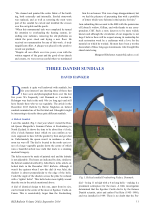
Descriptions of three distinct sundials seen in Denmark: a Piet Hein helical sundial at Fredensborg Palace, a dated (1655) vertical declining dial in Helsingør, and a canonical dial dating to c. 1200 at Vestervig Kirke in Jutland, which indicates unequal hours for monastic prayers.
Dials: Unusual, Dials: Vertical, Historical Dials
September 2014
Page 14
Page 14
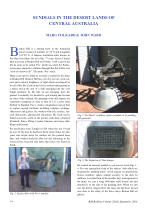
Discusses several unique sundials in Central Australia, including a large bronze armillary sphere made for artist Pro Hart, featuring an attached 400mm bronze ant, and 'Angels of Sun and Moon', a large sculpture at The Living Desert, Broken Hill, which also functions as a sundial and lunar dial.
Construction Projects, Dials: Armillary Sphere, Dials: Unusual, How Sundials Work
September 2014
Page 18
Page 18
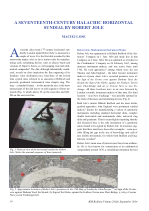
Analysis of a rare 17th-century horizontal brass sundial by London maker Robert Jole, notable for being his only recorded gnomonic instrument. It includes Jewish (Halachic/seasonal) hour-lines, astronomical hours, and declination arcs, designed for a London latitude, catering to the needs of the early Jewish community.
Dials: Horizontal, Dials: Unusual, Historical Dials, Mathematics of Dialling
September 2014
Page 30
Page 30
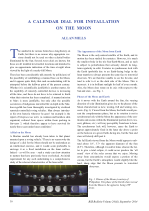
An intellectual exercise detailing the design considerations for a fixed calendar dial installed on the Moon. Due to the slow solar motion (180° in 15 days), the dial would calibrate the scale in terrestrial days (15–0) remaining until solar culmination or sunset, best constructed from readily available lightweight materials like cardboard.
Construction Projects, Dials: Unusual, Sundial Design & Layout
September 2014
Page 33
Page 33
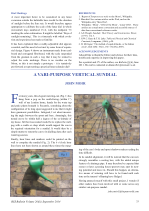
Describes a DIY sundial project using an ordinary watering can hung on a south-facing wall. The angle of the can's spout was found to match the co-latitude of the London house, allowing the spout to serve as the gnomon when properly supported.
DIY Sundial Projects, Dials: Unusual, Dials: Vertical
December 2014
Page 2
Page 2
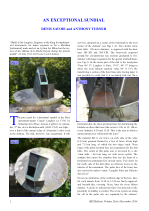
This article describes a unique horizontal sundial/meridian instrument constructed by Claude Langlois in 1741 for Alexandre de la Rochefoucauld at the château de la Roche-Guyon. The instrument features a large brass box gnomon with a slit and seven eyelets, allowing the spots of light to correspond to significant dates, such as the solstices and the entry of the sun into zodiac signs.
Dials: Horizontal, Dials: Noon Lines, Dials: Unusual, Historical Dials
March 2013
Page 18
Page 18
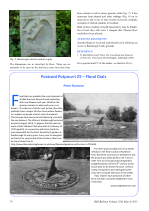
A light-hearted illustrated collection of sundials decorated with floral motifs. The article shares examples and stories from various gardens and public places where plants and flowers form part of the dial design.
Dials: Horizontal, Dials: Unusual, Mottoes
March 2013
Page 23
Page 23
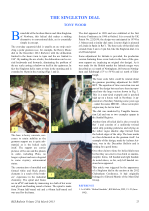
A technical and historical description of the patented ‘Singleton’ helical sundial. The article explains its geometry, manufacture, and later examples exhibited and sold in Britain.
Dials: Heliochronometer, Dials: Unusual, Mathematics of Dialling, Sundial Design & Layout
March 2013
Page 26
Page 26
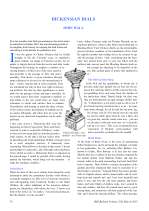
A literary exploration of references to sundials in the works of Charles Dickens. The author interprets the dials as metaphors for time, mortality, and moral reflection in Victorian literature.
Dials: Unusual, Historical Dials, The BSS and Members
March 2013
Page 34
Page 34
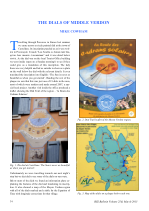
A travelogue describing a route through southern France known as ‘La Route des Cadrans Solaires’. The author records and photographs numerous historic and modern painted dials with local inscriptions.
Dials: Unusual, Dials: Vertical, Historical Dials, Mottoes
March 2013
Page 37
Page 37
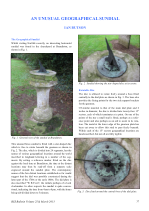
A technical description of a complex slate sundial featuring a rotatable star-shaped disc engraved with worldwide place names. The author explains its design, restoration, and probable use.
Dialling Tools, Dials: Horizontal, Dials: Unusual
March 2013
Page 46
Page 46
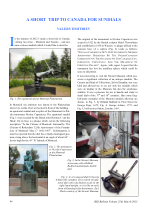
A travel article recounting visits to sundials in Montreal and Toronto, including modern designs and meetings with Canadian sundial enthusiasts.
Dials: Equatorial, Dials: Unusual, The BSS and Members
March 2013
Page 48
Page 48
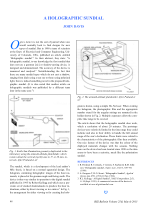
A discussion of an experimental holographic sundial design first described in 1990. The article explains how holography can replace the traditional gnomon and analyses its optical accuracy.
Dials: Unusual, How Sundials Work, Mathematics of Dialling, Sundial Design & Layout
June 2013
Page 23
Page 23
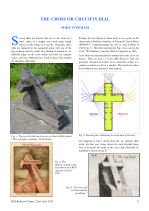
An exploration of dials incorporating the cruciform shape, tracing their symbolism, geometry, and examples across Europe, with commentary on their religious and artistic significance.
Dials: Unusual, Dials: Vertical, Historical Dials, Mottoes
September 2013
Page 6
Page 6
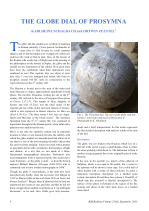
Detailed description and analysis of a solid white marble globe sundial from antiquity (c. 100 BC) found near Heraion. It uses the terminator (boundary of light and shadow) for time indication and features complex line systems representing hours, seasons, and zodiacal signs.
Dials: Hemispherical, Dials: Unusual, Historical Dials, Mathematics of Dialling
September 2013
Page 13
Page 13
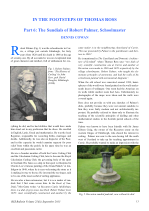
A biography of Robert Palmer (1828–1868), schoolmaster and astronomer, and a survey of his known sundials. Details are given of three scientifically constructed dials: one lost from Riccarton Castle, the detailed Currie dial (1836) with noon markings for global locations, and the Kirkbean dial (1826) containing equation of time details.
Dials: Horizontal, Dials: Unusual, Equation of Time, Historical Dials
September 2013
Page 24
Page 24
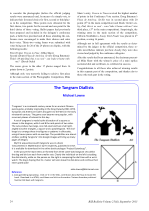
Introduction to Tangrams, an ancient Chinese puzzle game originating in the Song Dynasty (960-1279), involving seven geometric pieces derived from a square dissection. The article relates this puzzle to dialling illustrations, depicting figures formed from Tangram sets observing a sundial.
Dials: Unusual, Sundial Design & Layout
September 2013
Page 25
Page 25
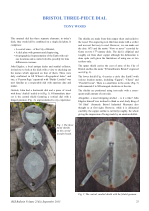
Examination of an intriguing three-piece artefact from 1675, attributed to R Smurthwaite, Bristol, possibly an amateur work. It consists of the Bristol Coat of Arms shield, a vertical dial with a hinged gnomon, and a topographical representation of the Earth with overseas locations, suggesting a possible nautical link.
Dials: Portable, Dials: Unusual, Dials: Vertical, Historical Dials
September 2013
Page 36
Page 36
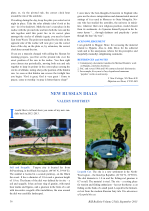
Showcase of several new sundials recently built in Russia (2012–2013). Examples include the maritime-themed ‘Sail and Seagulls’ in Tuapse, the ‘Leopold Cat’ dial designed for fishing enthusiasts in Kareliya, and the ‘Solar Flower’ in Toksovo, themed around cultivation.
Construction Projects, Dials: Horizontal, Dials: Unusual
December 2013
Page 8
Page 8
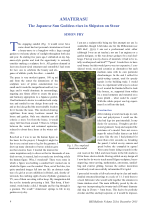
Describes the design and construction of a unique sculpture/sundial combining the figure of the Japanese Sun Goddess, Amaterasu, using her raised leg as the gnomon. The author details the materials used (cement/bronze effect, gold leaf), challenges faced in construction, and the astronomical details included on the plinth.
Construction Projects, DIY Sundial Projects, Dials: Unusual, Equation of Time
December 2013
Page 31
Page 31
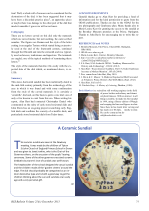
Describes a decorative, indoor ceramic sundial made by children of Tipton St John Church of England Primary School, given to Janet Jenkins. The headteacher designed the dial, and the children created the garden creatures around the edge.
DIY Sundial Projects, Dials: Unusual
December 2013
Page 50
Page 50
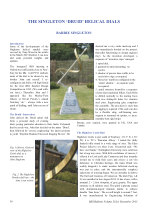
Provides personal insights and updates on the Singleton helical sundial, nicknamed ‘Druid’ (Daytime Readout Universal Imaging Device). It details the patented innovations, including the spiral dial structure and 'three bar' numerals, culminating in the fully funded installation at Highclere Castle in 2013.
Construction Projects, Dials: Unusual, Equation of Time, Sundial Design & Layout
March 2012
Page 7
Page 7
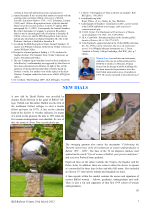
This article describes a new 70 cm diameter stainless steel spherical dial by David Harber, unveiled at Balliol College, Oxford. It celebrates the thirtieth anniversary of women's admission to Balliol and includes features like calendar bands, tropic lines, and moon-dial scales.
Dials: Unusual, Construction Projects, Mottoes
March 2012
Page 13
Page 13
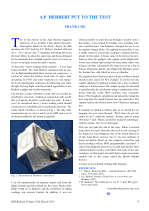
The author tests A.P. Herbert's idea of using a sundial "in reverse" for navigation during a flight to Australia in 1975. He describes making his own "sun clock" and recounts an encounter with a pilot familiar with Francis Chichester's navigation methods, highlighting the practical challenges of such a device.
Dials: Portable, Dials: Unusual, Sundial Design & Layout, DIY Sundial Projects, Historical Dials
March 2012
Page 17
Page 17
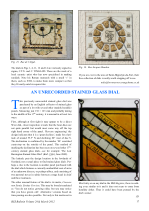
This article details a previously unrecorded 17th-century stained glass sundial. It's unusual for being a "great decliner" made for a latitude in the Scottish lowlands and for its unique motto, which suggests personal authorship rather than a known source.
Dials: Unusual, Historical Dials, Mottoes, Dials: Stained Glass
June 2012
Page 17
Page 17
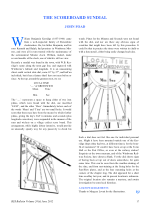
This article describes a unique direct south vertical slate sundial found in Wimborne Minster, made by clockmaker W.B. Kerridge. Its distinguishing feature is a system for displaying the Equation of Time and longitude correction using interchangeable 'FAST'/'SLOW' iron plates and possibly minute/second plates, resembling a cricket scoreboard, for public use.
Dials: Unusual, Dials: Vertical, Equation of Time, Historical Dials
June 2012
Page 34
Page 34
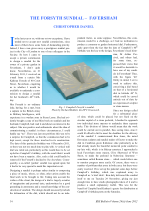
This article describes a custom-designed 'garden' sundial commissioned as a 40th birthday gift for Campbell Forsyth of Faversham. It is an inclining horizontal dial for latitude 40°N, tilted 11.5° southwards, with a unique gilded 'box' feature that indicates the exact date and time (8 December, 12 noon) on his birthday. The dial is a work of scientific art by Ben Jones, with a pedestal by Clive Sherwood.
Construction Projects, Dials: Horizontal, Dials: Unusual, Sundial Design & Layout
June 2012
Page 44
Page 44
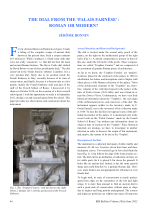
This article investigates a spherical sundial in the 'Palais Farnèse', Rome, questioning its Roman origin due to its perfect state of conservation and lack of gnomon hole. It hypothesises the dial is an 18th or 19th-century copy of a Roman original, potentially with a symbolic rather than functional purpose related to the palace's 'Trophées Farnèse' compositions about Time.
Dials: Scaphe, Dials: Unusual, Historical Dials, Restoration projects
June 2012
Page 46
Page 46
This section contains three letters from readers. Peter Drinkwater discusses a Canterbury pendant, questioning Arnaldi’s gnomon positions. Frank Coe references a Chichester Sun Compass. Sue Manston points out a potential error in the 'waxing' and 'waning' engravings on the Balliol Moondial's gnomon, to which David Harber responds confirming the mistake.
Dials: Portable, Dials: Unusual
June 2012
Page 52
Page 52
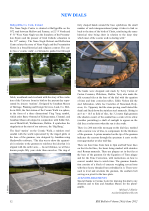
This article describes a stainless steel sundial at the Nano Nagle Centre in Ballygriffin, Ireland, which is the final 'station' of a 'cosmic walk'. Designed by Jonathan Mason, it features a 3.2-meter high gnomon with a central slit, a 200mm noon gap, and a prism for season indication. It also includes the world represented by a ringed globe and forty clasped hands symbolising intergenerational links.
Construction Projects, Dials: Equatorial, Dials: Unusual, Sundial Design & Layout
September 2012
Page 2
Page 2
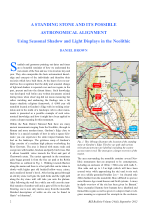
This article examines a 2-metre tall triangular monolith at Gardom’s Edge, Peak District, suggesting it was intentionally erected and astronomically aligned in the late Neolithic/early Bronze Age. It highlights how the stone's north-facing side would be illuminated during the summer, serving as a seasonal marker for ancient communities.
Dials: Unusual, Historical Dials, How Sundials Work, Sundial Design & Layout
September 2012
Page 15
Page 15
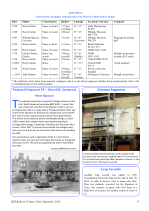
This brief piece draws attention to an unusual application of a sundial's gnomon in Airanne, Somme, France, where it appears to be providing minimal support to a scaffold tower. The author expresses hope for the sundial's survival following this unconventional use.
Dials: Unusual
September 2012
Page 35
Page 35
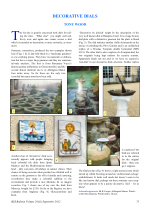
This article discusses sundials designed purely for decorative or ornamental purposes, rather than for time-telling. Examples include two identical large gnomon dials at Barnsley and Ablington Manor, colourful tile dials from the Mediterranean, and an expensive, unfinished replica of a Thomas Tompion double horizontal dial at Hampton Court.
Dials: Vertical, Dials: Unusual, Dials: Double Horizontal
September 2012
Page 41
Page 41
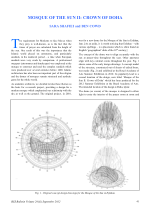
This article presents an architectural study for a solar dome, "Mosque of the Sun II: Crown of Doha" designed to align with the sun for prayer times and celestial events. It uses digital modeling and 3D printing, with the dome's solar orientation differing from the Mecca-aligned prayer room, allowing light to create a clock/calendar on the floor.
Dials: Unusual, How Sundials Work, Sundial Design & Layout, Construction Projects
September 2012
Page 43
Page 43
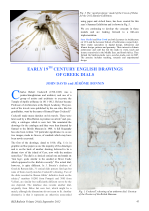
This article details two 19th-century drawings by Charles Robert Cockerell of Greek sundials, possibly newly excavated. One depicts an unknown classical conical dial with "lion legs" and the other illustrates a rare planar, vertical east-facing dial from Delos, which later came to reside in the Louvre, recording significant ancient finds.
Dials: Unusual, Historical Dials
September 2012
Page 45
Page 45
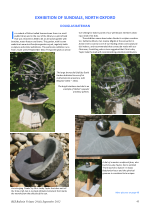
This entry describes a sundial exhibition held from June to September 2012 in the Turrill Sculpture Garden, Summertown, Oxford. It features 11 dials by BSS members, including David Harber's bronze dial and armillary sphere, Chris Lusby Taylor's sculptural "Undial" and "From Sunrise to Sunset" dials, and a cube dial by Harriet James.
Dials: Unusual, The BSS and Members, Dials: Cube, Dials: Armillary Sphere
December 2012
Page 2
Page 2
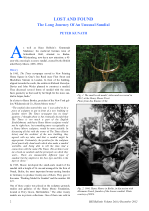
This article details the history and journey of a Henry Moore sundial, from its 1965 commission for The Times in London to its re-alignment in Schwäbisch Hall, Germany. It covers the creation of models, its sale, damage, recovery after theft in 2012, and precise re-installation, highlighting its remarkable travels and survival.
Dials: Unusual, Historical Dials, Restoration projects, Sundial Design & Layout
December 2012
Page 21
Page 21
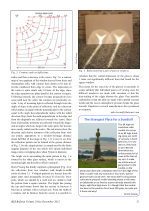
The article describes a 6ft high red sandstone cubic sundial atop an 8ft standing stone north of Luncarty, Perth & Kinross. Situated in a field, the dial's numerals and hour lines are indistinct, but gnomon holes are visible. Its century-long presence and origins remain a mystery.
Dials: Cube, Dials: Unusual, Historical Dials
December 2012
Page 36
Page 36
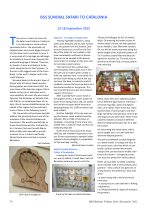
This report details the British Sundial Society's 2012 safari to Catalonia, covering visits to numerous sundials across Girona, Cabrils, Figueres, Barcelona, and other towns. Members explored diverse dials, including modern pillar dials, Salvador Dali's carved stone dial, multi-faceted and unusual museum pieces, showcasing the region's rich gnomonic heritage.
Dials: Multi Faced, Dials: Unusual, Historical Dials, The BSS and Members
December 2012
Page 41
Page 41
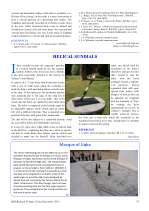
The article discusses helical sundials, particularly one made by Aylmer Astbury. These are a form of equatorial dial, with a brass strip helix marking hours via small holes or a terminator shadow. They can be adjusted for longitude and Equation of Time by rotating the helix on its axis, as explained in a 1992 Bulletin article.
Dials: Equatorial, Dials: Unusual, How Sundials Work, Sundial Design & Layout
December 2012
Page 41
Page 41
This entry describes a modern sundial from 1843 in the courtyard of the Mosque of Uqba (Great Mosque of Kairouan) in Tunisia. Engraved in Arabic script on a marble slab, it was designed by Almed Essoussi, inspired by Ibn al-Shatir's dial. It uses four separate point gnomons to indicate prayer times.
Dials: Unusual, Dials: Vertical, Historical Dials
March 2011
Page 39
Page 39
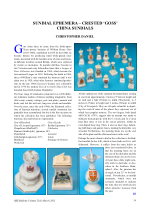
This article describes a collection of miniature crested 'Goss' china sundial ornaments produced from the 1880s. These decorative horizontal dials, typically featuring local heraldic arms, were collected as souvenirs and are now considered rare treasures, despite often having incorrect hour-line delineations.
Dials: Horizontal, Dials: Portable, Dials: Unusual, Historical Dials
March 2011
Page 41
Page 41
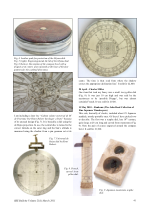
This article reviews notable sundials and related instruments sold at auction in 2010, including a silver pocket compass dial by Richard Glynne, a double inclining string gnomon dial by Jacques Le Maire, Japanese scaphe dials, and an ivory and silver compass dial by Elias Allen.
Dials: Portable, Dials: Unusual, Historical Dials
March 2011
Page 45
Page 45
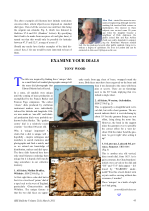
This article highlights three 'unique' sundials found in a collection of photographs, encouraging readers to identify similar features. It discusses a two-faced prism dial, a vertical dial with a bent gnomon, and a direct south dial with an unusual inscription, emphasizing the individuality of pre-mass production dials.
Dials: Multi Faced, Dials: Unusual, Dials: Vertical, Historical Dials
June 2011
Page 2
Page 2
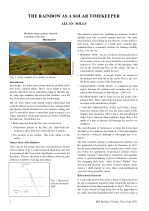
This article explores the rainbow as an alternative solar timekeeping phenomenon, discussing its complex optical properties, formation of primary and secondary bows, and the dispersion of light into colours. It also describes a rainbow dial instrument for time determination.
Dials: Unusual, How Sundials Work, Mathematics of Dialling, Sundial Design & Layout
June 2011
Page 26
Page 26
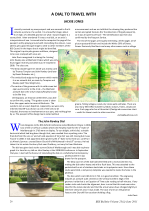
This note describes the discovery of the 'missing' John Rowley azimuth dial from Blenheim Palace, which was identified on a new passport design. It details the dial's distinctive features and its reinstallation in 2008.
Dials: Unusual, Historical Dials, The BSS and Members, Dials: Double Horizontal
June 2011
Page 26
Page 26
This article details the rediscovery and reinstallation of a lost John Rowley azimuth and equation of time dial from Blenheim Palace. It describes its unique features, including the deep double-ogee rim and specific gnomon design, and its historical significance.
Dials: Unusual, Equation of Time, Historical Dials, Restoration projects
September 2011
Page 2
Page 2
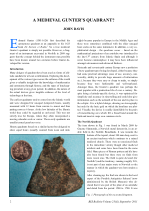
This article discusses the excavation of a quadrant fragment in Norfolk in 2009, initially misidentified as an astrolabe plate. Further investigation suggests it's a hybrid device combining features of a quadrans vetus and a Gunter's quadrant, leading to questions about its medieval origins despite Gunter's later development of his eponymous instrument.
Dials: Portable, Dials: Unusual, Historical Dials
September 2011
Page 16
Page 16
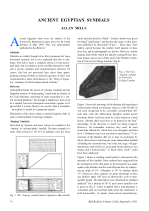
This article reviews ancient Egyptian timekeeping, debunking obelisks as gnomons and a Cairo Museum artifact as a sundial. It focuses on the ‘sloping’ or ‘inclined plane’ portable, seasonal-hour altitude dials, such as the Qantara dial, and earlier L-shaped 'shadow sticks' from the New Kingdom, discussing their construction, use, and the challenges in interpreting their time-telling functions.
Dials: Portable, Dials: Unusual, Historical Dials, How Sundials Work
September 2011
Page 27
Page 27
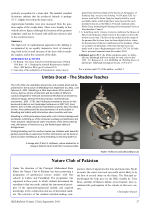
This piece announces an exhibition in Moedling, Austria, from September 2011 to February 2012, focusing on time and sundials. The exhibition features models of sundials from Johannes Gaupp's 'Gnomonica Mechanica Universalis' (1665-1738), symbolistic pictures by Ernst Steiner, and documentation of wall sundials in Moedling.
Dials: Vertical, Dials: Unusual
September 2011
Page 48
Page 48
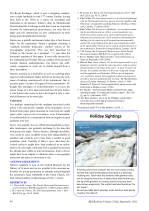
This short entry presents a photo of a declining, reclining sundial from Cavtat, Croatia, seen during a holiday. It suggests the dial likely uses the tip of the gnomon as a nodus and that the lines might have been drawn empirically, as the shadow of the gnomon does not align with the hour lines. The motto translates to 'Do not touch'.
Dials: Unusual, Sundial Design & Layout
December 2011
Page 8
Page 8
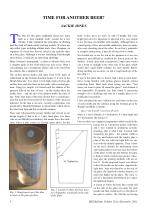
This article details the design and creation of a transparent chalice dial on a 1-pint beer glass, to be read from the outside like a shepherd's dial. The challenge was to make it simple to use, casting a beam of sunlight through a dark circle to indicate time on equal-width month columns. Calculations for sun's altitude were performed for different months and hours, leading to a functional beer-glass sundial.
Dials: Unusual, Sundial Design & Layout, Construction Projects
December 2011
Page 22
Page 22
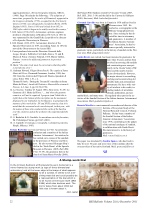
This short piece describes a stump-work mirror frame from about 1650 in Montacute House, Somerset, which features an image appearing to be a declining west sundial. It possibly represents a dial found on the house itself. Little else is known about this embroidered dial, highlighting an unusual artistic representation of a sundial.
Dials: Unusual, Dials: Vertical, Historical Dials
December 2011
Page 23
Page 23
This article describes a newly erected 180 cm high granite sundial in the Irish National Heritage Park, Ferrycarrig, weighing over 2 tonnes. Modelled on ancient monastic sundials, its temporal lines were designed to mark canonical prayer times rather than passing hours. Only twelve such ancient monastic sundials survive, making this reconstruction an important addition.
Construction Projects, Dials: Mass Dials, Dials: Unusual, Historical Dials
December 2011
Page 41
Page 41
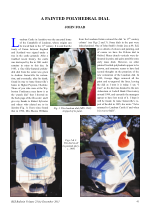
This article discusses a polyhedral dial from Loudoun Castle, Scotland, that was restored and controversially painted in the 1990s using 17th-century colours. The paint was later removed, and the lines re-engraved. The author expresses concern that the dial's current location at Jodrell Bank Observatory is unknown, raising questions about the preservation and tracking of historical sundials.
Dials: Multi Faced, Dials: Unusual, Historical Dials, Restoration projects
March 2010
Page 10
Page 10
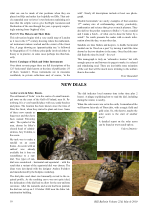
A collection of short articles describing new sundials. These include an equatorial 'solar acorn' dial in Solar, Russia; a vertical declining dial in Oxford inspired by Christopher Wren; and a mass-produced, flat-packed equatorial 'Sun Disc' from Australia designed for various latitudes.
Dials: Vertical, Dials: Equatorial, Dials: Unusual, Construction Projects
March 2010
Page 38
Page 38
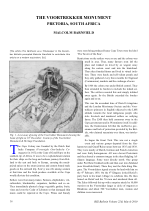
Describes how the Voortrekker Monument in Pretoria functions as a timekeeper. An aperture in the dome allows a ray of sunlight to illuminate a cenotaph at Local Solar Noon on 16th December each year, commemorating the 1838 Battle of Blood River.
Dials: Unusual, Sundial Design & Layout, Historical Dials, Dials: Noon Lines
June 2010
Page 2
Page 2
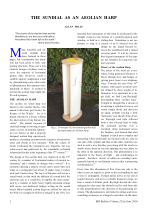
This article explores the concept of integrating an aeolian harp into a sundial's support structure to complement the visual time-telling with ethereal wind-generated music. It details the history and theory of aeolian harps, including the physics of 'aeolian tones' and string resonance. The author describes the construction of a prototype venturi-type aeolian sundial using inexpensive materials, highlighting design considerations for soundboxes, strings, and the integration of a horizontal dial.
Construction Projects, DIY Sundial Projects, Dials: Unusual, Sundial Design & Layout
June 2010
Page 38
Page 38
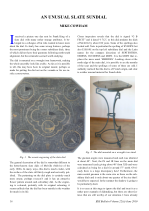
This article examines a unique slate dial from 1712, signed 'G B FECIT'. It notes several unusual features, including incorrect gnomon alignments on subsidiary dials, ornate rococo-like decoration, and French origin due to spellings and slate material. The article also highlights a large discrepancy between calculated latitude and gnomon angle, along with various other intriguing engravings like months, zodiac signs, lunar cycles, epacts, and a crest.
Dials: Multi Faced, Dials: Unusual, Historical Dials
June 2010
Page 41
Page 41
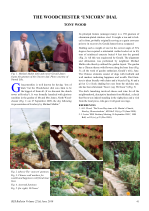
This article describes the formal launch of the 'Unicorn dial' at North Woodchester, Gloucestershire. It features a massive 17ft helical gnomon made of chromium-plated stainless steel, weighing a ton, and held at a 51¾-degree angle. The gnomon was aligned by Michael Maltin, outlining the garden layout which incorporates Chinese themes and floral hour lines.
Construction Projects, Dials: Horizontal, Dials: Unusual, Sundial Design & Layout
June 2010
Page 46
Page 46
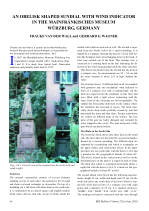
This article describes a unique obelisk-shaped sundial from 1742 in the Mainfränkisches Museum Würzburg. Made of Franconian sandstone, it features 10 sundials and a mechanical wind indicator with a rotating hand connected to a vane by internal gearing. The construction, with dials on inclined surfaces and a Turk's head sculpture, is highly unusual and suggests a learned, wealthy commissioner for an impressive park.
Dials: Multi Faced, Dials: Unusual, Historical Dials, Sundial Design & Layout
September 2010
Page 26
Page 26
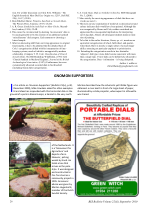
This note describes a horizontal sundial in the Netherlands with a pole-style gnomon shaped as a farm labourer holding a hoe, designed and constructed in Cor-Ten steel as a community project.
Construction Projects, Dials: Horizontal, Dials: Unusual, Sundial Design & Layout
September 2010
Page 31
Page 31
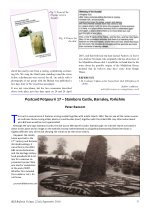
This article features a postcard from March 1932 depicting a living sundial with Roman numerals and lines laid out using plants or bushes, located at Wentworth Castle, Stainborough, and seeks information about the initials 'BW' visible on it.
Dials: Unusual, Historical Dials
September 2010
Page 36
Page 36
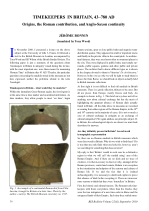
This article investigates the presence and influence of Roman timekeepers in Britain from 43-780 AD, noting the scarcity of archaeological finds compared to other Roman provinces. It explores historical, cultural, and military evidence, including a mosaic depiction and rudimentary sundial objects, and briefly discusses the obscure origins of Saxon dials.
Dials: Mass Dials, Dials: Unusual, Historical Dials
December 2010
Page 9
Page 9
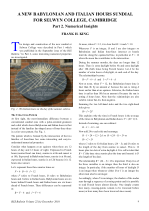
This article is the second part of a series detailing the Selwyn College sundial, focusing on its numerical properties. It explains the criss-cross pattern of Babylonian and Italian hour-lines, their relationship with French hours, and the concept of 'extra daylight.' It also provides methods for setting out these hour-lines.
Dials: Unusual, How Sundials Work, Mathematics of Dialling, Sundial Design & Layout
December 2010
Page 11
Page 11
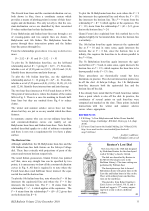
This entry describes a now-lost sundial designed by Nicholaus Kratzer in 1520 for St Mary's churchyard wall in Oxford. Based on a design in Kratzer's MS De Horologiis it showed Babylonian hours in green on the East side, Italian hours in blue on the West, and ordinary hours and declinations on the south face.
Dials: Multi Faced, Dials: Unusual, Historical Dials
December 2010
Page 31
Page 31
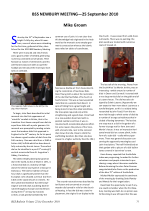
This report summarises the British Sundial Society's Newbury Meeting on 25 September 2010, attended by 36 members. It highlights short talks on scientific sundials in Britain, Essex dial restorations, and Devon/Cornwall dials. Exhibits included devices for determining sun direction, reproductions of historical dials, and modern designs.
Dials: Unusual, Historical Dials, Restoration projects, The BSS and Members
December 2010
Page 37
Page 37
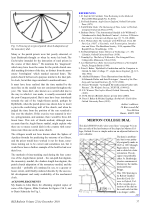
This entry describes the sundial on the east side of the chapel at Merton College, Oxford. Dating possibly from 1629 or 1659, and potentially redesigned by Jo. Bainbridge or Henry Briggs, it uses a simple nodus on an adjacent buttress to cast a shadow with criss-cross lines, although an extension on the south side shown in a 1922 drawing is no longer visible.
Dials: Unusual, Historical Dials
December 2010
Page 41
Page 41
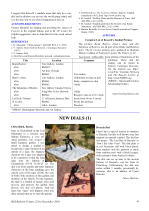
This article presents two new sundial designs. The first is a white marble sundial for a Japanese garden near Chelyabinsk, Russia, featuring a gnomon adapted from the Japanese character for 'tiger' and Japanese characters for hour markings. The second is a Dracula Dial with a gnomon of stainless steel and black lacquer, set near Korporie fortress, which was unfortunately stolen.
Construction Projects, Dials: Unusual, Sundial Design & Layout
December 2010
Page 45
Page 45
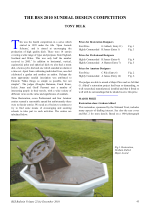
This report covers the fourth BSS Sundial Design Competition, which received 14 entries across restoration, professional, and amateur classes, though no junior entries. Graham Aldred won the Major Prize for his restoration of the Lyme Park dial. Other prizes were awarded for a south-facing vertical dial and highly commended entries for a sun/moon dial, a prototype noon mark dial, and a vertical dial using a 'super ellipse.'
Dials: Unusual, Restoration projects, Sundial Design & Layout, The BSS and Members
March 2009
Page 27
Page 27
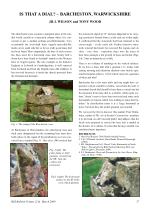
This article describes the discovery of a unique sundial carved into the base of a former churchyard cross at Barcheston, Warwickshire. The stonework was trimmed to a 52° slope on the south side, with recessed flat regions revealing traces of hour lines. It is classified as a large horizontal in stone with a notably wide gnomon.
Dials: Horizontal, Dials: Unusual, Historical Dials
March 2009
Page 43
Page 43
This article explores sundials used as memorials, discussing their historical significance from Roman times. It details numerous examples, including tombstone dials, pillar-mounted dials in churchyards (e.g., St Mawnan's, Dryburgh Abbey), and war memorials. The article highlights epitaphs, theft incidents, and the symbolic connection between sundials and the passage of time.
Dials: Unusual, Historical Dials, Mottoes
March 2009
Page 48
Page 48
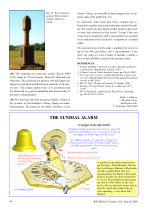
This entry describes an inventive "Ye Sundyal Alarme Bafic Modelle" and a "Deluxe modelle" The basic model uses sunlight focused by a cylindrical lens to heat a copper ball, melting wax that triggers a mousetrap and a bell. The deluxe version also lights a fire for a morning posset, offering a creative, if anachronistic, take on sundial functionality.
Dials: Unusual, DIY Sundial Projects
June 2009
Page 44
Page 44
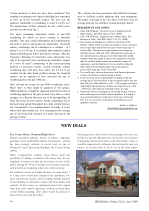
Describes two new dials. The first is a vertical declining dial with symbolic hour marks created using incised plasterwork (pargeting) in Wanstead. The second is a new globe moondial in stainless steel which shows time by the moon for nine days around the full moon.
Dials: Unusual, Dials: Vertical, Sundial Design & Layout
June 2009
Page 47
Page 47
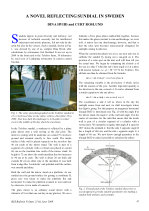
Describes a unique reflecting sundial where a flat mirror reflects a sunbeam onto a curved wall that serves as the dial plate. The article explains the geometry, calculations, and calibration process for this artistic and scientific instrument located at Tolefors Farm, Sweden.
Dials: Reflected, Dials: Unusual, Sundial Design & Layout
June 2009
Page 48
Page 48
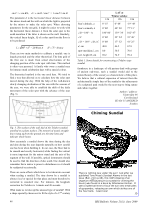
A short note featuring a 1645 drawing by Athanasius Kircher of an ‘Organum Heliocausticum’. This is a sundial designed to chime the hours by using a spherical lens to focus sunlight onto gunpowder, which in turn releases an arm to strike a bell.
Dials: Unusual, Historical Dials
September 2009
Page 2
Page 2
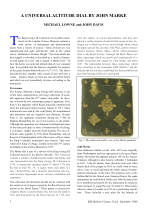
Describes a unique universal altitude dial made by John Marke, possibly for Robert Boyle, now in the London Science Museum. The article details the instrument's provenance, its physical characteristics, and its complex operation as a combined clinometer and sundial. It provides an in-depth analysis of the mathematical principles involved and its potential accuracy.
Dials: Portable, Dials: Unusual, Historical Dials, Mathematics of Dialling
September 2009
Page 9
Page 9
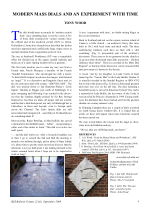
Discusses modern scratch dials made since the medieval period for various reasons other than marking mass times. It presents several examples, including a decorative dial in Scotland, a memorial dial in Macclesfield, unusual dials on windowsills on the island of Canna, and the 'Toucan Dial' at Leeds Castle.
Dials: Mass Dials, Dials: Unusual, Historical Dials
September 2009
Page 10
Page 10
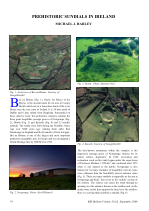
Explores potential prehistoric sundials within the megalithic passage tombs of Brú na Bóinne in Ireland, including Newgrange, Dowth, and Knowth. The article examines specific stone carvings, such as the 'Stone of the Seven Suns' and Kerbstones K7 and K15 at Knowth, discussing theories that they may be sundials or calendars.
Dials: Unusual, Historical Dials, How Sundials Work
September 2009
Page 20
Page 20
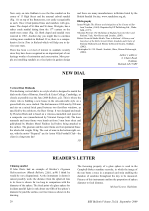
A letter responding to a previous article on Kircher’s 'Organum Heliocausticum'. The author argues that the instrument as depicted could not work because the focal length of the spherical lens is drawn incorrectly.
Dials: Unusual, How Sundials Work
September 2009
Page 25
Page 25
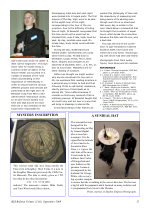
Features a unique sundial hat designed by Joanna Migdal for the Ascot races. The hat is a functional sundial designed for the latitude of Ascot, with its gnomon made of feathers. It is delineated to show "Race Time," indicating the start times of the races.
Dials: Unusual, Sundial Design & Layout
September 2009
Page 32
Page 32
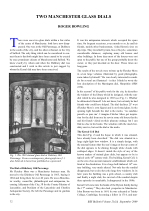
Discusses two now-lost stained-glass sundials from the Manchester area. One, at Didsbury Old Parsonage, was designed in 1903 by Fletcher Moss. The author describes the second, an 18th-century dial at Kersal Cell, and speculates it may have been instigated by its owner, the prominent Jacobite John Byrom.
Dials: Unusual, Dials: Vertical, Historical Dials
September 2009
Page 36
Page 36
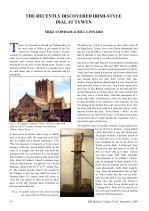
Details the discovery and preservation of an Irish-style pillar dial (c. 700-1000 AD) in Tywyn, Wales. Found in 1986 among rubble, the dial was later used as a milepost. The article describes its features and recounts the successful effort to have the vulnerable stone moved to St Cadfan's Church.
Dials: Mass Dials, Dials: Unusual, Historical Dials, Restoration projects
September 2009
Page 45
Page 45
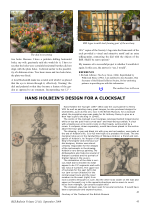
Presents and discusses a drawing by Hans Holbein the Younger for a 'clocksalt'—a combined hourglass, clock, and salt cellar—designed as a gift for Henry VIII. The piece incorporates two curved sundials, whose design is attributed to Nikolaus Kratzer, and the author notes their curious and unusual delineation.
Dials: Unusual, Historical Dials
December 2009
Page 2
Page 2
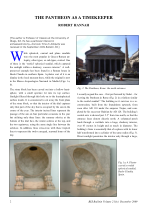
This article argues that the Pantheon in Rome functions as a large-scale timekeeper, similar to a roofed spherical sundial. It examines how sunlight entering through the oculus marks specific times of the year, such as the equinoxes, and compares its astronomical features to those of Nero's Domus Aurea.
Dials: Hemispherical, Dials: Unusual, Historical Dials
December 2009
Page 5
Page 5
The first letter describes an innovative focusing sphere lens made of lucite and copper sulphate, designed for use in a sundial. The second letter confirms that Samuel Turner, a diallist, was also the sculptor of his own tombstone which features a direct west dial.
Dials: Unusual, How Sundials Work, Historical Dials
December 2009
Page 14
Page 14
This section presents two new dials. The first is a stone vertical dial near St Petersburg with a theme from a Chekhov story. The second is a 'triple horizontal dial' made of stainless steel for a garden in South Africa, which includes a nocturnal and family anniversary lines.
Dials: Horizontal, Dials: Unusual, Dials: Nocturnals
December 2009
Page 26
Page 26
Describes the design and use of a pocket-sized device for photographers to predict the sun's direction at any time of day or year. Based on a horizontal stereographic projection, the instrument uses a rotating dowel aligned with date and time scales to help plan for specific lighting conditions.
DIY Sundial Projects, Dials: Unusual, Sundial Design & Layout
December 2009
Page 34
Page 34
This article describes a large and innovative bifilar sundial. It uses the intersecting shadows cast by two suspended chains hanging in catenary curves to indicate both the time and the date on a large tiled pavement. The article provides a summary of the complex mathematical calculations involved in its design.
Dials: Bifilar, Dials: Unusual, Mathematics of Dialling, Sundial Design & Layout
December 2009
Page 37
Page 37
A report on a commercial satellite dish, produced by the German firm Fuba, that incorporates a functional sundial on its parabolic surface. The author notes that the dial is designed for a specific latitude and satellite position and remarks on its similarity to a dish dial he built himself in 1999.
Dials: Vertical, Dials: Unusual
March 2008
Page 16
Page 16
This article recounts the legend of Sir Henry Yule, a Bengal Engineer in the 1840s, who, vexed by his own temper and his native workmen's unpunctuality, fined himself two rupees each time he lost his temper. He used the accumulated money to erect a 'handsome' sundial at Roorkee to teach the locals the value of time.
Dials: Unusual, Historical Dials
March 2008
Page 48
Page 48
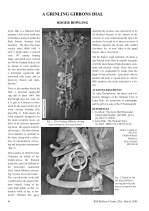
Describes a non-working universal equinoctial ring dial, about 12cm in diameter, incorporated into a 1684 lime-wood carving by Grinling Gibbons. This carving, representing arts and sciences, is located in the saloon of Lyme Hall, alongside other astronomical and navigation instruments, reflecting Sir Richard Legh's interest in the sciences.
Dials: Equatorial, Dials: Unusual, Historical Dials
September 2008
Page 106
Page 106
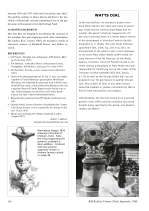
This piece follows up on the whereabouts of George Watts' sundial, confirming Mary Watts as its maker. It reports that the terracotta dial was stolen from a private garden in the 1990s and remains unrecovered, appealing to readers for information. The text also mentions the existence of a better photograph in Veronica Franklin Gould's biography of Mary.
Dials: Multi Faced, Dials: Unusual, Historical Dials
September 2008
Page 118
Page 118
Irene Brightmer shares details of a vertical surrealist sundial by Salvador Dalí in Paris, featuring a blue-eyed female face. She also describes two historic meridians nearby: one in the Church of Saint-Sulpice, commissioned from Henry Sully, and the official Paris meridian marked by over a hundred Arago medallions.
Dials: Noon Lines, Dials: Unusual, Dials: Vertical, Historical Dials
September 2008
Page 141
Page 141
Tony Wood writes about a porcelain dial from 1766 at the Royal Worcester Porcelain Museum, describing its detailed delineation. Jill Wilson responds to Chris Williams' mass dial article, noting a correlation between dial distribution and geology, and suggesting further research into building materials and church histories for a complete picture of dial loss.
Dials: Mass Dials, Dials: Unusual, Historical Dials, The BSS and Members
September 2008
Page 148
Page 148
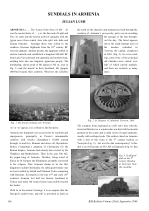
Julian Lush explores the prevalence of sundials in Armenia, linking their abundance to the nation's ancient veneration of the sun deity 'Ar.' He describes the common 'shell' or 'scallop' dial form found on 5th-13th century churches and monasteries, noting unique Armenian alphanumeric hour numbering and the enduring sun disc emblem on khachkars.
Dials: Vertical, Dials: Unusual, Historical Dials
December 2008
Page 203
Page 203

This article investigates a puzzling sundial in the Rose Garden of Villa Cimbrone at Ravello, Italy. Despite its fine design and the builder's knowledge of clocks, the dial's inclination and gnomon angle are incorrect for its latitude, suggesting it was originally a horizontal dial for England or is a non-dial. It also mentions another horizontal dial at the villa.
Dials: Unusual, Historical Dials
March 2007
Page 9
Page 9
This section contains correspondence from readers. Chris Lusby Taylor discusses the use of Hooke’s joint for delineating declining and reclining dials, while Allan Mills replies regarding an error in a previous paper. Tony Ashmore suggests an interpretation for the 'Egyptian Face' design on a sundial pillar at Lord Tennyson's home, attributing it to Ptolemy.
Dials: Unusual, How Sundials Work, Mathematics of Dialling
June 2007
Page 84
Page 84
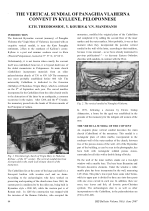
This article describes a unique vertical sundial at the Byzantine Panaghia Vlaherna Convent in Kyllene, Greece. Made of white marble, it features 13 fan-shaped petals representing hours without numerals, reflecting local tradition and contrasting with Western sundial practices. It discusses the monastery's history and the dial's architectural integration.
Dials: Unusual, Dials: Vertical, Historical Dials
September 2007
Page 105
Page 105
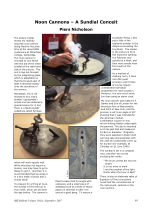
This article discusses noon cannons, devices that fire at solar noon using a magnifying glass to ignite powder. It describes preparing and firing a cannon, noting it's more for fun than accuracy. It also mentions historical examples from the mid-17th and 18th centuries, modern versions, and current licensing restrictions in England. A specific F. Barker and Son cannon is detailed.
Dials: Noon Lines, Dials: Unusual, Historical Dials
February 2006
Page 14
Page 14
This article provides instructions for assembling and using a moon dial. It explains how to determine the moon's phase using the Golden Number and how to rotate the dial to find the current time. The author notes that this dial relies on estimating the moon’s direction rather than casting a visible shadow, due to the moon's light intensity.
Dials: Equatorial, Dials: Unusual, Construction Projects, DIY Sundial Projects, Dials: Nocturnals
February 2006
Page 40
Page 40
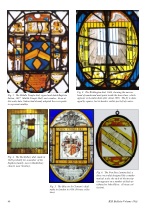
This article explores the careers and working methods of prominent 17th-century London glass sundial makers, including Baptist Sutton, John Oliver, Richard Dutton, and William Price. It identifies common features of London dials, discusses challenges in attributing their work, and examines the role of these figures as mathematical practitioners.
Dials: Unusual, Historical Dials
June 2006
Page 78
Page 78
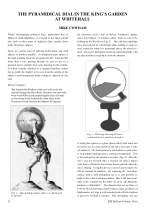
This article reconstructs the spherical dials from the complex 1669 Pyramidical Dial in Whitehall, based on descriptions by William Leybourn. It details various glass sphere dials, including those showing time by heat ("fire"), water, optical alignment ("air"), and terrestrial globes ("earth"), and discusses their delicate construction and short lifespan.
Dials: Hemispherical, Dials: Unusual, Historical Dials
March 2005
Page 14
Page 14
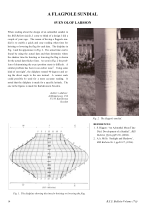
Presents design of a vertical sundial adapted for flagpole installation, with dial furniture indicating sunrise and sunset signal times for hoisting and lowering the flag. Covers dial plate calibration for specific latitude, readability challenges under low contrast, and suggests precision improvements via vernier scales and solar-aligned sighting mechanisms.
DIY Sundial Projects, Dials: Unusual
March 2005
Page 36
Page 36
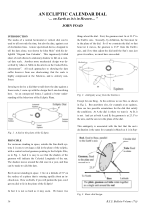
Introduces a novel ecliptic-aligned sundial for direct solar date indication on a linear scale. Describes aligning the dial plane with the ecliptic, date scale calibration, equation of date application, and improved prism-based design. Demonstrates lunar path visualization and usage for sun compass orientation.
Dials: Unusual, Mathematics of Dialling, Sundial Design & Layout
December 2005
Page 160
Page 160
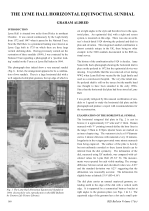
This article details the discovery and reconstruction of a unique 1683 combined horizontal equinoctial sundial at Lyme Hall. The author describes deciphering the inscription "R Legh 1683," examining its robust bronze construction and innovative two-hole sight/screen system. The article also explores the dial's historical context, its owner Richard Legh, and a possible link to George Gibbs's Helio-Chronometer.
Dials: Equatorial, Dials: Horizontal, Dials: Unusual, Historical Dials, Restoration projects, Sundial Design & Layout
December 2005
Page 172
Page 172
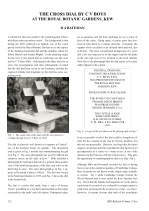
This article investigates the bronze cross dial by C.V. Boys at Kew Gardens, noting its unusual design and puzzling errors in the engraved latitude and longitude. It traces the dial's history, including its temporary display and previous locations within the gardens, and highlights the scientific reputation of its designer, Sir Charles Vernon Boys FRS.
Dials: Polar, Dials: Unusual, Historical Dials, Sundial Design & Layout
December 2005
Page 175
Page 175
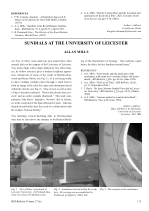
This piece highlights four unusual sundials at the University of Leicester campus. It features a two-meter-high "Eye of Time" noon mark, a modern sculptural piece indicating both time of year and day via an analemma. Also mentioned are John Davis's "Newton" dial and two matching vertical declining dials in Westmoreland slate, one showing equal hours and the other seasonal hours.
Dials: Noon Lines, Dials: Unusual, Dials: Vertical
March 2004
Page 6
Page 6
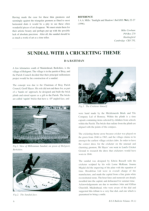
This article describes a millennium sundial project in Holyport, Berkshire, featuring a unique cricketing theme due to the village's history with the sport. Designed by Edwin Russell with cricketer sculptures by Lorne McKean, the dial includes hand-made 'quint' bricks, a time capsule, and hour lines delineated for summer time.
Construction Projects, Dials: Unusual, Sundial Design & Layout
March 2004
Page 18
Page 18
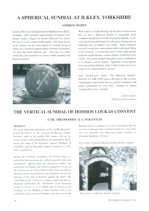
The author describes the rediscovery of a spherical sundial in a garden rockery in Ilkley, Yorkshire. Though eroded, the dial's equatorial line and Roman numerals were visible. The article notes its previous location and the commonality of such dials on gateposts, suggesting a possible need for closer examination of stone balls in similar settings.
Dials: Unusual
June 2004
Page 47
Page 47
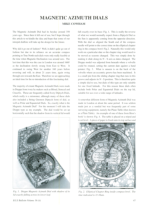
Historical and technical discussion of magnetic azimuth dials from the 17th century, including Dieppe ivory examples, London surveying instruments, and design considerations for modern reconstructions.
Dialling Tools, Dials: Unusual, Historical Dials
June 2004
Page 53
Page 53
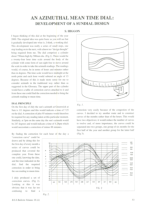
Step-by-step account of designing and building a cylindrical azimuthal mean time dial with mechanical correction application, including prototype testing and accuracy assessment.
DIY Sundial Projects, Dials: Unusual, Sundial Design & Layout
September 2004
Page 103
Page 103
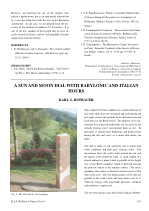
Description of a multi-plane stone dial ensemble that shows Babylonian and Italian hours by day and acts as a moon dial at night; discusses decorative Earth/moon motifs, orientation relative to local and Basel reference planes and how the lunar readout is used.
Dials: Horizontal, Dials: Unusual, How Sundials Work
September 2004
Page 124
Page 124
Analysis of the small Roman bronze ‘cylindrical box’ with pierced disks in Vienna; interprets the object as a portable/rolling sundial (viatoria pensilia), applies Padre Secchi calculations and discusses mounting/suspension possibilities and function.
Dials: Portable, Dials: Unusual, Historical Dials
December 2004
Page 143
Page 143
Concluding analysis of the Roman cylindrical portable dial/box. Examines iconography, construction hypotheses (lateral hole or pivot gnomon), latitude and use-mode limitations, accuracy concerns and comparisons with related museum pieces; concludes it is plausibly a status object with limited gnomonic precision.
Dials: Portable, Dials: Unusual, Historical Dials
December 2004
Page 160
Page 160
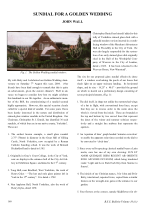
Account of a commissioned engraved glass sundial created for a golden wedding anniversary. The gnomon is replaced with an aperture on the outer window, illuminating the dial on the engraved inner pane of glass. Covers design choices, layout and the inclusion of equation-of-time/longitude correction features, installation notes and the personal significance of the dedication.
Dials: Unusual, Sundial Design & Layout
March 2003
Page 17
Page 17
Follow-up on sundials along the Centrovalli railway line in Northern Italy, including new photographs and credit to designer Giacomo Bonzani.
Dials: Unusual, Dials: Vertical
March 2003
Page 24
Page 24
Annual round-up of notable sundials discovered or reported in 2002, highlighting interesting examples and unusual features.
Dials: Horizontal, Dials: Unusual
June 2003
Page 58
Page 58
This article explores the concept of creating a sundial for the visually impaired. It reviews historical attempts, such as one by the 17th-century Jesuit priest Francis Hall, and discusses modern approaches that use the heat of the sun rather than visible light.
Construction Projects, DIY Sundial Projects, Dials: Unusual, Sundial Design & Layout
September 2003
Page 108
Page 108
The first part of an article on a unique 'New Optical Dial' invented by W. Gordon Benoy. It's a sundial that tells time with a beam of light rather than a shadow. The article describes its construction, its weight, and some technical details including using a glass cylinder filled with water containing anti-freeze.
Dials: Equatorial, Dials: Unusual
September 2003
Page 116
Page 116
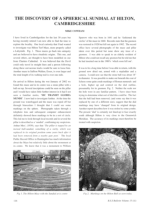
A discussion about a spherical sundial discovered in the village of Hilton. The article compares it to other historical spherical dials and suggests it may have been incorrectly restored.
Dials: Unusual, Historical Dials
September 2003
Page 122
Page 122
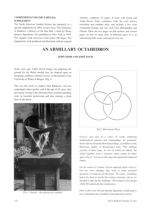
This article details the design and construction of an armillary octahedron, a complex sundial structure. It describes the process of making the intersecting V shapes and the challenges of assembly due to thermal expansion.
Construction Projects, Dials: Unusual
September 2003
Page 129
Page 129
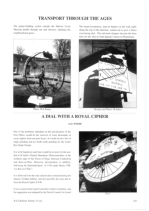
This article features two sundials with a transportation theme. One is a west-facing dial on a house in Warminster with hour lines that look like railway sleepers, and the other is a photo of a penny-farthing cyclist outside a cycle museum.
Dials: Unusual, Dials: Vertical
December 2003
Page 144
Page 144
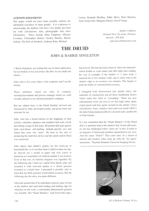
An account of the conception and development of a helical sundial known as 'The Druid', highlighting the innovation of the 'Smart Shadow' and construction techniques.
Dials: Unusual, Sundial Design & Layout, DIY Sundial Projects
December 2003
Page 175
Page 175
Continuation of a discussion of an innovative dial, focussing light through a cylinder onto an equatorial dial plate
Dials: Equatorial, Dials: Unusual
March 2002
Page 4
Page 4
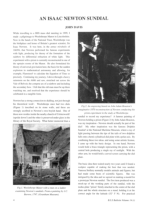
Describes the design and creation of a unique sundial featuring a statue of Newton holding a prism, inspired by his optical work and historic dials at Woolsthorpe.
Construction Projects, Dials: Polar, Dials: Unusual, Sundial Design & Layout
March 2002
Page 27
Page 27
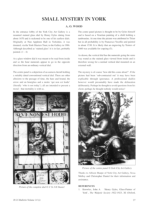
Reports on an unusual stained glass window sundial in York with a curiosity in the painting of a wrongly deliniated sundial in its centre.
Dials: Unusual, Historical Dials, Dials: Stained Glass
March 2002
Page 32
Page 32
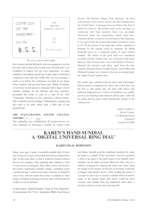
Describes a simple sundial formed purely by the hands, giving approximate time and direction towards north.
DIY Sundial Projects, Dials: Portable, Dials: Unusual
March 2002
Page 39
Page 39
Explores dials intended to show the date rather than the time, by reading the shadow of an equinoctial ring on a scale on the stile.
Dials: Polar, Dials: Unusual, How Sundials Work
June 2002
Page 46
Page 46
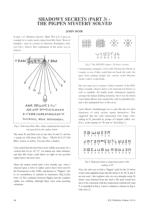
A ciphered sundial motto in Italy is decoded using a Masonic pigpen cipher; the story follows the decoding process and offers a translation.
Dials: Unusual, Historical Dials
June 2002
Page 67
Page 67
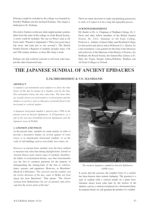
Study of a Greek sundial gifted to Epidaurus by the Japanese town of Nishiki, exploring ancient cross-cultural astronomical instrumentation.
Dials: Horizontal, Dials: Unusual
June 2002
Page 69
Page 69
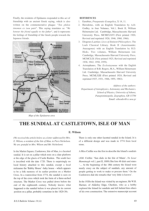
Description and analysis of a unique local sundial in Castletown with regional design features.
Dials: Multi Faced, Dials: Unusual, Dials: Vertical, Historical Dials
June 2002
Page 71
Page 71
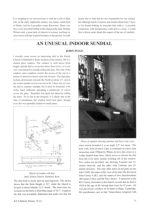
September 2002
Page 91
Page 91
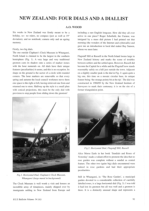
The author explores four distinctive sundials across New Zealand, discussing their design, settings, and local cultural influences, with special focus on Ray Sanson’s dials.
Dials: Horizontal, Dials: Unusual, Dials: Vertical, Historical Dials
September 2002
Page 104
Page 104
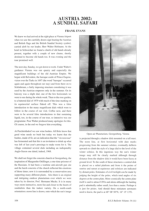
Travelogue of the BSS tour of Austria led by Walter Hofmann, visiting monasteries, public dials, and craftspeople; rich in descriptions of painted and sculptural dials.
Dials: Portable, Dials: Unusual, Dials: Vertical, The BSS and Members
September 2002
Page 109
Page 109
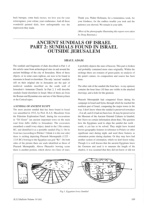
Continuation of a study cataloguing archaeological sundials discovered in various parts of Israel outside Jerusalem, detailing design, materials, and historical significance.
Dials: Horizontal, Dials: Unusual, Historical Dials
September 2002
Page 115
Page 115
An essay reflecting on the evolution of sundial making and the Society's activities during the 20th century, highlighting significant developments and personalities.
Dials: Bifilar, Dials: Equatorial, Dials: Heliochronometer, Dials: Unusual, Historical Dials, The BSS and Members
September 2002
Page 131
Page 131
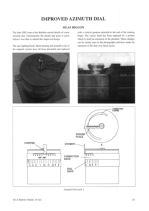
Proposal for a design enhancement to the azimuth dial, aiming to improve readability and construction precision.
Dials: Horizontal, Dials: Unusual
December 2002
Page 161
Page 161
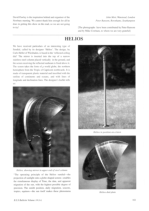
Brief note on a modern artistic reflective sundial design named 'Helios'
Dials: Reflected, Dials: Unusual, Sundial Design & Layout
June 2001
Page 65
Page 65
Describes the Uttoxeter Millennium Monument, a large stone disc featuring a solar system theme and an armillary sundial. Conceived to inspire exploration and celebrate the town, it incorporates local craftsmanship, planetary representations, and embedded plaques documenting its creation and sponsors. A time capsule is also concealed within the monument.
Construction Projects, Dials: Equatorial, Dials: Unusual
June 2001
Page 67
Page 67
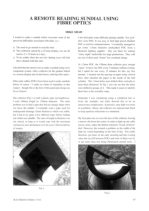
Mike Shaw details his innovative two-component sundial system, comprising an equatorial collector in the garden and a remote display unit indoors, linked by fibre optics. Designed to overcome the need to go outside to read time and simplify the display, the article describes its construction, addressing material challenges and light-gathering techniques.
DIY Sundial Projects, Dials: Unusual
June 2001
Page 73
Page 73
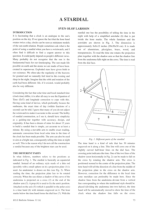
The article presents the Stardial, an innovative device functioning as an equatorial sundial by day and a simplified astrolabe by night. Designed for simplicity, accuracy, and originality, it enables automatic conversion from local solar time to clock time and provides methods for precise time-telling using bright stars and even the moon.
Dials: Equatorial, Dials: Unusual, Dials: Astrolabe, DIY Sundial Projects, Dials: Nocturnals
June 2001
Page 82
Page 82
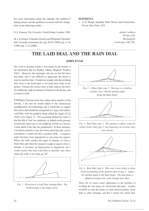
John Foad proposes new categories for sundials designed to prevent rain accumulation: the "Laid Dial," a reclining dial with an "Angle of Lie," and the "Rain Dial", featuring a conical raised centre. He discusses the practical advantages of these forms in preserving dial plates and enhancing readability, and the pleasing play on words.
Dials: Horizontal, Dials: Unusual, Sundial Design & Layout
September 2001
Page 92
Page 92
This article explores three freestanding stone "Father Time" statues in Britain, each incorporating a horizontal sundial. All are attributed to sculptor John Nost from the early 18th century and feature sundial plates by Thomas Heath. The article discusses the origin of the Father Time iconography and notes the uniqueness of these statues in depicting him with a sundial rather than an hourglass.
Dials: Horizontal, Dials: Unusual, Historical Dials
September 2001
Page 113
Page 113
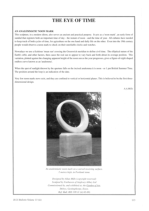
Describes a modern, three-dimensional noon mark sculpture in Portland stone, with analemma. It indicates both the instant of mean-time noon and the time of year by projecting a spot of sunlight onto an incised analemma. This design is believed to be the first of its kind that is 3-dimensional.
Dials: Noon Lines, Dials: Unusual, Equation of Time
September 2001
Page 127
Page 127
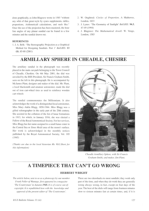
An armillary sundial, commemorating the Millennium, was recently unveiled in Cheadle, Cheshire. Designed and made by local blacksmith Jim Plant from iron cart-wheel tires, it also honours astronomer Miss Mary Adela Blagg. The sundial's unveiling was attended by BSS President Sir Francis Graham-Smith.
Construction Projects, Dials: Equatorial, Dials: Unusual
September 2001
Page 127
Page 127
Originally published in "The Countryman" in 1948, this article describes a highly accurate horizontal sundial built by the author while interned in a Japanese camp in China. Constructed from scrap materials using improvised tools and limited references, this unique dial provided correct clock time with built-in Equation of Time correction, serving as the camp's only reliable timepiece.
DIY Sundial Projects, Dials: Horizontal, Dials: Unusual, Equation of Time
December 2001
Page 147
Page 147
This article reports on the 2001 Wales Sundial Safari, detailing the examination of various sundials across the region. Highlights include a rare bridge sundial, historical church dials, a heliochronometer, and an ancient Celtic stele dial. The tour also featured a moon dial, various horizontal and vertical designs, and complex multi-component dials like the 1595 Marrington Hall example, showcasing Wales's diverse gnomonic heritage.
Dials: Unusual, Historical Dials, The BSS and Members
December 2001
Page 156
Page 156
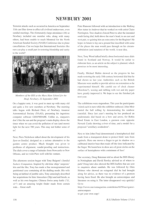
This report covers the well-attended BSS meeting at Newbury. Presentations included astronomy software, 'Spot-on-Sundial' development, and a 'Sundial Seekers Companion' kit. Updates were given on dial restoration. Exhibitions showcased diverse designs, including a rainbow dial, a hemispherical dial made from a bird feeder, and an electronic biscuit box sundial. Various other dials, a nocturnal, and calendars were also displayed.
Dials: Unusual, Restoration projects, Sundial Design & Layout, The BSS and Members
February 2000
Page 17
Page 17
Brief photographic descriptions of a translucent horizontal dial in Brisbane and a camel-shaped sundial in Marree made from railway sleepers.
Dials: Horizontal, Dials: Unusual
February 2000
Page 20
Page 20
Design and construction of an electronic equatorial sundial with phototransistors and LED display for remote indication of time.
DIY Sundial Projects, Dials: Equatorial, Dials: Unusual
June 2000
Page 70
Page 70
Describes a modern noon-marking stone and tests its alignment by observation of solar shadows.
Dials: Unusual
June 2000
Page 72
Page 72
Reflects on unintentional yet personally meaningful shadow effects observed in architectural settings.
DIY Sundial Projects, Dials: Unusual
February 1999
Page 8
Page 8
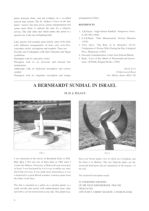
The author recounts discovering a Bernhardt dial at the Hebrew University in Rehovoth, Israel, in 1980. This memorial to Sir Hans Kronberger features special gnomon and dial shapes designed to provide directly read local mean time accurate to within a fraction of a minute.
Dials: Unusual, Equation of Time, Historical Dials
February 1999
Page 25
Page 25
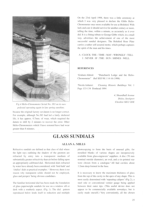
This article introduces refractive sundials made from transparent solids like glass, specifically glass paperweight sundials for window sills. The nodus is an 'aperture' on the top of the paperweight, casting a spot on a dial card on the bottom, with a more compact pattern than in air.
Dials: Horizontal, Dials: Portable, Dials: Unusual, Sundial Design & Layout, DIY Sundial Projects
February 1999
Page 33
Page 33
This section contains diverse reader correspondence, including a tribute to Charles Aked, discussions on the Equation of Time and Bernhardt dials, explanations of the Lluc sundial in Mallorca, a comparison of Eureka compass cards, reflections on restoration, and a submission on 'Tipple Times'.
Dials: Unusual, Equation of Time, Dialling Tools, The BSS and Members
February 1999
Page 40
Page 40
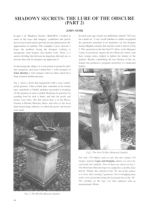
John Moir continues his exploration of hidden meanings and symbolism in sundials, presenting examples of 'false identity' dials like a bowl dial and a cat-shaped memorial. He delves into using logos, Morse code, and snooker ball colour codes, as well as analogies like railway lines and hair-lines, to enrich sundial design.
Dials: Unusual, Sundial Design & Layout, Equation of Time, Mottoes
June 1999
Page 70
Page 70
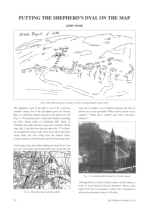
This article investigates a hillside sundial, known as the "Shepherd's Dyal," in Settle, Yorkshire, depicted in a 1720 sketch by Samuel Buck. It examines the dial's creation, disappearance between 1750 and 1779, and functionality. The analysis suggests the dial, with stone hour markers, was likely laid out empirically at the Summer Solstice, making it useful as a time-keeper only for a few weeks around mid-summer.
Dials: Unusual, Historical Dials
June 1999
Page 87
Page 87
This article describes a rare eyelet-hole scaphe sundial discovered at a Roman villa in Carthage, dating to 1st century AD or later. It details the marble artefact's exterior, including oak-leaf decoration and a fixing wedge, and its highly polished interior with seven non-concentric curves and eleven hour lines. Unique inscriptions in Greek and Latin Julian month names, including 'Augustus' (dating it after 9 BC), and zodiac signs mark its exceptional nature.
Dials: Scaphe, Dials: Unusual, Historical Dials
October 1999
Page 135
Page 135
This article discusses millennium projects, highlighting two commissions. One is a 10ft tall horizontal dial sculpture for the Harborough canal basin, costing £15,000 with Lottery Funds. The other is a memorial in Rimpton Parish, Dorset, consisting of two 8ft high standing slabs with a 50mm slot aligned to sunrise on 1st January 2000. Despite likely cloudy weather, the intention is to attend annually for a champagne ritual, establishing a new English tradition.
Construction Projects, Dials: Horizontal, Dials: Unusual
October 1999
Page 148
Page 148
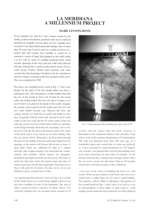
This article describes a millennium project involving the construction of a tower, 'La Meridiana', near Rome, to house a series of internal sundials. The author designed 10 dials for the walls and ceiling, read by sunlight projected through openings or reflected by a mirror. An experimental dial at his family house achieved accuracy within 10 seconds. The project aims to demonstrate precise time and date measurement, zodiac, altitude, and azimuth, using novel methods for declination, horizon, and meridian establishment.
Construction Projects, Dials: Reflected, Dials: Unusual, Sundial Design & Layout
February 1998
Page 3
Page 3
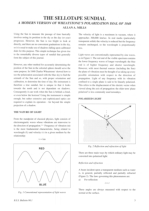
Explains a shadow-free sundial using sky polarization: a fan of Sellotape (cellophane) sectors is viewed with an analyser at the Brewster angle. The brightest sector (or equal adjacent sectors) indicates hours and half-hours, and the dial can work with the Sun behind cloud or after sunset.
DIY Sundial Projects, Dials: Unusual
February 1998
Page 13
Page 13
Notes an article from 1896 describing a dial found in a tomb of the VII or VIIIth century, with equal hour lines, which would be the earliest known dial in Europe with 'astronomical' hours.
Dials: Unusual, Historical Dials
June 1998
Page 4
Page 4
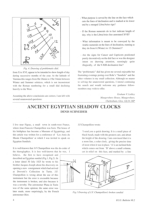
A history of ancient Egyptian methods of time measurement, from early shadow clocks to later step-sundials. It explains how these instruments worked, their limitations, and mentions the work of Jean-Francois Champollion in identifying one.
Dials: Unusual, Historical Dials
June 1998
Page 11
Page 11
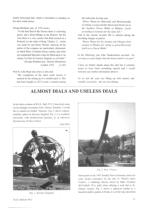
Showcases several examples of sundials deemed either 'almost' functional or 'useless.' It features a quasi-armillary sphere, a horizontal dial with a dysfunctional gnomon, a spherical sundial with perplexing projections, and a cathedral dial whose black face renders the shadow invisible, highlighting design flaws.
Dials: Unusual, Sundial Design & Layout
June 1998
Page 12
Page 12
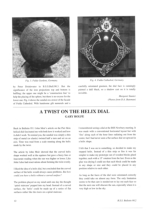
The article describes how to make a sundial by setting a series of faces on a solid object to indicate time. The faces are parallel to the earth's axis and turn to show specific times. The design, which can be cast from a mould, allows for time to be judged to within five minutes by observing the changing shadow on the face. The novel design has been patented
Dials: Unusual, Sundial Design & Layout
June 1998
Page 16
Page 16
This article describes the distinctive equatorial sundials designed by modern German artist M. Bernhardt. These feature a polished aluminium gnomon pointing towards Polaris, and an hour scale calibrated for mean time, incorporating the equation-of-time correction within the gnomon's outline. Interchangeable gnomons allow for seasonal adjustments.
Dials: Equatorial, Dials: Heliochronometer, Dials: Unusual, Equation of Time, Sundial Design & Layout
June 1998
Page 21
Page 21
This article explores the extraordinary sundials documented in Athanasius Kircher's 17th-century masterpiece, Ars Magna Lucis et Umbrae. It highlights Kircher's unique integration of gnomonics with esoteric disciplines like astrology and alchemy, showcasing innovative dials that provided astronomical data, medical advice, and even produced sound and fire.
Dials: Unusual, Mathematics of Dialling, Sundial Design & Layout
October 1998
Page 3
Page 3
This article explores hidden meanings, symbolism, and imagery in sundials. It delves into devices like chronograms, palindromes, anagrams, rebuses, and "false identity" dials, presenting examples and puzzles (with solutions) related to cryptic inscriptions and designs.
Dials: Unusual, Historical Dials, Mottoes, Sundial Design & Layout
October 1998
Page 8
Page 8
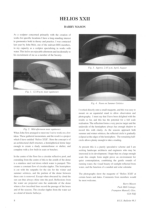
This article introduces an innovative 'Helios XXII' sundial concept, designed as an architectural shell structure or summerhouse. It features a hemispherical dome with a reflective pool at its centre and a stainless steel rod circulating water creating ripples. Reflections from the water, with shadows from the concentric ripples, are projected onto the dome's underside, marking hours and seasons, aiming for a tranquil contemplative environment.
Construction Projects, Dials: Hemispherical, Dials: Unusual, Sundial Design & Layout
October 1998
Page 16
Page 16
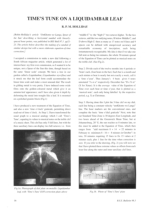
This article describes a unique sundial commission, featuring a gilded metal liquidambar leaf design. It incorporates an innovative equation-of-time correction system called 'Time's Tune,' which uses musical analogy to plot values on a treble clef. The dial provides a direct read-out of clock time with specific adjustments for longitude.
Construction Projects, Dials: Unusual, Equation of Time, Sundial Design & Layout
October 1998
Page 24
Page 24
This section features a collection of correspondence from readers covering diverse topics. These include the origin of Bernhardt Dials, methods for finding the meridian, updates on Newbury BSS meetings, a problematic sundial in Lluc, Mallorca, discussions on the 'Eureka' credit card compass, and inquiries about spherical and 'problematic' Italian dials.
Dialling Tools, Dials: Unusual, Historical Dials, The BSS and Members
October 1998
Page 27
Page 27
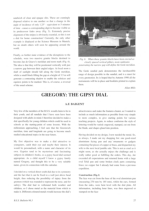
This article reports on the International Sundial Symposium in Genk, Belgium, which showcased designs from an international competition. It describes several winning sundials, including polyhedral, polar, catenary, and an innovative digital sundial by Hans Scharstein, highlighting the diversity and ingenuity in contemporary gnomonic design.
Construction Projects, Dials: Unusual
October 1998
Page 40
Page 40
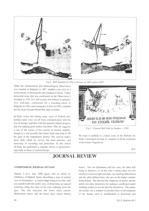
This article reviews *Compendium*, the journal of NASS, featuring J.M. Bores' new conical sundial design, measuring Babylonian and Italian hours, and an article by Robert L. Kellogg on Bede's cosmological and geographical works, including his observations on day-length variations. It also mentions a regular "Sightings" feature on notable dials.
Book Reviews, Dials: Unusual, Sundial Design & Layout
January 1997
Page 43
Page 43
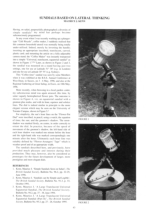
Introduces creative sundial designs employing unconventional concepts. Encourages innovation in form and function while respecting core gnomonic principles.
Dials: Unusual
July 1997
Page 13
Page 13
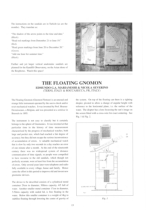
Describes the making of an unusual device for regulating watches following a design from 1895. It finds solar noon, by measuring the times the sun is at the same elevation just before and after noon, using a sighting mechanism floating in a can of water to ensure it is horizontal.
Dials: Unusual, Dialling Tools, DIY Sundial Projects
July 1997
Page 15
Page 15
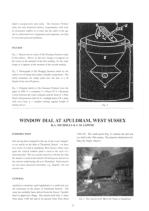
This article investigates a window dial in a church at Apuldram, using a vertical gnomon, thus being accurate on only two days in the year, one of which is the patronal saints day. It discusses the history of the church and the dial, and that the architectural changes to the church mean that the dial is now shaded for half the time.
Dials: Unusual, Historical Dials
July 1997
Page 34
Page 34
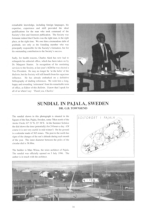
Description of a very large, notable sundial in Pajala, Sweden, north of the Arctic Circle.
Dials: Horizontal, Dials: Unusual
July 1997
Page 43
Page 43
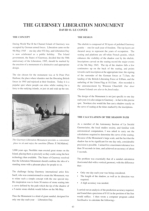
This article details the design and construction of the Guernsey Liberation Monument, which includes a sundial as a central feature. The shadow falls on a curved bench with markers at times of significant events calibrated for the annual Liberation Day, 19 May. It discusses the challenges and the methods used to ensure the dial's accuracy and the shadow's visibility.
Construction Projects, Dials: Unusual, Sundial Design & Layout
October 1997
Page 21
Page 21
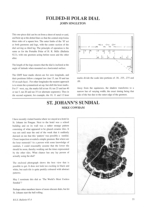
This article describes a large sundial on a school building in St. Johann im Pongau, Austria, made of glazed ceramic tiles. The author questions its usability due to the absence of hour numerals, requiring prior knowledge to interpret the times, and humorously nominates it as "The World's Most Useless Sundial".
Dials: Unusual, Sundial Design & Layout
February 1996
Page 33
Page 33
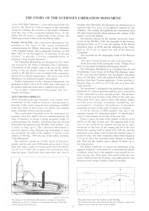
An account of the sundial monument built in Guernsey to mark its liberation during WWII, and its design.
Dials: Unusual, Historical Dials
February 1996
Page 34
Page 34
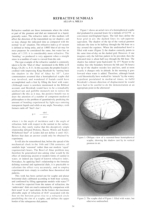
A look at sundials that use lenses and refraction to tell time, particularly medieval concepts like the Dial of Ahaz.
Dials: Scaphe, Dials: Unusual
June 1996
Page 42
Page 42
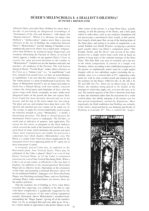
An analytical discussion of the sundial-like instrument depicted in Dürer’s ‘Melancholia I’, considering artistic interpretation and gnomonic function.
Dials: Unusual
October 1996
Page 13
Page 13
A description of constructing a sundial that uses the polarisation of skylight rather than shadows to tell time, explaining the optical principles, historical references, and potential applications.
Dials: Unusual, Sundial Design & Layout, DIY Sundial Projects
October 1996
Page 16
Page 16
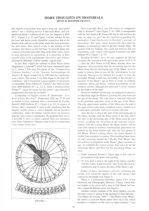
An in-depth examination of moondial designs and historical interpretations, correcting common errors in classical references, and proposing refinements to improve accuracy and aesthetic integration.
Dials: Unusual, Historical Dials
October 1996
Page 21
Page 21
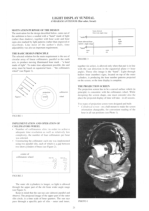
An innovative sundial design that projects light patterns as time indicators, demonstrating a creative approach to dialling aesthetics and function, with principles of optics.
Dials: Unusual, Sundial Design & Layout
February 1995
Page 2
Page 2
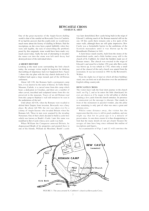
A detailed historical and archaeological analysis of the Bewcastle Cross in Cumbria, focusing on its origins, runic inscriptions, and the embedded early Christian sundial, alongside its stylistic comparisons with other Anglo-Saxon monuments.
Dials: Unusual, Dials: Vertical, Historical Dials
February 1995
Page 49
Page 49
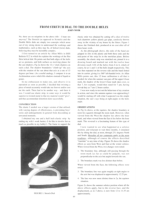
An innovative exploration of dial design evolution, tracing conceptual shifts from traditional layouts to experimental double helix arrangements.
Dials: Unusual, Sundial Design & Layout
June 1995
Page 39
Page 39
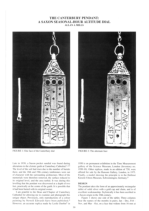
A detailed study of a multi-faced pendant dial designed to tell time on multiple surfaces, including its design, layout, and astronomical considerations.
Dials: Portable, Dials: Unusual, Historical Dials
October 1995
Page 4
Page 4
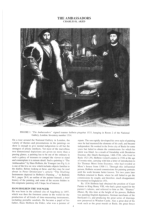
A deep exploration of Holbein’s painting 'The Ambassadors', interpreting its rich symbolism, especially the dialling instruments depicted. The article covers the painting’s history, the identities of the subjects, and technical discussion of the dials, torquetum, and polyhedral sundial shown.
Dials: Unusual, Historical Dials
October 1995
Page 27
Page 27
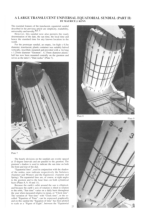
A technical and descriptive account of a large equatorial sundial made from translucent materials, designed for broad geographic usability and visual impact, including discussion of its structure and application.
Dials: Equatorial, Dials: Unusual
October 1995
Page 35
Page 35
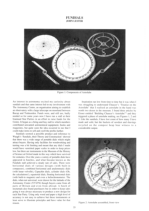
A creative examination of 'fundials', a whimsical category of dials built with humour, novelty, or playfulness in mind. The piece blends observation and storytelling with examples.
Dials: Unusual
February 1994
Page 33
Page 33
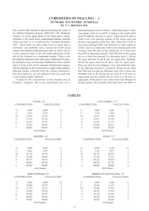
Describes construction of eccentric sundials with non-standard hour lines and geometries. Focuses on design theory and practical outcomes.
Dials: Unusual, Mathematics of Dialling
June 1994
Page 30
Page 30
An account of a rare Chinese sundial that divides the day into 100 equal parts, reflecting non-Western conceptions of time. The author explains its structure, cultural context, and implications for timekeeping history, offering a comparative view with European traditions.
Dials: Unusual, Historical Dials
October 1994
Page 32
Page 32
This article explores the concept of using shadows cast by window sills, jambs, and parapets on floors and walls as simple sundials. It explains the gnomonic principles involved, detailing how the moving "shadow straight line" can indicate the hour. The author provides formulas and diagrams for calculating the shadow's position based on latitude, window sill height and orientation (declination), solar altitude, and azimuth. It outlines the process of drawing date and hour lines, noting practical considerations like difficult-to-read periods for certain sill orientations, and suggests applications for terraces and balconies, or even for single hour lines with time-zone and Equation of Time corrections.
DIY Sundial Projects, Dials: Unusual, Mathematics of Dialling, Sundial Design & Layout
February 1993
Page 30
Page 30
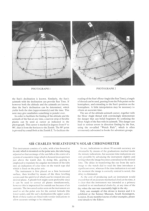
This article describes Sir Charles Wheatstone's Solar Chronometer, pictured on the front cover, an instrument designed to indicate solar time with high accuracy. It explains its construction, featuring a lens-fitted tube on a polar axis with scales for latitude and sun's declination, intended as a primary standard for setting mechanical clocks.
Dials: Unusual
February 1993
Page 36
Page 36
This paper elaborates on the theory and construction of bifilar sundials, a twentieth-century type invented by Hugo Michnik. It highlights their equiangular hour-lines, allowing direct reading of standard clock time by simple daily adjustment, and explains how time is indicated by the intersection of shadows from two horizontal threads.
Dials: Bifilar, Dials: Unusual, How Sundials Work, Mathematics of Dialling, Sundial Design & Layout
June 1993
Page 2
Page 2
This article details the discovery and analysis of the 'Quarantale', a lost gnomonic instrument invented by Geminiano Montanari, found through manuscript inscriptions related to a meridian line in Bologna. It explains how the instrument was designed for stellar observations, covering a 140° meridian arc to cover two apertures, by using a unique optical sight and mathematical calculations based on similar triangles, restoring its historical context.
Dials: Noon Lines, Dials: Unusual, Historical Dials, Dials: Nocturnals
June 1993
Page 40
Page 40
This article describes the unusual sundial on the north wall of Merton College Chapel, Oxford, discussing its restoration and historical attribution to Henry Briggs or John Bainbridge. It analyses the confusing sets of lines, including declination and azimuth lines, and explains the dial's limited functionality (5.30 to 10.00 am in summer) due to its orientation and surrounding buildings, suggesting it was an academic exercise rather than a practical time indicator.
Dials: Unusual, Dials: Vertical, Historical Dials, Sundial Design & Layout
June 1993
Page 42
Page 42
This article explores Athanasius Kircher's Sunflower Clock, a theoretical and whimsical device described in his 1641 treatise that uses a sunflower's heliotropic movement to indicate time. It discusses the technical and etymological inaccuracy of the term sunclock for sundials, explains the sunflower's mechanism (a pointer against a circular scale), and questions the practicality of such a clock given the plant's limited functional period.
Dials: Unusual
October 1993
Page 2
Page 2
This article details the restoration of a unique astronomical chronogram sundial in Rouffach, France, dating from the early 17th century. It describes the fresco's depiction of planetary orbits based on Ptolemy and Tycho Brahe, highlighting challenges in deciphering faded inscriptions and the astrological significance of a lunar eclipse on the original dial's date in 1617.
Dials: Unusual, Dials: Vertical, Historical Dials, Restoration projects, Sundial Design & Layout
October 1993
Page 12
Page 12
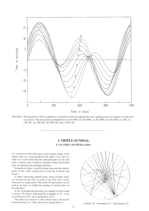
This article describes a unique sundial designed with three styles intersecting at a single point, allowing for the reading of various lines on the dial plane, including azimuth and astrological houses. An example dial is illustrated, delineated for latitude 52° with inclination and declination of 45°, demonstrating how different styles can indicate solar time or other phenomena.
Dials: Unusual, Sundial Design & Layout
February 1992
Page 11
Page 11
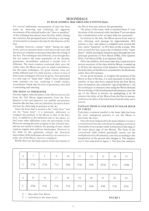
This article reviews historical techniques for telling time by the moon, noting their limited accuracy due to the moon's irregular movements and the need to convert lunar time to solar time. It describes methods like using correction tables (e.g., Queen's College, Cambridge, or Rene Rohr's diagram) and specific moondial instruments (Oronce Fine, Bion). The author also proposes a new model of lunar dial, adapting a horizontal sundial with "lunar hour lines" as spiral curves.
Dials: Unusual, Dials: Nocturnals, Sundial Design & Layout
February 1992
Page 16
Page 16
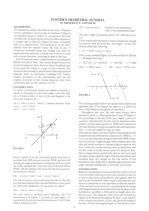
This article describes Samuel Foster's diametral sundial, a horizontal dial with a movable stile where hour-points lie on a straight line. Its unique feature is that the shadow becomes retrograde daily at a selected hour, allowing for the recreation of the Biblical miracle of Ahaz's dial. The article provides construction details and mathematical justifications for this special form of elliptical dial, also attributing the original discovery of the circular hour-arc dial to Foster.
Dials: Unusual, Mathematics of Dialling, Sundial Design & Layout
June 1992
Page 10
Page 10
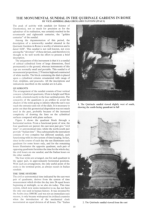
This article describes a unique monumental cubical-cylindrical sundial from 1628 in Rome's Quirinale Gardens, 2.70 meters high, constructed of white marble. It features four concave quadrants indicating both civil/astronomical time and 'Italian time,' reflecting different timekeeping systems. The dial also includes zodiacal curves for calendrical indications and intricate Latin inscriptions from its author Theodosius Rubeus and patron Urbano VIII Barberini.
Dials: Cube, Dials: Multi Faced, Dials: Unusual, Historical Dials
June 1992
Page 21
Page 21
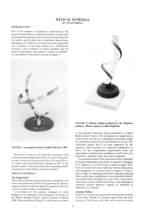
This article introduces helical sundials as a variation of the equatorial dial, where the receiving surface extends axially along the gnomon in a helix. It describes a prototype by John Singleton, a monumental example in Lerida by J. Masuet, and Piet Hein's design at Egeskov Castle. There are two types: the first has a gnomon casting its shadow, the second uses the shadow cast by the other part of the helical strip. The article explains their operation, with the light/dark boundary marking time and hour markings set by the pitch.
Dials: Equatorial, Dials: Unusual, Sundial Design & Layout
June 1992
Page 24
Page 24
The phoeboscope is presented as a self-sufficient instrument combining time-keeping, meridian-finding, and calendrical functions by detecting solar declination. Designed during WWII as an improvement of the existing sun-compass, its adoption was frustratingly held up in bureaucracy until too late to be useful. It uses a lens to focus sunlight onto a shadow-plate engraved with an analemma, allowing accurate determination of time, meridian, and date anywhere in the world without a watch or almanac.
DIY Sundial Projects, Dials: Heliochronometer, Dials: Unusual, Equation of Time
June 1992
Page 38
Page 38
This article explores the concept of a tidal dial for estimating tidal times, acknowledging the moon's primary influence on tides over the sun. It discusses the 'Port Establishment' and 'Lunar Situation,' and how a specially designed watch or optical sight, combined with knowledge of the moon's age, could provide approximate tidal information globally, even correcting for hydrographic board errors.
Dials: Unusual, Dials: Nocturnals
October 1992
Page 2
Page 2
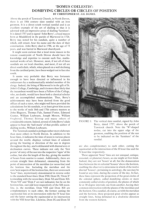
This article describes 18th-century slate sundials at Tawstock and Marwood churches by John Berry, the Tawstock dial being notable for its "domifying circles" or "circles of position". Berry, a local stonemason probably had help from a Cambridge don in laying out these sophisticated dials. These unusual domus lines indicate which astrological (rather than astronomical) zodiacal house the sun is in. The dial also features zodiacal signs, time of noon in various places, azimuth lines, and diurnal arcs for day length.
Dials: Unusual, Dials: Vertical, Historical Dials
October 1992
Page 27
Page 27
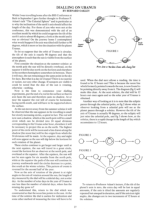
This article explores hypothetical sundial behaviour on Uranus, where the planet's axis tilt is almost 90 degrees. At solstices, the sun would appear stationary overhead at the pole, and a rod gnomon would cast no shadow. As the sun moves, shadows would form circles, indicating a sidereal day, with significant changes in day length at solstices, leading to a "missing" solar day.
Dials: Unusual, How Sundials Work, Mathematics of Dialling
February 1991
Page 18
Page 18
Introduces the concept and a model of a sundial designed to tell time without needing to be constructed or adjusted for the specific latitude of the observer. The design utilizes a gnomon with a curved edge and relies on determining the sun's position based on its declination, altitude, and azimuth. The article details the construction of the scales, noting that the model has accuracy limitations, particularly at certain times of day
Dials: Unusual, Mathematics of Dialling, DIY Sundial Projects
July 1991
Page 5
Page 5
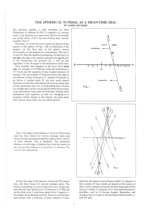
Building on Peter Drinkwater's work, this article explores adapting a spherical sundial to indicate mean time for six months of the year, by offsetting the hour marks away from the equator. This is possible because the slanting terminator at different solar declinations, adjusted for corresponding equation of time, happen to fall very close to one of two circles (within 1.5 minutes). The author also discusses using surface texture, like paint brush marks, to significantly improve the dial's readability and precision.
DIY Sundial Projects, Dials: Unusual, Equation of Time, Sundial Design & Layout
July 1991
Page 14
Page 14
This article presents a novel DIY sundial for a window sill, featuring a stationary reading point. The author explains the construction process: delineating a vertical sundial as if for exterior mounting, then rotating it 180 degrees about the horizontal axis perpendicular to the window. Read the time by watching the shadows of the hour lines pass a stationary reading point 'nodus' on a horizontal surface. Mirroring the hour figures allows them to be read legibly.
DIY Sundial Projects, Dials: Unusual, Dials: Vertical, Sundial Design & Layout
October 1991
Page 4
Page 4
This article describes "flower dials," a decorative 19th-century European garden method of telling time using flower beds designed as a clock face. Different flowers open at approximate hourly intervals during summer days, synchronized to local solar time. While less accurate and seasonal than sundials, a smaller version with a central sundial feature is suggested as an attractive garden addition.
Dials: Unusual
October 1991
Page 28
Page 28
Gerard Sonius developed a sundial for the blind, located at the Bartimeus blind institution in Zeist, Netherlands. This equatorial rotating dial features figures in relief and an electronic device that emits a sound when pointing to the sun. Marks for summer and winter time allow blind users to determine the time in 5-minute intervals, with explanations provided in Braille and print.
Dials: Equatorial, Dials: Unusual, Sundial Design & Layout
October 1991
Page 33
Page 33
Maurice Kern describes his simple, legible sundial made from commonplace materials, featuring a translucent semi-cylindrical dial and a conventional gnomon. Designed for readability from multiple angles, it indicates solar time and can be adjusted for local mean time or summer time using the Equation of Time, highlighting a frustration with complex and indistinct conventional dials.
Dials: Equatorial, Dials: Unusual, Sundial Design & Layout, DIY Sundial Projects
October 1991
Page 37
Page 37
J.A.F. de Rijk describes a new, simple, and more accurate latitude-independent sundial, building upon Freeman's 1978 solution. This type of sundial can indicate local apparent solar time without requiring knowledge of the observer's latitude. The article explains the mathematical principles, focusing on how the product sin(Az)cos(h) and sin(T)cos(δ) are obtained and combined to determine the time (T).
Dials: Unusual, How Sundials Work, Mathematics of Dialling, Sundial Design & Layout
February 1990
Page 20
Page 20
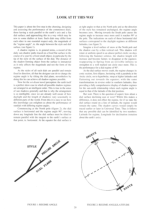
This paper explores the concept of "regime angle" in sundials, defined as the angle between the style and the dial surface. It introduces the idea that the Earth itself acts as a "show case" for various shadow regimes and illustrates how shadow curves change with latitude, showing examples for locations from the North Pole to the South Pole. The article also features Mr. Woodford's "Amundsen" dial
Dials: Unusual, How Sundials Work, Mathematics of Dialling
November 1989
Page 16
Page 16
A novel sundial system that uses fibre optics to display the time remotely. The system comprises a "sensor unit" placed in direct sunlight and a "display unit" located indoors, linked by flexible fibre optic cables. The sensor unit utilises a lens to focus sunlight onto a screen fitted with fibre optic ends positioned at five-minute intervals. These fibres transmit light to the display unit, which shows a moving point of light on a circular screen resembling a clock face. The system includes adjustments for latitude and Summer Time, and an extra fibre provides a double spot indication on the hour. The editor adds that this optical design, based on Benoy's patent, can indicate time even in hazy conditions and offers improved accuracy and contrast.
Dials: Unusual