- Home
- /
- Sundial Encyclopaedia
- /
- Dials: Equatorial
Dials: Equatorial
March 2023
Page 6
Page 6
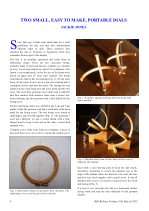
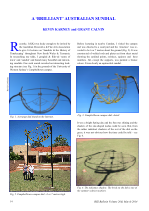
Details how to construct two accessible types of small, portable sundials. The first is an armillary equatorial dial made from embroidery hoops. The second is an altitude card dial, also known as a Capuchin dial, which uses a thread and bead mechanism. Both projects demonstrate less traditional dial types requiring minimal skill.
DIY Sundial Projects, Dials: Armillary Sphere, Dials: Equatorial, Dials: Portable
March 2023
Page 25
Page 25
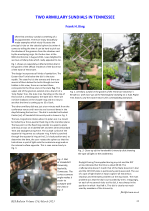
Compares two armillary dials seen during a NASS conference tour. The first, at the Governor’s Residence, is exquisite and highly symbolic. The second, at Vanderbilt University, uses a unique method where a spot of light shines through the equatorial ring onto an analemma plate to indicate the time.
Dials: Armillary Sphere, Dials: Equatorial, Dials: Unusual, Equation of Time
December 2023
Page 28
Page 28
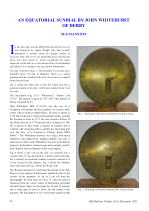
Describes an interesting and possibly unique equatorial sundial acquired by Annie Wright, signed "Whitehurst" "Derby" and "1761" (Lat: 53D: 00M). The dial features two centres of delineation, hour lines marked from 4 am to 8 pm, solstice lines on the gnomon, and some engraving errors.
Dials: Equatorial, Dials: Portable, Dials: Unusual, Historical Dials, Sundial Design & Layout
September 2022
Page 29
Page 29
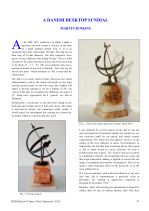
Examines a small, mass-produced equatorial desktop sundial made of brass and onyx alabaster, inscribed with a Danish motto. Concludes the dial was likely a commercial giftware product from the 1950s to 1970s, possibly manufactured in India.
Dials: Equatorial, Dials: Portable, Mottoes
March 2021
Page 10
Page 10
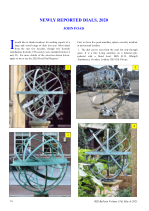
A selection of sundials reported in 2020 and entered into the Fixed Dial Register. The list includes armillary spheres, equatorial dials, various vertical dials (like the one at Staple Inn), several horizontal dials (such as the large Solum dial), and multiple or special dials.
Dials: Armillary Sphere, Dials: Equatorial, Dials: Horizontal, Dials: Vertical
June 2021
Page 40
Page 40
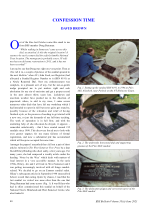
The author recounts his failure to formally register many of the approximately 215 sundials he has created since 1990, prompted by the discovery of an unrecorded dial he made at Piles Mill, Allerford (SRN 8191). Includes the transcription of a 1994 article by Hilary Binding detailing a sundial safari in West Somerset, describing the Piles Mill dial (a double-sided equatorial dial designed to look like a millstone).
Construction Projects, Dials: Equatorial, Historical Dials, The BSS and Members
September 2021
Page 26
Page 26
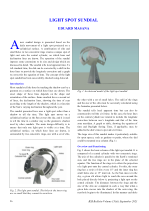
Introduces a novel equatorial sundial design that uses a moving light spot, rather than a shadow, to indicate time. The spot is projected onto a central cylinder via concentric rings with slits and holes. The design requires complex mathematical calculations for accurate sizing and component placement, ideal for large installations.
Dials: Equatorial, Mathematics of Dialling, Sundial Design & Layout
March 2020
Page 29
Page 29
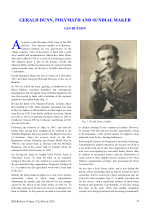
A biography of Gerald Raymond Dunn (1917–2002), detailing his military career, farming attempts, and later ventures, including tracing unclaimed estates and inventing the Cruiserfix solar navigator. He undertook metalwork training and became a sundial maker, specializing in equinoctial ring dials. He also supplied a simple solar compass for a Sahara expedition.
Construction Projects, Dials: Equatorial, Dials: Portable, The BSS and Members
December 2020
Page 2
Page 2
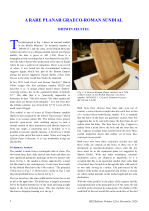
This article describes and analyses an unusual Roman sundial in the British Museum (1884,0615.1), likely originating from Egypt. It examines the dial’s equinoctial planar design, estimating the design latitude (27.3° N) and nodus height using physical measurements and a graphical approach. It challenges the idea that the declination arcs correspond to zodiac cusps.
Dials: Equatorial, Historical Dials, How Sundials Work, Mathematics of Dialling
December 2020
Page 9
Page 9
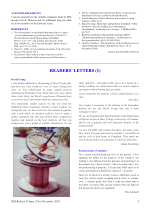
John Moir recounts collaborating on a quirky equatorial dial for Mudchute Farm. Julian Greenberg corrects an obituary detail for David Young. Pete Caldwell asks readers to shed light on the proper pronunciation (Greek vs English) of the word 'gnomon'.
Dials: Equatorial, How Sundials Work, The BSS and Members
December 2020
Page 19
Page 19
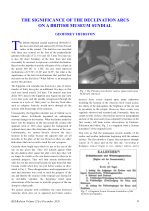
This article follows Ortwin Feustel’s analysis of the British Museum sundial (1884,0615.1) to determine the meaning of its declination arcs. By calculating the corresponding solar declinations, the author correlates them with agriculturally significant events recorded in the ancient Egyptian Geminos parapegma, such as the rising of Sirius and the setting/rising of the Pleiades.
Dials: Equatorial, Historical Dials, How Sundials Work, Mathematics of Dialling
March 2019
Page 2
Page 2
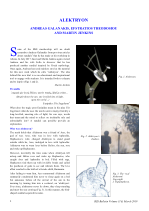
Describes a new universal stainless steel equatorial sundial called 'Alektryon', inspired by Greek mythology (the story of the sleepless cockerel). Designed by Andreas Galanakis, it serves as an educational tool with adjustments for latitude and practical uses like orientation and star gazing. Its proportions were determined using the golden ratio instrument, Eumetron.
Construction Projects, Dials: Equatorial, Sundial Design & Layout
June 2019
Page 30
Page 30
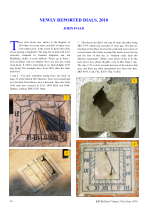
Presents 18 selected entries from the more than 100 dials added to the Fixed Dial Register in 2018. Examples include historical dials by George Adams and Heath and Wing, a Dollond cube dial, a vertical slate dial from 1698, and modern ground-level and wall dials.
Construction Projects, Dials: Equatorial, Dials: Horizontal, Dials: Vertical, Historical Dials
December 2019
Page 24
Page 24
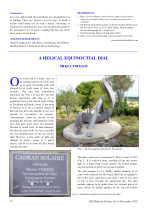
Description of a recently constructed, large helical equinoctial dial located in Fouzilhon, France. Made of Vosges granite, the dial features a gnomon with a unique helical slot that projects a strip of light onto the hour scale engraved inside the helical chapter ring. The design also incorporates zodiac signs and information on Equation of Time corrections.
Dials: Equatorial, Dials: Unusual, Sundial Design & Layout, Construction Projects
March 2018
Page 28
Page 28
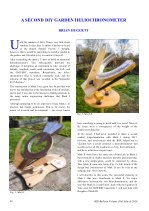
Details the creation of a second, improved equatorial heliochronometer, 'Mark II'. This design is smaller and more portable than the first model. It incorporates a precise rotation mechanism (belt and pulley system) and an Equation of Time correction method based on the Pilkington Sol Horometer, which also accommodates automatic adjustment for GMT/BST transitions.
DIY Sundial Projects, Dials: Equatorial, Dials: Heliochronometer, Equation of Time
March 2017
Page 10
Page 10
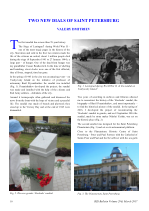
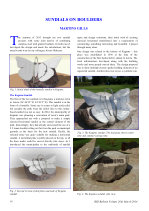
This piece details the history and 2016 granite reconstruction of a 1943 'blockade' sundial, originally made of wood and plywood during the Siege of Leningrad. Additionally, a new horizontal sundial designed with celestial spheres imagery was installed on the astronomical platform of the Saint Petersburg Planetarium.
Construction Projects, Dials: Equatorial, Dials: Horizontal, Historical Dials
September 2017
Page 36
Page 36
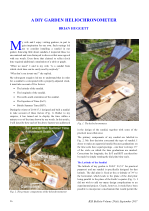
This details the design and construction of a DIY equatorial heliochronometer intended to show clock time easily. It compensates for latitude, longitude, BST, and EoT by allowing the time scale (mounted on a rotating dial plate annulus) to be physically rotated via an acrylic pointer aligned to an EoT graph. The gnomon is a thin, tensioned stainless steel wire.
DIY Sundial Projects, Dials: Equatorial, Dials: Heliochronometer, Sundial Design & Layout
December 2017
Page 34
Page 34
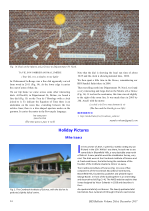
Presents two unusual sundials seen in Bloomfield Hills, USA: an equatorial dial of cast bronze at the Cranbrook Institute of Science with an analemma; and a horizontal dial at Cranbrook House designed in the shape of a swan, where the tail serves as the gnomon.
Dials: Equatorial, Dials: Horizontal, Dials: Unusual, Equation of Time
December 2017
Page 37
Page 37
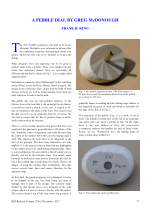
Describes a single-sided equatorial sundial, made from a pebble, that was given to delegates at the 2017 NASS Conference. The gnomon features a crescent cut-out as a memento of the solar eclipse, and time is read from the leading edge shadow falling on sandblasted alternate gaps.
Dials: Equatorial, Dials: Portable, Dials: Unusual, The BSS and Members
March 2016
Page 31
Page 31
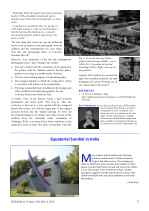
A brief note on an equatorial sundial located on the campus of the University at Pune, India. This variant of the famous large Indian masonry dials was constructed in concrete and steel in the 1980s.
Dials: Equatorial
June 2016
Page 19
Page 19
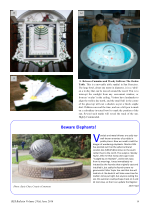
Discusses threats to sundials, including vandals, thieves, and wandering elephants. It reports that the spherical dial at London Zoo is incorrectly inclined because it was "nudged by an elephant" years ago, and the subsequent re-installation failed to correct the orientation.
Dials: Equatorial
September 2016
Page 14
Page 14
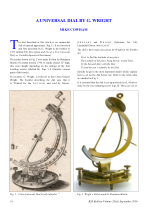
A detailed analysis of an equinoctial dial, or Portable Equatorial Instrument, invented by G. Wright in 1781 and manufactured by Benjamin Martin (c. 1790). The precise instrument uses spirit levels and latitude arcs to find latitude, time (by sun/stars), and the sun’s azimuth.
Dials: Equatorial, Historical Dials
March 2015
Page 6
Page 6
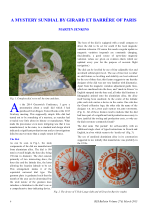
An investigation into a portable equatorial universal dial manufactured using anodized aluminium alloy, potentially dating from the late 1930s or early 1940s, or perhaps post-1960. Research reveals the involvement of the designer T.H. de Lange (W.G. ten Houte de Lange) and the publishing house Girard et Barrère. The dial's rarity and design anomalies suggest it may be a pre-production prototype run.
Dials: Equatorial, Dials: Portable
March 2015
Page 38
Page 38
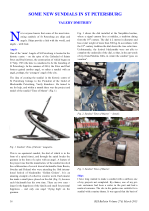
A description of three contemporary sundials installed in or around St Petersburg in 2014. These include the equatorial 'Time of Master' dial, constructed by multiple blacksmiths and featuring an angel on a spire; the 'Sailing vessel' dial based on the frigate Standart; and the 'Dandelion or nothing is forever' dial, designed by a 12-year-old following a children's competition.
Construction Projects, Dials: Equatorial, Dials: Unusual, Sundial Design & Layout
June 2015
Page 7
Page 7
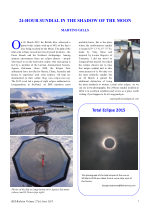
This reports on a 24-hour sundial located in Longyearbyen, Svalbard (the northernmost sundial), gaining the distinction of being the most northerly to witness the total solar eclipse on 20 March 2015.
Dials: Equatorial, Dials: Unusual
September 2015
Page 2
Page 2
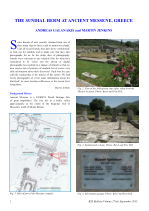
Describes the conceptualisation, design, and installation (2011) of a modern equatorial sundial named 'Sundial Herm' at the ancient UNESCO site of Messene, Greece. It details its unique numbering system, artistic philosophy, orientation challenges, and connection to ancient monumental orientations.
Dials: Equatorial, Sundial Design & Layout, Construction Projects
September 2015
Page 42
Page 42
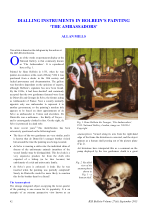
Analysis of the dialling and astronomical instruments depicted in Hans Holbein's 1533 painting, ‘The Ambassadors’. Instruments covered include the torquetum, shepherd’s dial, universal equatorial dial, horary quadrant, and polyhedral dial, noting potential artistic inaccuracies.
Dialling Tools, Dials: Equatorial, Dials: Portable, Historical Dials
December 2015
Page 24
Page 24
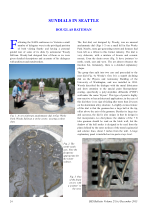
Recounts a guided tour of Seattle dials following the NASS conference, featuring four dials designed by Woody Sullivan. Highlights include an elaborate analemmatic dial in Gas Works Park, a vertical declining dial at UW, and the earliest Seattle dial dating from 1909.
Dials: Analemmatic, Dials: Equatorial, Dials: Vertical, The BSS and Members
March 2014
Page 14
Page 14
This article describes the Solar Chronograph II, a large equinoctial dial sculpture by Grant Calvin at the University of Western Sydney. The user tells time by lining up so their head shadow eclipses the star-shaped nodus, then turns to look at the nodus which brilliantly eclipses the sun. The design is intended as an educational tool promoting passive solar energy management and sustainable building design.
Construction Projects, Dials: Equatorial, How Sundials Work, Sundial Design & Layout
March 2014
Page 18
Page 18
This piece details two stainless steel and granite sundial projects in Latvia. The Kegums Sundial (56°44' N) is a nodus-based butterfly design, inclined at 40 degrees, which displays winter time and summer savings time. The Marsneni Sundial (57°25' N) is an equatorial dial supported by three stones, using dots for hour notation and incorporating Latvian ethnographic signs.
Construction Projects, Dials: Equatorial, Dials: Unusual, Sundial Design & Layout
June 2014
Page 22
Page 22
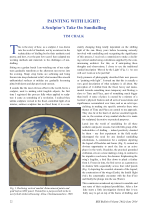
A sculptor reflects on the aesthetic and poetic aspects of sundials, seeing his work as ‘painting with light’. He details several sculptural commissions, including a combined horizontal and equatorial dial with a glass centre, the Scottish Enlightenment lectern dial, and the Robert Burns sculptural sundial.
Construction Projects, Dials: Equatorial, Dials: Vertical, Sundial Design & Layout
December 2014
Page 8
Page 8
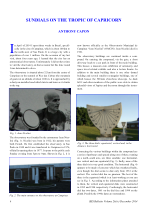
An account of sundials found in and around Campinas, Brazil, specifically mentioning the Observatorio Municipal de Campinas, founded by Jean Nicolini. The observatory site holds three dials (horizontal, vertical, and equatorial), though their condition varies. Other documented dials include one in Parque Taquaral (1962) and two at the Americana Observatory.
Dials: Horizontal, Dials: Vertical, Dials: Equatorial
March 2013
Page 20
Page 20
A scholarly report on a fragmentary Greek sundial held in the Louvre. The authors discuss its geometry, probable use, and its place in the evolution of ancient dial types.
Dials: Astrolabe, Dials: Equatorial, Dials: Hemispherical, Historical Dials
March 2013
Page 46
Page 46
A travel article recounting visits to sundials in Montreal and Toronto, including modern designs and meetings with Canadian sundial enthusiasts.
Dials: Equatorial, Dials: Unusual, The BSS and Members
September 2013
Page 27
Page 27
Investigates two pseudo-antique sundials recently reported, falsely signed with variations of the 17th-century maker name Bladon and dated 1610 and 1655. Examination of features, mottoes (one invented in 1860), and catalogue evidence strongly suggests they were manufactured much later, possibly by Pearson Page, as fake antique pieces.
Dials: Equatorial, Dials: Portable, Historical Dials, Mottoes
September 2013
Page 29
Page 29
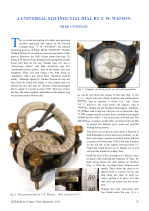
Description of a nice precision portable equatorial dial, circa 1880, by T.W. Watson. It is designed for use in both hemispheres and includes specialized chapter ring and compass card layouts, featuring both an Equation of Time chart and a separate map of Isogonic Lines for 1877 for precise time setting.
Dialling Tools, Dials: Equatorial, Dials: Portable, Equation of Time
December 2013
Page 52
Page 52
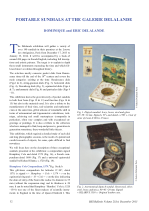
Previews an exhibition of over 140 pocket dials (Renaissance to late 18th century) held in Paris. It describes three exceptional examples: a complex Humphrey Cole gilt-brass compendium (1579), a French diptych compendium (1608), and a universal equinoctial sundial by Richard Glynne (c.1720).
Dials: Equatorial, Dials: Portable, Historical Dials
March 2012
Page 14
Page 14
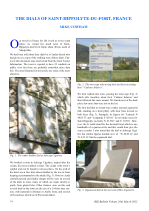
This article describes a walking tour of the 23 (or more) sundials in Saint-Hippolyte-du-Fort, France. It highlights attractive examples, including an equatorial dial, a church dial, and several made by local ceramic artist C. TINGAUD, noting features like 24-hour systems and Provençal mottoes.
Dials: Equatorial, Dials: Vertical, Historical Dials, Mottoes
June 2012
Page 21
Page 21
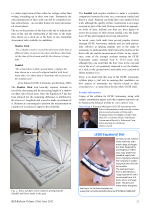
Don Rogerson of Red Oak, Iowa (USA) designs sundials using standard Lego bricks. This entry briefly describes an example: a 'Large Equatorial' dial constructed from 1x4 bricks and a 1x2 hinge plate, with grey and white blocks designating hours. Rogerson hopes to interest Lego in producing special sundial sets.
Construction Projects, DIY Sundial Projects, Dials: Equatorial
June 2012
Page 43
Page 43
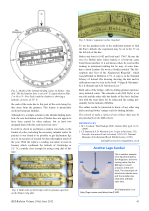
This short entry presents another equatorial sundial designed by Don Rogerson using Lego bricks. It is built around a 1x4x5 arch brick, with central blue bricks marking noon and outer bricks indicating 6am and 6pm solar time, resembling the BSS logo.
Construction Projects, DIY Sundial Projects, Dials: Equatorial
June 2012
Page 52
Page 52
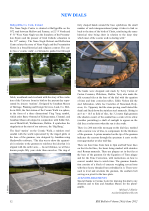
This article describes a stainless steel sundial at the Nano Nagle Centre in Ballygriffin, Ireland, which is the final 'station' of a 'cosmic walk'. Designed by Jonathan Mason, it features a 3.2-meter high gnomon with a central slit, a 200mm noon gap, and a prism for season indication. It also includes the world represented by a ringed globe and forty clasped hands symbolising intergenerational links.
Construction Projects, Dials: Equatorial, Dials: Unusual, Sundial Design & Layout
September 2012
Page 22
Page 22
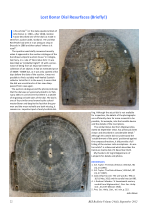
This article reports the brief reappearance of a 1634 slate equatorial dial by John Bonar, originally from Loudon Castle, Scotland, at a German auction. Unsold, it subsequently disappeared from public view. Despite missing its gnomon and moon volvelle, the dial is considered an important artefact of early Scottish dialling, featuring detailed engravings.
Dials: Equatorial, Historical Dials, Restoration projects
September 2012
Page 36
Page 36
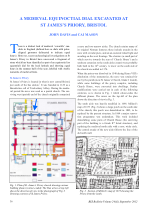
This article describes the excavation of a fragment of a medieval equinoctial (equatorial) dial at St James’s Priory, Bristol. Dated pre-1540 and likely late 14th/15th century due to the use of Arabic numerals, it is a significant find that reinforces awareness of early scientific dials in Europe, and is believed to be one of the oldest in Britain.
Dials: Equatorial, Historical Dials
September 2012
Page 46
Page 46
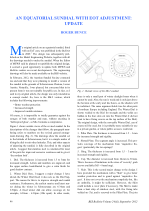
This article provides an update on an equatorial sundial design with Equation of Time adjustment, originally published in 2009. The Mk.2 version incorporates improvements for public use, focusing on weather protection, increased strength, and enhanced vandal resistance, developed in response to the Austrian Sundial Society's plans to install a version.
Dials: Equatorial, Construction Projects, Equation of Time
December 2012
Page 12
Page 12
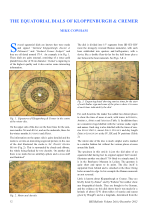
The article examines unusual 18th-century equatorial dials by Gerhard Kloppenburgh and Gerhard Cremer, made of gold-plated brass. It details their summer and winter sides, including hour lines, zodiac signs, and global noon times. The author discusses peculiar reversed Roman numerals, possible origins in northern Germany, and an anomaly in numeral thickness.
Dials: Equatorial, Historical Dials, Sundial Design & Layout
December 2012
Page 41
Page 41
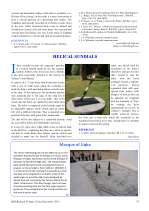
The article discusses helical sundials, particularly one made by Aylmer Astbury. These are a form of equatorial dial, with a brass strip helix marking hours via small holes or a terminator shadow. They can be adjusted for longitude and Equation of Time by rotating the helix on its axis, as explained in a 1992 Bulletin article.
Dials: Equatorial, Dials: Unusual, How Sundials Work, Sundial Design & Layout
March 2011
Page 15
Page 15
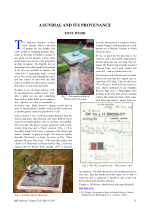
This article describes an equatorial sundial at Weston-under-Penyard, initially believed to be 17th-century due to its inscription. The author's investigation, including a 1932 sales receipt and a Christie's report, reveals it was made by Pearson Page in the early 20th century, highlighting the importance of provenance.
Dials: Equatorial, Historical Dials
September 2011
Page 27
Page 27
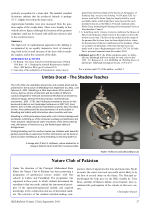
This report highlights a successful gnomonical science studies programme by the Nature Club of Pakistan in Lahore and Faisalabad schools with support from the BSS.
Dials: Horizontal, Dials: Equatorial, How Sundials Work, DIY Sundial Projects, The BSS and Members
September 2011
Page 35
Page 35
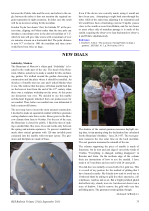
Aleksandr Boldyrev describes the creation of an equatorial sundial for the Rosarium of Sokolniky Park in Moscow. Utilizing an antique piece of Italian marble, the dial features three brass gnomons: one for daylight saving time, one for true solar time, and one for solar azimuth. The dial is designed to operate from spring to autumn equinoxes.
Construction Projects, Dials: Equatorial, Sundial Design & Layout
December 2011
Page 10
Page 10
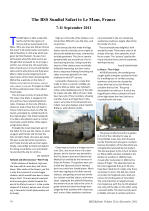
This report covers the British Sundial Society's 2011 safari to the Sarthe and Perche regions of France, based in Le Mans. The group visited various sundials, historical sites, and chateaux, including a specific mean-time dial in Le Mans and other vertical and mass dials in surrounding villages. The trip offered cultural experiences and opportunities to meet fellow enthusiasts.
Dials: Vertical, Dials: Multi Faced, Dials: Equatorial, Historical Dials, The BSS and Members
March 2010
Page 10
Page 10
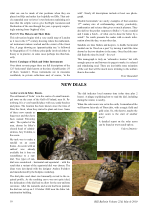
A collection of short articles describing new sundials. These include an equatorial 'solar acorn' dial in Solar, Russia; a vertical declining dial in Oxford inspired by Christopher Wren; and a mass-produced, flat-packed equatorial 'Sun Disc' from Australia designed for various latitudes.
Dials: Vertical, Dials: Equatorial, Dials: Unusual, Construction Projects
March 2010
Page 12
Page 12
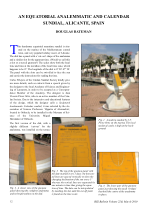
Describes a modern, equatorial meantime sundial on the marina in Alicante, Spain, designed by Juan Vicente Pérez Ortiz. The dial features a 'cut-out' analemma shape and a slot for apparent time, and has scales for both local and time zone time.
Dials: Analemmatic, Dials: Equatorial, Equation of Time
June 2010
Page 13
Page 13

This article features a postcard from 1908 depicting the impressive multiple-dialled structure, L'Unique, on the banks of Lake Annecy, France. Dated 1874 and named in 1876, the dial is credited to Frère Arsène. It features an equatorial dial, multiple gnomons on a 7-pointed star, and various dial plates indicating noon for several European cities and zodiac signs.
Dials: Equatorial, Dials: Multi Faced, Historical Dials
June 2010
Page 36
Page 36
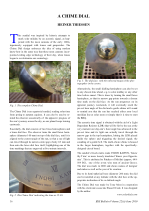
This article introduces the Chime Dial, an equatorial sundial inspired by historic noon cannons, designed to read solar time and provide an acoustic reminder of the sun's journey. It consists of two brass hemispheres and a dial face with five-minute intervals. A Light Dependent Resistor (LDR) inside the sphere triggers a chime when a sunray passes through a narrow gap, marking a pre-set time.
Construction Projects, DIY Sundial Projects, Dials: Equatorial, Sundial Design & Layout
December 2010
Page 17
Page 17
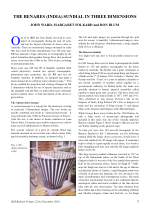
This article discusses the Benares Sundial, one of five equatorial sundial observatories built in India by astronomer prince Sawai Jai Singh II in the 18th century to rectify astrological errors. The authors also describe their work with stereoscopic images and an autocyclostereoscope for viewing 3D images without special glasses, including a 1902 stereograph of the Benares sundial.
Dials: Equatorial, How Sundials Work, Historical Dials
December 2010
Page 22
Page 22
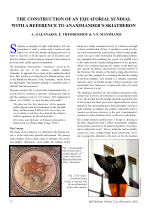
This article describes the design and construction of an equatorial sundial inspired by Anaximander's 'skiatheron,' aiming to be an operational work of art. Made from matted stainless steel, the dial uses dots instead of Arabic or Roman numerals for a timeless aesthetic. It also details the construction process, including computer design, prototyping, and addressing issues like rust and plate bending.
Dials: Equatorial, Sundial Design & Layout, Construction Projects, Historical Dials
March 2009
Page 13
Page 13
Maurice Kenn shares observations from Brisbane, Australia, contrasting the reliability of his universal equatorial 'coffee-time' sundial and heliochronometer with his UK radio-controlled clock. He notes the significant variation in local apparent noon relative to Eastern Standard Time in Brisbane.
Dials: Equatorial, Dials: Heliochronometer, How Sundials Work
June 2009
Page 24
Page 24
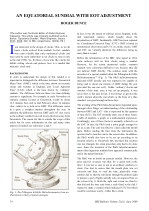
Details the design and construction of an equatorial sundial that directly indicates clock time (UTC). It incorporates a mechanical cam to automatically apply the Equation of Time correction, and includes adjustments for latitude and longitude. An appendix explains how to design the cam.
Construction Projects, Dials: Equatorial, Equation of Time, Sundial Design & Layout
March 2008
Page 43
Page 43
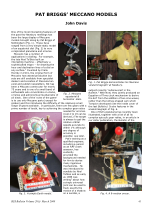
Showcases Pat Briggs' Meccano models, ranging from simple equatorial dials to complex planetaria and astronomical clocks. It highlights his ingenious mechanisms, including a universal joint for shadow tracking, an Equation of Time clock, and a 'Meccano Analemmagraph' for drawing the analemma, using cunningly-designed gear ratios.
Dials: Equatorial, Equation of Time, Dialling Tools, DIY Sundial Projects
March 2008
Page 46
Page 46
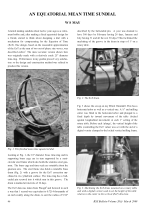
Describes the design and construction of an 18-inch brass equatorial mean time sundial, incorporating a mechanism to compensate for the Equation of Time. The article details the machining of a groove on a rotatable drum for EoT correction and the careful assembly and alignment of the time-ring and gnomon, calibrated to read GMT directly.
Construction Projects, DIY Sundial Projects, Dials: Equatorial, Equation of Time
March 2008
Page 48
Page 48
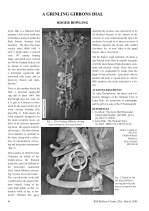
Describes a non-working universal equinoctial ring dial, about 12cm in diameter, incorporated into a 1684 lime-wood carving by Grinling Gibbons. This carving, representing arts and sciences, is located in the saloon of Lyme Hall, alongside other astronomical and navigation instruments, reflecting Sir Richard Legh's interest in the sciences.
Dials: Equatorial, Dials: Unusual, Historical Dials
December 2008
Page 159
Page 159
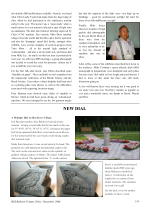
This piece describes a new multiple dial created by Alex Boldyrev for Shevelkovo Village. Carved from Crimean limestone, it features an equatorial dial's upper half and a south-facing scaphe dial in Greek style. It incorporates owls symbolizing Athena and a reconstructed historical mistake in its design, with gnomons made from cold-hammered copper rods.
Dials: Multi Faced, Dials: Equatorial, Sundial Design & Layout, Dials: Scaphe
February 2006
Page 14
Page 14
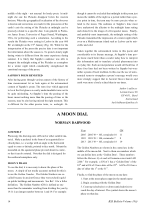
This article provides instructions for assembling and using a moon dial. It explains how to determine the moon's phase using the Golden Number and how to rotate the dial to find the current time. The author notes that this dial relies on estimating the moon’s direction rather than casting a visible shadow, due to the moon's light intensity.
Dials: Equatorial, Dials: Unusual, Construction Projects, DIY Sundial Projects, Dials: Nocturnals
February 2006
Page 18
Page 18
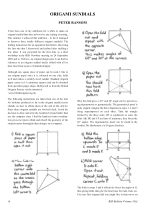
This article details the author's successful endeavour to create origami sundials without cutting or tearing, describing three unique designs. It provides step-by-step instructions for an equatorial dial, explaining the geometric principles behind folding hour lines and constructing a perpendicular gnomon.
Dials: Equatorial, Mathematics of Dialling, Construction Projects, DIY Sundial Projects
February 2006
Page 28
Page 28
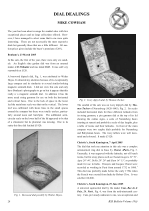
This article reviews notable sundial sales from 2005 auctions and catalogues. Featured items include diptych dials, astronomical ring dials, universal minute dials, and quadrants. The author also discusses a recognised forgery and provides insights into instrument collecting.
Dials: Equatorial, Dials: Portable, Historical Dials
February 2006
Page 32
Page 32
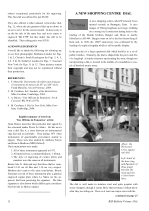
This article describes a new large stainless steel equatorial sundial, shaped like a Viking longship, installed at the Westwood Cross shopping centre in Ramsgate. The dial also serves as public seating and features large Roman numerals and an Equation of Time graph, although the author notes some elementary numbering and calibration errors.
Dials: Equatorial, Sundial Design & Layout, Equation of Time
December 2006
Page 163
Page 163
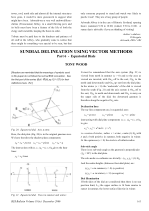
The article describes how the hour lines, declination lines and the sub-style angle are calculated using vectors. There is a summary which includes the assumptions made and the limitations of the method.
Dials: Equatorial, Mathematics of Dialling
March 2005
Page 13
Page 13
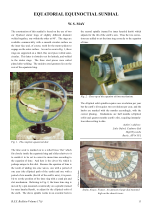
Details construction of a combined equatorial and equinoctial sundial using stacked car engine starter rings, cylindrical and brass components. Describes adjustable latitude setting and a novel gearing mechanism employing concentric eccentric spindles to apply the equation of time correction on two knobs, enabling mean time readings without manual calculation.
Dials: Equatorial, Construction Projects, Equation of Time
March 2005
Page 34
Page 34
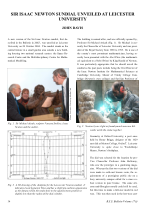
Describes unveiling of a bronze casting of Sir Isaac Newton for the new sundial at Leicester University. Covers lost-wax casting, assembly of multiple bronze sections, dimensional realignment, and recalculation of hour and date lines for new geometry. Discusses site installation, setting for local latitude and polar alignment.
Construction Projects, Dials: Equatorial
June 2005
Page 58
Page 58
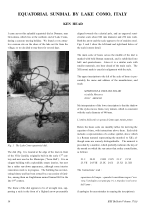
Report on an equatorial sundial in Domaso, Lake Como. Describes its construction, inscriptions, and unusual alignment to indicate clock time (at noon, inaccurate at other times) rather than true solar time, with observations of performance and speculation on design choices.
Dials: Equatorial, Historical Dials
December 2005
Page 154
Page 154
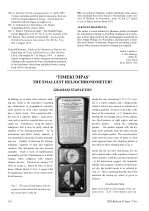
This article introduces the "Timekumpas," a small, cigarette-lighter-sized equatorial dial patented in 1926. While it lacks precision due to its size, it is notable for being a universal instrument designed to allow for latitude, longitude, equation of time, and magnetic variation, making a "noble effort" to create a sophisticated, portable standard time indicator.
Dials: Equatorial, Dials: Heliochronometer, Dials: Portable, Historical Dials
December 2005
Page 160
Page 160
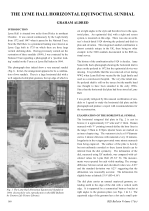
This article details the discovery and reconstruction of a unique 1683 combined horizontal equinoctial sundial at Lyme Hall. The author describes deciphering the inscription "R Legh 1683," examining its robust bronze construction and innovative two-hole sight/screen system. The article also explores the dial's historical context, its owner Richard Legh, and a possible link to George Gibbs's Helio-Chronometer.
Dials: Equatorial, Dials: Horizontal, Dials: Unusual, Historical Dials, Restoration projects, Sundial Design & Layout
September 2004
Page 91
Page 91
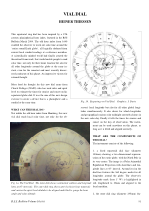
Description and design of an equatorial ‘vial’ ring dial that combines a planisphere with a sundial. Uses a spirit-level alidade and a rotating outer ring to read local apparent time for any longitude, and to estimate sunrise, sunset and the locus of solar midnight across longitudes.
Dials: Equatorial, How Sundials Work, Sundial Design & Layout
September 2004
Page 118
Page 118
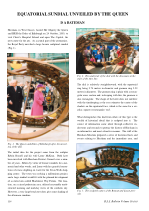
Report of a ceremonial unveiling of a new equatorial sundial: description of the dial type, event context and public/promotional aspects of the installation.
Dials: Equatorial, The BSS and Members
March 2003
Page 20
Page 20
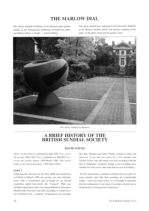
Correction and image for a previously published article on the Akeler Sundial at Marlow, showing its garden setting.
Dials: Equatorial, Sundial Design & Layout
September 2003
Page 108
Page 108
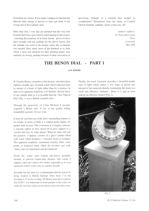
The first part of an article on a unique 'New Optical Dial' invented by W. Gordon Benoy. It's a sundial that tells time with a beam of light rather than a shadow. The article describes its construction, its weight, and some technical details including using a glass cylinder filled with water containing anti-freeze.
Dials: Equatorial, Dials: Unusual
December 2003
Page 175
Page 175
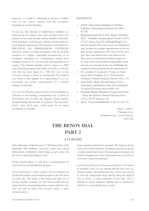
Continuation of a discussion of an innovative dial, focussing light through a cylinder onto an equatorial dial plate
Dials: Equatorial, Dials: Unusual
September 2002
Page 115
Page 115
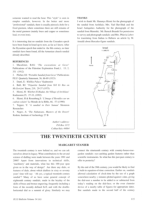
An essay reflecting on the evolution of sundial making and the Society's activities during the 20th century, highlighting significant developments and personalities.
Dials: Bifilar, Dials: Equatorial, Dials: Heliochronometer, Dials: Unusual, Historical Dials, The BSS and Members
December 2002
Page 141
Page 141
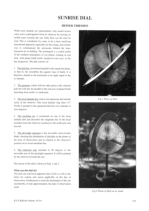
Description of an interactive, educational sundial model representing Earth and showing local apparent time, sunrise/sunset, solar declination, and more.
DIY Sundial Projects, Dials: Equatorial, How Sundials Work
December 2002
Page 146
Page 146
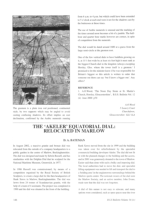
Detailed account of the design, relocation, and symbolism of Edwin Russell’s large equatorial dial now installed in Marlow, including technical specifications.
Dials: Equatorial, Dials: Polar
December 2002
Page 168
Page 168
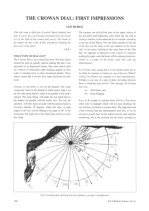
Observations on an unusual slate dial-plate from Crowan, Cornwall, including physical description and preliminary thoughts on its age and type.
Dials: Equatorial, Historical Dials
March 2001
Page 42
Page 42
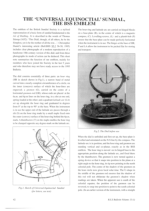
This article explores the "Universal Equinoctial" sundial, highlighting its significance as the emblem of the British Sundial Society. It discusses the historical context and design principles of this type of sundial, explaining its functionality and why it was chosen to represent the BSS.
Dials: Equatorial, Sundial Design & Layout, The BSS and Members
June 2001
Page 65
Page 65
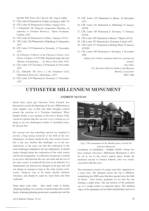
Describes the Uttoxeter Millennium Monument, a large stone disc featuring a solar system theme and an armillary sundial. Conceived to inspire exploration and celebrate the town, it incorporates local craftsmanship, planetary representations, and embedded plaques documenting its creation and sponsors. A time capsule is also concealed within the monument.
Construction Projects, Dials: Equatorial, Dials: Unusual
June 2001
Page 73
Page 73
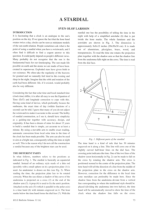
The article presents the Stardial, an innovative device functioning as an equatorial sundial by day and a simplified astrolabe by night. Designed for simplicity, accuracy, and originality, it enables automatic conversion from local solar time to clock time and provides methods for precise time-telling using bright stars and even the moon.
Dials: Equatorial, Dials: Unusual, Dials: Astrolabe, DIY Sundial Projects, Dials: Nocturnals
September 2001
Page 127
Page 127
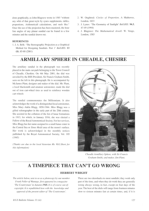
An armillary sundial, commemorating the Millennium, was recently unveiled in Cheadle, Cheshire. Designed and made by local blacksmith Jim Plant from iron cart-wheel tires, it also honours astronomer Miss Mary Adela Blagg. The sundial's unveiling was attended by BSS President Sir Francis Graham-Smith.
Construction Projects, Dials: Equatorial, Dials: Unusual
September 2001
Page 129
Page 129
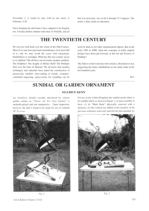
This article discusses an inexpensive armillary sundial widely advertised as "Classic Art For Your Garden" but designed for Latitude 38° N. It explains how to modify such a dial for correct use in the UK (approx. 52° N) by tilting its main body or by physically removing and reattaching elements, enabling it to indicate local solar time.
DIY Sundial Projects, Dials: Equatorial
February 2000
Page 20
Page 20
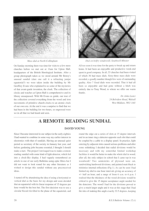
Design and construction of an electronic equatorial sundial with phototransistors and LED display for remote indication of time.
DIY Sundial Projects, Dials: Equatorial, Dials: Unusual
October 2000
Page 125
Page 125
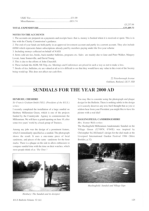
Showcase of sundials commissioned or constructed to commemorate the millennium year.
Dials: Analemmatic, Dials: Equatorial, Dials: Horizontal, Dials: Vertical, The BSS and Members
February 1999
Page 47
Page 47
This review covers two issues of *Compendium*, the NASS journal. It highlights articles on a 'Witch's Sundial', various sundial designs (conical gnomon, Ptolemaic coordinates, cycloid gnomon, split analemma), and 'Sightings' features on notable dials, concluding with a report on the NASS Fourth Annual Conference.
Dials: Equatorial, Book Reviews, Sundial Design & Layout, Equation of Time
June 1998
Page 16
Page 16
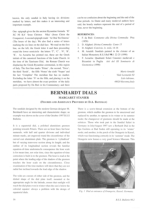
This article describes the distinctive equatorial sundials designed by modern German artist M. Bernhardt. These feature a polished aluminium gnomon pointing towards Polaris, and an hour scale calibrated for mean time, incorporating the equation-of-time correction within the gnomon's outline. Interchangeable gnomons allow for seasonal adjustments.
Dials: Equatorial, Dials: Heliochronometer, Dials: Unusual, Equation of Time, Sundial Design & Layout
April 1997
Page 53
Page 53
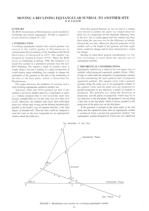
A description of the challenges and methods involved in relocating a reclining equiangular sundial, ensuring accuracy and preservation.
Dials: Equatorial
October 1997
Page 51
Page 51
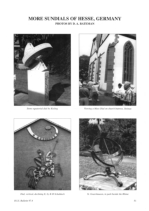
This section provides photographs of various sundials in Hesse, Germany, including a stone equatorial dial by Kieling, a vertical declining dial by Schaldach, a mass dial on a church buttress in Steinau, and a sundial in a park in St. Goarshausen.
Dials: Equatorial, Dials: Mass Dials, Dials: Vertical, Historical Dials
June 1996
Page 22
Page 22
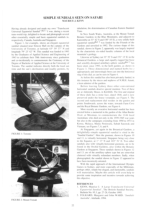
A personal travelogue documenting sundials discovered in Canada, Australia, and Singapore, including armillary and equatorial dials, with notes on design inspiration and memorial contexts.
Dials: Equatorial
June 1995
Page 36
Page 36
An article about recreating historical sundials using modern methods, reflecting on the balance between authenticity, materials, and function.
Dials: Equatorial, Dials: Portable, Restoration projects
October 1995
Page 27
Page 27
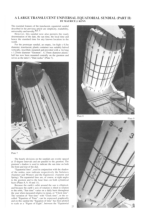
A technical and descriptive account of a large equatorial sundial made from translucent materials, designed for broad geographic usability and visual impact, including discussion of its structure and application.
Dials: Equatorial, Dials: Unusual
June 1994
Page 11
Page 11
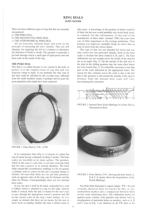
A comprehensive study of three classic types of ring dials: poke dials, equinoctial ring dials, and astronomical ring dials. The article examines their mechanical function, historical development, geographical usage, and craftsmanship, with detailed illustrations and commentary on their strengths and limitations in practical sundialling.
Dials: Equatorial, Dials: Portable, Historical Dials
June 1994
Page 37
Page 37
This article presents the design and construction of a large equatorial sundial made with translucent materials. The dial is universal, meaning it can be used at any latitude, and is designed to be both decorative and scientifically accurate. Its practical applications and display potential are discussed.
DIY Sundial Projects, Dials: Equatorial
October 1994
Page 14
Page 14
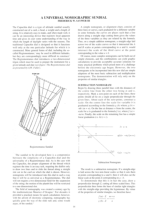
This article explores the history and characteristics of sundials produced in Augsburg, Germany, particularly from the 17th century onwards. It notes Augsburg's reputation for metalworking and clockmaking, which influenced the development of ornate and complicated early sundials. The article describes the mass production of "universal equinoctial dials" from around 1700, their common design, and the incorporation of compasses and latitude lists for European towns. It also highlights finer versions made by Johann Martin and Johann Willebrand, including unique "crescent dials" and "string gnomon dials," and provides a list of known Augsburg sundial makers.
Dials: Equatorial, Dials: Portable, Historical Dials
February 1993
Page 28
Page 28
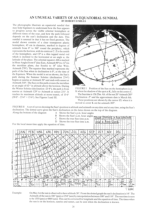
This article describes an unusual equatorial sundial without a fixed gnomon, featuring a transparent plastic hemisphere. It illustrates the Sun's apparent path and declination throughout the year, explaining how to determine sun time, altitude, azimuth, and declination on any given date using this instrument.
Dials: Equatorial, Dials: Scaphe, Sundial Design & Layout
February 1992
Page 19
Page 19
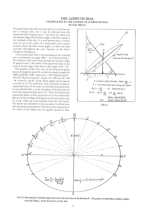
This article describes the azimuth dial, a type of horizontal dial with a vertical style, derived from the equatorial dial formula. It explains that while a vertical style at the center of a horizontal circle cannot show time correctly throughout the year due to declination changes, projecting an equatorial circle onto a horizontal plane forms an ellipse for the hour lines. The article provides the formula for the shadow angle and suggests this as a useful project for understanding geometry and for practical marking in playgrounds or gardens.
DIY Sundial Projects, Dials: Analemmatic, Dials: Equatorial, Dials: Horizontal, Mathematics of Dialling
February 1992
Page 36
Page 36
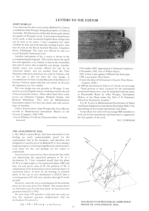
This section contains several letters. H.R. Mills provides mathematical formulae for an analemmatic dial, J.G. Freeman describes the bifilar sundial with two horizontal wires, and Alex Monroe encloses a photograph of his portable equatorial dial. M.J. Cowham contributes notes on John Worgan's work, highlighting a distinctive English Rose design on his instruments.
Dials: Analemmatic, Dials: Bifilar, Dials: Equatorial, Dials: Portable
June 1992
Page 21
Page 21
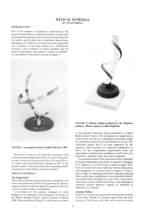
This article introduces helical sundials as a variation of the equatorial dial, where the receiving surface extends axially along the gnomon in a helix. It describes a prototype by John Singleton, a monumental example in Lerida by J. Masuet, and Piet Hein's design at Egeskov Castle. There are two types: the first has a gnomon casting its shadow, the second uses the shadow cast by the other part of the helical strip. The article explains their operation, with the light/dark boundary marking time and hour markings set by the pitch.
Dials: Equatorial, Dials: Unusual, Sundial Design & Layout
February 1991
Page 6
Page 6
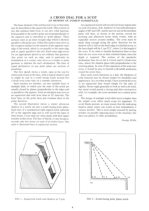
Describes the design of Cross or Star dials, focusing on the concept of the equatorial notch, which has surfaces parallel to the Earth's polar axis. The shadow cast by the outer edge of the notch onto the opposite surface is used to indicate time. The article provides details on the design and depth required for such dials, noting that each notch effectively functions as a separate dial.
Dials: Equatorial, Dials: Polar
February 1991
Page 11
Page 11
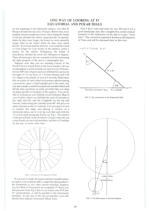
Equatorial and Polar Dials explores the principles behind these two types of sundials. The article also covers the Equation of Time and how to account for longitude to tell Greenwich Mean Time with a sundial.
Dials: Equatorial, Dials: Polar, Mathematics of Dialling
October 1991
Page 13
Page 13
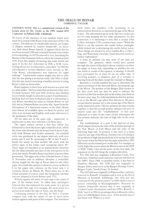
This article, a summary of a lecture by Mr. Taylor, examines four equatorial sundials made by John Bonar between 1623 and 1634. These dials feature poetry, zodiac signs, moon age, and compass points with port names, indicating their use for tidal calculations rather than just timekeeping. The article notes Bonar's errors in gnomonics despite his poetic skill and details the current locations of the surviving dials.
Dials: Equatorial, Historical Dials
October 1991
Page 16
Page 16
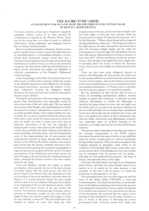
Rene R.-J. Rohr introduces the 18th-century Islamic instrument known as the "da'ire-yi mu'addil" (equatorial circle), used for determining daily and nightly prayer times. Driven by religious prescriptions, Islamic scientists developed sophisticated astronomical and mathematical methods. This instrument, although not mathematically precise, allows for the determination of prayer times, especially night prayers like isha and subh, through observation of the sun and moon's positions.
Dials: Equatorial, Historical Dials, Dials: Nocturnals
October 1991
Page 28
Page 28
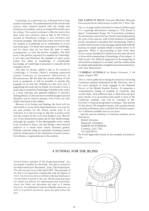
Gerard Sonius developed a sundial for the blind, located at the Bartimeus blind institution in Zeist, Netherlands. This equatorial rotating dial features figures in relief and an electronic device that emits a sound when pointing to the sun. Marks for summer and winter time allow blind users to determine the time in 5-minute intervals, with explanations provided in Braille and print.
Dials: Equatorial, Dials: Unusual, Sundial Design & Layout
October 1991
Page 33
Page 33
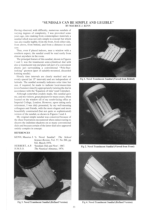
Maurice Kern describes his simple, legible sundial made from commonplace materials, featuring a translucent semi-cylindrical dial and a conventional gnomon. Designed for readability from multiple angles, it indicates solar time and can be adjusted for local mean time or summer time using the Equation of Time, highlighting a frustration with complex and indistinct conventional dials.
Dials: Equatorial, Dials: Unusual, Sundial Design & Layout, DIY Sundial Projects