- Home
- /
- Sundial Encyclopaedia
- /
- September 2003
September 2003
The articles link to the specific page in a PDF optimised for speed. If you want the whole issue, you can download it here, but the files from earlier years can be quite large.
September 2003
Page 90
Page 90
This editorial introduces several articles, including one on fakes and forgeries, and another on the origin of trigonometric terms. It also mentions a spherical sundial and a Benoy Dial. The issue reminds readers of past events, like the founding of the North American Sundial Society, and upcoming events like a BSS design competition.
September 2003
Page 91
Page 91
This article discusses how to recognise fake or imitation sundials. It provides a list of points to consider, such as the material used, how the markings were applied (engraved, punched, or etched), and the presence of suspicious mottoes or dates. The author also suggests tools for investigation and discusses common errors made by both forgers and legitimate makers.
Dialling Tools, Historical Dials
September 2003
Page 96
Page 96
Based on a talk at the BSS Annual Conference, this article traces the origins of trigonometry back to ancient Egypt and the 'rope stretchers' who used a 3,4,5 triangle to define right angles. It then moves on to the Greeks, specifically Pythagoras, and the Arabs, who are credited with preserving and developing trigonometry for astronomy.
Mathematics of Dialling
September 2003
Page 100
Page 100
This article describes and analyses a unique marble frieze from ancient Athens which is believed to be a calendar. The calendar is a significant find for astronomers and archaeologists, as it provides information about ancient Greek calendars, including a system of five seasons.
September 2003
Page 104
Page 104
This note from the editor discusses the British Sundial Society's five-yearly awards for the design, construction, and restoration of sundials. It encourages professionals, amateurs, and young people to apply, and also mentions a request for reciprocal arrangements with overseas sundial societies to exchange journals.
The BSS and Members
September 2003
Page 104
Page 104
This article re-examines the Morvah church sundial in Cornwall. The author finds that the dial was incorrectly laid out, possibly because the latitude was used where the co-latitude was needed in the design. He expresses alarm that this might be a common issue with Cornish church sundials.
Dials: Vertical, Mathematics of Dialling, Sundial Design & Layout
September 2003
Page 108
Page 108
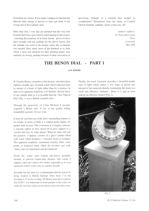
The first part of an article on a unique 'New Optical Dial' invented by W. Gordon Benoy. It's a sundial that tells time with a beam of light rather than a shadow. The article describes its construction, its weight, and some technical details including using a glass cylinder filled with water containing anti-freeze.
Dials: Equatorial, Dials: Unusual
September 2003
Page 110
Page 110
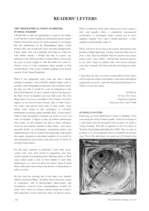
A collection of letters from readers. Topics include a thank you for information on sundial makers for the 'Biographical Index of British Sundial Makers,' and some pub dial sightings.
The BSS and Members
September 2003
Page 113
Page 113
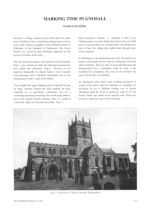
A historical account of sundials and clocks at St Lawrence's Church in Gnosall. The article details the installation and replacement of various clocks and sundials over time, including an octagonal dial plate from 1721 which is now preserved indoors. It also mentions a new dial made in 1992.
Historical Dials
September 2003
Page 116
Page 116
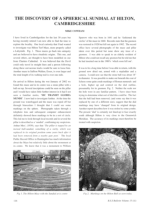
A discussion about a spherical sundial discovered in the village of Hilton. The article compares it to other historical spherical dials and suggests it may have been incorrectly restored.
Dials: Unusual, Historical Dials
September 2003
Page 119
Page 119
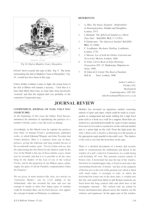
A review of four volumes of the Compendium, the journal of the North American Sundial Society (NASS). The review summarises articles on gnomonic modes, a sundial made of ropes, a millennium dial in a girl's school, a review of a Jefferson dial, a community analemmatic dial in Alaska, and a discussion of the Jaipur Sundial's penumbra at noon.
September 2003
Page 122
Page 122
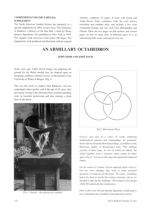
This article details the design and construction of an armillary octahedron, a complex sundial structure. It describes the process of making the intersecting V shapes and the challenges of assembly due to thermal expansion.
Construction Projects, Dials: Unusual
September 2003
Page 124
Page 124
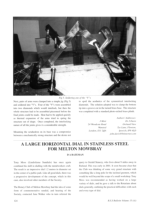
An article describing a large horizontal sundial made of stainless steel for Melton Mowbray Rotary Club. It highlights the dial's features, including an explanatory plaque with instructions on how to read the dial and correct for 'watch time' using the equation of time.
Construction Projects, Dials: Horizontal
September 2003
Page 128
Page 128
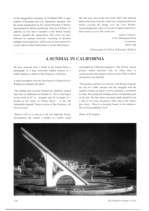
This entry describes a large horizontal sundial in San Francisco, California. Built in 1913 as a 'come-on' for a new housing development.
Dials: Horizontal, Historical Dials
September 2003
Page 129
Page 129
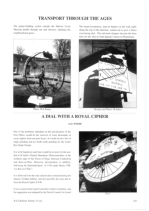
This article features two sundials with a transportation theme. One is a west-facing dial on a house in Warminster with hour lines that look like railway sleepers, and the other is a photo of a penny-farthing cyclist outside a cycle museum.
Dials: Unusual, Dials: Vertical
September 2003
Page 129
Page 129
A description of a new vertical dial at St John's Church, Ruardean, Gloucestershire. It is believed to be the only church dial to commemorate the Queen's Golden Jubilee and bear the Royal Cipher 'E II R'. The author also notes the process involved in its design and approval.
Construction Projects, Dials: Vertical
September 2003
Page 131
Page 131
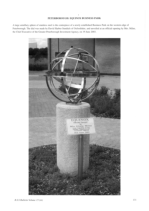
This short article describes a new armillary sphere located in Peterborough's Equinox Park.
Dials: Armillary Sphere