- Home
- /
- Sundial Encyclopaedia
- /
- Dials: Vertical
Dials: Vertical
March 2023
Page 2
Page 2

Describes the process of designing and constructing a large 90 cm square vertical declining dial for a house conservatory in Somerset. The project involved measuring the wall's 74.3° westerly declination, incorporating an Equation of Time plaque, and designing a unique lateral sliding system to avoid shadows cast by the glass roof rafters.
Construction Projects, Dials: Vertical, Equation of Time, Sundial Design & Layout
March 2023
Page 18
Page 18
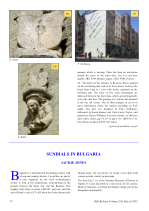
Recounts sightings of four sundials during an archaeological tour. These include an IX–XI century sun clock from Mogila, an ancient sundial of Marcianopolis, a 2nd–3rd century A.D. marble dial in Varna, and a damaged 1878 dial located on the southwest corner of the Dzhumaya Mosque in Plovdiv.
Dials: Vertical, Historical Dials, Restoration projects
March 2023
Page 24
Page 24
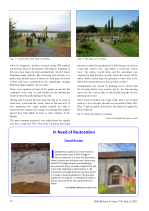
A note identifying a heavily weathered vertical sundial over a doorway at Clarks Village, Street, Somerset. The dial is made of Blue Lias, dated 1811, and the gnomon appears original. The author expresses interest in making a like-for-like replacement.
Dials: Vertical, Historical Dials, Restoration projects
September 2023
Page 2
Page 2

Analyzes the Erfurt rule, a medieval method for designing south-facing wall sundials, found in a 15th–16th-century codex owned by Fra Giocondo of Verona. It discusses the rule's origins (Paris/Germany, c. 1334), its non-empirical numerical angular values for temporal hours, and its later modification to suit equal equinoctial hours.
Dials: Vertical, Historical Dials, Mathematics of Dialling, Sundial Design & Layout
March 2022
Page 30
Page 30
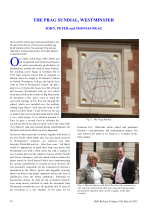
An article commemorating the creation and unveiling (2007) of the sundial at Westminster School, dedicated to former teacher Adolf Prag and his wife. Designed by Harriet James, the dial is based on Newton's ellipse, includes an Equation of Time graph, and features golden hemispherical hollows referencing scaphe dials.
Dials: Vertical, Sundial Design & Layout, Construction Projects, Equation of Time
March 2022
Page 32
Page 32
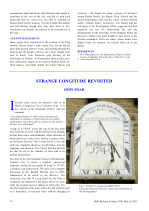
An analysis of the unusual longitude inscription found on the St Mark’s, Longwood dial. By comparison with the Hawkshead dial, it is concluded that the inscription refers to the 'Plane’s Longitude,' which defines the longitude where the dial could be used horizontally, and is numerically equal to the hour angle between the substyle and noon lines.
Dials: Vertical, Historical Dials, Mathematics of Dialling, Sundial Design & Layout
September 2022
Page 13
Page 13
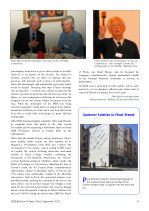
Presents a colourful photograph of the Fleet Street sundial, captured by Piers Nicholson, showing the dial in full sun on the day of the summer solstice in 2022.
Dials: Vertical
September 2022
Page 15
Page 15
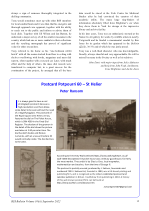
Examines a postcard featuring the dial on The Picket House in Royal Square, St Helier, Jersey (SRN 4509). The dial was made by local mapmaker Elias Le Gros, declines to the west and features both Arabic and Roman numerals.
Dials: Vertical, Historical Dials
December 2022
Page 31
Page 31
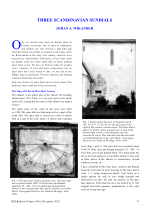
Investigates three Scandinavian dials: the reworked Tingvoll Church Mass Dial (Norway, ca. 1200/1660-70), the ivory Falsterbo sundial (Sweden, ca. 1500), and the soapstone Vardøhus Sundial (Norway, 16th/17th C), discussing octaval and unequal hours.
Dials: Vertical, Dials: Portable, Historical Dials, Dials: Mass Dials
December 2022
Page 39
Page 39
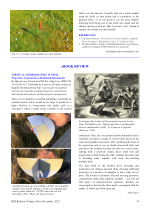
Review of Maciej Lose's free eBook, "Vertical Stereographic Sundial," which extends the concept of the double horizontal dial to various vertical and declining dials using geometric construction rather than algebraic methods.
Book Reviews, Dials: Vertical, Mathematics of Dialling, Sundial Design & Layout
December 2022
Page 40
Page 40
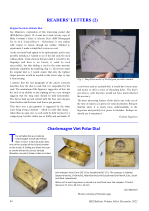
Commentary on the Belgian Portable Altitude Dial, suggesting that using the time of sunrise as a proxy for declination is an interesting, layperson-friendly feature.
Dials: Vertical, Dials: Portable, Dials: Unusual
March 2021
Page 10
Page 10
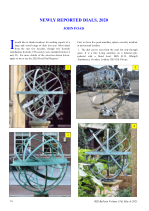
A selection of sundials reported in 2020 and entered into the Fixed Dial Register. The list includes armillary spheres, equatorial dials, various vertical dials (like the one at Staple Inn), several horizontal dials (such as the large Solum dial), and multiple or special dials.
Dials: Armillary Sphere, Dials: Equatorial, Dials: Horizontal, Dials: Vertical
March 2021
Page 38
Page 38
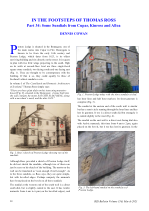
Continues the analysis of Scottish sundials described by Thomas Ross, focusing on several 17th-century examples. These include three square stone vertical dials on Preston Lodge (Cupar), two identical cube sundials at Kinross House, and a diptych sundial in Alloa made by mason Tobias Baak in 1695.
Dials: Cube, Dials: Multi Faced, Dials: Vertical, Historical Dials
March 2021
Page 42
Page 42
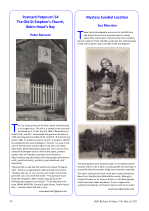
A description of a postcard showing a vertical south dial that was once located at The Old St Stephen’s Church. The dial, featuring two dates (1864 and 1736) and multiple sets of initials, is no longer in place. The postcard itself carried a reflective motto concerning shadow and sun.
Dials: Vertical, Historical Dials, Mottoes
June 2021
Page 20
Page 20
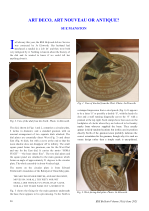
Analyzes a highly unusual circular sundial featuring separate curved direct West and East dials. The investigation, based on numerals and a foundry mark, suggests it might be a custom-made dial by Francis Barker & Son, possibly derived from their 'Antique' model (c. 1907). Concludes the dial incorporates elements of both Art Deco and Art Nouveau styles.
Dials: Vertical, Dials: Unusual, Sundial Design & Layout, Historical Dials
June 2021
Page 31
Page 31
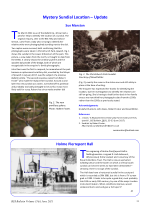
Discusses an engraving of Holme Pierrepont Hall showing a vertical south sundial on a demolished tower. Mentions a surviving horizontal sundial in the courtyard, likely dating from the late 18th or early 19th century, and requests further investigation.
Dials: Horizontal, Dials: Vertical, Historical Dials
September 2021
Page 10
Page 10
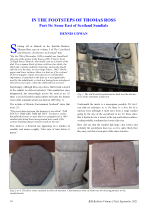
A continuation of the series following Thomas Ross, examining various sundials in the East of Scotland. Discusses the history, disappearance, and condition of dials in Hawick, Jedburgh, Ruchlaw House, Monkton House, Pitreavie (now Inveresk), Torryburn, and Cromarty.
Dials: Multi Faced, Dials: Vertical, Historical Dials, Mottoes
September 2021
Page 17
Page 17
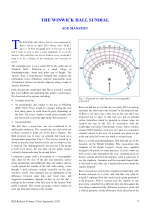
Details the project to convert a 30-foot telegraph pole at Winwick Hall into a large, highly visible outdoor sundial. The final design employs the vertical pole's shadow to cast time on 18-metre radius winter and summer arcs, prioritising fun and visibility over high accuracy for walkers.
Construction Projects, Dials: Unusual, Dials: Vertical
September 2021
Page 31
Page 31
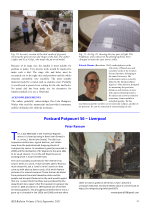
Focuses on a historical postcard depicting a vertical declining sundial (SRN 5665) located on the former Royal Insurance building in Liverpool. The card belongs to the "Lewis's Series," probably issued by the Lewis's department store during the late Edwardian period.
Dials: Vertical, Historical Dials
December 2021
Page 7
Page 7
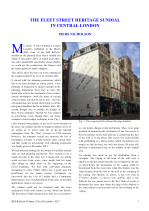
Chronicles the creation of the large Fleet Street vertical declining sundial, culminating in its 2021 opening. Key issues included City of London planning rules (e.g., banning current newspaper mastheads), securing funding during the pandemic, overcoming surveying difficulties using point cloud technology, and the logistical challenges of gnomon fabrication and installation.
Construction Projects, Dials: Vertical, Sundial Design & Layout
December 2021
Page 10
Page 10
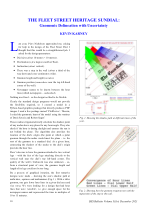
Details the gnomonic design of the large vertical declining Fleet Street dial using Python-based graphics and established trigonometric routines. The model enabled flexible design adjustments, accounting for physical realities like the wall's step and the final highly accurate laser survey data, ultimately producing the precise instruction graphics for the painter.
Construction Projects, Dials: Vertical, Mathematics of Dialling, Sundial Design & Layout
December 2021
Page 18
Page 18
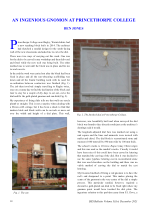
Describes the carving of a south-facing sundial at Princethorpe College, Rugby. The central design constraint was placing a decorative sun disk where the gnomon point usually rests. This was cleverly overcome by using a gnomon featuring a detachable point which was removed after securing the main gnomon.
Dials: Vertical, Sundial Design & Layout, Construction Projects
March 2020
Page 9
Page 9
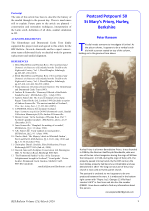
Describes a postcard of a vertical south dial at St Mary’s Priory, Hurley, Berkshire. The dial appears to feature a person seated on top of the column holding the gnomon. The author notes the need for further investigation into this dial and provides historical context about the priory.
Dials: Unusual, Dials: Vertical, Historical Dials
March 2020
Page 12
Page 12
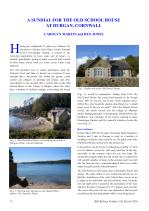
Describes the process of commissioning and constructing a diamond-shaped vertical dial on the Old School House at Durgan, Cornwall. The wall declination was measured at 17½ degrees east of south. The slate dial is adjusted for longitude to show 'Greenwich Apparent Time' and includes a small notch for local noon. It was a collaborative effort involving the National Trust and letter carver Ben Jones.
Construction Projects, Dials: Vertical, Mathematics of Dialling, Sundial Design & Layout
March 2020
Page 23
Page 23
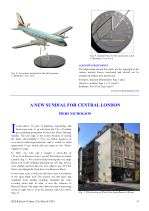
Describes the planning and design of the Fleet Street Heritage Sundial, a vertical dial facing a few degrees north of east, approved after 12 years. Located on the site of Richard Carlile's former publishing house (The Republican), the project commemorates Carlile and others who fought for the freedom of the press. The design incorporates hour lines (6 to 10 am) and newspaper mastheads, aiming to serve as a permanent heritage memorial.
Dials: Vertical, Sundial Design & Layout, Construction Projects
June 2020
Page 2
Page 2
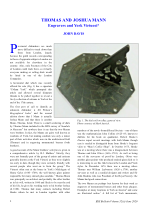
This article researches the work of late 17th-century York artisans Thomas and Joshua Mann, who, though primarily known for architecture and engraving, were also notable sundial makers. The article details several of their horizontal, vertical, and portable dials.
Dials: Horizontal, Dials: Vertical, Dials: Portable, Historical Dials
June 2020
Page 7
Page 7
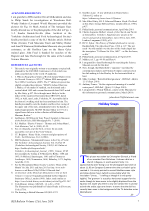
This short article presents a picture of a west-facing sundial on a church in Ragusa, Sicily. The dial is painted in normal Mediterranean style, shows Italian hours, and is notable for its gnomon which acts as a horizontal support for the nodus.
Dials: Vertical, Dials: Unusual, How Sundials Work
June 2020
Page 30
Page 30
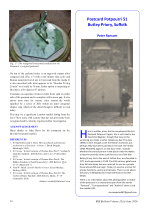
This segment describes a temporary-looking sundial dated 1905, painted on a wall at Butley Priory, Suffolk. The dial, which is not in the Fixed-Dial Register, has the motto 'TIME PASSETH' inscribed on the door lintel beneath it.
Dials: Vertical, Historical Dials, Mottoes
September 2020
Page 4
Page 4
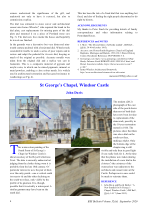
A watercolour painting likely from the late 18th century shows two dials (a vertical south and a declining south-west) on the chapel entry porch. Due to stonework replacement, most of both dials were lost, though evidence suggests there was once a third dial on the south-east face, forming a triplet.
Dials: Vertical, Historical Dials, Restoration projects
September 2020
Page 6
Page 6
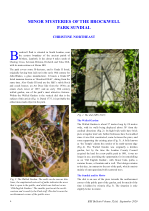
Examines a canted vertical limestone dial in Brockwell Park, dated 1775. The article focuses on translating the cryptic motto, “So Doct Ho In D,” suggesting the elegant interpretation “Sol Ducit Horas in Die” (the sun draws the hours in the day). The dial’s original location is questioned as it was designed for a wall declining approximately 38° west of south.
Dials: Vertical, How Sundials Work, Historical Dials, Mottoes
September 2020
Page 23
Page 23
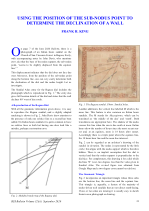
Presents a gnomonic method using the ratio of the horizontal distance between the sub-nodus point, the noon line, and the equinox line to determine a wall's declination. The technique, illustrated using the Ragusa dial, also allows calculation of the nodus height for a vertical dial.
Dialling Tools, Dials: Vertical, How Sundials Work, Mathematics of Dialling
December 2020
Page 10
Page 10
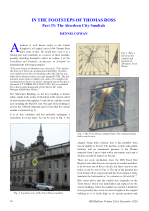
Part 33 explores three Aberdeen sundials mentioned by Thomas Ross in 1890. These include the vertical declining dial on the Municipal Building (Town House), two cubic dials on Andrew Begg's shop dated 1694, and the dial at King’s College Chapel, potentially Scotland’s oldest. The author doubts the 1494 dating of the latter.
Dials: Cube, Dials: Multi Faced, Dials: Vertical, Historical Dials
December 2020
Page 22
Page 22
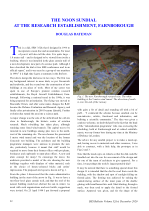
Description of a large aperture nodus noon dial designed by the author and installed in a glass curtain wall at the Farnborough research site in 1996. The 1.8-metre tall dial declines 13.5° west of south and incorporates a gilded analemma calculated for 1999, which allows it to show both the date and mean time noon.
Construction Projects, Dials: Noon Lines, Dials: Vertical, Equation of Time
December 2020
Page 31
Page 31
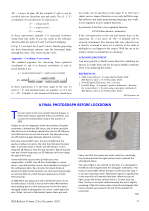
A brief note describing a visit to the Stock Exchange noon mark on 29 February 2020 (a leap year), managing to capture a photograph despite heavy rain. The spot of light aligned with the special thin strip for 29 February, marking GMT noon.
Dials: Vertical, Dials: Noon Lines
December 2020
Page 32
Page 32
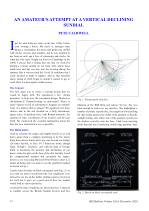
The author details his DIY project to design and install a polished slate vertical declining sundial on his house wall during the 2020 lockdown. The final design, featuring Roman numerals, the Equation of Time, and a musical 'treble clef' gnomon, was achieved through self-calculation (graphical method) and professional craftsmanship for cutting and fixing.
Construction Projects, DIY Sundial Projects, Dials: Vertical, Equation of Time
December 2020
Page 38
Page 38
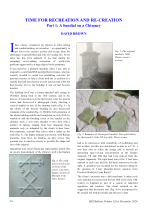
The author describes helping a client re-create a vertical sundial on a 16th-century Wiltshire mill cottage chimney stack, which had been lost around 1900. The design incorporated findings from original fragments, including a unique concatenation of Roman numerals. A separate slate plaque with an Equation of Time correction, featuring a millstone image, was also added.
Construction Projects, Dials: Vertical, Equation of Time, Restoration projects
March 2019
Page 13
Page 13
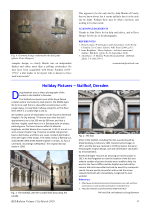
Features photographs of the sundial in the Stallhof courtyard, Dresden, a restored Baroque declining vertical dial destroyed in 1945. It was restored in 1976 and includes a ball nodus, constant-declination lines, Zodiac signs, and the motto *MORS CERTA HORA INCERTA*.
Dials: Vertical, Historical Dials, Mottoes
March 2019
Page 25
Page 25
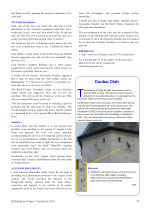
Describes the Category A listed Dunbar Town House, Scotland, which features two renovated wall dials. The dials—one direct-west-facing and one declining south—were originally painted in 1686 and restored in 2011, noting the unusual Roman numerals.
Dials: Vertical, Historical Dials
March 2019
Page 35
Page 35
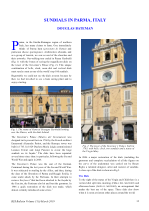
Describes the magnificent dials on the tower of the Governor’s Palace in Parma, Italy, restored in 2006. The combination includes a vertical dial split into morning/afternoon hours and a noon dial, both featuring an analemma with constant-declination lines and zodiac symbols. The dials were damaged during WWII when partisans attempted to remove Fascist symbols.
Dials: Noon Lines, Dials: Vertical, Historical Dials
March 2019
Page 40
Page 40
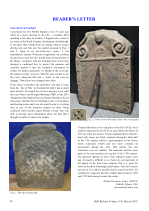
A reader shares the story of a heavy stone vertical sundial purchased in Edinburgh 35 years ago and said to have come from the 'Isle of Fife'. Experts determined the dial, featuring a cherub's head and cross patty for noon, dates between 1660 and 1720 and its delineation is consistent with Fife's latitude.
Dials: Vertical, Historical Dials
June 2019
Page 6
Page 6
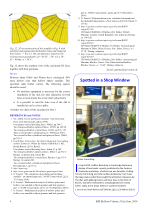
Describes a large slate sundial with a gilded gnomon and flame-like hour lines displayed in a Cambridge bookshop. The dial had originally been intended for a smithy in Buckinghamshire that had subsequently burned down before installation.
Dials: Vertical
June 2019
Page 26
Page 26
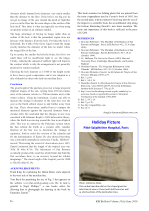
A photograph of a vertical meridian dial on the chapel of the Pitié-Salpêtrière Hospital in Paris. The dial shows solar time of noon ±1 hour (with half-hours) and short sections of the declination lines.
Dials: Noon Lines, Dials: Vertical, Historical Dials
June 2019
Page 30
Page 30
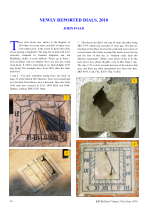
Presents 18 selected entries from the more than 100 dials added to the Fixed Dial Register in 2018. Examples include historical dials by George Adams and Heath and Wing, a Dollond cube dial, a vertical slate dial from 1698, and modern ground-level and wall dials.
Construction Projects, Dials: Equatorial, Dials: Horizontal, Dials: Vertical, Historical Dials
September 2019
Page 2
Page 2
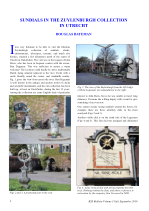
This article details a visit to the privately owned Zuylenburgh collection in Oud-Zuilen, Utrecht, which includes sundials, clocks, and scientific instruments. Highlights include a vertical dial by Pieter de Ruiter, several armillary dials, and portable dials by notable makers such as J. Smith, W. & S. Jones, Elias Allen, Thomas Wright, and Humfrey Cole.
Dials: Vertical, Dials: Portable, Historical Dials, Dials: Armillary Sphere
September 2019
Page 7
Page 7
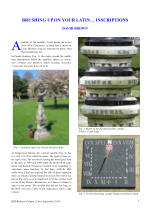
This piece examines Latin mottoes found on sundials visited during the 2019 BSS Conference in Bath. It provides translations for inscriptions on the Parade Gardens armillary sphere, Kingswood School’s vertical and analemmatic dials, and the Pilkington & Gibbs heliochronometer, ending with a challenge regarding the Royal Victoria Park cross dial inscription.
Dials: Analemmatic, Dials: Heliochronometer, Dials: Vertical, Mottoes
September 2019
Page 19
Page 19
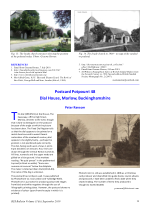
This entry describes a nineteenth-century vertical dial (SRN 0501) by Edwin Clark at Dial House, Marlow. The dial declines to the west, showing 1 pm to 8 pm, with gilded lines on a blue ground, and features the mottoes “Ne quid pereat” and “Horas non numero nisi serenas”.
Dials: Vertical, Historical Dials, Mottoes
September 2019
Page 36
Page 36
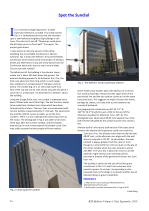
This piece describes a very large, difficult-to-spot sundial located high on the south-east face of the Alfred A. Arraj United States Courthouse in Denver, Colorado. The dial, declining 48.08° east, is estimated to be 38 feet wide by 19 feet high, uses stainless steel strips for furniture, and demonstrates the building’s green credentials.
Construction Projects, Dials: Vertical, Sundial Design & Layout
December 2019
Page 2
Page 2
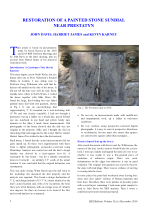
This article details the complex restoration of a large, venerable painted stone sundial near Prestatyn. After initial miscalculations, detailed analysis confirmed its 18th-century origin and correct design latitude. Scientific paint analysis suggested an original smalt blue and gilded finish. The sundial was subsequently restored, repainted, gilded, and reinstalled, canted correctly for its location.
Dials: Vertical, Historical Dials, Restoration projects, Sundial Design & Layout
December 2019
Page 26
Page 26
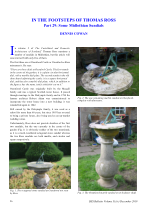
The 29th part of a series documenting sundials mentioned by Thomas Ross, focusing on five examples in Midlothian. The author traces the status and location of three dials at Oxenfoord Castle, a 1745 vertical dial in Dalkeith, and the relocation of a rare lectern sundial from Mid Calder House to Culzean Castle in Ayrshire.
Dials: Cube, Dials: Multi Faced, Dials: Vertical, Historical Dials
March 2018
Page 25
Page 25
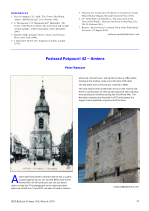
Features a postcard of the Belfry next to the market halls in Amiens, showing a sundial dating from 1753 that was restored in 1990. The postcard was produced by the French publisher Neurdein et Cie, typical of cards made in booklets during the First World War.
Dials: Vertical, Historical Dials
June 2018
Page 12
Page 12
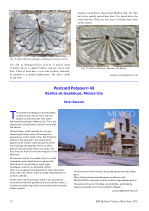
Features a postcard of the bell tower at the Basilica de Guadalupe, which integrates various time-telling devices. The tower includes a direct south-facing sundial (reclining), an analogue clock, an Aztec calendar representation, and an astronomical clock showing the sun, moon, and Zodiac symbols.
Dials: Unusual, Dials: Vertical, Historical Dials
June 2018
Page 13
Page 13
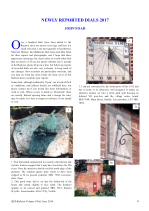
Reports on over one hundred dials added to the Fixed Dial Register in 2017, presenting 18 selected examples. These include a historical horizontal dial, a Francis Barker cross dial, a moon dial, an armillary sphere, and a stained glass millennium dial. Dials by makers Thomas Woodcock and John Bird are highlighted.
Dials: Armillary Sphere, Dials: Horizontal, Dials: Polar, Dials: Stained Glass, Dials: Vertical, Historical Dials
June 2018
Page 17
Page 17
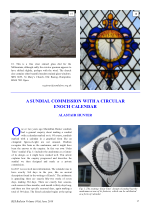
Details a commission for a vertical sundial incorporating a circular graphic of the Enoch calendar, which follows a 364-day year. The calendar graphic, divided into 52 weeks and 12 months, is superimposed but operates independently of the solar delineation due to the difference between the calendar and the true solar year.
Construction Projects, Dials: Vertical, Sundial Design & Layout
June 2018
Page 22
Page 22
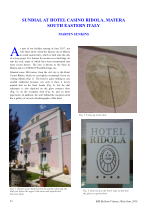
Describes the Hotel Casino Ridola, Matera, Italy, which features a painted sundial dating from 1900 on its front façade. The dial schematic is also etched onto the glass entrance door and used on hotel paperwork. The dial was lovingly restored when the residence was sold to the present owners in 2003.
Dials: Vertical, Historical Dials
June 2018
Page 48
Page 48
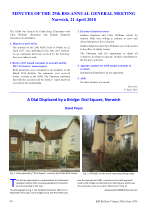
Describes a sundial in Norwich located at Dial Square, a location that was significantly reduced in size in September 1923 and could now be considered "Dial Corner". The displacement occurred when a new bridge across the River Wensum necessitated the construction of an approach road that encroached upon the square.
Dials: Vertical, Historical Dials
September 2018
Page 6
Page 6
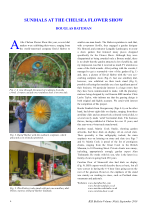
Reports on several dial makers exhibiting at the Chelsea Flower Show. David Harber featured the 'Aeon' sunburst sculpture and an armillary dial. Border Sundials displayed eight pieces, winning a 4-star trade stand award. Martin Cook Studio showed slate dials focusing on calligraphy, and Caroline Dear of Stonecraft displayed dials on Portland stone pedestals.
Dials: Armillary Sphere, Dials: Horizontal, Dials: Vertical
September 2018
Page 24
Page 24
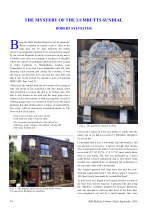
Investigates a vertical stone dial (1864) in Lumbutts, Calderdale, made by schoolmaster James Travis Whittaker MD. Despite accurately engraving the latitude, the hour lines were grossly incorrect. The author discovered Whittaker had mistakenly used the hour line spacings calculated for a *horizontal* dial at that latitude, rather than a vertical one.
Dials: Vertical, Historical Dials, Sundial Design & Layout
September 2018
Page 32
Page 32
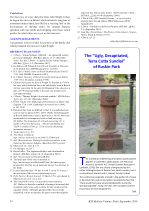
A short piece noting the unflattering description of the Grade II Listed terra cotta sundial in Ruskin Park, South London, quoted from a 1979 historical account. The dial, which is now missing, was originally erected in a Denmark Hill garden to commemorate the house where Mendelssohn wrote the Spring Song in 1842.
Dials: Unusual, Dials: Vertical, Historical Dials
September 2018
Page 33
Page 33
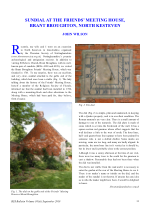
Describes a simple, unadorned stone vertical sundial installed in 1780 on the gable end of the Friends’ Meeting House in Brant Broughton, Lincolnshire. The square-section rod gnomon suggests the wall declines slightly west of south. Although the numerals are clear, the hour lines are poorly painted and the noon line is not vertical, indicating an unskilled diallist.
Dials: Vertical, Historical Dials, Sundial Design & Layout
September 2018
Page 36
Page 36
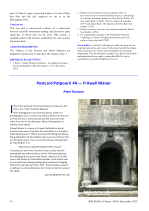
Features a postcard (circa 1930s) showing a sundial at Fritwell Manor, Oxfordshire, which is not currently in the Fixed Dial Register. Enlargement shows the dial declines to the east, as the 6 am line is not horizontal. The manor was once owned by Margaret Boleyn, Anne Boleyn’s grandmother.
Dials: Vertical, Historical Dials
December 2018
Page 6
Page 6
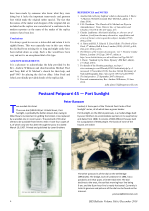
Features two sundials in the model village of Port Sunlight (SRN 2419 and SRN 2420) depicted on postcards, the first one published by Lever Brothers. The first is a cross dial at 11 Bath Street, and the second is a declining dial on the Dell Bridge which currently lacks its gnomon.
Dials: Polar, Dials: Vertical, Historical Dials, The BSS and Members
December 2018
Page 11
Page 11
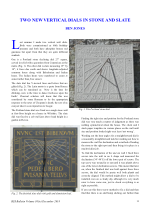
Details the commission and creation of two vertical wall dials. One is a declining Portland stone dial with a Copernicus quote. The second is a south-facing slate dial showing common, Babylonian, and Italian hours, utilising a notched rod gnomon to serve as a nodus and aid in reading the complex hour systems.
Construction Projects, Dials: Vertical, Sundial Design & Layout
December 2018
Page 38
Page 38
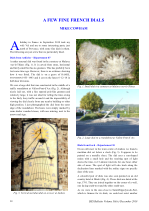
A travelogue describing various French sundials, including: a vertical meridian dial using an aperture nodus in Anduze; a huge dial near Tavel; a colourful, mottoed dial at Saint-Hippolyte-du-Fort; and a multi-faced tower dial at Valréas where the delineations appear inconsistent or mysterious.
Dials: Multi Faced, Dials: Noon Lines, Dials: Vertical, Historical Dials
December 2018
Page 48
Page 48
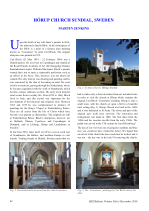
Describes the serendipitous discovery of a south-facing stone dial from 1739 on the tower of Hörup Church, Sweden, while searching for a Carl Bloch painting. The dial is unusual for Scandinavia as its furniture and embellishments are carved in relief rather than being incised.
Dials: Vertical, Historical Dials
March 2017
Page 20
Page 20
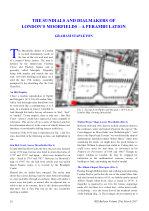
A historical survey of five sundial-related sites in the Moorfields district of London. Sites include Sun Dial Court (possibly an inn), Walter Hayes’ instrument-making shop, a vertical dial at Albion Chapel, an Astrological Physician’s house sign with a dial, and a unique 1706 Cross Dial.
Dials: Unusual, Dials: Vertical, Historical Dials
March 2017
Page 30
Page 30
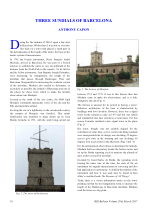
Description of two vertical declining sundials (32° east and 58° west declination) and a modern horizontal dial on the tower of the Montjuïc fortress in Barcelona. The tower was used by Pierre François André Méchain as a trig point for the meridian measurement required in determining the length of the metre in the late 18th century.
Dials: Vertical, Historical Dials
March 2017
Page 41
Page 41
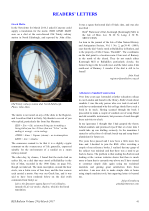
Includes translation and historical context for the Greek motto ‘Zoe Atme skie’ ('Life is smoke, shadow'), previously found on a dial in the Isle of Man and now noted in Edinburgh. Also features a letter discussing a member's return to simple sundial construction using reclaimed materials.
DIY Sundial Projects, Dials: Vertical, Mottoes, The BSS and Members
June 2017
Page 24
Page 24
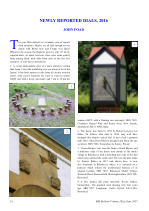
This report lists 47 newly reported dials added to the BSS Register in 2016. Descriptions include an analemmatic dial in New Lanark, a simple vertical dial designed for a Robert Lutyens house, a Dollond dial in London, and a vertical limestone monolith gnomon dial in Lancashire.
Dials: Analemmatic, Dials: Unusual, Dials: Vertical, Historical Dials
June 2017
Page 39
Page 39
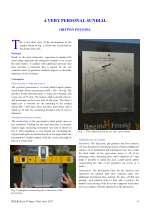
The author describes the design and laser-cut construction of a stainless steel pin gnomon gravestone sundial on black granite. The vertical dial includes solstices/equinoxes lines and additional declination lines marking the birth and passing dates of the author’s wife.
Construction Projects, Dials: Vertical, Sundial Design & Layout
September 2017
Page 19
Page 19
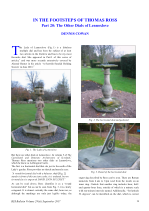
This article examines the other dials at Lennoxlove, Scotland, besides the famous multiple dial. It covers an octagonal horizontal dial engraved by David Lyon (possibly 18th century), a south and east vertical dial (1644), and a similar south and west vertical dial previously unknown to Ross.
Dials: Horizontal, Dials: Multi Faced, Dials: Vertical, Historical Dials
September 2017
Page 23
Page 23
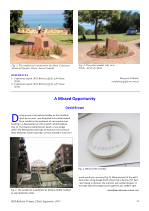
Reporting on a sundial seen on a new building in Dickens Heath, Solihull, the author notes that, despite initial delight, the dial was inaccurate upon closer inspection. The wall declines 59° East, and the author intends to contact the designer to persuade them to correct the inaccuracies.
Dials: Vertical, Sundial Design & Layout
December 2017
Page 5
Page 5
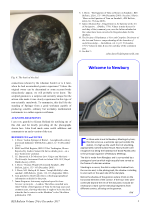
Features a photograph and description of a vertical fibreglass sundial, the handiwork of David Pawley, situated high on the south front of Sundial House near the Newbury train station.
Dials: Vertical, The BSS and Members
December 2017
Page 9
Page 9
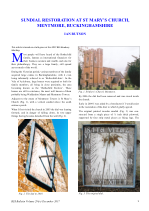
Reports on the protracted restoration of a vertical painted wooden sundial at St Mary’s Church, near the historic Rothschild estates. Due to extensive rot, a new plywood dial was constructed, the gnomon replaced, and the hour lines were corrected based on the wall's measured declination.
Dials: Vertical, Restoration projects
December 2017
Page 26
Page 26
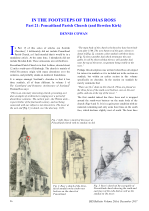
Examines two Scottish churches mentioned by Thomas Ross; Pencaitland Parish Church is unique for having three different sundials, including a multi-faced buttress dial and a cube dial. The dial at Bowden Kirk is a modern replacement that was installed with a major error in canting.
Dials: Cube, Dials: Multi Faced, Dials: Vertical, Historical Dials
December 2017
Page 30
Page 30
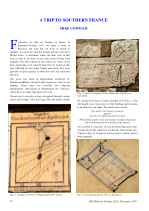
A report detailing a trip to Provence where the author found and photographed over 82 sundials, including a large one at Noyers, an almost direct east-facing dial from 1735 at Eyguières, and various painted dials featuring local mottoes.
Dials: Vertical, Historical Dials, Mottoes
March 2016
Page 18
Page 18
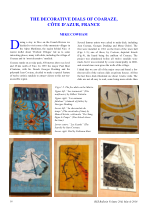
A report on the artistic sundials of the village of Coaraze, initiated in 1959 by the mayor and artists, including Jean Cocteau, to attract tourism. The dials, often made of painted tiles, are noted for being more artistic and decorative than practical timekeepers.
Dials: Unusual, Dials: Vertical, Historical Dials
March 2016
Page 25
Page 25
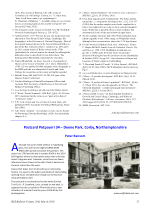
Analysis of a postcard featuring a vertical dial at Deene Park, dated 1769. The author argues that the dial declines to the east, based on the delineation of fewer afternoon hours, correcting a potential error in the BSS Register description.
Dials: Vertical, Historical Dials
March 2016
Page 26
Page 26
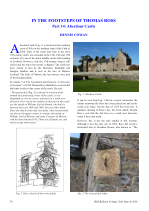
This article traces the historical sundials documented by Thomas Ross at Aberdour Castle. It describes a vertical dial (1635), a horizontal dial, and a multi-faceted dial moved from Castle Wigg, noting that the latter's Equation of Time table uses the Julian calendar appropriate for the early 18th century.
Dials: Horizontal, Dials: Multi Faced, Dials: Vertical, Equation of Time, Historical Dials
June 2016
Page 13
Page 13
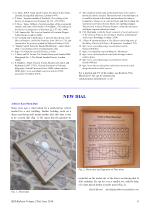
Description of a new direct east-facing moon dial commissioned for a client. The dial's gnomon is modelled on the nodus star of the Albi cathedral dial. It can function as a sundial using a chart located nearby, which also provides Equation of Time data.
Construction Projects, Dials: Nocturnals, Dials: Vertical, Equation of Time
June 2016
Page 14
Page 14
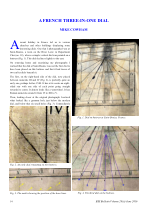
An analysis of a vertical dial in Saint-Bouize, France, revealing traces of two earlier dials beneath the modern one. One early dial might pre-date 1500, featuring a waterwheel-like star design; the third dial’s hour lines were reconstructed based on existing gnomon holes.
Dials: Vertical, Historical Dials
June 2016
Page 20
Page 20
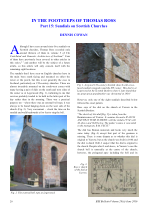
Continuation of the series, analyzing eight Scottish church sundials documented by Thomas Ross in 1892. Many are located on the south-west corner, often with two faces, suggesting afternoon services. Locations discussed include Yarrow (1640), Cortachy (1675), Inveresk (1735, by Archibald Handasyde), and Glencorse (1699).
Dials: Vertical, Historical Dials
June 2016
Page 34
Page 34
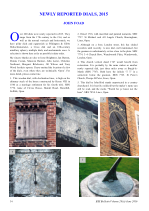
A list of over 200 sundials newly reported to the BSS Register in 2015, ranging from the 17th to 21st centuries. Examples include a 1540 wooden dial, a 1799 horizontal dial by Liverpool clockmaker Thomas Harrison, an exquisite square dial installed for Queen Victoria’s Diamond Jubilee, and a modern spiral analemmatic dial.
Dials: Heliochronometer, Dials: Horizontal, Dials: Multi Faced, Dials: Unusual, Dials: Vertical, Historical Dials, The BSS and Members
September 2016
Page 12
Page 12
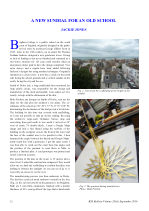
Details the successful construction and installation of a large, square, gold-leafed vertical sundial (1860 mm square) on the newly completed gatehouse tower of Brighton College. The dial was delineated 24° west of south and manufactured by Smith of Derby, utilizing modern materials and techniques.
Construction Projects, Dials: Vertical, Sundial Design & Layout
September 2016
Page 17
Page 17
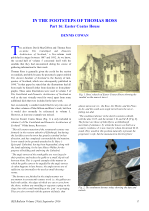
Examines a multi-faceted dial on the south-west angle turret of Easter Coates House (1615), Edinburgh, which Thomas Ross briefly mentioned. The author confirms a horizontal dial face on the upper surface, suggesting the dial is original to the building, despite it possibly containing repurposed stones.
Dials: Multi Faced, Dials: Vertical, Historical Dials, Restoration projects
September 2016
Page 24
Page 24
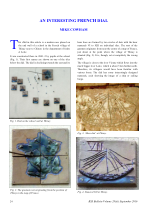
Analysis of a modern, east-declining vertical dial mounted on a school wall in Thizay, France, constructed in 2001–2 by pupils. The hour numerals feature artistic images of sailing barges copied from 15th-century graffiti found on nearby church walls, although the gnomon is incorrectly set.
Dials: Unusual, Dials: Vertical
September 2016
Page 26
Page 26
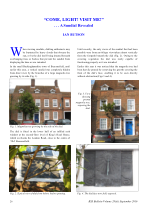
Reports on a vertical dial (SRN 6098) at King’s Head House, Beaconsfield, previously obscured by a large magnolia tree that has now been severely pruned. Although revealed, the dial is incorrectly delineated as direct south-facing, causing it to read 20–30 minutes earlier than true solar time for the wall's 14° east declination.
Dials: Vertical, Historical Dials
September 2016
Page 29
Page 29
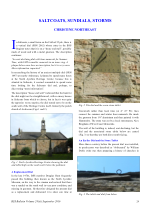
Investigation into a vertical dial (SRN 2062) found on the Heritage Centre wall in Saltcoats. The current dial is a canted, south-facing replacement (by Douglas Hunt) of an older, storm-damaged dial, commemorating the church's turbulent history of being rebuilt multiple times after violent storms.
Dials: Vertical, Historical Dials, Restoration projects
September 2016
Page 32
Page 32
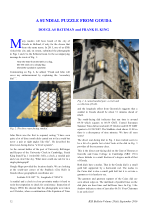
Analysis of a pair of canted vertical dials on the Stadhuis in Gouda, Holland, focusing on a direct east-facing nodus dial. Although the direct south-facing dial shows minor discrepancies with the clock time, the east-facing dial's parallel lines meant to be constant-declination curves are considered seriously suspect and likely the result of bad restoration.
Dials: Vertical, Historical Dials
December 2016
Page 10
Page 10
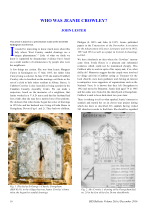
An analysis of the life of Jeanie Crowley (1885–1965), who compiled eight sketchbooks containing drawings and descriptions of 216 West Country sundials. The article outlines her family life in Devon, details her methods using measuring rods and field glasses, and suggests further research into her life. She primarily focused on vertical dials.
Dials: Vertical, Historical Dials
December 2016
Page 16
Page 16
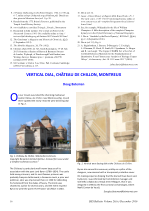
Description of a restored west-declining vertical dial found at the Château de Chillon. Though the castle is associated with Lord Byron, enquiries confirmed the dial was designed much later in 1905 by cantonal archaeologist Albert Naef.
Dials: Vertical, Historical Dials
December 2016
Page 34
Page 34
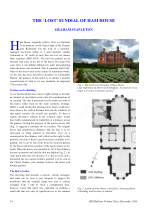
Proposes a reconstruction of the 'lost' great decliner mural sundial at Ham House, dated 162- (likely 1622) and rediscovered in 1965. The dial, positioned 16° north of east, was hidden when the house was extended in 1674. It carries the motto VIGILATE.
Dials: Vertical, Historical Dials, Mottoes
March 2015
Page 2
Page 2
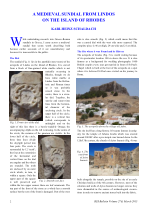
Analysis of a medieval sundial, inaccessible to the public, found in the store-room of the acropolis of Lindos on Rhodes. Carved from white marble, the dial features a circular design with three time lines dividing daylight into four parts. Based on similarity to English examples and the four-division structure unique to Latin Europe, the article suggests Frankish influence and dates its creation to the 14th century for use by the Hospitallers.
Dials: Unusual, Dials: Vertical, Historical Dials
March 2015
Page 5
Page 5
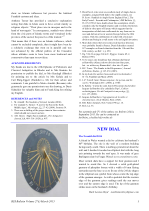
Details the design and construction of a new elliptical vertical dial crafted from grey Burlington slate for a private commission in Wales.
Dials: Vertical, Sundial Design & Layout, Construction Projects
March 2015
Page 10
Page 10
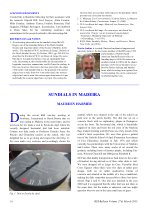
A report surveying several sundials encountered across Madeira. These include David Brown's horizontal slate dial at Escola da Apel, two less impressive dials in Red Cross Square, a horizontal W. Page & Co. dial at Liceu de Jaime Moniz, a large analemmatic dial on the Funchal seafront, a direct south vertical dial by Sampaio E Mello, and a Brookbrae horizontal dial in Palheiro Gardens.
Dials: Analemmatic, Dials: Horizontal, Dials: Vertical, Historical Dials
March 2015
Page 14
Page 14
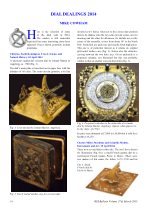
A compilation of interesting sundials sold at auction throughout 2014. Notable lots include a universal equinoctial crescent dial by Johann Martin of Augsburg (ca. 1700), a small French garden dial by Pierre le Maire, a magnetic compass dial by William Fraser, a vertical slate dial by Bianchi, and a significant double horizontal dial by Henricus Wynne (ca. 1667/8).
Dials: Double Horizontal, Dials: Portable, Dials: Vertical, Historical Dials
March 2015
Page 33
Page 33
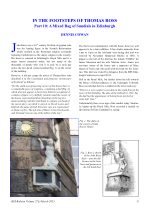
The tenth installment surveying Edinburgh's sundials mentioned by Thomas Ross. Highlights include the restored two-faced vertical dial on John Knox's House and the multi-faceted Huntly House dial (a copy of a 1732 Archibald Handasyde dial). Other dials reviewed are found at West Kirk, Corstorphine Church, Liberton House, Hudson Cottage, and Brighton Park in Portobello.
Dials: Multi Faced, Dials: Vertical, Historical Dials, Restoration projects
March 2015
Page 41
Page 41
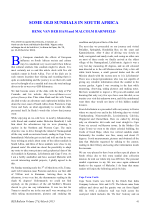
Report detailing a long research trip (4250 km) to record five historical sundials in South Africa. The dials documented include the two vertical dials at Cape Town Castle (1787); the 1828 octagonal horizontal dial at Leliefontein, notable for its Etruscan numbering; and the 1831 horizontal slate dial at the Kuruman Mission station.
Dials: Horizontal, Dials: Vertical, Historical Dials, Mottoes
June 2015
Page 15
Page 15
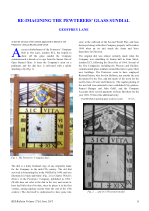
An examination of the new glass sundial commissioned for the Pewterers’ Company Hall, which is a copy of a mid-17th century original by Richard Dutton. It suggests a possible full reconstruction of the original dial and its architectural surround based on historical descriptions.
Dials: Vertical, Historical Dials, Sundial Design & Layout
September 2015
Page 19
Page 19
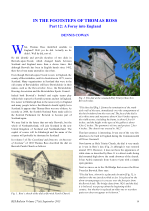
Discusses Thomas Ross's sketches and descriptions of two sundials found in Berwick-upon-Tweed (Holy Trinity Church and the Old Bridge). The article explores the historical ambiguity of Berwick's status between Scotland and England and recent restorations of the dials.
Dials: Horizontal, Dials: Vertical, Historical Dials
September 2015
Page 34
Page 34
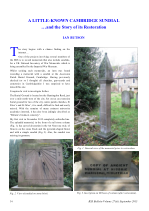
An account of the finding and restoration of the memorial sundial dedicated to Rudolf Cecil Hopkinson (died 1917) at Ascension Parish Burial Ground, Cambridge. It includes the history of the prominent Hopkinson family and details the reconstruction and fitting of the simple scrolled brass replacement gnomon.
Dials: Vertical, Restoration projects, Historical Dials
September 2015
Page 41
Page 41
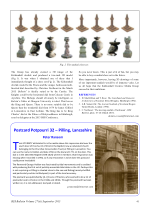
Describes a postcard of the vertical sundial (SRN 1625) above the south door of St John the Baptist Church, Pilling, Lancashire, dated 1766. Notes the motto, "Thus Eternity approacheth" and the historical note that the gnomon was missing when recorded in 1992.
Dials: Vertical, Mottoes
December 2015
Page 6
Page 6
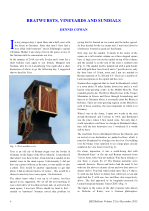
An account of a trip through Germany, specifically Trier and the Moselle wine region, detailing visits to five sundials. Dials included the Trier market cross dial, the Cusanus glass dial in Bernkastel-Kues, and various vertical dials in Wehlen, Zeltingen, and Urzig.
Dials: Horizontal, Dials: Vertical, Historical Dials
December 2015
Page 9
Page 9
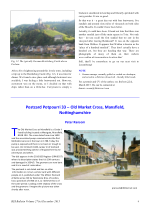
Describes a postcard showing the Old Market Cross at Mansfield, Nottinghamshire, a Grade II listed building dating from circa 1600. It notes the dial's 19th-century origin, damage (bent gnomons), and need for restoration according to the BSS Register.
Dials: Vertical, Dials: Multi Faced, Historical Dials
December 2015
Page 14
Page 14
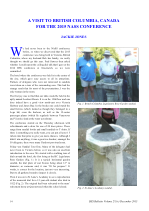
A report on the 2015 NASS Conference in Victoria, BC, Canada, which included presentations on gnomonics and sundial tours. The tour featured several dials, including the Orca totem dial and the impressive Ogden Point analemmatic dial.
Dials: Analemmatic, Dials: Horizontal, Dials: Vertical, The BSS and Members
December 2015
Page 24
Page 24
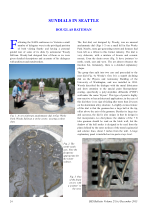
Recounts a guided tour of Seattle dials following the NASS conference, featuring four dials designed by Woody Sullivan. Highlights include an elaborate analemmatic dial in Gas Works Park, a vertical declining dial at UW, and the earliest Seattle dial dating from 1909.
Dials: Analemmatic, Dials: Equatorial, Dials: Vertical, The BSS and Members
December 2015
Page 41
Page 41
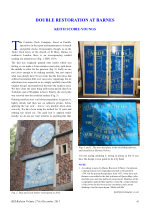
Describes the restoration work on the sundial (and accompanying clock) on the Tudor brick tower of St Mary, Barnes. The deteriorating painted dial was replaced with a 2 mm stainless steel plate, traced from the original design, etched, and traditionally painted and gilded.
Dials: Vertical, Restoration projects
December 2015
Page 44
Page 44
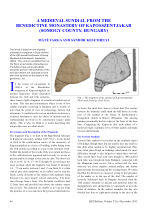
Analysis of a stone fragment found at a Benedictine monastery excavation, identified as a medieval vertical sundial. Its hour lines are nearly equiangular, suggesting monastic or temporal timing, and it is dated to the late 15th or early 16th century, before 1555.
Dials: Vertical, Historical Dials, Mathematics of Dialling
March 2014
Page 21
Page 21
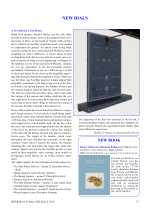
The author designed a vertical, direct south-facing sundial made of unpolished black marble for his new home in Northern Ireland. The dial uses a horizontal gnomon rod, and the length of the shadow cast at noon indicates the eight traditional calendric events that divide the year, such as the solstices and equinoxes, marked by Neolithic spiral motifs.
Construction Projects, Dials: Vertical, Sundial Design & Layout
June 2014
Page 7
Page 7
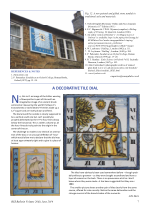
Describes a 12-inch square decorative tile dial featuring an imaginative image of an ancient Greek astronomer (possibly Eratosthenes or Archimedes). Although intended as a vertical south dial, the delineation appears incorrect due to hour lines drooping below the horizontal, leading to a challenge for readers to find a valid orientation.
Dials: Unusual, Dials: Vertical, Historical Dials, Sundial Design & Layout
June 2014
Page 16
Page 16
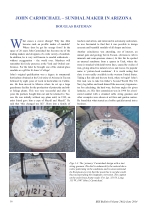
Profiles John Carmichael, detailing his career shift from horticulture to becoming a leading sundial maker in Tucson. It describes his primary design using a stranded cable gnomon, his use of modern software for complex dials (like heliochronometers), and his artistic stained glass dials and durable vitreous enamel finishes.
Construction Projects, Dials: Heliochronometer, Dials: Vertical, Sundial Design & Layout
June 2014
Page 22
Page 22
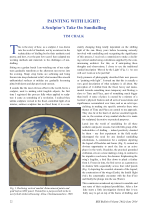
A sculptor reflects on the aesthetic and poetic aspects of sundials, seeing his work as ‘painting with light’. He details several sculptural commissions, including a combined horizontal and equatorial dial with a glass centre, the Scottish Enlightenment lectern dial, and the Robert Burns sculptural sundial.
Construction Projects, Dials: Equatorial, Dials: Vertical, Sundial Design & Layout
June 2014
Page 43
Page 43
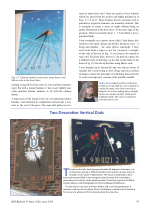
Images and descriptions of two decorated vertical dials are included.
Dials: Vertical, Dials: Unusual
June 2014
Page 44
Page 44
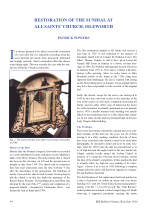
Documents the restoration of a vertical declining dial from All Saints’ Church, Isleworth (originally 1707), which was severely decayed and incorrectly delineated. The restoration included correcting mathematical errors and recreating unique features like solar altitude scales and time arcs for Jamaica, Jerusalem, and Moscow.
Dials: Vertical, Mathematics of Dialling, Restoration projects, Historical Dials
September 2014
Page 2
Page 2
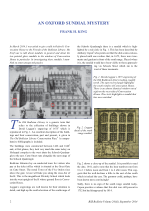
An investigation into two painted glass sundials in the windows of Convocation House at the Old Bodleian Library in Oxford, focusing on their history, appearance, dating, and the discovery that the south dial is incorrectly installed, facing the wrong way.
Dials: Vertical, Historical Dials, Restoration projects, Sundial Design & Layout
September 2014
Page 10
Page 10
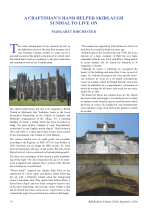
Recounts the personal story of Edward Brown, a Yorkshireman who, after being made redundant, funded his own stonemasonry course and dedicated ten years (1981–1991) to restoring St Augustine’s Parish Church in Skirlaugh, including the repair of its vertical stone sundial.
Dials: Vertical, Historical Dials, Restoration projects, The BSS and Members
September 2014
Page 11
Page 11
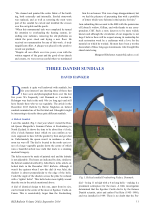
Descriptions of three distinct sundials seen in Denmark: a Piet Hein helical sundial at Fredensborg Palace, a dated (1655) vertical declining dial in Helsingør, and a canonical dial dating to c. 1200 at Vestervig Kirke in Jutland, which indicates unequal hours for monastic prayers.
Dials: Unusual, Dials: Vertical, Historical Dials
September 2014
Page 28
Page 28
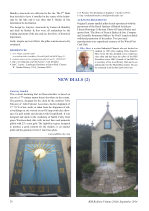
Describes a vertical declining sundial, the Gateway Sundial in Gloucestershire, based on a 17th-century design. It was made by Judith Verity from green Westmoreland slate with gilded incised lines and a brass gnomon.
Construction Projects, Dials: Vertical
September 2014
Page 33
Page 33
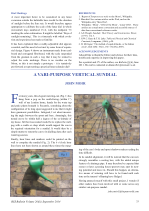
Describes a DIY sundial project using an ordinary watering can hung on a south-facing wall. The angle of the can's spout was found to match the co-latitude of the London house, allowing the spout to serve as the gnomon when properly supported.
DIY Sundial Projects, Dials: Unusual, Dials: Vertical
December 2014
Page 5
Page 5
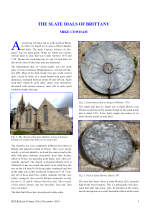
A report detailing a trip to northern Brittany to view approximately 24 vertical slate dials, primarily located on churches and dating from 1570 to 1750. These dials are typically round and carved in relief, featuring decorative motifs like the sun and moon, and often use Arabic numerals. Specific examples shown include dials at Saint Herbot (1587) and Pleyben (1619).
Dials: Vertical, Historical Dials
December 2014
Page 8
Page 8
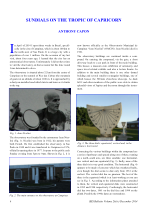
An account of sundials found in and around Campinas, Brazil, specifically mentioning the Observatorio Municipal de Campinas, founded by Jean Nicolini. The observatory site holds three dials (horizontal, vertical, and equatorial), though their condition varies. Other documented dials include one in Parque Taquaral (1962) and two at the Americana Observatory.
Dials: Horizontal, Dials: Vertical, Dials: Equatorial
December 2014
Page 20
Page 20
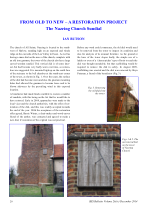
A detailed report on the restoration of a badly worn carved wooden vertical dial, dated 1765, found on Nazeing Church tower. Due to the dial's poor condition, a new chestnut wood replacement was crafted by Barrie Winter. The design analysis confirmed the motto “Meridies Solarium” and the inclusion of solar azimuth lines.
Dials: Vertical, Historical Dials, Restoration projects, Sundial Design & Layout
March 2013
Page 15
Page 15
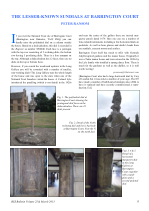
An illustrated survey of several overlooked sundials at Barrington Court. The article documents their styles, inscriptions, and historical setting, adding new information to the site’s known dial heritage.
Dials: Horizontal, Dials: Vertical, Historical Dials, Restoration projects
March 2013
Page 16
Page 16
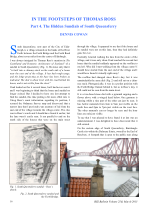
The author follows the traces of nineteenth-century architect Thomas Ross to rediscover forgotten Scottish sundials, including rare obelisk types near South Queensferry, with photographs and measurements.
Dials: Multi Faced, Dials: Vertical, Historical Dials
March 2013
Page 34
Page 34
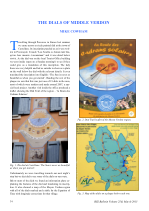
A travelogue describing a route through southern France known as ‘La Route des Cadrans Solaires’. The author records and photographs numerous historic and modern painted dials with local inscriptions.
Dials: Unusual, Dials: Vertical, Historical Dials, Mottoes
June 2013
Page 10
Page 10
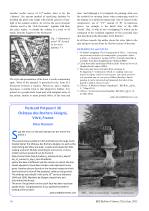
A short illustrated feature on a postcard depicting a multifaceted sundial at a French château, discussing its design features, historical background, and a humorous note about an inverted gnomon.
Dials: Horizontal, Dials: Multi Faced, Dials: Vertical
June 2013
Page 12
Page 12
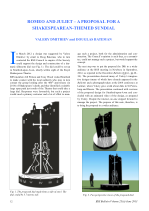
An artistic proposal for a monumental sundial inspired by *Romeo and Juliet*, designed for Stratford-upon-Avon. The article describes its symbolism, geometry, and design for public installation.
Dials: Horizontal, Dials: Vertical, Sundial Design & Layout, The BSS and Members
June 2013
Page 14
Page 14
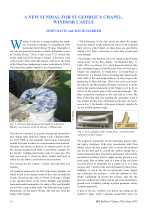
An illustrated account of designing and installing a new bronze vertical sundial at St George’s Chapel, Windsor Castle, featuring the Garter motto and a gnomon based on the Bray family’s heraldic ‘hemp press’.
Dials: Vertical, Historical Dials, Restoration projects, Sundial Design & Layout
June 2013
Page 23
Page 23
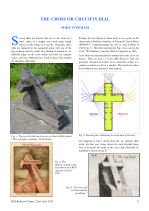
An exploration of dials incorporating the cruciform shape, tracing their symbolism, geometry, and examples across Europe, with commentary on their religious and artistic significance.
Dials: Unusual, Dials: Vertical, Historical Dials, Mottoes
June 2013
Page 33
Page 33
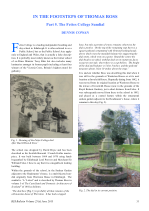
Continuing the series on Thomas Ross, this article documents a restored sundial at Fettes College, Edinburgh, with photographs and analysis of its design and craftsmanship.
Dials: Vertical, Historical Dials, Restoration projects
June 2013
Page 36
Page 36
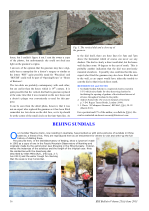
A short pictorial note on examples of ancient and modern sundials located in Beijing, illustrating the global reach of gnomonic design.
Dials: Horizontal, Dials: Vertical, Historical Dials
September 2013
Page 16
Page 16
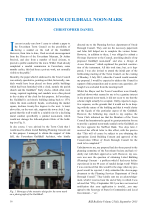
Account of securing Listed Building Consent for a painted noon-mark on the historic Faversham Guildhall, celebrating the Queen's Diamond Jubilee. The design features a gilded meridian line and a nodus on a gilded sun image, which projects a light spot to indicate the instant of Local Apparent Noon.
Construction Projects, Dials: Noon Lines, Dials: Vertical, Sundial Design & Layout
September 2013
Page 19
Page 19
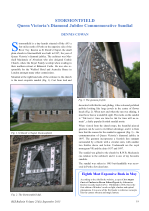
A description of the exquisite lead sundial installed on St David’s Chapel, Stormontfield, built in 1897 to commemorate Queen Victoria’s Diamond Jubilee. It is decorated with gilding and polished pebbles, featuring a pierced gnomon showing the royal monogram VR and the dates 1837/1897, alongside a Scottish motto.
Dials: Vertical, Historical Dials, Mottoes
September 2013
Page 25
Page 25
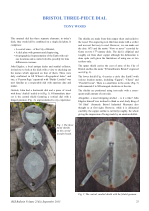
Examination of an intriguing three-piece artefact from 1675, attributed to R Smurthwaite, Bristol, possibly an amateur work. It consists of the Bristol Coat of Arms shield, a vertical dial with a hinged gnomon, and a topographical representation of the Earth with overseas locations, suggesting a possible nautical link.
Dials: Portable, Dials: Unusual, Dials: Vertical, Historical Dials
September 2013
Page 27
Page 27
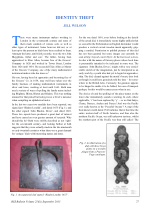
A description of the sundial at St Mary and All Saints Church, Conway, recorded from an early 1910 postcard. The dial, dated 1765 and signed by Mereidh Hughes, is still extant but heavily pitted. It is noted for its proximity to the gravestone that allegedly inspired Wordsworth's poem ‘We are seven’.
Dials: Vertical, Historical Dials
December 2013
Page 2
Page 2
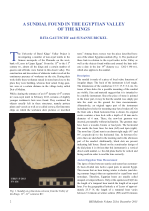
Describes a vertical direct south sundial made of ochre limestone found in workmen's huts in the Valley of the Kings, dated to the late 19th dynasty (ca. 1202–1190 BC). It discusses its dimensions, features, and the low precision inherent in ancient Egyptian temporal hours and canonical design.
Dials: Portable, Dials: Vertical, Historical Dials, Mathematics of Dialling
December 2013
Page 12
Page 12
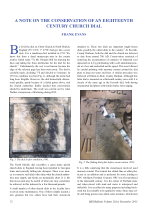
Details the conservation work performed on an 18th-century sandstone dial (1793) at Christ Church in North Shields, which was declining 7°E. The process involved cleaning, removal of cement, consolidation using lime mortar and grout, weatherproofing, and gilding the copper-based gnomon.
Dials: Vertical, Historical Dials, Restoration projects
December 2013
Page 16
Page 16
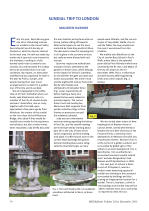
An account of a guided trip to London sundials, visiting the noon mark dial in Paternoster Square, a horizontal dial at Amen Court (attributed to Wren), the polar dial by Piers Nicholson, dials at Cheapside and St Katherine Cree, and the large horizontal dial over Tower Hill Underground Station.
Dials: Horizontal, Dials: Polar, Dials: Vertical, The BSS and Members
December 2013
Page 27
Page 27
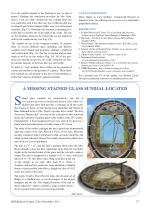
Reports the location of the "Roy Grosvenor Thomas" stained glass sundial, previously considered lost. Designed for latitude 51.5° and declination 16° W, it is tentatively dated to 1652 and carries the motto *Tempus Edax Rerum*.
Dials: Vertical, Historical Dials, Mottoes
March 2012
Page 14
Page 14
This article describes a walking tour of the 23 (or more) sundials in Saint-Hippolyte-du-Fort, France. It highlights attractive examples, including an equatorial dial, a church dial, and several made by local ceramic artist C. TINGAUD, noting features like 24-hour systems and Provençal mottoes.
Dials: Equatorial, Dials: Vertical, Historical Dials, Mottoes
June 2012
Page 17
Page 17
This article describes a unique direct south vertical slate sundial found in Wimborne Minster, made by clockmaker W.B. Kerridge. Its distinguishing feature is a system for displaying the Equation of Time and longitude correction using interchangeable 'FAST'/'SLOW' iron plates and possibly minute/second plates, resembling a cricket scoreboard, for public use.
Dials: Unusual, Dials: Vertical, Equation of Time, Historical Dials
June 2012
Page 30
Page 30
This entry discusses a postcard depicting a sundial at Powerscourt's Italian Garden in Enniskerry, Co. Wicklow. The sundial, declining 50° E, bears the motto 'Horas Non Numero Nisi Serenas' (I only mark the sunny hours) and is listed in the Register as SRN 3933, showing hours only from 5am to 1pm.
Dials: Vertical, Historical Dials, Mottoes
June 2012
Page 31
Page 31
This article is the first part of a quest to track down and photograph sundials identified by Thomas Ross in his late 19th-century work. It focuses on Scotland's oldest dials, specifically three 16th-century examples at Cockburnspath, Oldhamstocks, and Seton Palace, and a fourth at Fogo, all similar in type and potentially forerunners to lectern dials.
Dials: Multi Faced, Dials: Vertical, Historical Dials, Restoration projects
September 2012
Page 19
Page 19
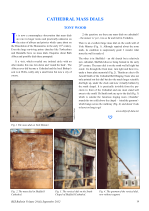
The article discusses the scarcity of mass dials in larger towns and on ruins of abbeys and priories, noting only two found on cathedrals so far, both in Yorkshire: one on York Minster and another inside Sheffield Cathedral. It describes the Sheffield Cathedral's mass dial and a larger, now largely hidden, scientific dial beneath the clock.
Dials: Vertical, Historical Dials, Dials: Mass Dials
September 2012
Page 26
Page 26
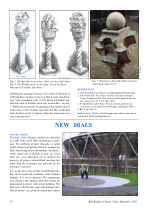
This section introduces several recent sundial projects, including an Olympic sundial by David Brown (an analemmatic dial), a vertical school science centre dial featuring periodic table elements, and the Angel with Sundial at Talaton church by Harriet James, inspired by Chartres Cathedral.
Dials: Vertical, Dials: Analemmatic, Sundial Design & Layout, Construction Projects
September 2012
Page 29
Page 29
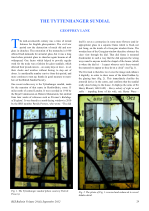
This article details the rediscovery of a mid-17th century glass sundial at Tyttenhanger mansion, Hertfordshire, designed for Sir Henry Blount's arms and a 13-14 degree declination. It bears the motto "Lumen Umbra Dei" and is compared to similar dials by John Oliver, suggesting Oliver as its likely maker despite earlier attributions to Henry Gyles.
Dials: Vertical, Historical Dials, Mottoes
September 2012
Page 32
Page 32
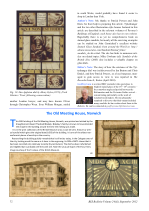
This entry features an 1842 etching of the Old Meeting House, Norwich, depicting a vertical sundial that dates the building to 1693. The sundial, which has undergone refurbishment and regilding, is noted for its unusual hour-line shape and the building's historical significance as one of the country's oldest non-conformist places of worship.
Dials: Vertical, Historical Dials
September 2012
Page 35
Page 35
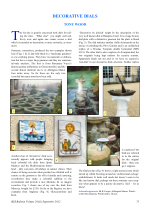
This article discusses sundials designed purely for decorative or ornamental purposes, rather than for time-telling. Examples include two identical large gnomon dials at Barnsley and Ablington Manor, colourful tile dials from the Mediterranean, and an expensive, unfinished replica of a Thomas Tompion double horizontal dial at Hampton Court.
Dials: Vertical, Dials: Unusual, Dials: Double Horizontal
December 2012
Page 15
Page 15
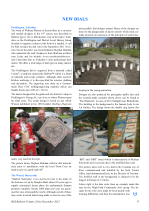
This section showcases several contemporary sundials, including a Corian® vertical dial in Pocklington by Stephen Holehan, based on an 1854 design. It also highlights analemmatic dials by Douglas Hunt's Modern Sunclocks for public sites and playgrounds, and a tile-based dial from High Peak Community Arts in Ston, Croatia.
Construction Projects, Dials: Analemmatic, Dials: Vertical, Sundial Design & Layout
December 2012
Page 17
Page 17
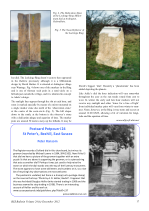
This entry discusses an undated postcard featuring a Dolland sundial in St Peter's churchyard, Bexhill, recorded as missing its gnomon. The image, by A. D. Hellier (1909-1938), shows the gnomon and an intriguing arc above it, raising questions about its purpose—whether support, another dial, or for raising the stone.
Dials: Vertical, Historical Dials
December 2012
Page 18
Page 18
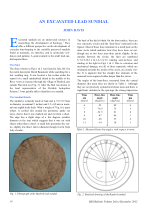
This article details a small, robust lead sundial, 51.5mm in diameter, found in the River Avon at Barford. Dated between the late 16th and late 17th centuries, its equi-angular, anticlockwise numbered hour-lines suggest a vertical dial, possibly an attempt at an equal-hour dial by a provincial artisan lacking scientific knowledge, with possible initials C W.
Dials: Vertical, Historical Dials, Sundial Design & Layout
December 2012
Page 22
Page 22
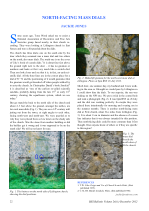
This article discusses mass dials on the north side of churches, specifically at Litlington and Firle in East Sussex. While a south-facing dial at Litlington is an early scientific dial, two north-facing mass dials, initially puzzling, were observed to work perfectly for evening use in summer, suggesting intentional placement.
Dials: Mass Dials, Dials: Vertical, Historical Dials, How Sundials Work
December 2012
Page 26
Page 26
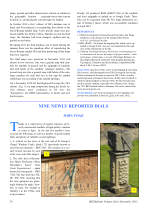
This article reports on nine previously unrecorded or undocumented sundials. Highlights include a 1723 vertical dial at Windsor Castle, a Scottish-style cube dial at Restoration House, a pre-1752 horizontal dial by John Davis of Windsor, and various vertical, geographical, and unusual fixed horizontal analemmatic dials across England.
Dials: Cube, Dials: Horizontal, Dials: Vertical, Historical Dials
December 2012
Page 41
Page 41
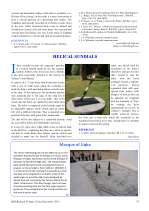
This entry describes a modern sundial from 1843 in the courtyard of the Mosque of Uqba (Great Mosque of Kairouan) in Tunisia. Engraved in Arabic script on a marble slab, it was designed by Almed Essoussi, inspired by Ibn al-Shatir's dial. It uses four separate point gnomons to indicate prayer times.
Dials: Unusual, Dials: Vertical, Historical Dials
March 2011
Page 2
Page 2
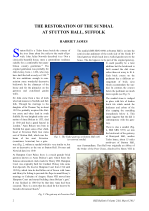
This article details the restoration of a Tudor sundial at Stutton Hall in Suffolk. It covers the history of the house and dial, archaeological findings suggesting its originality, and the methods used for cleaning, realigning the gnomon, and repainting based on known Tudor designs.
Dials: Vertical, Historical Dials, Restoration projects, Sundial Design & Layout
March 2011
Page 31
Page 31
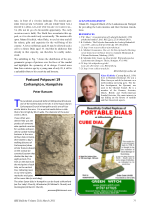
This entry describes a Saxon dial on Corhampton Church, Hampshire, one of four similar octaval dials in the area. The author wonders if they were products of a regional sundial-making business, noting their division of the day into eight periods based on tides.
Dials: Mass Dials, Dials: Vertical, Historical Dials
March 2011
Page 45
Page 45
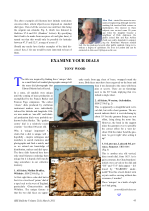
This article highlights three 'unique' sundials found in a collection of photographs, encouraging readers to identify similar features. It discusses a two-faced prism dial, a vertical dial with a bent gnomon, and a direct south dial with an unusual inscription, emphasizing the individuality of pre-mass production dials.
Dials: Multi Faced, Dials: Unusual, Dials: Vertical, Historical Dials
June 2011
Page 44
Page 44
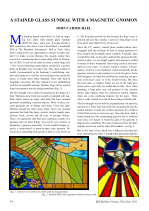
This article details the design and construction of a stained glass sundial featuring a novel magnetic gnomon, shaped like a frog, which attaches without drilling, soldering, or gluing. It explains the experimental process of developing this damage-resistant magnetic attachment.
Dials: Vertical, Sundial Design & Layout, Construction Projects, Dials: Stained Glass
June 2011
Page 48
Page 48
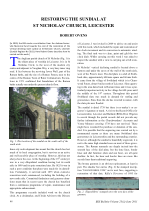
This article describes the restoration of a 1738 vertical declining Swithland slate sundial at St Nicholas’ Church, Leicester. It details the process of in-situ gilding of the numerals and lines, using specific materials and techniques for durability, and notes a previous gnomon replacement in 1896.
Dials: Vertical, Historical Dials, Restoration projects
September 2011
Page 27
Page 27
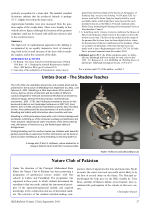
This piece announces an exhibition in Moedling, Austria, from September 2011 to February 2012, focusing on time and sundials. The exhibition features models of sundials from Johannes Gaupp's 'Gnomonica Mechanica Universalis' (1665-1738), symbolistic pictures by Ernst Steiner, and documentation of wall sundials in Moedling.
Dials: Vertical, Dials: Unusual
December 2011
Page 10
Page 10
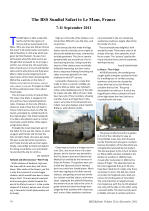
This report covers the British Sundial Society's 2011 safari to the Sarthe and Perche regions of France, based in Le Mans. The group visited various sundials, historical sites, and chateaux, including a specific mean-time dial in Le Mans and other vertical and mass dials in surrounding villages. The trip offered cultural experiences and opportunities to meet fellow enthusiasts.
Dials: Vertical, Dials: Multi Faced, Dials: Equatorial, Historical Dials, The BSS and Members
December 2011
Page 22
Page 22
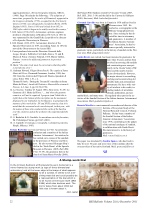
This short piece describes a stump-work mirror frame from about 1650 in Montacute House, Somerset, which features an image appearing to be a declining west sundial. It possibly represents a dial found on the house itself. Little else is known about this embroidered dial, highlighting an unusual artistic representation of a sundial.
Dials: Unusual, Dials: Vertical, Historical Dials
December 2011
Page 24
Page 24
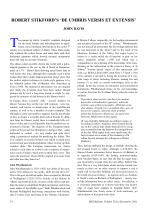
This article discusses Robert Stikford, a 14th-century monk from St Albans, credited in Whethamstede’s Granarium (c.1430) with inventing the equal-hour sundial. His rediscovered extensive Latin treatise, 'De Umbris Versis et Extensis', describes geometric constructions for projecting shadow positions and includes tables for Oxford’s latitude. It showcases detailed designs for various vertical dials, revealing sophisticated early European scientific dialling.
Dials: Vertical, Historical Dials, Mathematics of Dialling, Sundial Design & Layout
December 2011
Page 32
Page 32
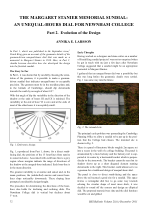
This is Part 2 of an article describing the design evolution of the Margaret Stanier Memorial Sundial, an unequal-hours dial for Newnham College, Cambridge. It details the aesthetic and gnomonic challenges, including discussions with planners, the development of hour-line alignments, and the artistic elements like sun rays and lettering. The article also covers the intricate cutting and gilding process.
Construction Projects, Dials: Vertical, Mathematics of Dialling, Sundial Design & Layout
December 2011
Page 38
Page 38
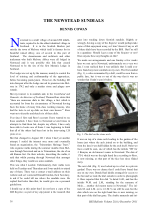
This article describes the author's quest to find and document sundials in Newstead, Scotland, following Thomas Ross's 19th-century account. It details several discoveries, including a cube dial, a semi-cylindrical dial, and other single-faced dials, some in private gardens, highlighting their historical significance and the challenges of locating them. The search continues for missing dials or fragments.
Dials: Horizontal, Dials: Multi Faced, Dials: Vertical, Historical Dials
March 2010
Page 2
Page 2
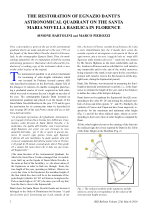
Describes the history and function of Egnazio Danti's 1572 astronomical quadrant in Florence. It details the five systems of time measurement it displayed and outlines the methodology used to re-compute the missing gnomons for a modern restoration and the creation of a working copy.
Dials: Vertical, Historical Dials, Restoration projects, Sundial Design & Layout
March 2010
Page 10
Page 10
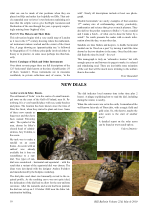
A collection of short articles describing new sundials. These include an equatorial 'solar acorn' dial in Solar, Russia; a vertical declining dial in Oxford inspired by Christopher Wren; and a mass-produced, flat-packed equatorial 'Sun Disc' from Australia designed for various latitudes.
Dials: Vertical, Dials: Equatorial, Dials: Unusual, Construction Projects
March 2010
Page 18
Page 18
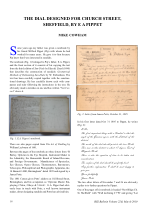
Explores the notebook of E.A. Pippet, detailing his original 1895 design for a west-declining vitreous enamel sundial for Cairns Chambers, Sheffield. It compares the design to the more modern stone dial currently on the building, which has a different declination.
Dials: Vertical, Historical Dials, Sundial Design & Layout
March 2010
Page 23
Page 23
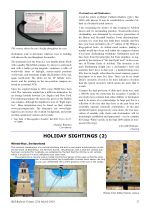
Features a vertical declining dial combined with a noon mark analemma on a church tower in Winterthur, Switzerland. The vertical dial is corrected for longitude, and the analemma is colour-coded for the two halves of the year.
Dials: Noon Lines, Dials: Vertical, Equation of Time
March 2010
Page 37
Page 37
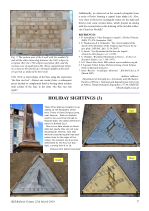
A photo feature of three dials on an obelisk at the Monastery of the Holy Trinity of Saint Sergius Lavra, near Moscow. The east-facing dial has declination lines for zodiac signs, while the west-facing dial shows the hours of daylight.
Dials: Multi Faced, Dials: Vertical, Historical Dials
March 2010
Page 47
Page 47
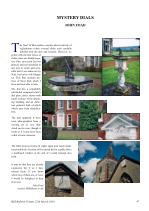
A request for help in identifying three sundials from an unidentified roll of film found in the Noel Ta'Bois archive. The images include a substantial octagonal dial, another photographed from a moving car, and a canted dial in a gable.
Dials: Horizontal, Dials: Vertical
June 2010
Page 7
Page 7
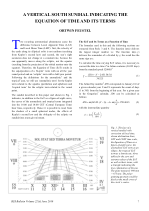
This paper describes a vertical sundial designed to indicate the Equation of Time (EoT) as a figure-of-eight curve, along with its anomalistic and tropical terms. It provides the mathematical formulae for calculating these values and their graphical representations as functions of time and the sun's declination.
Dials: Vertical, Mathematics of Dialling, Construction Projects, Equation of Time
June 2010
Page 10
Page 10
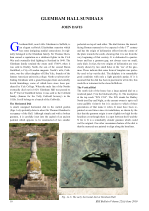
This article explores several sundials associated with Glemham Hall. It details a small, unsigned 17th-century horizontal dial, a large painted vertical dial from 1769, and discusses the 'Elihu Yale's sundial' mounted on a John Nost lead figure, whose current whereabouts are unknown but was possibly seen at Yale University. A modern 'Three Graces' horizontal dial is also mentioned.
Dials: Horizontal, Dials: Vertical, Historical Dials
June 2010
Page 16
Page 16
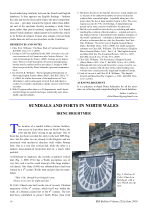
This article explores three instances of sundials located within former fortifications in North Wales. It describes a recently repainted vertical dial on St Cybi’s Church in Holyhead, a modern cast dialplate at St Mary’s churchyard in Caerhun, and a vertical declining dial from 1898 at Fort Belan.
Dials: Horizontal, Dials: Vertical, Historical Dials
June 2010
Page 51
Page 51
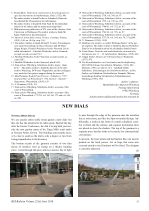
This short note describes a new sundial under construction at Trago Mills retail outlet in Newton Abbot, Devon. The dial, facing close to south, features a gnomon with a slot for a narrow line of light at solar noon and a cylindrical cross-bar nodus to show solstice and equinox declination lines. The hour points and lines are currently painted, with hopes for more durable stainless steel fittings.
Construction Projects, Dials: Vertical, Sundial Design & Layout
September 2010
Page 2
Page 2
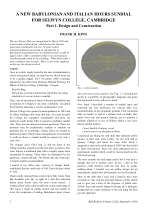
This article details the design and construction of a new elliptical slate sundial for Selwyn College, Cambridge, indicating both Babylonian and Italian hours. It discusses the selection of the site, the unique nodus design, precise surveying for wall parameters, and the process of setting out and cutting the dial with inscriptions.
Construction Projects, Dials: Vertical, Mathematics of Dialling, Sundial Design & Layout
December 2010
Page 12
Page 12
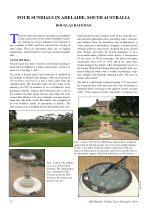
This report details four sundials in Adelaide. It includes the Olde Adelaide Sundial at Carrick Hill House with a unique equation of time reflecting South Australia's time zone, two dials at Seymour College, and an unusual polar meantime dial by Government Astronomer Charles Dodwell in the Pioneer Women’s Memorial Garden.
Dials: Horizontal, Dials: Polar, Dials: Vertical, Historical Dials
March 2009
Page 8
Page 8
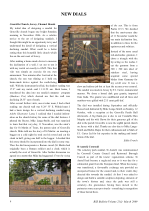
This section features descriptions of three new sundial projects. Eddie French details the creation of a vertical declining dial in Grouville Church, Jersey, Channel Islands. Bradley Dillon describes the construction of a large horizontal cemetery park sundial in St Austell. There is also an account of Valery Dmitriev's "Angel playing a harp" sundial in St Petersburg.
Dials: Horizontal, Dials: Vertical, Construction Projects
March 2009
Page 22
Page 22
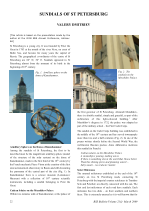
This article explores the history of sundials in St Petersburg, Russia, from the early 18th century. It describes various notable examples, including the armillary sphere on the Kunstkammer, the double sundial on the Menshikov Palace, solar milestones, and dials in Peterhof, Gatchina, Pavlovsk Park, and Demidov’s manors, as well as modern additions.
Dials: Horizontal, Dials: Vertical, Historical Dials, Dials: Armillary Sphere
June 2009
Page 2
Page 2
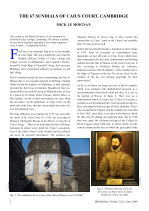
An exploration of the sundials at Gonville & Caius College, Cambridge. It details the six dials on the Gate of Honour, a lost fantastical column with 60 dials by the architect Theodore Haveus, and a rediscovered ‘great mural dial’ on the Chapel wall.
Dials: Multi Faced, Dials: Vertical, Historical Dials
June 2009
Page 5
Page 5
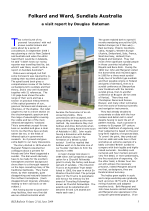
A report on a visit to Sundials Australia, run by Margaret Folkard and John Ward. It covers their design philosophy favouring cast relief dials for longevity, and manufacturing process using photopolymers. The article highlights their diverse work, including horizontal dials, armillary spheres, and international commissions.
Dials: Horizontal, Dials: Vertical, Dials: Armillary Sphere
June 2009
Page 10
Page 10
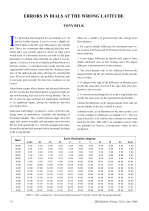
An analysis of the time-telling errors that occur when a horizontal or vertical non-declining sundial is used at a latitude different from its design latitude. The article provides tables and graphs illustrating the magnitude of these errors at different times of day and for different solar declinations.
Dials: Horizontal, Dials: Vertical, How Sundials Work, Mathematics of Dialling
June 2009
Page 12
Page 12
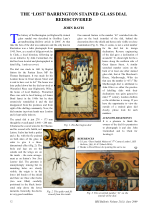
Announces the rediscovery of the Barrington (or Highworth) stained glass sundial, made in 1641 by Baptist Sutton. Previously thought lost, the dial was located with a private owner. The article details its features, including its coat of arms, a 3D-effect fly, and a scratched declination number.
Dials: Vertical, Historical Dials, Dials: Stained Glass
June 2009
Page 13
Page 13
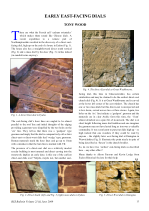
Discusses two potentially very early examples of direct east-facing vertical sundials. One is carved into the stonework of a house in Eydon, Northamptonshire. The other is carved on the church at Great Washbourne, Gloucestershire, and may be the earliest of its type.
Dials: Mass Dials, Dials: Vertical, Historical Dials
June 2009
Page 14
Page 14
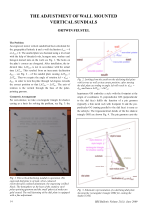
A technical article presenting a detailed mathematical method for correcting the alignment of a wall-mounted vertical sundial that has been installed with an inaccurate declination. It provides the necessary formulae and a worked example to calculate the required angle of rotation for adjustment.
Dials: Vertical, Mathematics of Dialling, Sundial Design & Layout
June 2009
Page 18
Page 18
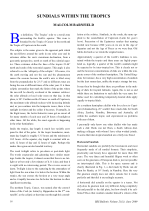
An overview of designing and using sundials in tropical regions. It discusses the suitability and challenges of various dial types, including horizontal, armillary, polar, and vertical, noting issues like noon-line crowding on horizontal dials and the advantages of other formats.
Dials: Horizontal, Dials: Vertical, Dials: Polar, Dials: Astrolabe, Dials: Armillary Sphere
June 2009
Page 44
Page 44
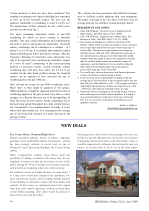
Describes two new dials. The first is a vertical declining dial with symbolic hour marks created using incised plasterwork (pargeting) in Wanstead. The second is a new globe moondial in stainless steel which shows time by the moon for nine days around the full moon.
Dials: Unusual, Dials: Vertical, Sundial Design & Layout
June 2009
Page 46
Page 46
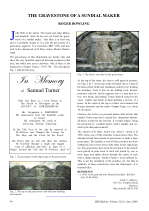
Identifies the gravestone of Samuel Turner (1716-1784), a shepherd who became a dial-maker and engraver. The slate memorial in Market Harborough, likely self-designed, features an engraved west-facing sundial and tells his life story.
Dials: Vertical, Historical Dials
September 2009
Page 8
Page 8
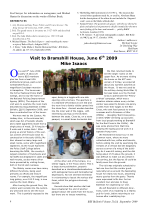
A report on a British Sundial Society visit to Bramshill House, a Jacobean mansion in Hampshire. The article describes the tour of the house, which was the former National Police Staff College, and the various timepieces examined, including a noon mark, a horizontal dial, a stone polyhedron, and a vertical dial.
Dials: Horizontal, Dials: Noon Lines, Dials: Vertical, The BSS and Members
September 2009
Page 15
Page 15
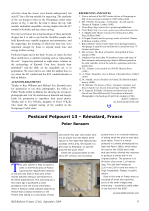
Features an early 20th-century postcard showing a sundial in Rémalard, Normandy, France. The postcard was used to guide a modern restoration of the dial. The article briefly describes the dial, its motto, and the author's visit to the Perche region, which is rich in sundials.
Dials: Vertical, Historical Dials, Mottoes, The BSS and Members
September 2009
Page 16
Page 16
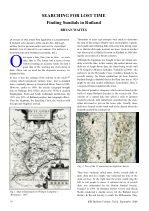
Provides a historical survey of sundials in the county of Rutland, from early scratch dials on churches to more scientific vertical and horizontal dials on mansions and public buildings. The article highlights significant local examples, discusses common mottoes, and suggests a route for a sundial tour of the area.
Dials: Mass Dials, Dials: Vertical, Historical Dials, Mottoes
September 2009
Page 20
Page 20
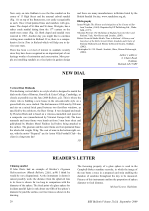
Describes a new declining vertical dial recently installed in the Midlands. The design is based on the dials at Gonville & Caius College, Cambridge. The article details its large size, construction materials including vitreous-enamelled steel and brass, and a unique feature: the coat of arms of Aston Villa Football Club.
Construction Projects, Dials: Vertical, Sundial Design & Layout
September 2009
Page 25
Page 25
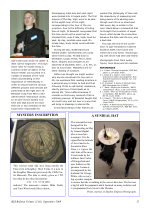
A query seeking help from readers to decipher a mysterious inscription on a vertical south dial from 1782, now in Keighley Museum. The dial was formerly at the Fleece Inn, Keighley, and the puzzling inscription reads: "C.G · 1 51 33·34·1450".
Dials: Vertical, Historical Dials, The BSS and Members
September 2009
Page 26
Page 26
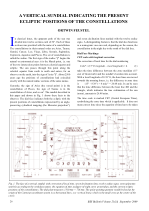
Describes the design and markings of a complex vertical sundial. In addition to time, the dial indicates the current ecliptic positions of the constellations using a Mercator projection. It also features longitude correction, an Equation of Time curve, declination lines, and functions as a nomogram for identifying constellations visible at night.
Dials: Vertical, Equation of Time, Mathematics of Dialling, Sundial Design & Layout
September 2009
Page 32
Page 32
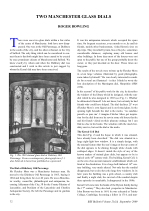
Discusses two now-lost stained-glass sundials from the Manchester area. One, at Didsbury Old Parsonage, was designed in 1903 by Fletcher Moss. The author describes the second, an 18th-century dial at Kersal Cell, and speculates it may have been instigated by its owner, the prominent Jacobite John Byrom.
Dials: Unusual, Dials: Vertical, Historical Dials
December 2009
Page 6
Page 6
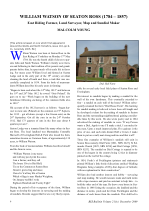
A biography of William Watson, a farmer, surveyor, and self-taught sundial maker from East Yorkshire. The article details his life, his unique 'canted-over gnomon' dial designs, his publication on dialling, and other interests. An addendum discusses the surviving examples of his work.
Dials: Vertical, Historical Dials
December 2009
Page 37
Page 37
A report on a commercial satellite dish, produced by the German firm Fuba, that incorporates a functional sundial on its parabolic surface. The author notes that the dial is designed for a specific latitude and satellite position and remarks on its similarity to a dish dial he built himself in 1999.
Dials: Vertical, Dials: Unusual
December 2009
Page 38
Page 38
This article examines 'prism dials', a form of multi-faced dial created from a diagonally sliced cube, resulting in south-east and south-west declining faces. The author provides a gazetteer of several examples found within a specific area of Gloucestershire and Wiltshire, questioning if they represent a local style.
Dials: Multi Faced, Dials: Vertical, Historical Dials
March 2008
Page 28
Page 28
This section features descriptions of recently unveiled sundials. It includes a large nodal dial in Blackrock, Co. Louth, Ireland, and a vertical sundial in Stouffville, Ontario, Canada, the latter using High Density Urethane material. It also mentions a large horizontal dial in a community garden in Barrow-upon-Soar, Lincolnshire.
Dials: Horizontal, Dials: Vertical
June 2008
Page 50
Page 50
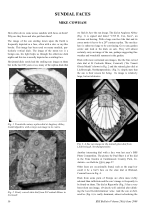
This article explores the depiction of faces on sundials, primarily smiling suns on vertical dials and replica horizontal dials, as well as moon faces and other figures like angels. It showcases various examples from Britain and Europe, discussing their symbolism and design variations.
Dials: Portable, Dials: Vertical, Historical Dials, Sundial Design & Layout
June 2008
Page 61
Page 61
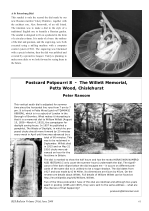
This entry features a vertical sundial in Petts Wood, Chislehurst, dedicated as a memorial to William Willett, the campaigner for daylight saving hours. The dial, dated 1927, is adjusted for summer time and carries the motto 'HORAS NON NUMERO NISI ÆSTIVAS'.
Dials: Vertical, Historical Dials, Mottoes
June 2008
Page 88
Page 88
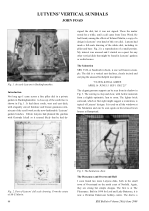
This article explores vertical sundials designed by architect Edwin Lutyens for his gardens and houses, including examples at The Salutation, The Pleasaunce, Overstrand Hall, Tigbourne Court, Hampstead Garden Suburb, Greywalls, and Mothecombe. It highlights his meticulous design, integration with architecture, and use of specific mottoes and materials.
Dials: Vertical, Historical Dials, Mottoes, Sundial Design & Layout
June 2008
Page 92
Page 92
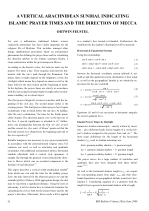
This paper describes the design of a vertical south arachnidean sundial to indicate Islamic prayer times (Zuhr, Asr) and the Qibla (direction to Mecca). It explains the astronomical principles and mathematical formulae used to calculate the specific prayer curves and Qibla curve, making it readable from a significant distance.
Dials: Vertical, Historical Dials, Mathematics of Dialling, Sundial Design & Layout
September 2008
Page 102
Page 102
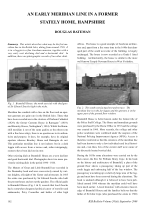
This article describes a meridian line at Bramshill House, Hampshire, believed to be the earliest in the British Isles, dating to around 1720. It also describes a west declining dial and a now-missing horizontal dial.
Dials: Horizontal, Dials: Vertical, Historical Dials, Dials: Noon Lines
September 2008
Page 108
Page 108
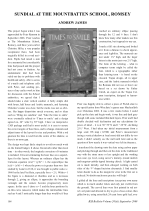
This article describes the creation of a slate vertical sundial as a memorial at The Mountbatten School. Designed for Greenwich time and features a superellipse for hour line termination. The piece details the carving, gilding, and stainless steel gnomon construction, culminating in its successful unveiling in 2007.
Dials: Vertical, Sundial Design & Layout, Construction Projects
September 2008
Page 118
Page 118
Irene Brightmer shares details of a vertical surrealist sundial by Salvador Dalí in Paris, featuring a blue-eyed female face. She also describes two historic meridians nearby: one in the Church of Saint-Sulpice, commissioned from Henry Sully, and the official Paris meridian marked by over a hundred Arago medallions.
Dials: Noon Lines, Dials: Unusual, Dials: Vertical, Historical Dials
September 2008
Page 121
Page 121
This paper describes the 1833 sundial at Liverpool Road Station, Manchester, the world's oldest extant railway station. It details the brass dial's features, its historical significance in railway timekeeping disputes, and its role as a public relations tool. The original dial is now in a museum, replaced by a 'dummy' dial on site.
Dials: Vertical, Historical Dials, The BSS and Members
September 2008
Page 123
Page 123
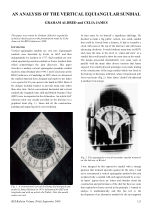
This paper provides a mathematical analysis of James Richard's rare vertical equiangular meantime sundial, designed to resemble a clock with equally spaced hours. It explains the gnomon's upward inclination and daily displacement, allowing for mean time and BST adjustments. The analysis, an alternative to Foster-Lambert theory, aims to stimulate interest in this unusual dial type.
Dials: Foster-Lambert, Dials: Vertical, Mathematics of Dialling, Sundial Design & Layout
September 2008
Page 129
Page 129
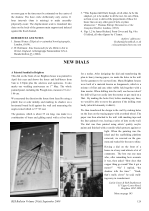
Jackie Jones and Rob Stephenson describe painting a new vertical sundial on their Brighton house in April 2008. The dial shows hours, half-hours, solstices, equinoxes, and their wedding anniversary. The article details the process from transferring the design to the wall, the painting and installation, along with amusing public reactions to the new dial.
Dials: Vertical, Sundial Design & Layout, Construction Projects, DIY Sundial Projects
September 2008
Page 136
Page 136
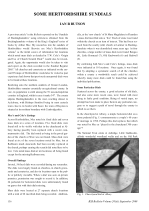
This article details a survey of sundials in Hertfordshire, reporting 56 fixed dials, 24 missing pedestals, and 68 mass dials across 27 church locations. The author highlights various interesting examples, including commemorative dials, vertical dials on cottages, historic horizontal dials, and unusual designs like a pestle and mortar scaphe dial.
Dials: Horizontal, Dials: Mass Dials, Dials: Vertical, Historical Dials
September 2008
Page 148
Page 148
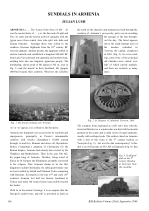
Julian Lush explores the prevalence of sundials in Armenia, linking their abundance to the nation's ancient veneration of the sun deity 'Ar.' He describes the common 'shell' or 'scallop' dial form found on 5th-13th century churches and monasteries, noting unique Armenian alphanumeric hour numbering and the enduring sun disc emblem on khachkars.
Dials: Vertical, Dials: Unusual, Historical Dials
December 2008
Page 172
Page 172
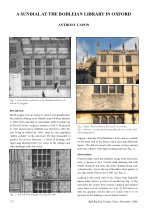
This article investigates the historical existence of a sundial on the south wall of the Bodleian Library, depicted in Loggan's 1675 drawing and a later 1818 engraving. It provides evidence for its reality, discusses its disappearance by 1814-1880 due to redundancy and weathering, identifies Richard Hawkins as its painter in 1641, and suggests its original positioning.
Dials: Vertical, Historical Dials
December 2008
Page 193
Page 193
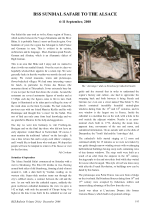
A report on the BSS Sundial Safari to the Alsace region of France, detailing visits to various towns and villages. It describes numerous sundials encountered, including those at Strasbourg Cathedral, Soultz, Guebwiller, St-Marc convent, Colmar, Eguisheim, Riquewihr, Bergheim, Mont Ste-Odile (featuring a polyhedral dial), and Freiburg (Germany), as well as the Kirschgarten Museum in Basel.
Dials: Vertical, Dials: Multi Faced, Historical Dials, The BSS and Members
March 2007
Page 2
Page 2
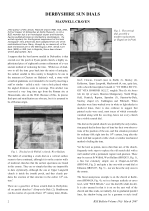
This article provides an overview of sundials found in Derbyshire, from ancient scratch dials on medieval churches to more sophisticated wall and public sundials. It highlights notable examples like the Eyam parish church dial and various works attributed to the Whitehurst family of clockmakers. It also touches on the historical context of timekeeping for ordinary people and the aristocracy.
Dials: Vertical, Restoration projects, Historical Dials, Dials: Cube
March 2007
Page 12
Page 12
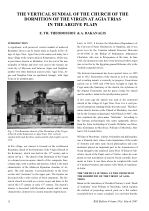
This paper describes a significant, well-preserved medieval Byzantine vertical sundial found at the Church of the Dormition of the Virgin in Agia Trias, Greece. It explores the dial's historical context, its connection to William of Moerbeke's translation of Ptolemy, and its design featuring Greek capital letters for hour lines. The authors also discuss its construction and possible dating.
Dials: Vertical, Historical Dials, Sundial Design & Layout
March 2007
Page 18
Page 18
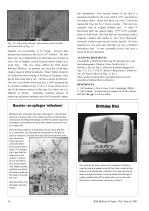
This short note describes an eightieth birthday cake made for Dr John Lester, which was delineated as a vertical south dial. The humorous observation is made that it might slide off the plate if placed on a wall and questions if it should show 'temporary' hours.
Dials: Vertical
March 2007
Page 19
Page 19
Mike Cowham describes a survey of early French 'shell' dials, often found carved into church walls, dating between 1050 and 1200 AD. He details 11 examples, noting their varying numbers of divisions, high mounting positions, and possible connection to pilgrimage routes. The article speculates on their purpose, mainly to record solar noon and indicate church services.
Dials: Mass Dials, Dials: Vertical, Historical Dials, Sundial Design & Layout
March 2007
Page 28
Page 28
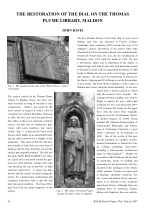
This article details the restoration of a vertical lead sundial on the Thomas Plume Library in Maldon, Essex. It describes the dial's historical context, its construction from lead sheet over oak boards, the damage caused by squirrels, and the repair process including repainting and gilding. The dial is a direct south design and dates from around the turn of the 18th century.
Dials: Vertical, Historical Dials, Restoration projects
June 2007
Page 69
Page 69
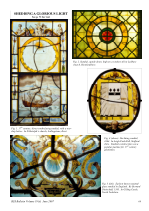
This article, a re-publication, discusses the history and art of painted or stained-glass window sundials in Britain. It covers their construction, fragility, the challenges of preservation, and highlights notable examples and makers like Bernard Dininckoff and Henry Gyles.
Dials: Vertical, Sundial Design & Layout, Restoration projects, Historical Dials, Dials: Stained Glass
June 2007
Page 83
Page 83
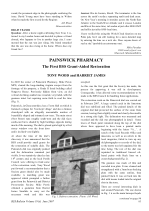
This article describes the restoration of a faded vertical declining sundial at Painswick Pharmacy, the first to receive a British Sundial Society grant. It details the cleaning, stabilisation of a crack, repainting, and strengthening of the iron gnomon. The article also touches on the dial's possible historical connection to local clockmakers and its asymmetrical placement.
Dials: Vertical, Restoration projects
June 2007
Page 84
Page 84
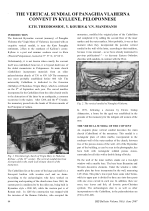
This article describes a unique vertical sundial at the Byzantine Panaghia Vlaherna Convent in Kyllene, Greece. Made of white marble, it features 13 fan-shaped petals representing hours without numerals, reflecting local tradition and contrasting with Western sundial practices. It discusses the monastery's history and the dial's architectural integration.
Dials: Unusual, Dials: Vertical, Historical Dials
September 2007
Page 114
Page 114
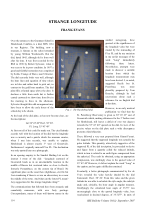
This article investigates a peculiar Pl. Long. inscription on the 1845 Hawkshead Grammar School sundial. Through extensive correspondence, Pl Long was identified as The Plane's Longitude referring to the hour angle in angular measure when the sun is directly over the style, rather than a geographical longitude.
Dials: Vertical, How Sundials Work, Sundial Design & Layout
December 2007
Page 153
Page 153
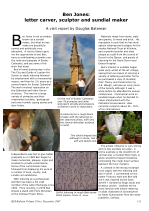
This report profiles Ben Jones, a letter carver and sculptor based in Devon, who has also become a skilled sundial maker. His work, which comprises 25-30% of his commissions, is noted for its artistic and unique designs, ranging from shield-shaped vertical dials to analemmatic dials and multi-faceted columns. He integrates his lettering skills and sculptural form into his creations.
Dials: Vertical, Dials: Polar, Sundial Design & Layout
December 2007
Page 178
Page 178
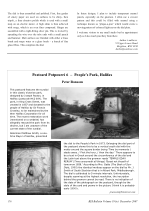
This article describes a sundial featured on a postcard from People’s Park, Halifax. The vertical south dial, presented in 1873, includes mottoes in English, Greek, and Latin. The author notes its similarities to another dial by J. Smith in Albert Park, Middlesbrough, and dates the postcard image to the early 1900s based on its style.
Dials: Vertical, Historical Dials, Mottoes
December 2007
Page 179
Page 179
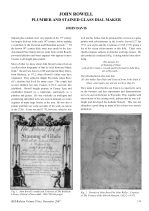
This biography details John Rowell (1689-1756), a provincial plumber and self-taught glass painter who became known for stained glass sundials in the 18th century. It covers his life, business, the influence of his clockmaker father-in-law, and two notable dials: the 'IR 1733' dial at Arbury Hall and the 1734 Purley Hall dial. The latter has undergone restoration, with analysis showing engraving errors and the design of a replacement gnomon.
Dials: Vertical, Sundial Design & Layout, Restoration projects, Historical Dials, Dials: Stained Glass
February 2006
Page 2
Page 2
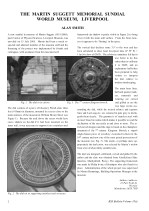
This article describes the unveiling of a memorial sundial for Martin Suggett at the World Museum, Liverpool. It details the dial's design, crafted from Welsh slate with a stainless steel gnomon, featuring a relief based on the 7th-century Kingston Brooch. The sundial is calibrated to show local Liverpool time, accompanied by an explanatory leaflet for visitors.
Dials: Vertical
February 2006
Page 16
Page 16
This article investigates the east-west orientation of UK churches and its implications for vertical sundials. It discusses historical reasons, such as facing Jerusalem or equinox sunrise, alongside practical influences like site topography that cause deviations. The author advises checking a church's orientation carefully before installing new sundials.
Dials: Vertical, Sundial Design & Layout, Historical Dials
February 2006
Page 26
Page 26
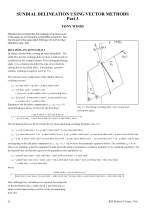
This instalment, the third in a series, presents the complex mathematical methods for delineating declining-inclining sundials using vector analysis. It provides detailed equations for calculating the shadow plane components, hour and declination lines, sub-style angles, and gnomon angles, building upon two previous articles.
Dials: Vertical, Mathematics of Dialling, Sundial Design & Layout
June 2006
Page 50
Page 50
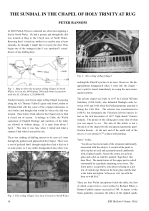
This article investigates an unusual 17th-century wall painting in Rug Chapel, North Wales, which features a dial. It details the analysis of the dial's geometry and hour lines using digital tools, comparing measured angles to calculated values for a 53° North latitude, and discusses the unexpected accuracy for a painting, suggesting sophisticated planning.
Dials: Vertical, Historical Dials, Mathematics of Dialling, Sundial Design & Layout
September 2006
Page 110
Page 110
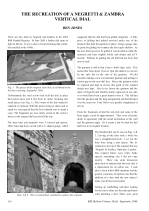
This article describes the challenging recreation of a slate vertical declining dial by Negretti & Zambra after the original was severely damaged. The process involved meticulous replication of the design, adapting features for better readability (without gilding), and installing the new dial with modern, durable fixings while preserving the original gnomon.
Dials: Vertical, Restoration projects, Sundial Design & Layout
September 2006
Page 115
Page 115
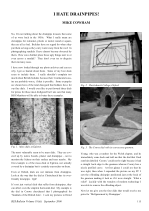
The author expresses his frustration with unsightly drainpipes and other structural elements that frequently disfigure sundials, particularly mass dials. He presents numerous photographic examples from the UK and Europe, illustrating how these obstructions cast shadows or obscure dials, advocating for greater consideration from builders to protect these historical timepieces.
Dials: Vertical, Dials: Mass Dials
September 2006
Page 118
Page 118
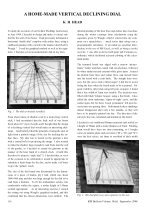
This article recounts the personal project of designing and constructing a vertical declining sundial for a golden wedding anniversary. It details the use of both graphical and computational methods for accurate delineation, the choice of materials, the incorporation of a brass heart-shaped nodus, and discusses the dial's performance and an inscribed motto.
DIY Sundial Projects, Dials: Vertical, Mottoes, Sundial Design & Layout
September 2006
Page 137
Page 137
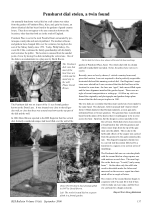
This report details the theft of a distinctive vertical sundial from Penshurst Place in Kent. Coincidentally, an almost identical twin dial was discovered in a private country garden, raising hopes for its potential replication to replace the stolen artifact. The article describes the unique design and features of these large, elegant vertical dials.
Dials: Vertical, Historical Dials, Restoration projects
September 2006
Page 142
Page 142
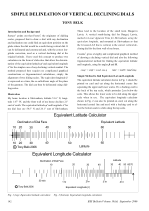
This article introduces a user-friendly method for delineating vertical declining sundials using bespoke slide rule-like calculators. These tools determine equivalent latitude and longitude, simplifying the process by eliminating complex trigonometry. The article explains how to use these calculators with standard dialling scales to accurately plot hour and sub-style lines.
Dialling Tools, Dials: Vertical, Mathematics of Dialling, Sundial Design & Layout
December 2006
Page 149
Page 149
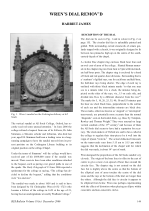
Harriet James recounts the history of Sir Christopher Wren's vertical sundial at All Souls College, Oxford, designed around 1658 with 'stepped transversals' for accuracy. The article details its relocation in 1877 and Dr. John Simmons's long-standing, unfulfilled campaign to restore it to its original position on the chapel, also touching on Wren's early interest in dialling.
Dials: Vertical, Historical Dials, Mottoes
December 2006
Page 172
Page 172
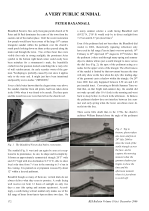
Peter Baxandall details the restoration of the 18th-century triangular sundial on St Peter and St Paul's church in Blandford Forum. The prominent dial, designed by William Bastard, features a unique numerical layout along the base and Aries symbols suggesting an equinoctial line. The restoration, led by Harriet James, preserved its original paintwork and clarified its seasonal indications despite pediment shadows.
Dials: Vertical, Sundial Design & Layout, Restoration projects, Historical Dials
March 2005
Page 15
Page 15
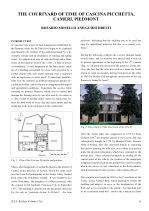
Examines the sundial ensemble in the courtyard of Cascina Picchetta, a 17th-century Italian villa. Analyses six wall-mounted sundials across two façades with varying hour systems (Italian, Babylonian, French, temporary), equatorial orientations, declination corrections, and historical decorative motifs. Explores Jesuit influences and conservation considerations.
Dials: Vertical, Historical Dials, Restoration projects
March 2005
Page 21
Page 21
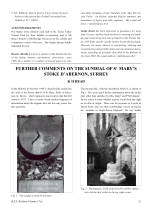
Reassesses the original Anglo-Saxon sundial at St Mary’s, Stoke D’Abernon through newly discovered early photographs. Reveals the dial’s inclined face, previously unrecognized, and reviews past interpretations. Discusses typological features of Saxon angled-gnomon dials, date uncertainty, and implications for correct dating and classification.
Dials: Vertical, Historical Dials
June 2005
Page 60
Page 60
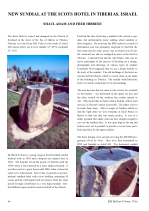
Accounts the design and installation of twin sundials—horizontal and vertical—on a basalt boulder at the Scots Hotel in Tiberias. Includes design features, analemmas, inscriptions, and collaborative process between designer and hotel staff.
Construction Projects, Dials: Horizontal, Dials: Vertical, Sundial Design & Layout
June 2005
Page 64
Page 64
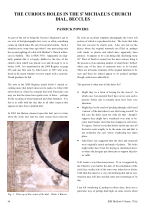
Investigation of unusual rows of holes in a declining painted dial partially obscured by a church clock. Considers possible purposes such as securing plaster or transfer of design, raising questions about early construction methods.
Dials: Vertical, Historical Dials
June 2005
Page 78
Page 78
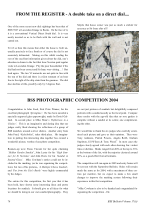
Short note describing an apparently south-facing vertical dial, that is likely accurately laid out for its small declination.
Dials: Vertical
September 2005
Page 101
Page 101
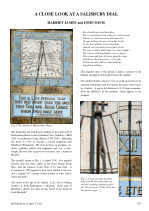
This article provides a detailed analysis of a horizontal sundial in Salisbury, noting its age and features. It describes the gnomon, which has a nodus that casts an ellipse of light on a black dot on the panel below the dial. It also examines the hour and declination lines, and discusses the decorations, such as the gilded letters and fleurs-de-lis.
Dials: Vertical, Historical Dials
September 2005
Page 116
Page 116
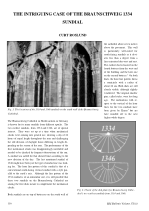
This article investigates two medieval German sundials from 1334 and 1346 that were early attempts to display equal-length hours. The 1334 dial had a horizontal style, which was a failure, while the 1346 dial used a style pointing to the celestial pole, making it the earliest known sundial of its kind.
Dials: Vertical, Historical Dials
December 2005
Page 175
Page 175
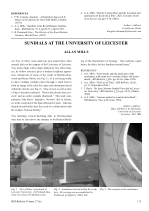
This piece highlights four unusual sundials at the University of Leicester campus. It features a two-meter-high "Eye of Time" noon mark, a modern sculptural piece indicating both time of year and day via an analemma. Also mentioned are John Davis's "Newton" dial and two matching vertical declining dials in Westmoreland slate, one showing equal hours and the other seasonal hours.
Dials: Noon Lines, Dials: Unusual, Dials: Vertical
March 2004
Page 18
Page 18
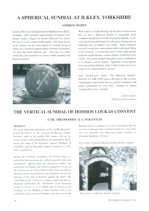
This article details the discovery of a previously undocumented vertical sundial at the Hossios Loukas Convent in Greece, a significant Byzantine monument. The simple, scratched dial on the Church of the Theotocos wall, featuring Indo-Arabic numerals, is noted as a rare example of sundials on Byzantine buildings in Greece, with its construction date unknown but post-13th century.
Dials: Vertical, Historical Dials
June 2004
Page 63
Page 63
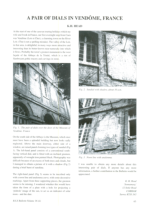
Report on two unusual dials above the doorway of Vendôme’s museum, one a vertical sundial and the other with a noon line with analemma, with observations on possible missing features.
Dials: Vertical, Historical Dials
June 2004
Page 64
Page 64
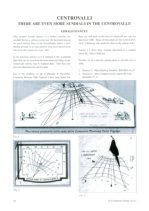
Update on sundials along the Centrovalli railway between Domodossola and Locarno, noting that there are over a hundred examples and highlighting three designs on public buildings.
Dials: Vertical
June 2004
Page 86
Page 86
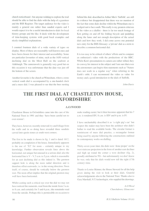
Investigation into the earliest known dial at Chastleton House, including historical documentation and physical description.
Dials: Vertical, Historical Dials
September 2004
Page 96
Page 96
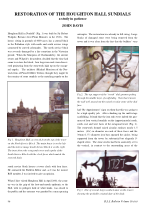
Account of discovering four large vertical dials on an octagonal cupola, surveying gnomon positions, choosing vitreous-enamel steel faces, manufacturing setbacks (overseas enamelling) and the final installation with alignment and conservation choices.
Dials: Multi Faced, Dials: Vertical, Restoration projects
September 2004
Page 101
Page 101
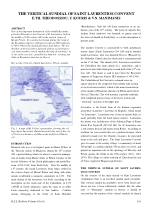
Study of a white marble vertical dial set into the south wall of the convent church: description of its semicircular plate, upside-down placement, ancient Greek numerals and discussion of likely origins (reuse from earlier Latin/antique fabric or a Byzantine installation).
Dials: Vertical, Historical Dials
September 2004
Page 105
Page 105
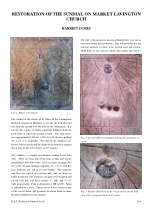
Conservation report for an east-declining carved sandstone dial: cleaning, uncovering original fixing holes, mortar repairs, paint-infill of hour lines and fitting a new brass gnomon; includes measured declination and assessment of layout inaccuracies.
Dials: Vertical, Historical Dials, Restoration projects
September 2004
Page 110
Page 110
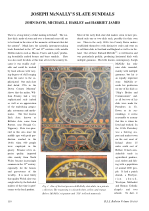
Survey of Joseph McNally’s early 19th-century slate dials (mainly Portaferry area): characteristics of multiple-gnomon plates, chapter rings with alternate longitudes, mottos, colouring evidence and the regional slate-working/dial-making context.
Dials: Vertical, Historical Dials
September 2004
Page 120
Page 120
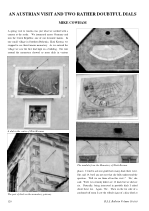
Travelogue describing a visit to several Austrian dials and analysis of two questionable/atypical examples.
Dials: Vertical
December 2004
Page 157
Page 157
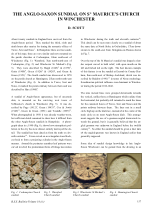
Detailed description and interpretation of the Anglo-Saxon sundial at St Maurice's Church: physical characteristics, carving motifs, probable dating, placement on the fabric and assessment of its historical and gnomonic significance.
Dials: Vertical, Historical Dials, Dials: Mass Dials
March 2003
Page 17
Page 17
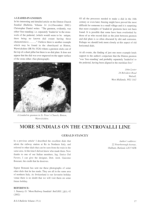
Follow-up on sundials along the Centrovalli railway line in Northern Italy, including new photographs and credit to designer Giacomo Bonzani.
Dials: Unusual, Dials: Vertical
March 2003
Page 29
Page 29
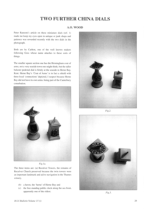
Description of two additional China sundials, extending previous findings with observations on layout and form.
Dials: Horizontal, Dials: Vertical, Historical Dials
March 2003
Page 35
Page 35
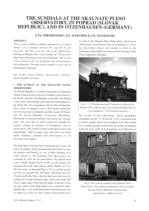
Survey of modern educational sundials installed at observatories in Slovakia and Germany, designed with scientific and pedagogical aims.
Dials: Vertical
June 2003
Page 71
Page 71
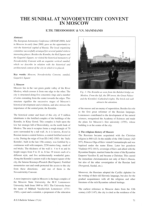
A description and analysis of the large vertical sundial located at the Novodevitchiy Convent in Moscow. The article details its construction, including the size and markings on the semicircular plate and its plain iron rod gnomon.
Dials: Vertical, Historical Dials
September 2003
Page 104
Page 104
This article re-examines the Morvah church sundial in Cornwall. The author finds that the dial was incorrectly laid out, possibly because the latitude was used where the co-latitude was needed in the design. He expresses alarm that this might be a common issue with Cornish church sundials.
Dials: Vertical, Mathematics of Dialling, Sundial Design & Layout
September 2003
Page 129
Page 129
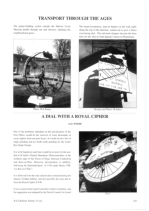
This article features two sundials with a transportation theme. One is a west-facing dial on a house in Warminster with hour lines that look like railway sleepers, and the other is a photo of a penny-farthing cyclist outside a cycle museum.
Dials: Unusual, Dials: Vertical
September 2003
Page 129
Page 129
A description of a new vertical dial at St John's Church, Ruardean, Gloucestershire. It is believed to be the only church dial to commemorate the Queen's Golden Jubilee and bear the Royal Cipher 'E II R'. The author also notes the process involved in its design and approval.
Construction Projects, Dials: Vertical
March 2002
Page 20
Page 20
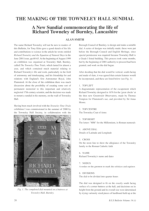
Details the conception, design, carving, and installation of a slate commemorative sundial for Richard Towneley.
Construction Projects, Dials: Vertical
June 2002
Page 45
Page 45
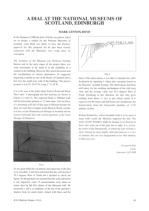
Describes the design and construction of a modern wall-mounted sundial using traditional techniques for the National Museums of Scotland.
Dials: Vertical, Sundial Design & Layout
June 2002
Page 48
Page 48
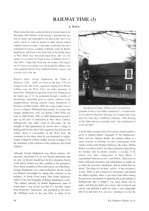
Explores the history and construction of the Stephenson sundial at Killingworth, discussing its educational significance and astronomical correctness.
Dials: Vertical, Historical Dials
June 2002
Page 63
Page 63
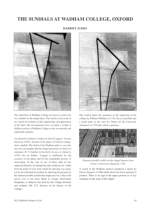
Historical investigation into two chapel sundials at Wadham College, including pictorial and documentary evidence of their former designs.
Dials: Vertical, Historical Dials
June 2002
Page 69
Page 69
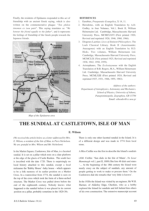
Description and analysis of a unique local sundial in Castletown with regional design features.
Dials: Multi Faced, Dials: Unusual, Dials: Vertical, Historical Dials
June 2002
Page 76
Page 76
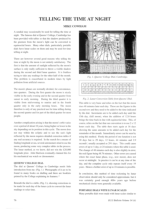
Explores historical and modern approaches to determining time after sunset using nocturnals and other devices.
Dials: Vertical, Dials: Portable, Dials: Astrolabe, Historical Dials, Dials: Nocturnals
June 2002
Page 82
Page 82
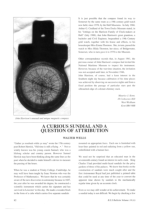
Presents a sundial of uncertain origin with unique design elements, and speculates on its maker.
Dials: Vertical, Historical Dials
September 2002
Page 91
Page 91
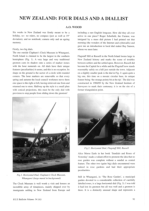
The author explores four distinctive sundials across New Zealand, discussing their design, settings, and local cultural influences, with special focus on Ray Sanson’s dials.
Dials: Horizontal, Dials: Unusual, Dials: Vertical, Historical Dials
September 2002
Page 104
Page 104
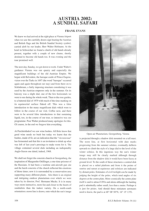
Travelogue of the BSS tour of Austria led by Walter Hofmann, visiting monasteries, public dials, and craftspeople; rich in descriptions of painted and sculptural dials.
Dials: Portable, Dials: Unusual, Dials: Vertical, The BSS and Members
September 2002
Page 129
Page 129
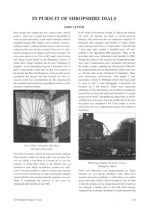
A personal account of locating and documenting sundials in Shropshire, discussing stylistic features, history, and condition.
Dials: Horizontal, Dials: Vertical, Historical Dials
September 2002
Page 132
Page 132
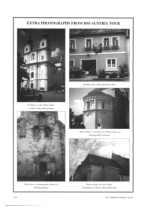
Supplemental photos from the Austria 2002 sundial tour, complementing the earlier article by Frank Evans.
Dials: Vertical, The BSS and Members
December 2002
Page 145
Page 145
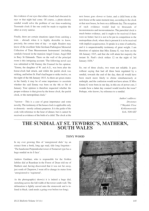
Field visit report on a large vertical church sundial in Mathern, including physical description, estimated dating, and call for other large-dial contenders.
Dials: Vertical, Historical Dials
December 2002
Page 155
Page 155
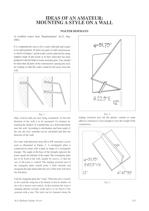
Practical notes and personal experiences regarding securely mounting a gnomon (style) on vertical walls, with attention to accuracy and materials.
DIY Sundial Projects, Dials: Vertical
December 2002
Page 172
Page 172
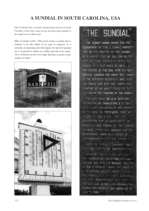
Short article describing a modern sundial built in the USA, highlighting its layout, construction, and purpose.
Dials: Vertical, Historical Dials
March 2001
Page 16
Page 16
The design and installation of the Pembroke College Wall Dial, emphasizing an uncluttered design and prominent nodus for clear time estimation. It highlights a unique coincidence for Cambridge students cycling past, aligning with lecture times. The article details the construction process, including the sealing of the mounting assembly and the replacement of missing stone, ensuring durability. It also mentions AT&T Research Laboratory's digital camera monitoring for shadow detection.
Construction Projects, Dials: Vertical
September 2001
Page 91
Page 91
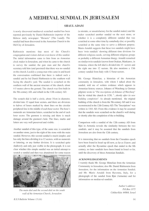
A newly discovered medieval scratch dial in the Armenian Church in Jerusalem is detailed. Discovered on the southern wall, it's a half-circle with 12 hour sectors marked by Armenian letters. A simpler "twin sundial" is also present, possibly for different religious needs. Historical evidence suggests the dials date to the 12th century, making them the first post-Byzantine sundials found in Israel.
Dials: Mass Dials, Dials: Vertical, Historical Dials
September 2001
Page 117
Page 117
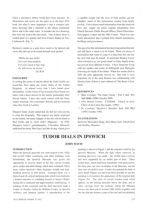
This article details the discovery of an earlier pair of wooden Tudor sundials hidden beneath later ones during demolition at Smart's Wharf in Ipswich. The original dials, dating around 1600, featured a "Protestant work ethic" motto. Analysis revealed the replacement dials were more accurate and likely installed in the mid-1700s, showcasing the efforts made to maintain dial accuracy.
Dials: Vertical, Historical Dials, Restoration projects
September 2001
Page 123
Page 123
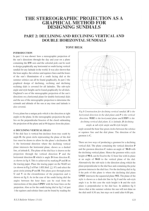
This second part details using stereographic projection for graphical design of declining and reclining vertical, and double horizontal sundials. It explains how to determine sub-style angles and style heights, and how the projection can cover full 24-hour periods. The article also covers William Oughtred"s "Horizontal Instrument" and Blagrave"s "Mathematical Jewel" as related applications.
Dials: Double Horizontal, Dials: Vertical, Mathematics of Dialling, Sundial Design & Layout
December 2001
Page 166
Page 166
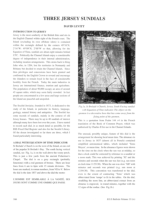
This article details three interesting sundials on Jersey. St Brelade's Church features an 1837 south-facing vertical dial with a unique Equation of Time indicator. A circa 1825 vertical declining dial by Elias le Gros in St Helier's Royal Square is notable for its history of obliteration and restoration. The third is a possible medieval Mass Dial, a carved stone found partially buried, suggesting its age and raising questions about its original function.
Dials: Mass Dials, Dials: Vertical, Equation of Time, Historical Dials
December 2001
Page 171
Page 171
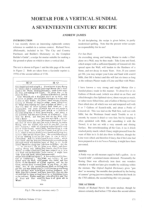
This article presents a 17th-century recipe for a strong mortar, suitable for creating a flat surface for a vertical sundial. From Richard Neve's 'The City and Country Purchaser, and Builder's Dictionary,' it uses lime and sand with linseed oil or skimmed milk. A tougher version includes 'boring/gun dust.' The author notes fast-drying and cracking issues, suggesting alternative preparations, and contextualizes Neve's architectural dictionary.
Dials: Vertical, Historical Dials
February 2000
Page 29
Page 29
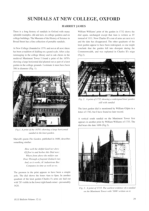
February 2000
Page 48
Page 48
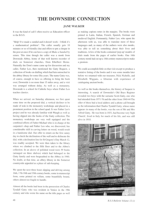
Description of Downside School's connections with BSS and installation of a wall dial designed by a master.
Dials: Vertical
October 2000
Page 125
Page 125
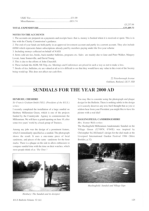
Showcase of sundials commissioned or constructed to commemorate the millennium year.
Dials: Analemmatic, Dials: Equatorial, Dials: Horizontal, Dials: Vertical, The BSS and Members
February 1999
Page 18
Page 18
This article describes a vertical, almost direct south, sundial made in 1997 for a barn wall in Nidderdale. Constructed from plywood with a wrought iron style, it features decorative figures symbolizing agricultural life and an equation-of-time correction system via an adjustable disk.
Dials: Vertical, Sundial Design & Layout, Construction Projects
February 1999
Page 38
Page 38
This article describes three wall sundials in Serbia: one in Strpce with historical day lines and a Cyrillic motto; one in Valjevo showing various international noons and birthdays of famous Serbians; and a rhyming motto dial in Lesak.
Dials: Vertical, Mottoes
June 1999
Page 96
Page 96
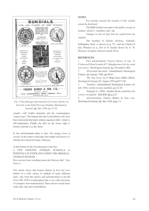
This technical article presents a method for estimating the declination of vertical sundials, particularly useful for dials high on buildings. Rather than measure the 'substyle distance' (angle between the gnomon and the noon line) one reads off the 'time' on the dial the gnomon is pointing to. This can be looked up in a precalculated table for a given latitude to give the degrees of declination of the dial.
Dialling Tools, Dials: Vertical, Mathematics of Dialling
June 1999
Page 98
Page 98
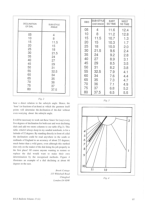
Details the restoration of the author's first vertical east declining sundial, originally made in 1986. It describes the process of stripping old paint, repainting, and redrawing the dial face with hour, equinox, and solstice lines. Challenges in transferring designs and painting fine lines are discussed, along with the decision to use black numerals for better contrast and adding a computer-drawn Equation of Time graph.
DIY Sundial Projects, Dials: Vertical, Restoration projects, Sundial Design & Layout
October 1999
Page 108
Page 108
This article describes two sundials in Andover, Hampshire, both linked to William Hawkins Heath (1787-1861), a brewer and banker. One, dated 1846, is on London Street with the motto 'Respice Finem' and an equation of time table bears just the initials W.H.H. The second, dated 1833, is in poor condition on the Savoy Cinema (formerly Heath House) and bears his full name, solving the initials riddle. The article details Heath's family business and civic roles.
Dials: Vertical, Equation of Time, Historical Dials, Mottoes
October 1999
Page 139
Page 139
This article surveys 214 fixed sundials in the former SFR Yugoslavia, now divided into multiple new states. It highlights a Roman spherical dial from Sremska Mitrovica, the oldest Serbian sundial at Studenica Monastery (12th century), and the horizontal dial at Belgrade Observatory. It notes the scarcity of sundials in Macedonia and Bosnia and Herzegovina due to Turkish reign, and discusses Italian-influenced medieval stone dials on the Croatian Adriatic coast, including one in Dubrovnik with both contemporary and old Italian hour scales.
Dials: Horizontal, Dials: Portable, Dials: Scaphe, Dials: Vertical, Historical Dials
October 1999
Page 146
Page 146
This article describes a technique for rapidly producing vertical skeleton sundials from stainless steel using a 3.5-kilowatt laser cutter. Designs are created on a computer with specific location, wall orientation, and date lines. The method allows for intricate details, including owner's names and quotations. The technique can also create silhouette window sundials with sandblasted glass, and accurate analemma plates in stainless steel and brass, suitable for human-involvement analemmatic dials.
Construction Projects, DIY Sundial Projects, Dials: Vertical, Sundial Design & Layout
February 1998
Page 21
Page 21
A commemorative dial marking a golden wedding, covering layout, materials and the celebratory inscription, with remarks on siting and legibility.
Construction Projects, Dials: Vertical, Mottoes
February 1998
Page 22
Page 22
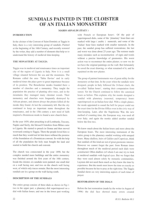
Survey of painted dials in a monastery cloister at Taggia (Imperia), noting multiple faces, canonical hours and decorative treatments, with historical context and observations on preservation.
Dials: Vertical, Historical Dials, Restoration projects
June 1998
Page 3
Page 3
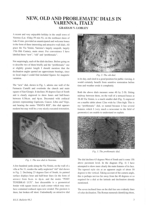
An account of a holiday in Varenna, Italy, which unexpectedly revealed three interesting wall dials. The author describes the new and old dials briefly and the 'problematic' dial in more detail, asking for help with its unexplained features.
Dials: Vertical
June 1998
Page 38
Page 38
This article provides a straightforward set of equations for the design of sundials that simultaneously recline from the vertical and decline from the south. It revisits the formulas for vertical declining dials and demonstrates how these two types of tilts combine to derive effective values for both angle and declination.
Dials: Vertical, Mathematics of Dialling, Sundial Design & Layout
June 1998
Page 41
Page 41
This article reports on the discovery of two medieval vertical scratched dials on churches in Narda and Sopron, Hungary, dating from the 13th and 14th centuries. It also features two recently constructed sundials on historical buildings in Szombathely and Pannonhalma, illustrating both ancient and contemporary gnomonic practices in Hungary.
Dials: Mass Dials, Dials: Vertical, Historical Dials
October 1998
Page 27
Page 27
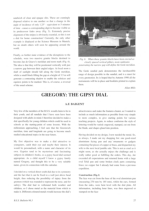
This article describes the creation of "Gregory," a vertical direct south sundial designed specifically for young children and school use. Made from recycled metals, the dial features a gypsy face, with hair and eyebrows shaped to represent the equation of time. Its design aims to attract youngsters and serve as a teaching aid for time and longitude.
DIY Sundial Projects, Dials: Vertical, Equation of Time, Sundial Design & Layout
October 1998
Page 37
Page 37
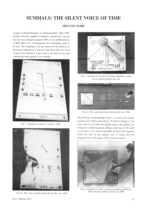
This article documents the impact of the civil war in former Yugoslavia on some sundials in Sarajevo, illustrating their destruction and disappearance. Through before-and-after photographs, it shows a marble sundial damaged by a shell fragment, a faculty building dial hit by artillery, and a west-facing wall dial that vanished, highlighting how even these silent timekeepers suffer during conflict.
Dials: Vertical, Historical Dials
January 1997
Page 45
Page 45
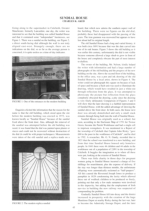
Description of the sundials at Sundial House in Culcheth, Greater Manchester, their historical setting, and unique design elements. Notes on their preservation and cultural value.
Dials: Vertical, Historical Dials
January 1997
Page 47
Page 47
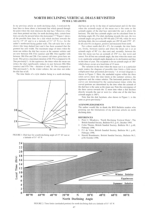
Re-examines the theory and practice behind north-declining vertical dials, correcting misconceptions and providing updated construction guidelines.
Dials: Vertical, Mathematics of Dialling
April 1997
Page 34
Page 34
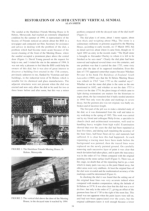
A case study in the careful restoration of an old vertical sundial, detailing the methods used, historical context, and preservation considerations.
Dials: Vertical, Historical Dials
April 1997
Page 51
Page 51
An account of the Queen’s College sundial, its history, design, and significance within its architectural setting.
Dials: Vertical, Historical Dials
July 1997
Page 3
Page 3
This article provides a historical overview of sundials in Israel, from ancient biblical references and archaeological artifacts to sundial makers of the 20th century. It describes various types of dials, including hemicycliums, portable stone dials, and modern vertical and horizontal dials.
Dials: Hemispherical, Dials: Horizontal, Dials: Vertical, Historical Dials
July 1997
Page 8
Page 8
A short piece about the south-facing sundial designed and built by George and Robert Stephenson in 1816, of which they were very proud, delineating it from first principles.
Dials: Vertical, Historical Dials
July 1997
Page 20
Page 20
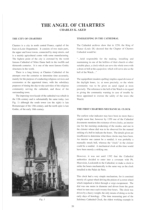
This article explores the history and function of the sundial at Chartres Cathedral, which is known as 'The Angel of Chartres'. It discusses how the dial provided local solar time and served as a benchmark for timekeeping, even after the introduction of mechanical clocks.
Dials: Vertical, Historical Dials
October 1997
Page 51
Page 51
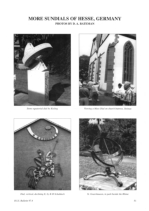
This section provides photographs of various sundials in Hesse, Germany, including a stone equatorial dial by Kieling, a vertical declining dial by Schaldach, a mass dial on a church buttress in Steinau, and a sundial in a park in St. Goarshausen.
Dials: Equatorial, Dials: Mass Dials, Dials: Vertical, Historical Dials
February 1996
Page 16
Page 16
A description of a large vertical sundial erected in Chatham to commemorate Admiral Nelson, designed to mark the time of his death at Trafalgar.
Dials: Vertical, Historical Dials
June 1996
Page 10
Page 10
An in-depth exploration of azimuth sundials, comparing projection methods, construction techniques, and their advantages, with historical and modern examples.
Dials: Horizontal, Dials: Vertical, How Sundials Work, Mathematics of Dialling
June 1996
Page 39
Page 39
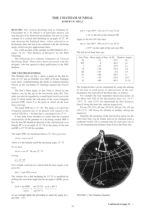
An overview of a large commemorative sundial in Chatham, highlighting its naval heritage, symbolic design, and community impact.
Dials: Vertical, Historical Dials, Mathematics of Dialling
October 1996
Page 32
Page 32
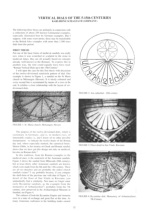
A scholarly examination of vertical sundials from the early medieval to late medieval periods, including typologies, geographic distribution, and functional evolution.
Dials: Vertical, Historical Dials
February 1995
Page 2
Page 2
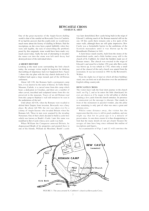
A detailed historical and archaeological analysis of the Bewcastle Cross in Cumbria, focusing on its origins, runic inscriptions, and the embedded early Christian sundial, alongside its stylistic comparisons with other Anglo-Saxon monuments.
Dials: Unusual, Dials: Vertical, Historical Dials
June 1995
Page 49
Page 49
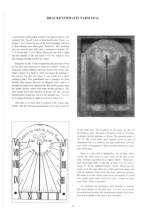
A short description and technical summary of a farm sundial, its design, history, and geographical placement.
Dials: Vertical
October 1995
Page 33
Page 33
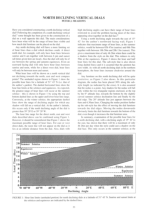
An analysis of the challenges and methods for designing sundials on north-declining vertical surfaces, with trigonometric solutions and practical tips for layout and correction.
Dials: Vertical
October 1994
Page 7
Page 7
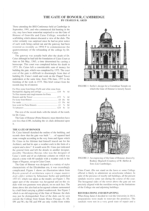
This article describes the large painted sundial in the Old Court of Queens' College, Cambridge. It discusses its history, including early records, refurbishments, and frequent repainting due to paint deterioration. The article refutes the tradition that Sir Isaac Newton designed the dial, details its features like the gilt sun-burst gnomon, Roman numerals, zodiacal signs, and scales for day duration and sunrise time. It also clarifies that it's not a "Moon dial" but has a moon table of dubious utility, and suggests improvements for future restoration for better clarity and accuracy.
Dials: Vertical, Historical Dials
October 1994
Page 24
Page 24
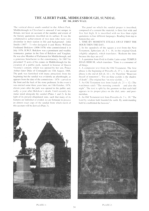
This article details the unusual vertical direct south sundial in Albert Park, Middlesbrough, a collaborative achievement designed by John Smith and commissioned by H.W.F. Bolckow in 1876. It highlights the dial's numerous literary quotations in four languages, reflecting Victorian spiritual sentiments, and its unique feature of showing time in New York, Melbourne, and Albert Park. The article discusses the dial's dilapidated state, the existence of an almost exact wooden copy (possibly a prototype), and delves into John Smith's eccentric life as a self-taught farmer-astronomer-diallist, tracing his earlier sundial creations and inventions that culminated in this masterpiece.
Dials: Vertical, Historical Dials
October 1994
Page 41
Page 41
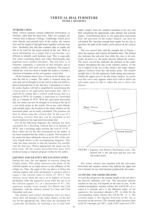
This article focuses on the additional informational elements, or "furniture," found on vertical sundials beyond just hour lines. It uses the Queens' College dial as an example of a dial rich in such information (altitude, azimuth, zodiac, sunrise time, day length). The author explains how to calculate and display various furniture types, including equinox and solstice declination lines, altitude and azimuth lines, and monthly declination lines, all based on the shadow cast by a "nodus" on the dial. The methodology involves transforming the vertical dial to an equivalent horizontal dial for simplified calculations and discusses the practical aspects of displaying such data.
Dials: Vertical, Mathematics of Dialling, Sundial Design & Layout
June 1993
Page 28
Page 28
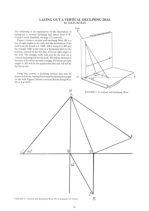
This article explains the geometric method for laying out a vertical declining sundial, drawing from F.W. Cousin's book Sundials. It details how to determine the style base, style height, equinoctial line, and noon line using a series of right angles and specific angles for latitude and wall declination. The process is illustrated with an example of a vertical dial declining West 30° at Latitude 50°N.
DIY Sundial Projects, Dials: Vertical, Mathematics of Dialling, Sundial Design & Layout
June 1993
Page 40
Page 40
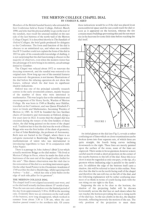
This article describes the unusual sundial on the north wall of Merton College Chapel, Oxford, discussing its restoration and historical attribution to Henry Briggs or John Bainbridge. It analyses the confusing sets of lines, including declination and azimuth lines, and explains the dial's limited functionality (5.30 to 10.00 am in summer) due to its orientation and surrounding buildings, suggesting it was an academic exercise rather than a practical time indicator.
Dials: Unusual, Dials: Vertical, Historical Dials, Sundial Design & Layout
October 1993
Page 2
Page 2
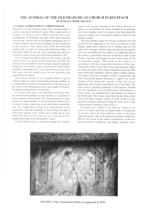
This article details the restoration of a unique astronomical chronogram sundial in Rouffach, France, dating from the early 17th century. It describes the fresco's depiction of planetary orbits based on Ptolemy and Tycho Brahe, highlighting challenges in deciphering faded inscriptions and the astrological significance of a lunar eclipse on the original dial's date in 1617.
Dials: Unusual, Dials: Vertical, Historical Dials, Restoration projects, Sundial Design & Layout
October 1993
Page 20
Page 20
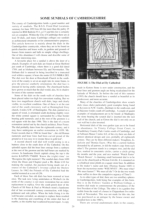
This article surveys various sundials across Cambridgeshire, including church wall dials, horizontal garden dials, and armillary spheres. It highlights specific examples, discussing their dates, inscriptions, restoration efforts, and the materials used. The text also notes the ongoing loss of old dials due to weathering but also the creation of new commemorative ones.
Dials: Armillary Sphere, Dials: Horizontal, Dials: Mass Dials, Dials: Multi Faced, Dials: Vertical, Historical Dials
October 1993
Page 24
Page 24
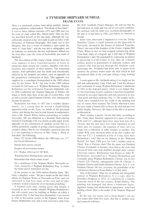
This article tells the story of a sundial from the Neptune Shipyard in Walker, Newcastle-on-Tyne, founded by J. Wigham Richardson in 1860. It traces the dial's history, its motto, and its eventual restoration. The article highlights Richardson's skill as a geometrist and the involvement of his partner, Denham Christie, and describes the dial's characteristics and its journey to the Trinity Maritime Centre.
Dials: Vertical, Historical Dials, Restoration projects
February 1992
Page 40
Page 40
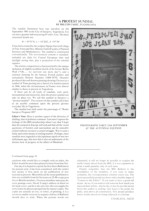
This article describes a "protest sundial" unveiled in Sarajevo, Yugoslavia, on September 6, 1991. Carved into a granite slab, it features standard astronomical content but incorporates a modified sketch of the former Berlin Wall and a satirical drawing by Honoré Daumier depicting Chronos with a cannon. The creators named it a "protest sundial" as an acerbic comment on the gloomy everyday life in Yugoslavia, reflecting political commentary through gnomonics.
Dials: Vertical, Mottoes
June 1992
Page 36
Page 36
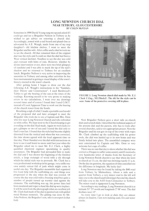
This account describes the restoration of a West vertical decliner church dial at Long Newnton, Gloucestershire, initiated by Brigadier Neilson. Colin McVean assisted in redrawing the dial, correcting for local apparent time, and creating a card model. Mr. E.J. Clark then professionally crafted the painted oak dial with gilded Roman numerals, which was successfully erected and confirmed to be accurate.
Dials: Vertical, Restoration projects
October 1992
Page 2
Page 2
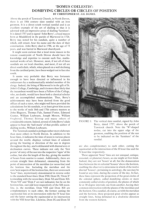
This article describes 18th-century slate sundials at Tawstock and Marwood churches by John Berry, the Tawstock dial being notable for its "domifying circles" or "circles of position". Berry, a local stonemason probably had help from a Cambridge don in laying out these sophisticated dials. These unusual domus lines indicate which astrological (rather than astronomical) zodiacal house the sun is in. The dial also features zodiacal signs, time of noon in various places, azimuth lines, and diurnal arcs for day length.
Dials: Unusual, Dials: Vertical, Historical Dials
October 1992
Page 17
Page 17
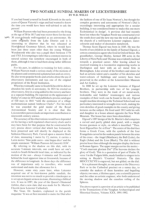
This article profiles two Leicestershire sundial makers: William Pearson and Thomas Scott Elgood. Pearson, a rector and astronomer, constructed a precise direct vertical dial in 1834 for his observatory. Elgood, an engineer, crafted a decorative slate dial in 1897 for St. Martin's Church, featuring biblical mottoes and Evangelist symbols, focusing on elegance rather than scientific precision.
Dials: Vertical, Historical Dials, Mottoes
July 1991
Page 14
Page 14
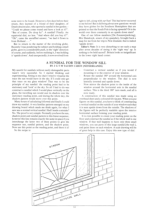
This article presents a novel DIY sundial for a window sill, featuring a stationary reading point. The author explains the construction process: delineating a vertical sundial as if for exterior mounting, then rotating it 180 degrees about the horizontal axis perpendicular to the window. Read the time by watching the shadows of the hour lines pass a stationary reading point 'nodus' on a horizontal surface. Mirroring the hour figures allows them to be read legibly.
DIY Sundial Projects, Dials: Unusual, Dials: Vertical, Sundial Design & Layout
October 1990
Page 4
Page 4
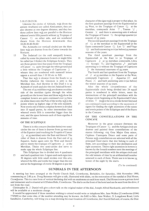
This is a notice for a meeting on 10th November 1990 in Crowthorne, Berkshire. Doug Bateman will speak on the restoration of a vertical declining dial with an analemma at Dial House, and Christopher St. J. Daniel will discuss its original maker, Joseph Alfred Hardcastle.
Dials: Vertical, Historical Dials, Restoration projects
October 1990
Page 15
Page 15
This article explains seasonal hours, a duodecimal system of dividing daylight used before mechanical clocks. It provides accurate patterns for horizontal and vertical seasonal-hour sundials suitable for latitudes 50-60° in the British Isles, noting that hour lines are shallow curves rather than straight.
Dials: Horizontal, Dials: Vertical, Sundial Design & Layout
October 1990
Page 28
Page 28
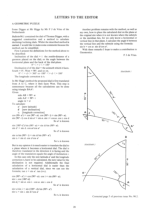
This guide provides step-by-step instructions for beginners to construct a south-facing vertical sundial using basic geometry. It covers drawing hour lines at 15° intervals and determining gnomon placement, encouraging readers to transfer their design to a permanent plate and understand the difference between local solar time and clock time.
DIY Sundial Projects, Dials: Vertical, Sundial Design & Layout
November 1989
Page 2
Page 2
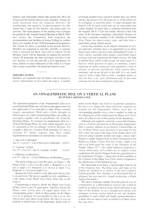
The author explores applying the analemmatic dial principle to vertical planes, contrasting it with the more common horizontal version. The article provides the trigonometric calculations necessary for constructing such a dial on a vertical declining plane, detailing how to find the sub-style to meridian, the dial's "latitude," and the difference of meridians. It describes the layout process involving primary and minor axis circles to generate hour points and arcs for zodiacal signs, explaining why a movable gnomon is impractical for vertical planes and instead a horizontal rod is used. The dial is presented as a philosophical exercise, a functional piece for those interested in the Zodiac, or an aesthetic wall ornament.
Dials: Vertical, Dials: Analemmatic, Mathematics of Dialling