- Home
- /
- Sundial Encyclopaedia
- /
- September 2020
September 2020
The articles link to the specific page in a PDF optimised for speed. If you want the whole issue, you can download it here, but the files from earlier years can be quite large.
September 2020
Page 1
Page 1
Discusses the assistance provided by John Davis for desktop publishing following the University of Cambridge closure. Notes the easing of Covid-19 restrictions and the completion of a new computer room for Christine Northeast. Commends Tony Moss's article and sadly announces the obituaries for David Young, Gordon Taylor, and Alan Smith.
The BSS and Members
September 2020
Page 2
Page 2
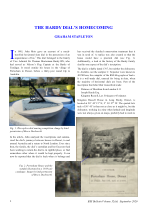
A horizontal slate dial, reliably dated 1767, belonging to Vice Admiral Sir Thomas Masterman Hardy, is tracked through its travels from Dorset to Australia and back to London. The article concludes with the dial's conservation and placement inside Portesham House, alongside a replica placed outside.
Dials: Horizontal, Historical Dials, Restoration projects, The BSS and Members
September 2020
Page 4
Page 4
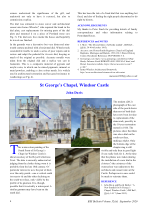
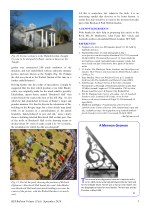
A watercolour painting likely from the late 18th century shows two dials (a vertical south and a declining south-west) on the chapel entry porch. Due to stonework replacement, most of both dials were lost, though evidence suggests there was once a third dial on the south-east face, forming a triplet.
Dials: Vertical, Historical Dials, Restoration projects
September 2020
Page 5
Page 5
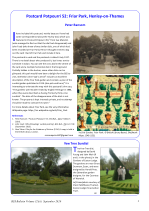
A postcard, postmarked 1917, is presented showing the Ye Dial Garden at Friar Park, which contains a cross dial and a multiple horizontal dial. The gardens were described in 1984 as having formerly contained thirty-nine sundials, though their disappearance date is unknown.
Dials: Horizontal, Dials: Multi Faced, Dials: Unusual, Historical Dials
September 2020
Page 5
Page 5
Features a photograph of the Yew Tree dial located in the Gardens of Easton Lodge, near Great Dunmow, Essex. The dial was designed by David Young and John Moir.
Sundial Design & Layout, The BSS and Members
September 2020
Page 6
Page 6
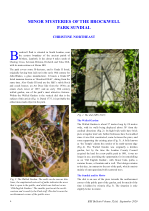
Examines a canted vertical limestone dial in Brockwell Park, dated 1775. The article focuses on translating the cryptic motto, “So Doct Ho In D,” suggesting the elegant interpretation “Sol Ducit Horas in Die” (the sun draws the hours in the day). The dial’s original location is questioned as it was designed for a wall declining approximately 38° west of south.
Dials: Vertical, How Sundials Work, Historical Dials, Mottoes
September 2020
Page 9
Page 9
Describes an unusual 18th-century horizontal dial, signed Edward Hunter Fecit, which features a pierced gnomon depicting a merman. Hunter is identified as an Irish maker.
Dials: Horizontal, Dials: Unusual, Historical Dials
September 2020
Page 10
Page 10
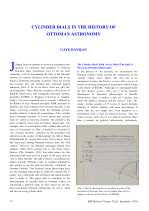
Explores the terminology and history of cylinder dials ("al-ustuwana", "‘Asâ-yı Mûsâ") in the Ottoman Empire, where they were less common than astrolabes. Introduces two Ottoman manuscripts and discusses two surviving cylinder dials from the 18th and 19th centuries, both calculated for the latitude of Istanbul (41°).
Dials: Portable, How Sundials Work, Mathematics of Dialling, Historical Dials
September 2020
Page 15
Page 15
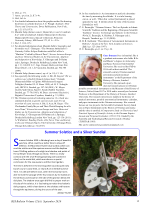
Details the performance of the Macmillan Hunter dual sundial, Dihelion, during the Summer Solstice 2020 in Edinburgh. The metal dial has a silver finish and features a horizontal rod that marks the passage of the four seasons by its shadow on a curved scale.
Dials: Horizontal, Dials: Unusual, How Sundials Work
September 2020
Page 16
Page 16
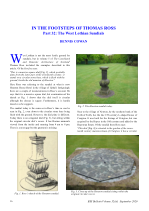
Examines sundials in West Lothian mentioned by Thomas Ross, including those at Houston House Hotel, Craigton, and Hopetoun House. Comparisons are drawn between Ross’s sketches and the dials' current condition, such as the mass dial at St Michael’s church, Linlithgow.
Dials: Horizontal, Dials: Mass Dials, Historical Dials
September 2020
Page 19
Page 19
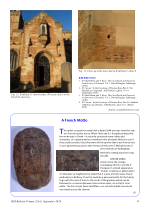
Concerns a horizontal dial dated 1644 seen at a French auction. The motto was deciphered as “CHEVER NOBLE,” possibly a personal motto associated with the family name Chever from Brittany.
Dials: Horizontal, Historical Dials, Mottoes
September 2020
Page 20
Page 20
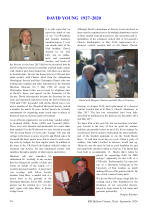
An obituary for David Young, a founder member (no. 3) and Vice-President of the BSS. He served as Secretary for ten years, organised conferences and international ‘sundial safaris,’ and was involved in projects like the Yew Tree Dial and sundial restoration projects.
Restoration projects, The BSS and Members
September 2020
Page 21
Page 21
An obituary for Gordon Ernest Taylor (no. 146), the BSS's first Registrar, renowned for his work in astronomy and lunar occultations. Highlights his gnomonic contributions, including a paper on reclining equiangular sundials (Foster-Lambert dial).
Dials: Foster-Lambert, Mathematics of Dialling, The BSS and Members
September 2020
Page 22
Page 22
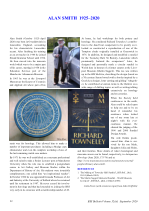
An obituary for Alan Smith (no. 49), noting his career in museum studies and horology. He designed the Towneley Hall Sundial and the Martin Suggett Memorial Sundial in Welsh slate, and contributed extensively to the Bulletin.
Sundial Design & Layout, The BSS and Members
September 2020
Page 23
Page 23
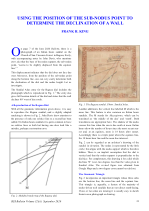
Presents a gnomonic method using the ratio of the horizontal distance between the sub-nodus point, the noon line, and the equinox line to determine a wall's declination. The technique, illustrated using the Ragusa dial, also allows calculation of the nodus height for a vertical dial.
Dialling Tools, Dials: Vertical, How Sundials Work, Mathematics of Dialling
September 2020
Page 26
Page 26
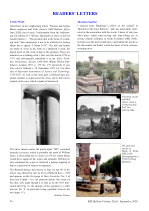
Anthony Turner clarifies that a portable dial signed J Mann 1679 should not be attributed to Joshua Mann. John Foad compares the association of the Thornton sundial with stocks to a similar instance in Ripley, North Yorkshire.
Dials: Portable, Historical Dials
September 2020
Page 27
Page 27
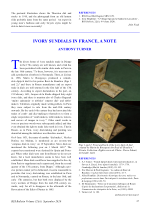
Examines the manufacture and export of ivory sundials in France, historically linked to Dieppe. Provides evidence for production in Rouen during the first half of the 17th century and mentions a notable diptych dial made in Lisieux in 1598.
Dials: Portable, Historical Dials
September 2020
Page 28
Page 28
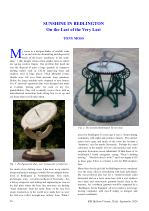
The author recounts the design and project management of his final large sundial: a horizontal mean time dial for his hometown of Bedlington. The stainless steel dial incorporates local history, featuring winding gear designs in the base and a Bedlington Terrier gnomon.
Dials: Horizontal, Sundial Design & Layout, Construction Projects
September 2020
Page 29
Page 29
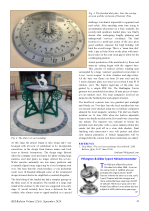
Notes that a rare, early Type 6 Tropical Pilkington & Gibbs Heliochronometer, featuring a strong base covering 90° of latitude, was offered for sale in 1996.
Dials: Heliochronometer, Dials: Portable, Historical Dials
September 2020
Page 30
Page 30
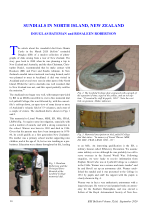
Reports on a tour detailing various sundials across New Zealand's North Island, including a memorial dial at Lynfield College. Describes a commemorative dial at the Treaty of Waitangi Grounds and the analemmatic 'Sundial of Human Involvement' in Wellington Botanic Garden.
Dials: Horizontal, Dials: Analemmatic, Historical Dials, Dials: Armillary Sphere
September 2020
Page 35
Page 35
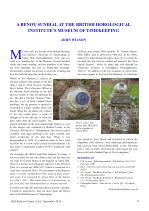
Describes an unusual Benoy dial (SRN 4074) at Upton Hall, invented by W. Gordon Benoy, that uses a liquid-filled glass cylinder to focus a light beam onto the dial face instead of a shadow. Notes the dial is in need of refurbishment and mentions a second, missing Benoy dial.
Dials: Reflected, Dials: Unusual, Historical Dials
September 2020
Page 36
Page 36
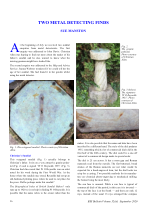
Reports on two sundial finds by metal detectorists. The first is an octagonal horizontal dial signed ‘W O Reynolds 1935’ with the motto 'Sole orto spes; decedente pax'. The second is a square dial inscribed 'Raymond Surrey', possibly made by a clockmaker.
Dials: Horizontal, Historical Dials, Mottoes
September 2020
Page 38
Page 38
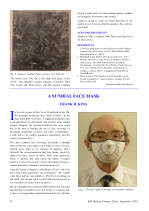
Describes the author's personal DIY project of printing a working stereographic sundial, calculated for his latitude, onto a face mask. Details the construction of a gnomon using a ball-point pen refill and a push pin, and the complexities of reading the time while wearing it.
DIY Sundial Projects, Dials: Portable, Dials: Unusual, Sundial Design & Layout
September 2020
Page 40
Page 40
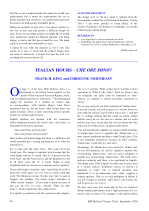
Explains the Italian terminology for 'Italian hours' (e.g., "ore italiche") and the two historical systems based on sunset. These are "ora italica comune" (geometric sunset) and "ore italiche da campanile" (half an hour after sunset, marked by the Angelus bell).
How Sundials Work, Mathematics of Dialling, Historical Dials
September 2020
Page 42
Page 42
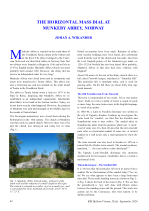
Investigates the remains of a large horizontal mass dial at the Cistercian Munkeby Abbey ruins, Norway. The term "Timstokk" (hour/rod) in Old Scandinavian refers to such a dial. Based on the alignment, the dial is estimated to date from the Middle Ages, possibly around 1350.
How Sundials Work, Historical Dials, Dials: Mass Dials
September 2020
Page 46
Page 46
Reports the results of the 2020 BSS Photographic Competition, which was moved online due to the inability to hold the Annual Conference. Mike Shaw won first place for 'Time….. Flys'.
The BSS and Members