- Home
- /
- Sundial Encyclopaedia
- /
- March 2005
March 2005
The articles link to the specific page in a PDF optimised for speed. If you want the whole issue, you can download it here, but the files from earlier years can be quite large.
March 2005
Page 3
Page 3
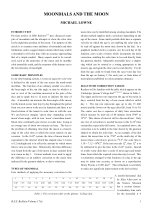
Explores principles and types of moondials, including tabular, volvelle, graphical and adjustable designs. Analyses moon’s orbital motion, parallax, illumination, and visual limitations under moonlight. Proposes improvements to enhance accuracy towards that of simple sundials, and presents prototype experimental dials demonstrating refined timekeeping performance.
Dials: Nocturnals
March 2005
Page 13
Page 13
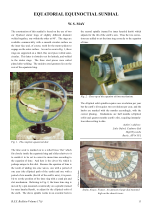
Details construction of a combined equatorial and equinoctial sundial using stacked car engine starter rings, cylindrical and brass components. Describes adjustable latitude setting and a novel gearing mechanism employing concentric eccentric spindles to apply the equation of time correction on two knobs, enabling mean time readings without manual calculation.
Dials: Equatorial, Construction Projects, Equation of Time
March 2005
Page 14
Page 14
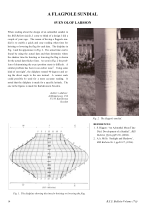
Presents design of a vertical sundial adapted for flagpole installation, with dial furniture indicating sunrise and sunset signal times for hoisting and lowering the flag. Covers dial plate calibration for specific latitude, readability challenges under low contrast, and suggests precision improvements via vernier scales and solar-aligned sighting mechanisms.
DIY Sundial Projects, Dials: Unusual
March 2005
Page 15
Page 15
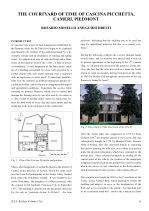
Examines the sundial ensemble in the courtyard of Cascina Picchetta, a 17th-century Italian villa. Analyses six wall-mounted sundials across two façades with varying hour systems (Italian, Babylonian, French, temporary), equatorial orientations, declination corrections, and historical decorative motifs. Explores Jesuit influences and conservation considerations.
Dials: Vertical, Historical Dials, Restoration projects
March 2005
Page 21
Page 21
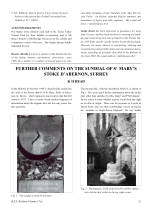
Reassesses the original Anglo-Saxon sundial at St Mary’s, Stoke D’Abernon through newly discovered early photographs. Reveals the dial’s inclined face, previously unrecognized, and reviews past interpretations. Discusses typological features of Saxon angled-gnomon dials, date uncertainty, and implications for correct dating and classification.
Dials: Vertical, Historical Dials
March 2005
Page 23
Page 23
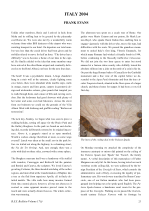
Narrates the British Sundial Society’s 2004 tour of Italy, detailing visits to Rome, Florence and Ravenna. Highlights significant sundials and meridian installations, including the Palazzo Spada ceiling dial, Pantheon meridian, San Petronio line, the La Meridiana villa and private designs. Describes historical context, local hosts, and field observations of classical gnomonic art.
The BSS and Members
March 2005
Page 28
Page 28
Celebratory poem in the style of Lord Macaulay's "Horatius" honouring David Young’s organisational role in the Society’s Italian sundial tour. Names participants, guides and hosts, and recounts itinerary highlights in rhyming verse, blending humour and historical references to classical and modern sundials encountered on the journey.
The BSS and Members
March 2005
Page 29
Page 29
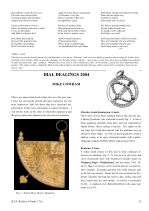
Reviews significant auction results for sundials and related instruments in 2004. Features rare horological artifacts by Wolfgang Hager, Thomas Tompion, Christoffer Schissler, Elias Allen, Hans Ducher and others. Describes design features, historical importance, condition and sale prices, illuminating market trends in scientific timekeeping collectibles.
Historical Dials
March 2005
Page 33
Page 33
Announces the British Sundial Society’s affiliation with the Royal Astronomical Society. Outlines mutual benefits including library access, journal subscriptions, use of Burlington House facilities, membership collaborations and participation in RAS meetings. Emphasises enhanced status and shared resources for astronomical research and sundial study.
The BSS and Members
March 2005
Page 34
Page 34
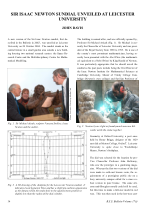
Describes unveiling of a bronze casting of Sir Isaac Newton for the new sundial at Leicester University. Covers lost-wax casting, assembly of multiple bronze sections, dimensional realignment, and recalculation of hour and date lines for new geometry. Discusses site installation, setting for local latitude and polar alignment.
Construction Projects, Dials: Equatorial
March 2005
Page 35
Page 35
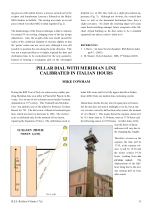
Analyses a rare Italian pillar dial in Ravenna with a horizontal gnomon, calibrated for reading the time in the Italian hours system at solar noon. Discusses calculating local noon offsets, latitude influences, and historical context of Venetian installation. Examines missing gnomon, hurricane damage and the cultural practice of hour counting from event-based day start.
Historical Dials, Dials: Noon Lines
March 2005
Page 36
Page 36
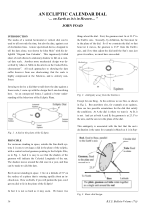
Introduces a novel ecliptic-aligned sundial for direct solar date indication on a linear scale. Describes aligning the dial plane with the ecliptic, date scale calibration, equation of date application, and improved prism-based design. Demonstrates lunar path visualization and usage for sun compass orientation.
Dials: Unusual, Mathematics of Dialling, Sundial Design & Layout
March 2005
Page 42
Page 42
Reports recent identification of likely Anglo-Saxon sundials at English parish churches. Analyses stylistic features such as relief circles, gnomon placement and line patterns. Compares regional examples, explores reuse and church reconstructions, and discusses prospects for future discoveries, preservation strategies and scholarly classification.
Dials: Mass Dials, Historical Dials, Restoration projects