- Home
- /
- Sundial Encyclopaedia
- /
- June 2012
June 2012
The articles link to the specific page in a PDF optimised for speed. If you want the whole issue, you can download it here, but the files from earlier years can be quite large.
June 2012
Page 1
Page 1
This editorial discusses feedback from a recent membership survey regarding the Bulletin. It addresses contradictory comments on article topics and tone, highlights a consensus for more design and construction articles, and touches on ideas for a beginners' series, sundial trails, and the ongoing debate about a digital version of the Bulletin.
The BSS and Members
June 2012
Page 2
Page 2
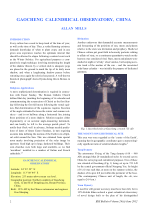
This article details the historical Gaocheng Calendrical Observatory in China, focusing on its construction in 1276 AD by Guo Shoujing, its role in calendrical observations for the Yuan Dynasty, and its design principles for measuring solstices and equinoxes using a monumental gnomon. It also describes the 'shadow-definer' device used for accuracy and the methods for orientation and timekeeping.
Dials: Noon Lines, Historical Dials, How Sundials Work, Mathematics of Dialling
June 2012
Page 8
Page 8
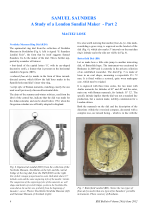
This is the second part of a study on London sundial makers named Samuel Saunders. It identifies and attributes several equinoctial ring dials, a Butterfield dial, a plane table, and other instruments based on distinctive engraving styles and features.
Dials: Portable, Historical Dials
June 2012
Page 12
Page 12
This article presents and translates a c.1440 manuscript from Aberdeen University Library, which contains what may be the earliest known description of how to make a horizontal sundial in English. It details a simple geometric construction method, discusses the design's unique features, and explores the type of gnomon described, providing insight into early scientific dials in England.
Dials: Horizontal, Historical Dials, Mathematics of Dialling, Sundial Design & Layout
June 2012
Page 16
Page 16

This article reports on the first Russian children's competition for sundial drawings held in Siversky, near St Petersburg, in late 2011. Seventeen children aged 9-13 participated, creating simplistic but impressive designs. The winner, Shimolina Irina, designed 'Pushkins', which is hoped to be built in Spring 2012.
DIY Sundial Projects
June 2012
Page 17
Page 17
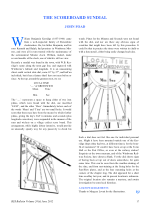
This article describes a unique direct south vertical slate sundial found in Wimborne Minster, made by clockmaker W.B. Kerridge. Its distinguishing feature is a system for displaying the Equation of Time and longitude correction using interchangeable 'FAST'/'SLOW' iron plates and possibly minute/second plates, resembling a cricket scoreboard, for public use.
Dials: Unusual, Dials: Vertical, Equation of Time, Historical Dials
June 2012
Page 18
Page 18
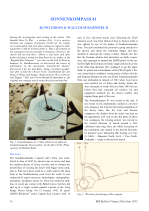
This addendum describes the German Sonnenkompass 41, issued to the Sonderkommando Dora unit in North Africa during WWII. Based on an analemmatic sundial, it featured removable dial plates for different latitudes and seasons, including German Summer Time adjustments. Despite its design, field reports deemed it unsuitable for desert use due to gnomon issues, leading to its obscurity.
Dials: Analemmatic, Dials: Portable, Historical Dials
June 2012
Page 20
Page 20
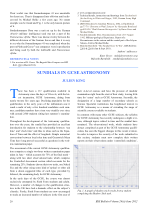
This article discusses the role of sundials in the GCSE Astronomy qualification as an introduction to 'sun time' versus 'clock time', the Equation of Time, and longitude effects. It highlights two popular Controlled Assessment tasks: using a shadow stick to determine local noon and longitude, and comparing sundial time with local mean time to assess accuracy.
How Sundials Work, Equation of Time
June 2012
Page 21
Page 21
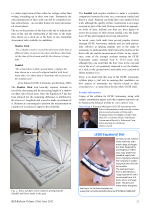
Don Rogerson of Red Oak, Iowa (USA) designs sundials using standard Lego bricks. This entry briefly describes an example: a 'Large Equatorial' dial constructed from 1x4 bricks and a 1x2 hinge plate, with grey and white blocks designating hours. Rogerson hopes to interest Lego in producing special sundial sets.
Construction Projects, DIY Sundial Projects, Dials: Equatorial
June 2012
Page 22
Page 22
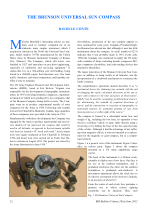
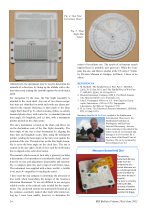
This article describes the Brunson Universal Sun Compass (Model 7637B), an elaborate US Army instrument developed in the 1950s. Its innovations included usability at all latitudes and a clockwork mechanism to counteract Earth's rotation, making it a valuable complement to magnetic/gyro-compasses for true azimuth determination in navigation and surveying.
Dials: Portable, How Sundials Work, Historical Dials
June 2012
Page 24
Page 24
This entry briefly describes a working Butterfield dial made from components of a Pocket Meccano set. It was created as a challenge for Noel Ta' Bois while he was in hospital and is now held by the BSS.
DIY Sundial Projects, Dials: Portable
June 2012
Page 25
Page 25
This entry presents the minutes from the British Sundial Society's 23rd Annual General Meeting held in Cheltenham.
The BSS and Members
June 2012
Page 30
Page 30
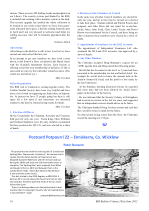
This entry discusses a postcard depicting a sundial at Powerscourt's Italian Garden in Enniskerry, Co. Wicklow. The sundial, declining 50° E, bears the motto 'Horas Non Numero Nisi Serenas' (I only mark the sunny hours) and is listed in the Register as SRN 3933, showing hours only from 5am to 1pm.
Dials: Vertical, Historical Dials, Mottoes
June 2012
Page 31
Page 31
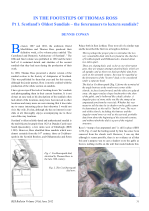
This article is the first part of a quest to track down and photograph sundials identified by Thomas Ross in his late 19th-century work. It focuses on Scotland's oldest dials, specifically three 16th-century examples at Cockburnspath, Oldhamstocks, and Seton Palace, and a fourth at Fogo, all similar in type and potentially forerunners to lectern dials.
Dials: Multi Faced, Dials: Vertical, Historical Dials, Restoration projects
June 2012
Page 34
Page 34
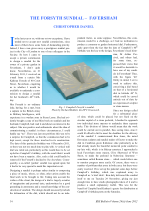
This article describes a custom-designed 'garden' sundial commissioned as a 40th birthday gift for Campbell Forsyth of Faversham. It is an inclining horizontal dial for latitude 40°N, tilted 11.5° southwards, with a unique gilded 'box' feature that indicates the exact date and time (8 December, 12 noon) on his birthday. The dial is a work of scientific art by Ben Jones, with a pedestal by Clive Sherwood.
Construction Projects, Dials: Horizontal, Dials: Unusual, Sundial Design & Layout
June 2012
Page 36
Page 36
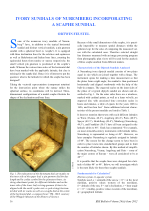
This article analyses the scaphe sundial component found in Nuremberg ivory diptych sundials. It uses vectorial representation and measured photographic distances to determine the intended latitude for three examples, concluding that Reinmann and Miller's scaphes were likely designed for 49° latitude, and Lesel's for 48°, primarily for Nuremberg.
Dials: Scaphe, Historical Dials, Mathematics of Dialling, Sundial Design & Layout
June 2012
Page 42
Page 42
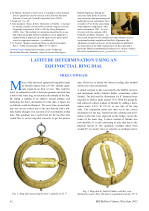
This article describes Gabriel Stokes' innovative 1735 design for equinoctial ring dials, which incorporated a direct readout declination scale for latitude determination. By setting the suspension point to the correct solar declination for the day, travellers could directly read their geographical latitude, simplifying a process that traditionally required calculations.
Dials: Portable, How Sundials Work, Historical Dials
June 2012
Page 43
Page 43
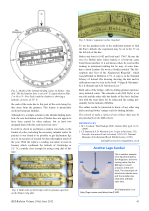
This short entry presents another equatorial sundial designed by Don Rogerson using Lego bricks. It is built around a 1x4x5 arch brick, with central blue bricks marking noon and outer bricks indicating 6am and 6pm solar time, resembling the BSS logo.
Construction Projects, DIY Sundial Projects, Dials: Equatorial
June 2012
Page 44
Page 44
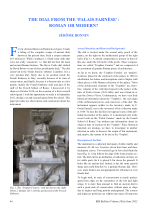
This article investigates a spherical sundial in the 'Palais Farnèse', Rome, questioning its Roman origin due to its perfect state of conservation and lack of gnomon hole. It hypothesises the dial is an 18th or 19th-century copy of a Roman original, potentially with a symbolic rather than functional purpose related to the palace's 'Trophées Farnèse' compositions about Time.
Dials: Scaphe, Dials: Unusual, Historical Dials, Restoration projects
June 2012
Page 46
Page 46
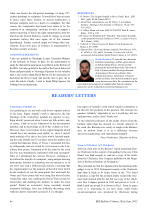
This section contains three letters from readers. Peter Drinkwater discusses a Canterbury pendant, questioning Arnaldi’s gnomon positions. Frank Coe references a Chichester Sun Compass. Sue Manston points out a potential error in the 'waxing' and 'waning' engravings on the Balliol Moondial's gnomon, to which David Harber responds confirming the mistake.
Dials: Portable, Dials: Unusual
June 2012
Page 47
Page 47
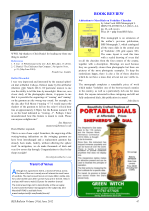
This is a review of Alan Cook’s 'Addendum to Mass Dials on Yorkshire Churches' (BSS Monograph 9), an extension of a previous publication cataloguing mass dials in Yorkshire. The monograph provides scaled drawings and descriptions of dials across the county, completing a comprehensive survey and serving as a must-read for those interested in these intriguing dials.
Book Reviews, Dials: Mass Dials
June 2012
Page 48
Page 48
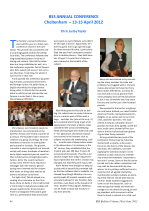
This report summarises the British Sundial Society's annual conference in Cheltenham. It covers various talks including Allan Mills on the Gaocheng Observatory, Kevin Karney on sundial software, Johan Wikander on Norwegian horizontal dials, and presentations by David Brown and Tony Moss on their dial designs. The conference also featured a discussion forum on the Society's future and a tour of local dials.
DIY Sundial Projects, Historical Dials, Sundial Design & Layout, The BSS and Members
June 2012
Page 52
Page 52
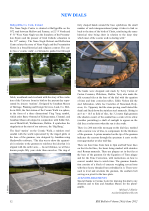
This article describes a stainless steel sundial at the Nano Nagle Centre in Ballygriffin, Ireland, which is the final 'station' of a 'cosmic walk'. Designed by Jonathan Mason, it features a 3.2-meter high gnomon with a central slit, a 200mm noon gap, and a prism for season indication. It also includes the world represented by a ringed globe and forty clasped hands symbolising intergenerational links.
Construction Projects, Dials: Equatorial, Dials: Unusual, Sundial Design & Layout