- Home
- /
- Sundial Encyclopaedia
- /
- Dennis Cowan
Dennis Cowan
December 2023
Page 12
Page 12
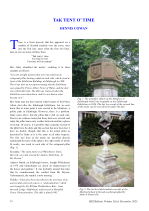
A survey of various Scottish sundials featuring the Scots proverb motto “Tak tent o’ time Ere time be tint For time will no remain,” translating to “Make the most of our time as we don’t know how long we have.” Examples include armillary spheres, multi-faced dials, and vertical dials.
Dials: Armillary Sphere, Dials: Horizontal, Dials: Multi Faced, Historical Dials, Mottoes
March 2022
Page 14
Page 14
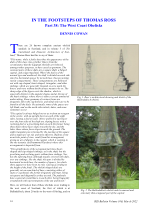
Examination of four ancient obelisk sundials located near the West Coast of Scotland, following descriptions by Thomas Ross. Sites include Ballindalloch, Lochgoilhead, Asknish House, and Mount Stuart. It also reports on the rediscovery of the mutilated Ardgowan lectern sundial and describes a cube dial at Ardgowan.
Dials: Cube, Dials: Multi Faced, Historical Dials, Restoration projects
June 2022
Page 10
Page 10
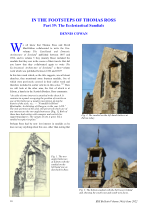
Continuing the series following Thomas Ross, this article examines nine sundials documented in his work on Scottish ecclesiastical architecture. It details the current condition, location, and history of dials found mostly on church walls or associated structures like lych-gates, including cubes and verticals, often noting signs of wear or required restoration.
Dials: Cube, Dials: Multi Faced, Historical Dials, Restoration projects
September 2022
Page 16
Page 16
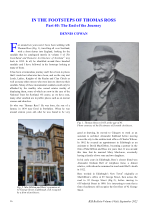
The final instalment tracing the sundials catalogued by Scottish architect Thomas Ross (1839–1930). Recounts the author's search for a rediscovery of the sundial at Magdalen Chapel, Edinburgh, and the examination of Ross's personal annotated copy of The Castellated and Domestic Architecture of Scotland.
Dials: Multi Faced, Historical Dials
March 2021
Page 38
Page 38
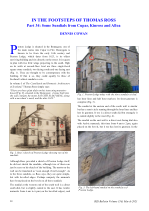
Continues the analysis of Scottish sundials described by Thomas Ross, focusing on several 17th-century examples. These include three square stone vertical dials on Preston Lodge (Cupar), two identical cube sundials at Kinross House, and a diptych sundial in Alloa made by mason Tobias Baak in 1695.
Dials: Cube, Dials: Multi Faced, Dials: Vertical, Historical Dials
June 2021
Page 13
Page 13
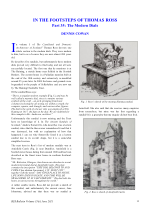
Part 35 of a series tracking dials documented by Thomas Ross, focusing on five "modern dials" (c. 19th century). The article investigates the current status of these Scottish sundials, including the missing dials at The Haining, Amisfield Castle, and Bredisholm, and detailing the surviving, unique designs at Newhall and Grange.
Dials: Multi Faced, Historical Dials, Sundial Design & Layout
September 2021
Page 10
Page 10
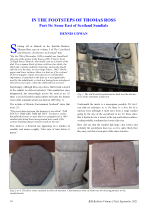
A continuation of the series following Thomas Ross, examining various sundials in the East of Scotland. Discusses the history, disappearance, and condition of dials in Hawick, Jedburgh, Ruchlaw House, Monkton House, Pitreavie (now Inveresk), Torryburn, and Cromarty.
Dials: Multi Faced, Dials: Vertical, Historical Dials, Mottoes
December 2021
Page 26
Page 26
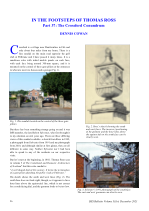
Detailed investigation into the historical changes of a cube sundial at Crossford, Fife, by comparing sketches and photographs from 1892, 1991, and 2010. The study resolved delineation errors, wrong gnomon placements, and incorrect Roman numerals, concluding the errors resulted from a rushed, poor-quality restoration following vehicle damage in the mid-1990s.
Dials: Cube, Historical Dials, Restoration projects
March 2020
Page 26
Page 26
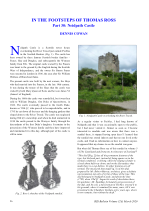
Focuses on the lectern-type sundial originally from Neidpath Castle. The article recounts the dial's history, noting it was saved by a gardener in 1795 and eventually returned to the castle in 1961. The dial is unusual as it is oblong and features a sloping hemi-cylinder ending halfway down with a cup-hollow underneath. It includes descriptions of the multiple faces, incorporating sunken, reclining, and proclining dials.
Dials: Multi Faced, Dials: Scaphe, Dials: Unusual, Historical Dials
June 2020
Page 25
Page 25
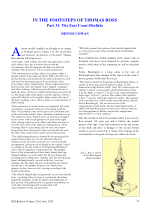
This article examines three Scottish obelisk sundials on the east coast, following the earlier historical descriptions by Thomas Ross. The dials discussed are located at Bonnington, Leven (where a conjectural restoration occurred), and a structure now at Brechin Castle, which may not have originally been an obelisk shaft.
Dials: Cube, Dials: Multi Faced, Historical Dials
September 2020
Page 16
Page 16
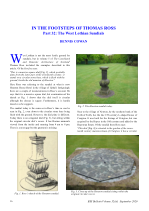
Examines sundials in West Lothian mentioned by Thomas Ross, including those at Houston House Hotel, Craigton, and Hopetoun House. Comparisons are drawn between Ross’s sketches and the dials' current condition, such as the mass dial at St Michael’s church, Linlithgow.
Dials: Horizontal, Dials: Mass Dials, Historical Dials
December 2020
Page 10
Page 10
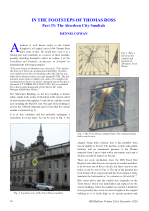
Part 33 explores three Aberdeen sundials mentioned by Thomas Ross in 1890. These include the vertical declining dial on the Municipal Building (Town House), two cubic dials on Andrew Begg's shop dated 1694, and the dial at King’s College Chapel, potentially Scotland’s oldest. The author doubts the 1494 dating of the latter.
Dials: Cube, Dials: Multi Faced, Dials: Vertical, Historical Dials
March 2019
Page 8
Page 8
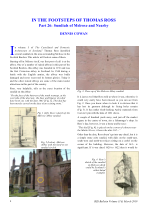
Examines historical sundials identified by Thomas Ross in the Scottish Borders near Melrose, including a carved dial (1661) at Melrose Abbey. Investigates a Melrose cube dial (c. 162-) and five of the six historical dials in Newstead. Discusses the provenance and arms on the Abbotsford dial (originally from Dryburgh Abbey).
Dials: Multi Faced, Historical Dials
June 2019
Page 10
Page 10
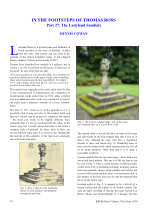
Examines two historical sundials at Ladyland House, Scotland, documented by Thomas Ross. The first is a 1673 lectern dial (star type) on an unusual pedestal. The second is an obelisk capital (dated 1821) on a graceful pedestal, noted as possibly not original to the location, and currently neglected.
Dials: Multi Faced, Historical Dials
September 2019
Page 34
Page 34
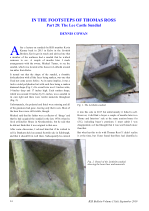
The author investigates a sunken rhombic dodecahedron sundial found in Leitholm. Initially theorised to be the missing multi-faced dial described by Thomas Ross at Lee Castle, this theory was later refuted by evidence showing that broken pieces of the original Lee Castle dial still existed elsewhere in 1984. The Leitholm and Lee Castle dials are likely by the same maker.
Dials: Cube, Dials: Multi Faced, Historical Dials
December 2019
Page 26
Page 26
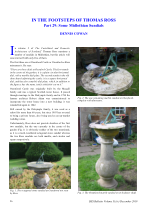
The 29th part of a series documenting sundials mentioned by Thomas Ross, focusing on five examples in Midlothian. The author traces the status and location of three dials at Oxenfoord Castle, a 1745 vertical dial in Dalkeith, and the relocation of a rare lectern sundial from Mid Calder House to Culzean Castle in Ayrshire.
Dials: Cube, Dials: Multi Faced, Dials: Vertical, Historical Dials
March 2018
Page 8
Page 8
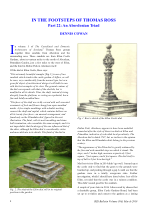
Examines three historical sundials in the Aberdeen area: Ellon Castle (two dials), Pitmedden Garden, and Duthie Park. The author reports on the discovery of the shafts and capitals of the Ellon dials during garden conservation efforts, noting their similarity to the Pitmedden dial (c. 1675). Issues of restoration and the originality of paint on the 1707 Duthie Park dial are discussed.
Dials: Multi Faced, Historical Dials
March 2018
Page 26
Page 26
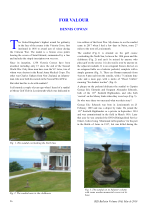
Examines the dedication of the octagonal bronze sundial at Moray Golf Club in Lossiemouth, Scotland. The dial, featuring the motto 'Docet Umbra', commemorates cousins George Eric Edwards (DSO recipient) and Sergeant Alexander Edwards (VC recipient) of the Seaforth Highlanders, both of whom perished in the First World War. The memorial was unveiled in 1931.
Dials: Horizontal, Historical Dials
June 2018
Page 6
Page 6
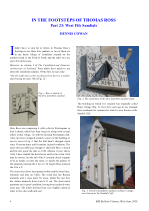
Examines four historical sundials in West Fife, Scotland, following the work of Thomas Ross. Locations include two dials in Limekilns (one possibly dated 1689), Culross Palace, and the restored Pitfirrane Castle pedestal. The replacement dial at Pitfirrane features the Halkett motto Fides Sufficit.
Dials: Multi Faced, Historical Dials
September 2018
Page 16
Page 16
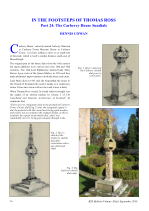
Examines two historical sundials at Carberry House, East Lothian. The first is a hollow obelisk dial capital, restored according to Thomas Ross's sketch. The second, missing for a time but now in the National Museum of Scotland, is a unique 13-dial structure featuring a female bust support, combining upright, reclining, and horizontal dials.
Dials: Horizontal, Dials: Multi Faced, Historical Dials
December 2018
Page 33
Page 33
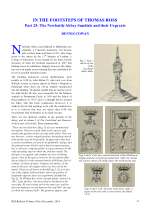
Examines the two monumental octagonal dials at Newbattle Abbey (1635), featuring unusual sunken dial-pairs with profile gnomons. Discusses two later copies: Lord Home’s (moved to King’s Park, Glasgow, 1885) and Lord Haddington’s at Tyninghame, which remains an undelineated non-sundial.
Dials: Multi Faced, Historical Dials
March 2017
Page 12
Page 12
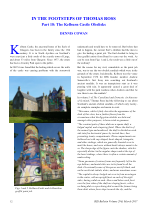
A study of two historical Scottish obelisk sundials at Kelburn Castle. The article describes the typical obelisk structure (shaft, bulged capital, tapering finial, multiple sinkings including scaphe dials). It notes the first dial's 1707 date and wrought-iron vane restoration, and the deteriorated state of the second dial, whose capital and finial have broken off.
Dials: Multi Faced, Dials: Scaphe, Historical Dials
June 2017
Page 10
Page 10
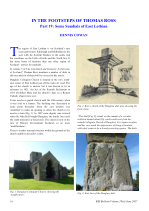
This article covers six sundials in East Lothian, Scotland, previously mentioned by Thomas Ross in volume 5 of his work. Sites detailed include Dunglass Collegiate Church and Nunraw Abbey Tower, noting their history, multi-faceted nature, and current condition or replacement status.
Dials: Cube, Dials: Multi Faced, Historical Dials
September 2017
Page 19
Page 19
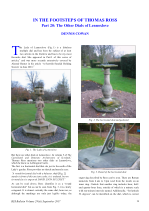
This article examines the other dials at Lennoxlove, Scotland, besides the famous multiple dial. It covers an octagonal horizontal dial engraved by David Lyon (possibly 18th century), a south and east vertical dial (1644), and a similar south and west vertical dial previously unknown to Ross.
Dials: Horizontal, Dials: Multi Faced, Dials: Vertical, Historical Dials
December 2017
Page 26
Page 26
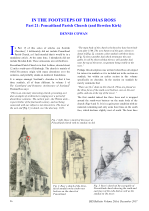
Examines two Scottish churches mentioned by Thomas Ross; Pencaitland Parish Church is unique for having three different sundials, including a multi-faced buttress dial and a cube dial. The dial at Bowden Kirk is a modern replacement that was installed with a major error in canting.
Dials: Cube, Dials: Multi Faced, Dials: Vertical, Historical Dials
March 2016
Page 26
Page 26
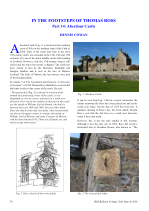
This article traces the historical sundials documented by Thomas Ross at Aberdour Castle. It describes a vertical dial (1635), a horizontal dial, and a multi-faceted dial moved from Castle Wigg, noting that the latter's Equation of Time table uses the Julian calendar appropriate for the early 18th century.
Dials: Horizontal, Dials: Multi Faced, Dials: Vertical, Equation of Time, Historical Dials
June 2016
Page 20
Page 20
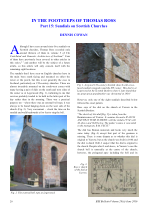
Continuation of the series, analyzing eight Scottish church sundials documented by Thomas Ross in 1892. Many are located on the south-west corner, often with two faces, suggesting afternoon services. Locations discussed include Yarrow (1640), Cortachy (1675), Inveresk (1735, by Archibald Handasyde), and Glencorse (1699).
Dials: Vertical, Historical Dials
September 2016
Page 17
Page 17
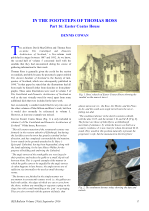
Examines a multi-faceted dial on the south-west angle turret of Easter Coates House (1615), Edinburgh, which Thomas Ross briefly mentioned. The author confirms a horizontal dial face on the upper surface, suggesting the dial is original to the building, despite it possibly containing repurposed stones.
Dials: Multi Faced, Dials: Vertical, Historical Dials, Restoration projects
December 2016
Page 22
Page 22
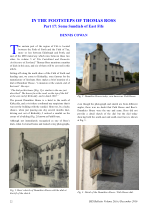
Covers six historical sundials in East Fife documented by Thomas Ross. Examples include the Path House dial (formerly Dunnikier House), the Muckle Yett dial with seven faces including scaphe dials, and cube dials at Kellie Castle (1722) and St Mary’s College (1664).
Dials: Cube, Dials: Multi Faced, Dials: Scaphe, Historical Dials
March 2015
Page 33
Page 33
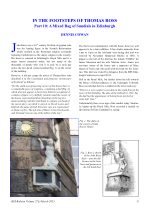
The tenth installment surveying Edinburgh's sundials mentioned by Thomas Ross. Highlights include the restored two-faced vertical dial on John Knox's House and the multi-faceted Huntly House dial (a copy of a 1732 Archibald Handasyde dial). Other dials reviewed are found at West Kirk, Corstorphine Church, Liberton House, Hudson Cottage, and Brighton Park in Portobello.
Dials: Multi Faced, Dials: Vertical, Historical Dials, Restoration projects
June 2015
Page 8
Page 8
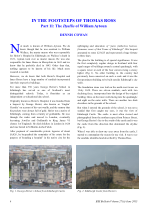
This explores the life and work of master mason William Aytoun (d. 1643), responsible for incorporating numerous sundials at Heriot’s Hospital in Edinburgh and Innes House in Morayshire. The article discusses similar dials potentially attributed to Aytoun, such as those at Peffermill House.
Dials: Multi Faced, Historical Dials
June 2015
Page 21
Page 21
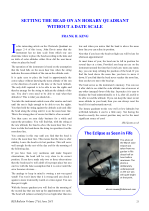
A photo and brief note regarding the partial solar eclipse of March 2015, taken from the author's garden in Fife shortly before the maximum occultation.
September 2015
Page 19
Page 19
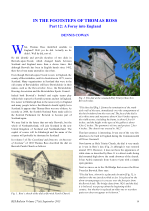
Discusses Thomas Ross's sketches and descriptions of two sundials found in Berwick-upon-Tweed (Holy Trinity Church and the Old Bridge). The article explores the historical ambiguity of Berwick's status between Scotland and England and recent restorations of the dials.
Dials: Horizontal, Dials: Vertical, Historical Dials
September 2015
Page 40
Page 40
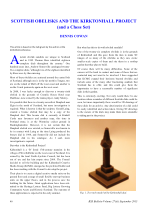
Discusses the Kirktonhall Creative Media Group project to create 3D images and small-scale copies of unique Scottish obelisk sundials for a rooftop garden archive. The author also playfully suggests a sundial-themed chess set using various famous Scottish dials.
Construction Projects, Dials: Multi Faced, Historical Dials, Sundial Design & Layout
December 2015
Page 6
Page 6
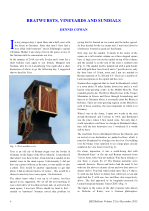
An account of a trip through Germany, specifically Trier and the Moselle wine region, detailing visits to five sundials. Dials included the Trier market cross dial, the Cusanus glass dial in Bernkastel-Kues, and various vertical dials in Wehlen, Zeltingen, and Urzig.
Dials: Horizontal, Dials: Vertical, Historical Dials
December 2015
Page 12
Page 12
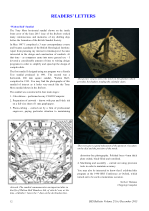
Includes three letters: Norbert Halama discusses his horizontal ‘Walton Hall’ dial; Alison Morrison-Low details James Clark’s horizontal Niddrie Marischal dial, now missing; Dennis Cowan updates on the failed Kirktonhall Project and clarifies the modern Dunphail obelisk dial's origin.
Dials: Horizontal, Construction Projects, Historical Dials
December 2015
Page 32
Page 32
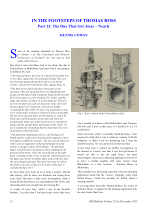
Details the successful search for the missing Polton House dial, originally sketched by Thomas Ross, which had been incorporated into a rockery. Parts of the dial (dating 1685 and 1672) were discovered and re-erected at Arniston House, Midlothian.
Dials: Multi Faced, Historical Dials, Restoration projects
March 2014
Page 44
Page 44
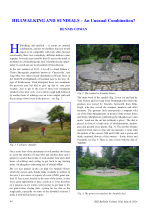
The author combines hillwalking trips in Scotland with sundial observation. Examples include the giant 35-foot gnomon-based dial at Attadale House (2009), a historic horizontal pedestal dial at Attadale made by Gilbert, Wright and Hooke (1794–1805), and a late 18th-century stumpy octagonal facetted dial at Glengarry Castle Hotel.
Dials: Horizontal, Dials: Multi Faced, Historical Dials
June 2014
Page 32
Page 32
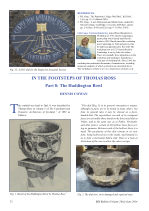
Details the rediscovery of the Haddington Bowl, a unique 17th-century facet-headed dial described by Thomas Ross in 1892. It is a vase-form dial hollowed out to form an internal horizontal dial, featuring cup-hollows (scaphes) and faces acting as gnomons, despite suffering severe damage.
Dials: Scaphe, Dials: Unusual, Historical Dials, Restoration projects
June 2014
Page 47
Page 47
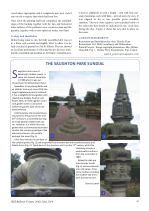
Describes the tall, ornately decorated multi-faced sundial located in the rose garden of Saughton Park, Edinburgh. The upper parts, including four vertical circular dials and a decorative finial, date from the 17th century, while the lower supporting structure resulted from an 1899 restoration.
Dials: Multi Faced, Historical Dials, Sundial Design & Layout
December 2014
Page 12
Page 12
This article examines Scottish mercat (market) crosses that incorporate sundials, such as those described by Thomas Ross. These are symbolic structures, often featuring multi-faced cube dials. Examples discussed include the Peebles cross (1662 cube sundial) and the Airth cross (1697). The author notes the common issues of relocation and subsequent restoration/damage.
Dials: Cube, Dials: Multi Faced, Historical Dials
March 2013
Page 16
Page 16
The author follows the traces of nineteenth-century architect Thomas Ross to rediscover forgotten Scottish sundials, including rare obelisk types near South Queensferry, with photographs and measurements.
Dials: Multi Faced, Dials: Vertical, Historical Dials
June 2013
Page 33
Page 33
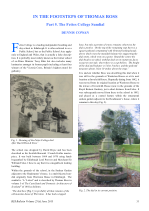
Continuing the series on Thomas Ross, this article documents a restored sundial at Fettes College, Edinburgh, with photographs and analysis of its design and craftsmanship.
Dials: Vertical, Historical Dials, Restoration projects
June 2013
Page 35
Page 35
A detailed report on multiple sundials found at Glassmount, including a rare palimpsest gnomon showing evidence of successive historical restorations.
Dials: Multi Faced, Historical Dials, Restoration projects
September 2013
Page 13
Page 13
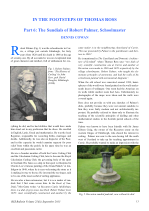
A biography of Robert Palmer (1828–1868), schoolmaster and astronomer, and a survey of his known sundials. Details are given of three scientifically constructed dials: one lost from Riccarton Castle, the detailed Currie dial (1836) with noon markings for global locations, and the Kirkbean dial (1826) containing equation of time details.
Dials: Horizontal, Dials: Unusual, Equation of Time, Historical Dials
September 2013
Page 19
Page 19
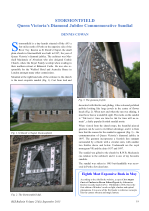
A description of the exquisite lead sundial installed on St David’s Chapel, Stormontfield, built in 1897 to commemorate Queen Victoria’s Diamond Jubilee. It is decorated with gilding and polished pebbles, featuring a pierced gnomon showing the royal monogram VR and the dates 1837/1897, alongside a Scottish motto.
Dials: Vertical, Historical Dials, Mottoes
December 2013
Page 22
Page 22
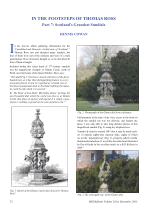
Explores four magnificent 17th-century Scottish sundials documented by Thomas Ross: the complex multi-faced dials at Glamis Castle (stellar rhombicuboctahedron), Drummond Castle (obelisk, 1630), Holyroodhouse Palace (polyhedral, 1633), and the fountain/dial at Dundas Castle (lectern type, 1623).
Dials: Multi Faced, Dials: Scaphe, Historical Dials, Sundial Design & Layout
March 2012
Page 28
Page 28
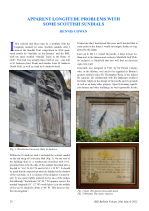
This article investigates "longitude problems" on Scottish sundials from 1877-1913, including those by famous architects. The author discovers that the inscribed "longitude" is actually the time difference from Greenwich, making it more user-friendly for time telling and correcting previous assumptions about design errors.
How Sundials Work, Historical Dials
June 2012
Page 31
Page 31
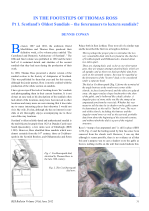
This article is the first part of a quest to track down and photograph sundials identified by Thomas Ross in his late 19th-century work. It focuses on Scotland's oldest dials, specifically three 16th-century examples at Cockburnspath, Oldhamstocks, and Seton Palace, and a fourth at Fogo, all similar in type and potentially forerunners to lectern dials.
Dials: Multi Faced, Dials: Vertical, Historical Dials, Restoration projects
September 2012
Page 16
Page 16
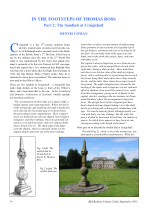
This article details two sundials at Craigiehall: a 4-metre high obelisk dial, restored in 1965 after being found in fragments, and a horizontal brass dial by John England, dating from 1702-1714. The obelisk is unique due to an 18th-century globe base, while the horizontal dial features an Equation of Time table and armorial devices.
Dials: Multi Faced, Equation of Time, Historical Dials, Restoration projects
September 2012
Page 33
Page 33
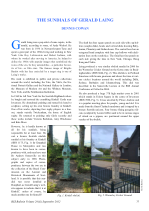
This article highlights the sundial works of pop artist Gerald Laing, known for at least four large sculptural pieces. These include two Scottish obelisk sundials, a 37ft market cross in Inverness, and "Axis Mundi" in Edinburgh, often featuring complex gnomonics and graphical representations of the Equation of Time.
Dials: Multi Faced, Sundial Design & Layout, Equation of Time, Dials: Scaphe
December 2012
Page 6
Page 6
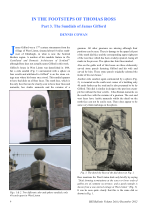
This third part traces sundials attributed to 17th-century Scottish stonemason James Gifford, following Thomas Ross's research. It examines various cube-and-sphere dials in West Linton and Newhall House, as well as the intricate multi-faceted dial at Lennoxlove, detailing their designs, numerals, and historical context within the Scottish Borders region.
Dials: Cube, Dials: Multi Faced, Historical Dials, Sundial Design & Layout
December 2012
Page 21
Page 21
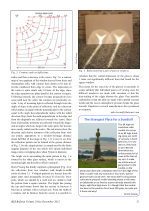
The article describes a 6ft high red sandstone cubic sundial atop an 8ft standing stone north of Luncarty, Perth & Kinross. Situated in a field, the dial's numerals and hour lines are indistinct, but gnomon holes are visible. Its century-long presence and origins remain a mystery.
Dials: Cube, Dials: Unusual, Historical Dials
June 2011
Page 25
Page 25
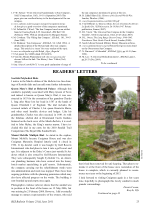
This letter provides additional information on Scottish polyhedral dials, specifically clarifying the history of Queen Mary’s Dial at Holyrood Palace and providing an update on the Mount Melville Multiple Dial's restoration plans after its removal for safekeeping.
Dials: Multi Faced, Restoration projects, Historical Dials
December 2011
Page 38
Page 38
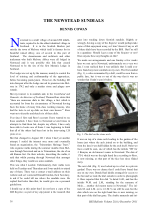
This article describes the author's quest to find and document sundials in Newstead, Scotland, following Thomas Ross's 19th-century account. It details several discoveries, including a cube dial, a semi-cylindrical dial, and other single-faced dials, some in private gardens, highlighting their historical significance and the challenges of locating them. The search continues for missing dials or fragments.
Dials: Horizontal, Dials: Multi Faced, Dials: Vertical, Historical Dials