- Home
- /
- Sundial Encyclopaedia
- /
- Graham Aldred
Graham Aldred
March 2013
Page 19
Page 19
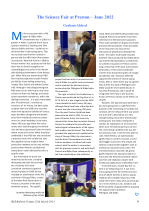
A short report on the BSS presence at a school science fair, describing the public response, educational displays, and promotion of sundial science to younger audiences.
How Sundials Work, The BSS and Members
March 2013
Page 44
Page 44
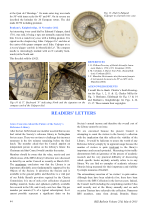
A collection of letters discussing Society matters, mass-dial archives, and north-facing dials. Contributors debate historical interpretations and the future of BSS collections.
Dials: Mass Dials, Historical Dials, The BSS and Members
March 2012
Page 34
Page 34
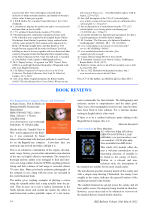
This section contains three book reviews: "The Bagnold Sun-Compass: History and Utilization" by Kuno Gross, "Essex Sundials" by Peter Meadows, and "A Dial in your Poke: A Book of Portable Sundials" by Mike Cowham, offering insights into each publication.
Book Reviews
March 2008
Page 17
Page 17
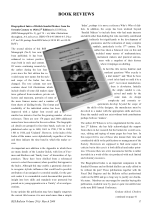
This section reviews 'Biographical Index of British Sundial Makers from the Seventh Century to 1920 (2nd Edition)' by Jill Wilson, praising its enhancements, new names, and comprehensive scope beyond simple indexing. It also reviews 'The Astrolabe' by James E. Morrison, highlighting it as a much-needed, comprehensive guide to astrolabe design, function, and construction.
Dials: Astrolabe, Book Reviews, Historical Dials
March 2008
Page 18
Page 18
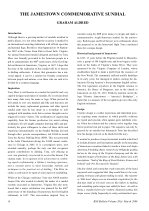
Describes the design, creation, and dedication of a large horizontal sundial by Tony Moss, commemorating the 400th anniversary of the Jamestown settlement. The unique 'navette' shaped dial incorporates Anglo-American symbolism, funded by the Sawyer Dialling Prize and sponsors, and was installed at Turner Farm Park.
Dials: Horizontal, Sundial Design & Layout, Construction Projects, The BSS and Members
March 2008
Page 22
Page 22
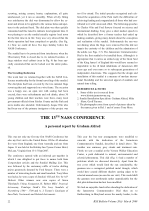
A personal report on the 13th NASS Conference in McLean, Virginia, covering presentations on various sundial topics, a bus tour to significant dials like the Lyman Briggs Memorial Dial and the Gaithersburg Latitude Observatory, and the dedication of the Jamestown Commemorative Sundial. It also details the Sawyer Dialling Prize presentation and practical workshops.
Dials: Horizontal, Dials: Polar, The BSS and Members
September 2008
Page 123
Page 123
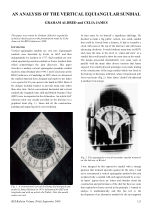
This paper provides a mathematical analysis of James Richard's rare vertical equiangular meantime sundial, designed to resemble a clock with equally spaced hours. It explains the gnomon's upward inclination and daily displacement, allowing for mean time and BST adjustments. The analysis, an alternative to Foster-Lambert theory, aims to stimulate interest in this unusual dial type.
Dials: Foster-Lambert, Dials: Vertical, Mathematics of Dialling, Sundial Design & Layout
December 2008
Page 193
Page 193
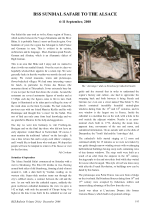
A report on the BSS Sundial Safari to the Alsace region of France, detailing visits to various towns and villages. It describes numerous sundials encountered, including those at Strasbourg Cathedral, Soultz, Guebwiller, St-Marc convent, Colmar, Eguisheim, Riquewihr, Bergheim, Mont Ste-Odile (featuring a polyhedral dial), and Freiburg (Germany), as well as the Kirschgarten Museum in Basel.
Dials: Vertical, Dials: Multi Faced, Historical Dials, The BSS and Members
September 2007
Page 98
Page 98
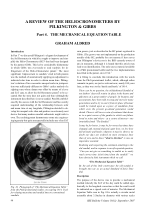
This article reviews Pilkington's Mechanical Equation Table a device for converting sundial time to mean time, detailing its two versions. It covers the design evolution, Pilkington's reluctant use of Gibbs' cam mechanism due to practical limitations, and their patent disputes.
Equation of Time, Dials: Heliochronometer
September 2007
Page 111
Page 111
This section features three letters: Robert Scott Simon identifies a dial he made. John Wall comments on a bizarre sundial plot in a TV series, where a pivoted gnomon reveals gold. Graham Aldred discusses corrosion on sundial plates and P&G heliochronometers, suggesting material substitutions and their implications.
Dials: Heliochronometer, Restoration projects, The BSS and Members
June 2006
Page 91
Page 91
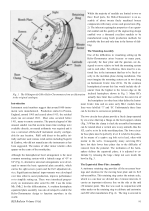
This first part of a review examines the design and accuracy of the Pilkington & Gibbs Helio-Chronometer, an equatorial sundial known for its mean time accuracy. It details the instrument's components, mounting assembly, sight screen system, and the mechanism for integrating the Equation of Time using a cam, and discusses factors affecting its long-term accuracy, such as wear and calibration.
Dials: Heliochronometer, Equation of Time, How Sundials Work, Sundial Design & Layout
September 2006
Page 128
Page 128
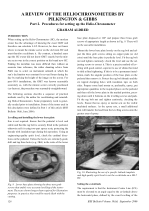
This article provides comprehensive, practical procedures for calibrating and reinstalling Pilkington & Gibbs Helio-Chronometers. It covers essential steps such as precise levelling, accurate co-latitude setting, meridian alignment, and adjustments for the equation of time and longitude, offering detailed guidance for both Northern and Southern Hemisphere models, aimed at owners and restorers.
Dials: Heliochronometer, Equation of Time, Restoration projects, Sundial Design & Layout
December 2006
Page 186
Page 186
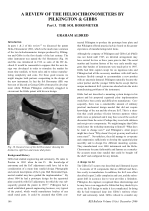
Graham Aldred reviews the Sol Horometer, William Pilkington's 1912 heliochronometer, developed to bypass George Gibbs's patent. It details Pilkington’s unique EoT adjustment mechanism, contrasting it with Gibbs's system, and discusses manufacturing, sighting, and pointer design. The article also compares its performance and rarity to the original Helio-Chronometer, noting the limited sales.
Sundial Design & Layout, Equation of Time, Historical Dials, Dials: Heliochronometer
December 2005
Page 160
Page 160
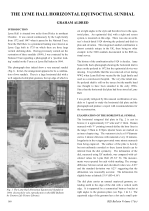
This article details the discovery and reconstruction of a unique 1683 combined horizontal equinoctial sundial at Lyme Hall. The author describes deciphering the inscription "R Legh 1683," examining its robust bronze construction and innovative two-hole sight/screen system. The article also explores the dial's historical context, its owner Richard Legh, and a possible link to George Gibbs's Helio-Chronometer.
Dials: Equatorial, Dials: Horizontal, Dials: Unusual, Historical Dials, Restoration projects, Sundial Design & Layout
February 1999
Page 23
Page 23
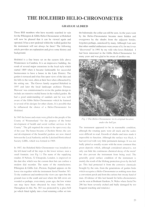
This article details the restoration and reinstallation of the Pilkington & Gibbs Helio-Chronometer at Holehird. It recounts its history, its protection by a glass bell jar, and the innovative security measures implemented for its current display, allowing it to accurately tell time for another century.
Restoration projects, Historical Dials, Dials: Heliochronometer
February 1998
Page 14
Page 14
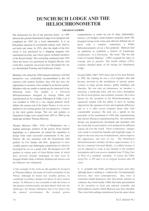
A site note on a heliochronometer at Dunchurch Lodge, describing layout, reading, and mechanical features of this precision time-telling instrument and its context on the estate.
Dials: Heliochronometer, Historical Dials