- Home
- /
- Sundial Encyclopaedia
- /
- Malcolm Barnfield
Malcolm Barnfield
March 2015
Page 41
Page 41
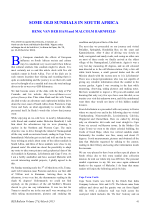
Report detailing a long research trip (4250 km) to record five historical sundials in South Africa. The dials documented include the two vertical dials at Cape Town Castle (1787); the 1828 octagonal horizontal dial at Leliefontein, notable for its Etruscan numbering; and the 1831 horizontal slate dial at the Kuruman Mission station.
Dials: Horizontal, Dials: Vertical, Historical Dials, Mottoes
June 2015
Page 6
Page 6
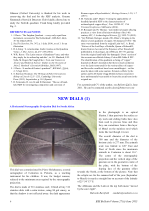
This details the commissioning and construction of a horizontal stereographic projection dial made of stainless steel for Pierre Holtzhausen in Centurion, Pretoria, South Africa, intended as a teaching instrument.
Construction Projects, Dials: Horizontal, Sundial Design & Layout
June 2015
Page 17
Page 17
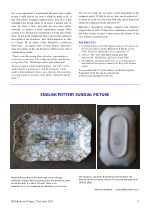
This is a brief note describing a dish decorated with a picture including a sundial. The dish is 160 x 110 mm, numbered on the back, and identified as being made by Lancaster & Sandland of Hanley, Stoke-on-Trent.
Dials: Unusual
March 2012
Page 34
Page 34
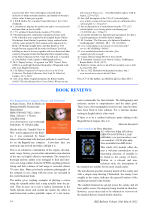
This section contains three book reviews: "The Bagnold Sun-Compass: History and Utilization" by Kuno Gross, "Essex Sundials" by Peter Meadows, and "A Dial in your Poke: A Book of Portable Sundials" by Mike Cowham, offering insights into each publication.
Book Reviews
June 2012
Page 18
Page 18
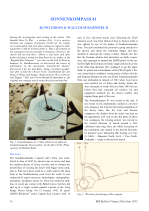
This addendum describes the German Sonnenkompass 41, issued to the Sonderkommando Dora unit in North Africa during WWII. Based on an analemmatic sundial, it featured removable dial plates for different latitudes and seasons, including German Summer Time adjustments. Despite its design, field reports deemed it unsuitable for desert use due to gnomon issues, leading to its obscurity.
Dials: Analemmatic, Dials: Portable, Historical Dials
December 2012
Page 34
Page 34
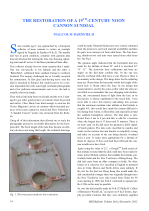
This article describes the restoration of a 19th-century Negretti & Zambra noon cannon sundial. The author recreated missing brass parts, noting design anomalies like incorrect latitude calibration and an inappropriate date scale. The true maker and date remain uncertain, highlighting the common practice of firms selling goods made by others.
Dials: Noon Lines, Historical Dials, Restoration projects, Sundial Design & Layout
June 2011
Page 20
Page 20
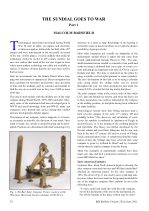
This article explores the military use of solar compasses, particularly during World War II, for navigation in unmapped desert terrains. It describes several models, including the Burt, Abrams, Cole Universal, Bagnold, and Union Observatory sun compasses, highlighting their principles and operational advantages.
Dials: Analemmatic, Dials: Portable, Dialling Tools, Historical Dials
September 2011
Page 10
Page 10
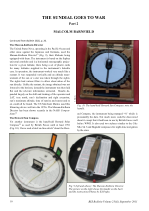
This is the second part of an article exploring the use of sundials and solar compasses in military contexts. It describes instruments like the Marean-Kielhorn Director, Howard Sun Compass, Evans-Lombe, Richards, and Micklethwait sun compasses used by Allied forces. It also details German sun compasses, particularly the C. Plath device used by Rommel's Afrika Korps, and the astrocompass, discussing their applications and limitations in wartime navigation.
Dials: Portable, How Sundials Work, Historical Dials
March 2010
Page 38
Page 38
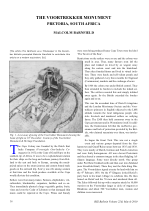
Describes how the Voortrekker Monument in Pretoria functions as a timekeeper. An aperture in the dome allows a ray of sunlight to illuminate a cenotaph at Local Solar Noon on 16th December each year, commemorating the 1838 Battle of Blood River.
Dials: Unusual, Sundial Design & Layout, Historical Dials, Dials: Noon Lines
June 2009
Page 18
Page 18
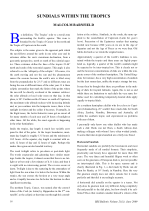
An overview of designing and using sundials in tropical regions. It discusses the suitability and challenges of various dial types, including horizontal, armillary, polar, and vertical, noting issues like noon-line crowding on horizontal dials and the advantages of other formats.
Dials: Horizontal, Dials: Vertical, Dials: Polar, Dials: Astrolabe, Dials: Armillary Sphere
December 2009
Page 14
Page 14
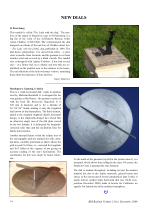
This section presents two new dials. The first is a stone vertical dial near St Petersburg with a theme from a Chekhov story. The second is a 'triple horizontal dial' made of stainless steel for a garden in South Africa, which includes a nocturnal and family anniversary lines.
Dials: Horizontal, Dials: Unusual, Dials: Nocturnals
December 2008
Page 166
Page 166
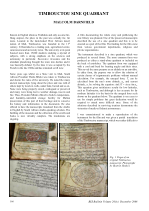
This article details the reproduction of a sine quadrant from a preserved Timbouctou manuscript for a documentary film. It describes the instrument's function in solving trigonometric problems without manual calculation, like determining unequal hours, and its historical context as a teaching tool in Islamic astronomy. The author discusses the challenges of interpretation and the modern construction using laser-cut perspex.
Construction Projects, Dialling Tools, Historical Dials, Mathematics of Dialling
December 2007
Page 173
Page 173
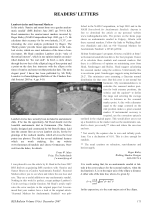
This section contains various letters from readers. Frans W. Maes discusses Lambert circles and seasonal markers on analemmatic sundials. Roger Bailey provides corrections and recommendations for seasonal markers. Frank King confirms a relationship for seasonal marker distance. Ken Head replies to Maes and Bailey. John Lester solves the mystery of a partial sundial motto. Malcolm Barnfield describes the making of a noon cannon sundial.
Dials: Analemmatic, Sundial Design & Layout, DIY Sundial Projects, The BSS and Members