- Home
- /
- Sundial Encyclopaedia
- /
- Mike Shaw
Mike Shaw
March 2022
Page 10
Page 10
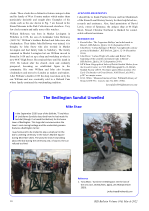
A report on the unveiling ceremony for the Bedlington sundial, made by Tony Moss, in December 2021. The large dial, located in the Market Square, commemorates the town's coal mining heritage and incorporates a Bedlington terrier motif in its undershot gnomon.
Construction Projects, Sundial Design & Layout
June 2019
Page 19
Page 19
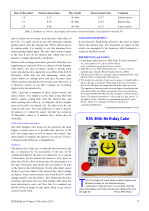
A picture showing the largest of the celebratory cakes baked by Pauline and Michael Faraday that was used for the ceremonial cutting at the 30th Anniversary Conference dinner in Bath.
The BSS and Members
December 2019
Page 11
Page 11
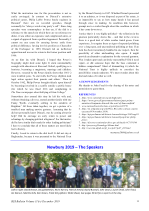
A group photograph of the speakers who presented at the Newbury One-Day Meeting on 21 September 2019, taken by Mike Shaw.
The BSS and Members
September 2016
Page 8
Page 8
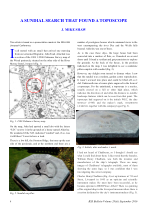
Following an enquiry about a suspected sundial marked on a 1909 map in the Wirral, the author found a pillar topped by a modern 'garden centre' dial. Underneath was a 1945 bronze toposcope (showing directions of visible geographic features) made by Chadburns of Liverpool, likely a gift for William E. Corlett, the company’s solicitor, following the relocation of the bombed factory.
Dials: Horizontal, Historical Dials
December 2016
Page 27
Page 27
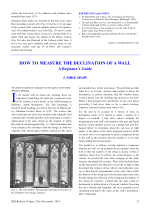
A guide detailing a method for accurately measuring wall declination, based on a talk at Newbury (2016). It involves using a plumb line, mirror, and white board to determine the exact moment the sun is perpendicular to the wall. The subsequent azimuth is derived easily using the 'Sun Seeker' mobile application.
Dialling Tools, Mathematics of Dialling
September 2014
Page 24
Page 24
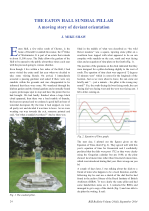
Research into a square, tapering stone pillar sundial at Eaton Hall, designed by Lutyens (1898) with dials by F. Barker & Son. The pillar has been moved multiple times on the estate and currently stands incorrectly orientated (rotated 180 degrees), despite expert advice.
Dials: Multi Faced, Historical Dials, Restoration projects, The BSS and Members
December 2014
Page 24
Page 24
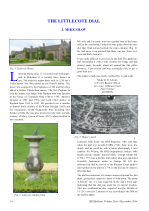
The discovery and dating of a horizontal sundial at Littlecote House, made by George Adams Snr, instrument maker to George III. Analysis of the maker’s mark and the 'Æquation of Natural Days' table (which uses pre-1752 Julian calendar dates) helped date the dial to the 14-year period between 1738 and 1752.
Dials: Horizontal, Equation of Time, Historical Dials
March 2009
Page 37
Page 37
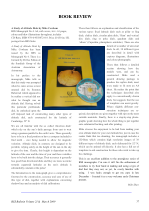
This review covers "A Study of Altitude Dials" by Mike Cowham (BSS Monograph No 4). It praises the monograph's comprehensive overview of altitude dials, including their construction, accuracy, and various types like pillar, chalice, and quadrant dials. The book also provides detailed construction guides, diagrams, and a CD-Rom with templates for readers to make their own dials.
How Sundials Work, Book Reviews, Sundial Design & Layout, DIY Sundial Projects
March 2008
Page 42
Page 42
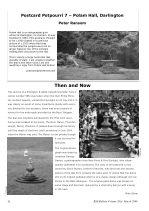
Compares an early 20th-century postcard of a Pilkington & Gibbs heliochronometer at Thornton Manor with a modern photograph. It notes the dial's original purchase by Lord Leverhulme, its continued presence on its pedestal, and the replacement of its glass dome with a chemistry bell jar.
Dials: Heliochronometer, Historical Dials
December 2005
Page 156
Page 156
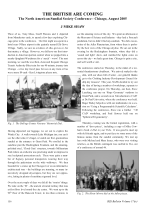
This report details the author's trip to the North American Sundial Society (NASS) conference in Chicago, August 2005. It covers tourist activities in the city, workshops held, the formal registration, meeting other sundial enthusiasts, and the bus tour to see local sundials, including the DuPage County Veterans’ Memorial Dial and the Henry Moore sundial.
The BSS and Members
June 2001
Page 67
Page 67
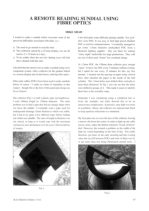
Mike Shaw details his innovative two-component sundial system, comprising an equatorial collector in the garden and a remote display unit indoors, linked by fibre optics. Designed to overcome the need to go outside to read time and simplify the display, the article describes its construction, addressing material challenges and light-gathering techniques.
DIY Sundial Projects, Dials: Unusual
February 1999
Page 14
Page 14
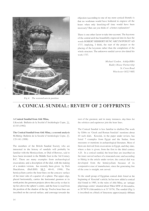
This review discusses two papers on conical sundials, a less familiar type compared to the hemicyclium. It focuses on a conical dial found at Abu Mina, Egypt, dating from the 1st to 3rd century A.D., analyzing its construction, accuracy, and challenging previous interpretations of its markings.
Book Reviews, Sundial Design & Layout, Historical Dials, Dials: Scaphe
February 1999
Page 47
Page 47
This review covers two issues of *Compendium*, the NASS journal. It highlights articles on a 'Witch's Sundial', various sundial designs (conical gnomon, Ptolemaic coordinates, cycloid gnomon, split analemma), and 'Sightings' features on notable dials, concluding with a report on the NASS Fourth Annual Conference.
Dials: Equatorial, Book Reviews, Sundial Design & Layout, Equation of Time
October 1999
Page 121
Page 121
This review covers two issues of NASS's *Compendium* (Vol.6 No.1 and No.2). It highlights articles on a stone cube dial from Ross-on-Wye, the Capuchin and Apian dials, and a monolith memorial sundial in Charleston, S.C. The second issue features horizontal garden dials and an ingenious 'sundot polar dial' design for a hollow cylinder. It also notes reader queries on wood types for sundials and finding wall declination.
Book Reviews
February 1998
Page 19
Page 19
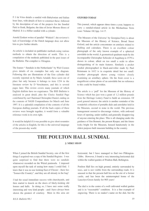
Describes the Poulton Hall dial on the Wirral peninsula: setting, design features and inscriptions, with observations on the equation of time using the pre-Gregorian calendar, an the lack of a noon gap.
Dials: Horizontal, Historical Dials
October 1998
Page 38
Page 38
This section reviews three offprints: Dr. Wall's study of Anglo-Saxon sundials in Ryedale, detailing octaval day divisions; Finn Magnusen's monograph on ancient Scandinavian time divisions and 'daymarks'; and Dr. Milutin Tadic's paper on old sundials in Serbian lands, covering Roman, medieval, and 19th-century examples, noting their scarcity due to Turkish rule.
Book Reviews, Historical Dials
October 1998
Page 40
Page 40
This article reviews *Compendium*, the journal of NASS, featuring J.M. Bores' new conical sundial design, measuring Babylonian and Italian hours, and an article by Robert L. Kellogg on Bede's cosmological and geographical works, including his observations on day-length variations. It also mentions a regular "Sightings" feature on notable dials.
Book Reviews, Dials: Unusual, Sundial Design & Layout