- Home
- /
- Sundial Encyclopaedia
- /
- Dials: Polar
Dials: Polar
June 2023
Page 15
Page 15
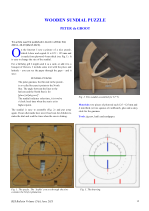
Provides detailed instructions and drawings for constructing an educational wooden sundial puzzle, measuring 125 × 125 mm. The project utilizes plywood and a satay stick as a polar gnomon, designed to be easy to assemble and explain the concept of solar time.
Construction Projects, DIY Sundial Projects, Dials: Polar
September 2022
Page 20
Page 20
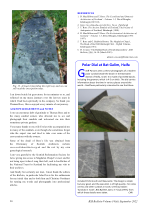
Describes a modern, high-quality polar sundial located beside the beach in Haifa, Israel. The dial is made of polished basalt and carries time information for various global locations, including Portsmouth and Newcastle.
Dials: Polar, Dials: Unusual
December 2022
Page 40
Page 40
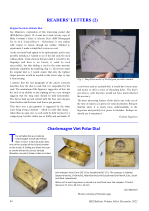
Brief description of a small portable dial made by Charlemagne Viet (fl. 1673-95) in Blois, France. It features two polar dials and a folding arc to set the latitude for 16 listed cities.
Dials: Polar, Dials: Portable, Historical Dials
June 2019
Page 35
Page 35
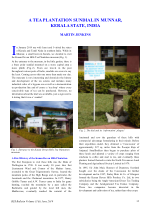
Describes a brass polar sundial found at the Kanan Devan Hills Tea Plantation museum in Munnar. The dial, stamped "ART INDUSTRIAL SCHOOL, NAZARETH, 1913," was made by a vocational school in Tamil Nadu. The capital's angle (10°) is appropriate for Munnar's latitude, though the current setting is inaccurate.
Dials: Polar, Historical Dials
June 2018
Page 2
Page 2
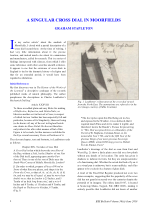
Investigates a rare 1706 cross dial in Moorfields, London, made by Robert Trevitt, a painter, as a parish boundary marker and memorial to the Battle of Ramillies. The article explores why cross dials were uncommon in England, suggesting their imagery was historically considered idolatrous due to religious connotations.
Dials: Polar, Dials: Unusual, Historical Dials, Mottoes
June 2018
Page 13
Page 13
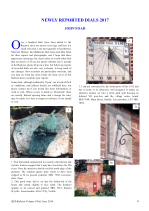
Reports on over one hundred dials added to the Fixed Dial Register in 2017, presenting 18 selected examples. These include a historical horizontal dial, a Francis Barker cross dial, a moon dial, an armillary sphere, and a stained glass millennium dial. Dials by makers Thomas Woodcock and John Bird are highlighted.
Dials: Armillary Sphere, Dials: Horizontal, Dials: Polar, Dials: Stained Glass, Dials: Vertical, Historical Dials
June 2018
Page 30
Page 30
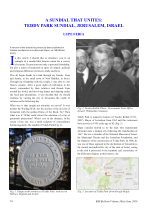
Focuses on the 2013 polar granite sundial in Teddy Park, Jerusalem, designed by Maty Grünberg. The dial is symbolic of cooperation, achieved through the collaboration of Arab and Jewish participants during its construction. It uses an aperture nodus to mark key dates, including the International Day of Tolerance.
Construction Projects, Dials: Polar
December 2018
Page 6
Page 6
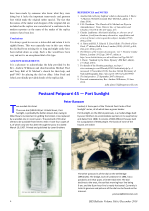
Features two sundials in the model village of Port Sunlight (SRN 2419 and SRN 2420) depicted on postcards, the first one published by Lever Brothers. The first is a cross dial at 11 Bath Street, and the second is a declining dial on the Dell Bridge which currently lacks its gnomon.
Dials: Polar, Dials: Vertical, Historical Dials, The BSS and Members
December 2018
Page 8
Page 8
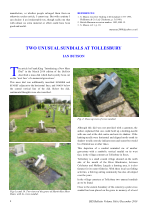
Examines two memorials in Tollesbury, Essex. One is a polar cross sundial (a cruciform equatorial dial), inscribed with a reference to Apparent Time. The other, for his polymath father Gerald Dunn, features a symbolic vertical dial engraving and references the patented "Cruiserfix" Solar Navigator, which uses a polar cross dial for navigation.
Dials: Polar, Historical Dials
September 2017
Page 22
Page 22
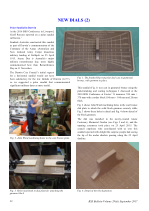
This article describes a polar sundial constructed by Sundials Australia for the Anzac Centenary Memorial Garden in Darwin (latitude 12.5° N). The gunmetal bronze dial includes a block gnomon and features a dedicated dateline for 25 April, Anzac Day.
Construction Projects, Dials: Polar, Sundial Design & Layout
December 2013
Page 16
Page 16
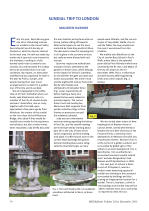
An account of a guided trip to London sundials, visiting the noon mark dial in Paternoster Square, a horizontal dial at Amen Court (attributed to Wren), the polar dial by Piers Nicholson, dials at Cheapside and St Katherine Cree, and the large horizontal dial over Tower Hill Underground Station.
Dials: Horizontal, Dials: Polar, Dials: Vertical, The BSS and Members
December 2010
Page 12
Page 12
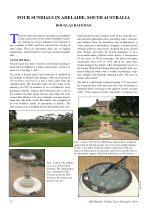
This report details four sundials in Adelaide. It includes the Olde Adelaide Sundial at Carrick Hill House with a unique equation of time reflecting South Australia's time zone, two dials at Seymour College, and an unusual polar meantime dial by Government Astronomer Charles Dodwell in the Pioneer Women’s Memorial Garden.
Dials: Horizontal, Dials: Polar, Dials: Vertical, Historical Dials
December 2010
Page 20
Page 20
This article describes a very large polar sundial designed by José Luis Basanta Campos for a multi-purpose building in Lalín, Spain. The dial is 20m x 10m on a south-facing roof inclined at the site's latitude, with a 3m gnomon. It shows hour lines from 7:00 am to 5:00 pm and lines of declination for the 20th of each month, applied using weather-resistant adhesive plastic.
Construction Projects, Dials: Polar, Sundial Design & Layout
March 2009
Page 2
Page 2
This article explores alternative methods for measuring the sun's position, specifically focusing on a north-facing polarization sundial. It delves into the principles of polarized light from the sky, its application in sundial design using materials like 'Sellotape', and the construction of an experimental translucent equatorial dial that produces varying interference colours throughout the day.
Construction Projects, DIY Sundial Projects, Dials: Polar, How Sundials Work
March 2009
Page 14
Page 14
This article describes an electronic polarization sundial and sky photometer designed to measure the intensity and polarization of skylight. It uses a rotatable polar and a selenium photovoltaic cell to detect the solar meridian to within ±8 minutes of time and quantitatively assess the percentage of linear polarization in light from a selected area of the sky.
Dials: Polar, How Sundials Work, Construction Projects
June 2009
Page 18
Page 18
An overview of designing and using sundials in tropical regions. It discusses the suitability and challenges of various dial types, including horizontal, armillary, polar, and vertical, noting issues like noon-line crowding on horizontal dials and the advantages of other formats.
Dials: Horizontal, Dials: Vertical, Dials: Polar, Dials: Astrolabe, Dials: Armillary Sphere
March 2008
Page 22
Page 22
A personal report on the 13th NASS Conference in McLean, Virginia, covering presentations on various sundial topics, a bus tour to significant dials like the Lyman Briggs Memorial Dial and the Gaithersburg Latitude Observatory, and the dedication of the Jamestown Commemorative Sundial. It also details the Sawyer Dialling Prize presentation and practical workshops.
Dials: Horizontal, Dials: Polar, The BSS and Members
December 2008
Page 154
Page 154
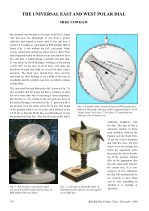
This article describes a portable universal East and West polar dial that is self-aligning and does not require a compass. It details its design, operation, and identifies limitations such as a two-hour gap around noon. It also explores improvements through hinged flaps and cylindrical designs, and relates it to other dial types like the double crescent dial.
Dials: Polar, Dials: Portable, How Sundials Work, Sundial Design & Layout
December 2008
Page 157
Page 157
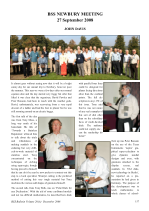
A report on the BSS Newbury meeting on 27 September 2008, detailing talks on stainless steel sundials, polar dials, dynamic sundial design using calculators, and 3-D modelling for overshadowing. It also covers a survey of early horizontal dials in Flintshire, exhibits, and presentations on paper sundials and dials in Mexico and the southern hemisphere.
Dials: Horizontal, Dials: Polar, Sundial Design & Layout, The BSS and Members
December 2008
Page 170
Page 170
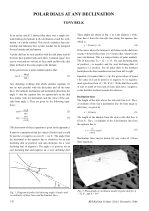
This article presents a method for designing polar sundials for any latitude and declination using four simple formulae. It explains that polar dials have a style parallel with the dial plane and parallel hour lines, and describes how to determine the angle of the equinox line and the sub-style hour angle.
Dials: Polar, How Sundials Work, Mathematics of Dialling, Sundial Design & Layout
December 2008
Page 184
Page 184
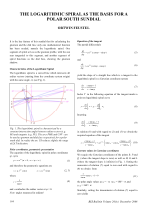
This article proposes the logarithmic spiral as the sole mathematical function needed for designing a polar south sundial, where one spiral segment forms the gnomon profile and another acts as the dial face. It details the spiral's characteristics, equations for tangents and arc lengths, and presents a calculation example for a model, illustrating its construction and operation.
Construction Projects, Dials: Polar, Mathematics of Dialling, Sundial Design & Layout
December 2007
Page 153
Page 153
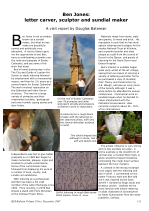
This report profiles Ben Jones, a letter carver and sculptor based in Devon, who has also become a skilled sundial maker. His work, which comprises 25-30% of his commissions, is noted for its artistic and unique designs, ranging from shield-shaped vertical dials to analemmatic dials and multi-faceted columns. He integrates his lettering skills and sculptural form into his creations.
Dials: Vertical, Dials: Polar, Sundial Design & Layout
September 2006
Page 138
Page 138
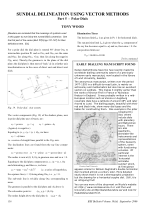
The fifth instalment in a series, this article applies vector methods to the specific challenge of delineating polar sundials. It presents the vector components for the shadow plane and declination lines, mathematically deriving the straight hour lines and hyperbolic declination lines.
Dials: Polar, Mathematics of Dialling, Sundial Design & Layout
December 2005
Page 172
Page 172
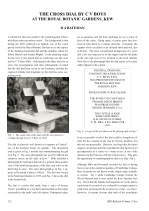
This article investigates the bronze cross dial by C.V. Boys at Kew Gardens, noting its unusual design and puzzling errors in the engraved latitude and longitude. It traces the dial's history, including its temporary display and previous locations within the gardens, and highlights the scientific reputation of its designer, Sir Charles Vernon Boys FRS.
Dials: Polar, Dials: Unusual, Historical Dials, Sundial Design & Layout
March 2002
Page 4
Page 4
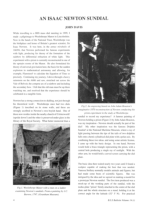
Describes the design and creation of a unique sundial featuring a statue of Newton holding a prism, inspired by his optical work and historic dials at Woolsthorpe.
Construction Projects, Dials: Polar, Dials: Unusual, Sundial Design & Layout
March 2002
Page 39
Page 39
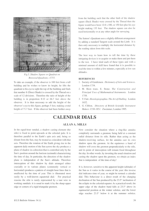
Explores dials intended to show the date rather than the time, by reading the shadow of an equinoctial ring on a scale on the stile.
Dials: Polar, Dials: Unusual, How Sundials Work
December 2002
Page 146
Page 146
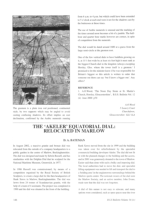
Detailed account of the design, relocation, and symbolism of Edwin Russell’s large equatorial dial now installed in Marlow, including technical specifications.
Dials: Equatorial, Dials: Polar
October 2000
Page 107
Page 107
Detailed account of the design process and construction of the Tylers' and Bricklayers' polar sundial in London, including technical and logistical challenges.
Construction Projects, Dials: Polar, Sundial Design & Layout
October 1997
Page 21
Page 21
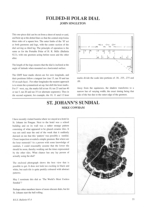
This article introduces a one-piece polar dial that can be cut from metal or card and folded to form a square box. Its outer limbs serve as gnomons and legs, with one gnomon for before noon and another for after. The design ensures the dial is inclined at the angle of latitude, and it operates on the same principle as the portable polar dial, with considerations for GMT hour marks at different longitudes.
DIY Sundial Projects, Dials: Polar, Dials: Portable
October 1992
Page 25
Page 25
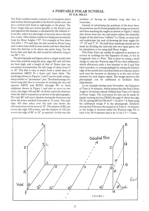
This article introduces a portable polar sundial design that overcomes the issue of an infinitely long dial face for extreme hour angles. It uses two end-styles, which cast shadows for forenoon and afternoon hours, respectively. The dial can be adjusted using a wedge to correct for the Equation of Time or longitude.
DIY Sundial Projects, Dials: Polar, Equation of Time, How Sundials Work
February 1991
Page 6
Page 6
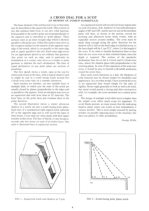
Describes the design of Cross or Star dials, focusing on the concept of the equatorial notch, which has surfaces parallel to the Earth's polar axis. The shadow cast by the outer edge of the notch onto the opposite surface is used to indicate time. The article provides details on the design and depth required for such dials, noting that each notch effectively functions as a separate dial.
Dials: Equatorial, Dials: Polar
February 1991
Page 11
Page 11
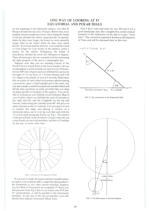
Equatorial and Polar Dials explores the principles behind these two types of sundials. The article also covers the Equation of Time and how to account for longitude to tell Greenwich Mean Time with a sundial.
Dials: Equatorial, Dials: Polar, Mathematics of Dialling
July 1991
Page 8
Page 8
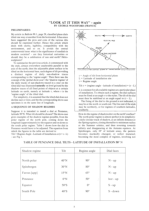
This article re-examines plane dials tilted from the horizontal, focusing on clarity, legibility, and environmental compatibility. It explains 'shadow regimes,' how tilt relates to equivalent latitude, and the impact on sun-shadow patterns. Key considerations include local horizons and the 'night factor'—periods where the dial cannot register time. It highlights the clarity of polar regime dials, despite seasonal limitations, for educational and aesthetic purposes.
Dials: Polar, How Sundials Work, Mathematics of Dialling, Sundial Design & Layout
June 1990
Page 14
Page 14
This article describes the 1975 discovery of a unique Greek sundial slab at Ai Khanoum, Afghanistan. Dating between 325 and 145 B.C., this polar dial, designed to indicate temporary hours, represents an evolutionary advancement in ancient gnomonics, despite a discrepancy between its marked latitude and discovery site.
Dials: Polar, Historical Dials, Dials: Scaphe