- Home
- /
- Sundial Encyclopaedia
- /
- Jérôme Bonnin
Jérôme Bonnin
March 2015
Page 28
Page 28
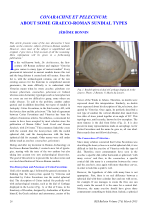
A specialized study proposing a revised classification of Graeco-Roman sundial types based on literary sources (Vitruvius, Cetius Faventinus) and archaeological evidence, including newly identified examples.
Dials: Unusual, Sundial Design & Layout, Historical Dials, Dials: Scaphe
June 2015
Page 35
Page 35
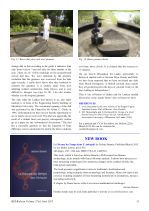
A review of *La Mesure du Temps dans L’Antiquité* by Jérôme Bonnin, published in March 2015. The book deals primarily with Graeco-Roman sundials and revises traditional classification and terminology, with a chapter on mathematical challenges by Denis Savoie.
Book Reviews, Historical Dials
March 2013
Page 20
Page 20
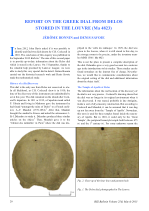
A scholarly report on a fragmentary Greek sundial held in the Louvre. The authors discuss its geometry, probable use, and its place in the evolution of ancient dial types.
Dials: Astrolabe, Dials: Equatorial, Dials: Hemispherical, Historical Dials
March 2013
Page 25
Page 25
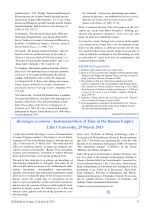
A review of a conference on Roman timekeeping instruments, summarising research on ancient dials, calendars, and astronomical devices.
Dials: Astrolabe, Historical Dials, Mathematics of Dialling
June 2012
Page 44
Page 44
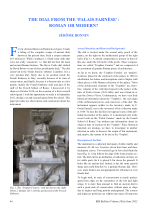
This article investigates a spherical sundial in the 'Palais Farnèse', Rome, questioning its Roman origin due to its perfect state of conservation and lack of gnomon hole. It hypothesises the dial is an 18th or 19th-century copy of a Roman original, potentially with a symbolic rather than functional purpose related to the palace's 'Trophées Farnèse' compositions about Time.
Dials: Scaphe, Dials: Unusual, Historical Dials, Restoration projects
September 2012
Page 43
Page 43
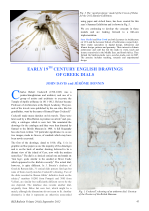
This article details two 19th-century drawings by Charles Robert Cockerell of Greek sundials, possibly newly excavated. One depicts an unknown classical conical dial with "lion legs" and the other illustrates a rare planar, vertical east-facing dial from Delos, which later came to reside in the Louvre, recording significant ancient finds.
Dials: Unusual, Historical Dials
December 2012
Page 23
Page 23
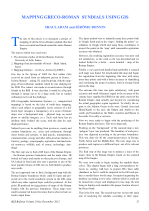
This article details a project to map over 500 excavated Greco-Roman sundials across the Roman Empire using GIS. It describes georeferencing historical maps, digitising province boundaries, and creating a database to display sundials by location, type, shape, and period, thereby analysing them in their geographic context.
Sundial Design & Layout, Historical Dials
March 2011
Page 6
Page 6
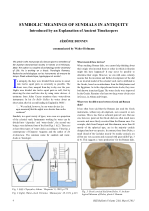
This article explores the symbolic meanings of sundials in antiquity, drawing on literary and epigraphical evidence from the Greco-Roman world. It also introduces ancient timekeepers, including clepsydra and various types of horologia, and discusses the differences between Greek and Roman dials.
How Sundials Work, Historical Dials
September 2010
Page 36
Page 36
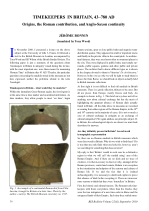
This article investigates the presence and influence of Roman timekeepers in Britain from 43-780 AD, noting the scarcity of archaeological finds compared to other Roman provinces. It explores historical, cultural, and military evidence, including a mosaic depiction and rudimentary sundial objects, and briefly discusses the obscure origins of Saxon dials.
Dials: Mass Dials, Dials: Unusual, Historical Dials