- Home
- /
- Sundial Encyclopaedia
- /
- Ortwin Feustel
Ortwin Feustel
December 2020
Page 2
Page 2
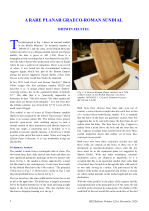
This article describes and analyses an unusual Roman sundial in the British Museum (1884,0615.1), likely originating from Egypt. It examines the dial’s equinoctial planar design, estimating the design latitude (27.3° N) and nodus height using physical measurements and a graphical approach. It challenges the idea that the declination arcs correspond to zodiac cusps.
Dials: Equatorial, Historical Dials, How Sundials Work, Mathematics of Dialling
June 2019
Page 2
Page 2
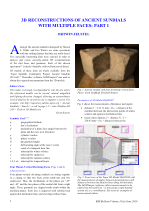
Analyses ancient multi-faced and scaphe marble sundials catalogued by Gibbs and Winter, using 3D models and software (GOM Inspect) to measure parameters for reconstruction. Focuses on dials with planar-vertical deviating faces, hollow spherical faces (scaphe), and hollow conical faces, detailing the geometrical reconstruction and function of hour lines.
Dials: Multi Faced, Dials: Scaphe, Historical Dials
September 2019
Page 22
Page 22
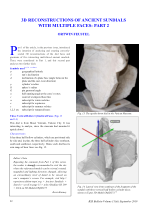
This article continues the analysis of ancient multi-faced sundials using 3D reconstructions. It examines a dial from the Musei Vaticani with three vertical hollow cylindrical faces and a combination dial from Herculaneum featuring vertical hollow cylindrical and spherical faces. Analysis includes calculation based on geographical latitude and declination lines.
Dials: Hemispherical, Dials: Multi Faced, Historical Dials, Mathematics of Dialling
June 2017
Page 39
Page 39
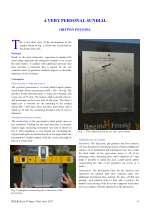
The author describes the design and laser-cut construction of a stainless steel pin gnomon gravestone sundial on black granite. The vertical dial includes solstices/equinoxes lines and additional declination lines marking the birth and passing dates of the author’s wife.
Construction Projects, Dials: Vertical, Sundial Design & Layout
September 2017
Page 21
Page 21
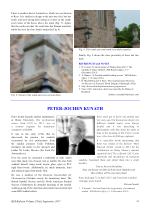
An obituary for Peter-Jochen Kunath (1944–2017), a German enthusiast and BSS member who calculated and built numerous sundials. He collected and translated over 2,000 Latin aphorisms, and won the 2012 Bulletin ‘Most Enjoyed Article’ award for his piece on Henry Moore’s equatorial dial.
The BSS and Members
September 2013
Page 6
Page 6
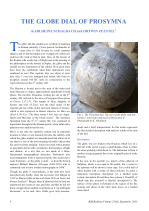
Detailed description and analysis of a solid white marble globe sundial from antiquity (c. 100 BC) found near Heraion. It uses the terminator (boundary of light and shadow) for time indication and features complex line systems representing hours, seasons, and zodiacal signs.
Dials: Hemispherical, Dials: Unusual, Historical Dials, Mathematics of Dialling
June 2012
Page 36
Page 36
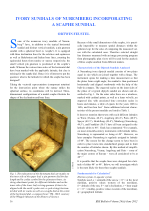
This article analyses the scaphe sundial component found in Nuremberg ivory diptych sundials. It uses vectorial representation and measured photographic distances to determine the intended latitude for three examples, concluding that Reinmann and Miller's scaphes were likely designed for 49° latitude, and Lesel's for 48°, primarily for Nuremberg.
Dials: Scaphe, Historical Dials, Mathematics of Dialling, Sundial Design & Layout
June 2010
Page 7
Page 7
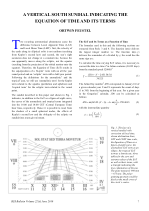
This paper describes a vertical sundial designed to indicate the Equation of Time (EoT) as a figure-of-eight curve, along with its anomalistic and tropical terms. It provides the mathematical formulae for calculating these values and their graphical representations as functions of time and the sun's declination.
Dials: Vertical, Mathematics of Dialling, Construction Projects, Equation of Time
June 2009
Page 14
Page 14
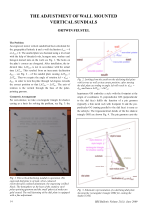
A technical article presenting a detailed mathematical method for correcting the alignment of a wall-mounted vertical sundial that has been installed with an inaccurate declination. It provides the necessary formulae and a worked example to calculate the required angle of rotation for adjustment.
Dials: Vertical, Mathematics of Dialling, Sundial Design & Layout
September 2009
Page 26
Page 26
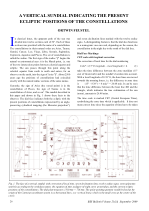
Describes the design and markings of a complex vertical sundial. In addition to time, the dial indicates the current ecliptic positions of the constellations using a Mercator projection. It also features longitude correction, an Equation of Time curve, declination lines, and functions as a nomogram for identifying constellations visible at night.
Dials: Vertical, Equation of Time, Mathematics of Dialling, Sundial Design & Layout
June 2008
Page 92
Page 92
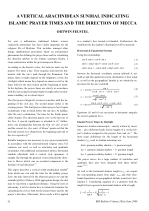
This paper describes the design of a vertical south arachnidean sundial to indicate Islamic prayer times (Zuhr, Asr) and the Qibla (direction to Mecca). It explains the astronomical principles and mathematical formulae used to calculate the specific prayer curves and Qibla curve, making it readable from a significant distance.
Dials: Vertical, Historical Dials, Mathematics of Dialling, Sundial Design & Layout
December 2008
Page 184
Page 184
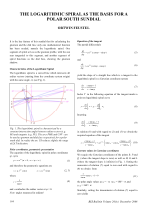
This article proposes the logarithmic spiral as the sole mathematical function needed for designing a polar south sundial, where one spiral segment forms the gnomon profile and another acts as the dial face. It details the spiral's characteristics, equations for tangents and arc lengths, and presents a calculation example for a model, illustrating its construction and operation.
Construction Projects, Dials: Polar, Mathematics of Dialling, Sundial Design & Layout