- Home
- /
- Sundial Encyclopaedia
- /
- October 1997
October 1997
The articles link to the specific page in a PDF optimised for speed. If you want the whole issue, you can download it here, but the files from earlier years can be quite large.
October 1997
Page 2
Page 2
This October issue of the Bulletin contains articles on sundials, both ancient (Ireland) and modern (a wooden cross-dial), covering topics such as construction, inaccuracies, cardboard cutouts (H-Dial, Christmas Cards, Sun Calendar), and encounters with dials in art (Rossetti) and real life (Turnbull Sundial). It includes contributions from three European countries and will soon feature one from the Southern Hemisphere.
The BSS and Members
October 1997
Page 3
Page 3
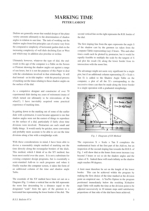
This article describes the "XY method", a practical process for marking time divisions on sundials. It details how to calculate shadow angles from first principles for various dial types and then plot them directly along rectangular borders using a graduated straightedge, acting as an "Add-on" to computer design programs. The method was adapted for complex declining/proclining dials and can also be applied to circular or octagonal dials.
Dialling Tools, Mathematics of Dialling, Sundial Design & Layout
October 1997
Page 5
Page 5

This article analyses the sundials depicted in Dante Gabriel Rossetti's paintings, specifically "Beata Beatrix" and "Saint Cecile". It highlights inaccuracies in the hour lines and numbering, attributing them to artistic licence and the symbolic importance of the "ninth hour" in relation to Beatrice's death, rather than scientific precision.
October 1997
Page 8
Page 8
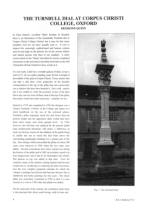
This article describes the Turnbull Dial at Corpus Christi College, Oxford, a 26-foot pillar featuring a total of 27 dials. Designed in 1579-1583 by Charles Turnbull, it includes a principal south-facing dial, a perpetual calendar, tables for planetary years and lunar months, and moon-time corrections. The dials use the old unequal hour system, and the pillar has undergone several restorations.
Dials: Multi Faced, Dials: Scaphe, Historical Dials, Restoration projects
October 1997
Page 10
Page 10
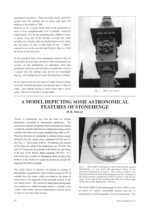
This article describes a 48cm diameter model that depicts the horizon around Stonehenge. It shows the astronomical significance of the monument, particularly the alignment of the midsummer sun's rising and setting and the moon's major standstill rising with the four station stones. The model was constructed from 12 photographic transparencies and can predict solar and lunar events.
October 1997
Page 11
Page 11
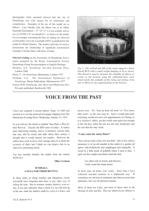
This piece reproduces a 1914 newspaper clipping titled "Sun-Dials, a Plea for their Revival" which advocates for the return of sundials. It discusses the general use of sundials in ancient times (Babylon, Egypt, Hezekiah's dial), their construction (Byzantium eagle dial), the principle of the gnomon, common objections (blurred shadow, refraction, sunshine reliance), and various mottoes and famous public and private dials in London and England.
Mottoes
October 1997
Page 13
Page 13
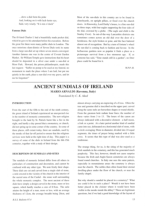
This survey details the unique sundials of early Irish monastic communities (6th-15th centuries), cut from single stone steles and often engraved with crosses. Used by monks for religious services, these dials feature varying hour lines and decorative elements for canonical hours. The article describes specific examples and discusses their construction, placement in cemeteries, and the debate over large gnomon holes.
Dials: Mass Dials, Historical Dials
October 1997
Page 21
Page 21
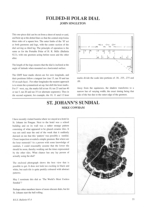
This article introduces a one-piece polar dial that can be cut from metal or card and folded to form a square box. Its outer limbs serve as gnomons and legs, with one gnomon for before noon and another for after. The design ensures the dial is inclined at the angle of latitude, and it operates on the same principle as the portable polar dial, with considerations for GMT hour marks at different longitudes.
DIY Sundial Projects, Dials: Polar, Dials: Portable
October 1997
Page 21
Page 21
This article describes a large sundial on a school building in St. Johann im Pongau, Austria, made of glazed ceramic tiles. The author questions its usability due to the absence of hour numerals, requiring prior knowledge to interpret the times, and humorously nominates it as "The World's Most Useless Sundial".
Dials: Unusual, Sundial Design & Layout
October 1997
Page 22
Page 22
This section reviews *Appunti per uno studio delle Meridiane Islamiche* (Islamic sundials) and *A Roman Cylinder Dial; Witness to a Forgotten Tradition* (an ancient Roman portable cylinder dial).
Book Reviews
October 1997
Page 23
Page 23
This section reviews journals from various sundial societies, including *ZONNETUDINGEN* (Belgian), *DE ZONNEWUZERKRING* (Netherlands), *COMPENDIUM* (NASS), and *LA BUSCA DE PAPER* (Catalan).
Book Reviews
October 1997
Page 26
Page 26
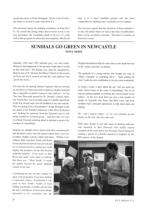
Report on a "Green Day" event in Newcastle-upon-Tyne, where British Sundial Society members set up a display to promote sundialling. Despite poor weather, they engaged with visitors, including the Lady Lord Mayor, and provided information about sundials. The author notes that while it may not have significantly advanced "Green Issues or the cause of Sundialling," it created a pleasant opportunity for members to discuss dials.
The BSS and Members
October 1997
Page 27
Page 27
This section contains letters discussing various topics: the likely mythical use of cordierite by Vikings for navigation; challenges to the historical claim of 14th-century clocks being the most advanced machines, citing ancient mechanisms with differential gearing; the use of an abacus to decipher binary notation on a sundial; a query about a missing sundial supporter figure; and a discussion on aperture gnomons for sharper solar images in large sundials and meridian lines.
October 1997
Page 31
Page 31
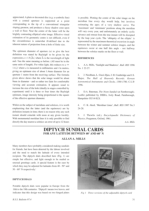
This article describes how to make adjustable diptych sundials from card, acting as a modern, lightweight version of antique portable diptych dials. It explains the principle of two hinged plates with a taut string gnomon, a built-in compass, and the "theorem of the sundial" for adjusting to various latitudes (40-50° N and 50-60° N) by tilting the entire instrument.
DIY Sundial Projects, Dials: Portable, Sundial Design & Layout
October 1997
Page 36
Page 36
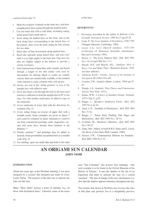
This article describes how to create an origami sun calendar from a single sheet of card, which indicates the date rather than the time. It reverses the roles of the dial plate and gnomon, and the shadow of a cone's rim indicates the date on a central gnomon-like scale. The article provides the mathematical solution for its design and construction.
DIY Sundial Projects, Mathematics of Dialling
October 1997
Page 38
Page 38
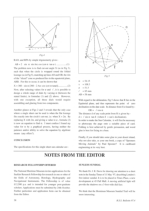
Announces a Sackler Research Fellowship for astronomy, horology, hydrography, and navigational instruments. It also mentions London's first indoor sundial, which uses a moving artificial light, and requests information for two unpublished items: 'Four 19th century meridian lines in Rome' and a review of a catalogue of fixed dials in Austria. It also contains errata for previous articles.
The BSS and Members
October 1997
Page 41
Page 41
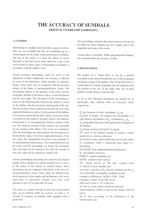
This article explains three sources of misreadings on sundials: annual recurring errors (adjustment and fabrication errors), annual accumulating misreadings (due to unequal year lengths and celestial body motion), and errors in defining shadow transit. It details the mathematical treatment of these errors, including geographic coordinates, refraction, and parallax, and provides numerical examples.
Mathematics of Dialling, Sundial Design & Layout
October 1997
Page 47
Page 47
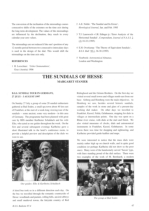
A report on the British Sundial Society's 1997 tour of sundials in Hesse, Germany. The tour, guided by Karlheinz Schaldach, visited ancient and modern dials in towns like Alsberg, Homberg, Frankfurt, Kassel, and Fulda. Highlights included 14th-century mass dials, modern dials with built-in equation-of-time adjustment, large painted building dials, and various vertical dials, as well as some humorous or unreadable examples.
The BSS and Members
October 1997
Page 49
Page 49
Summarises the second Essex Sundial Meeting at Moulsham Mill. Presentations included a history of calendars, the sun's nuclear reactions, and a detailed look at the massive astronomical instruments and sundials at Jaipur, India, built in the early 18th century to determine celestial positions. The meeting concluded with slides of the German sundial safari.
The BSS and Members
October 1997
Page 49
Page 49
This report details a Mass Dial Group meeting in Gloucestershire, featuring talks on the 'Nature in Art' centre's work, a sundial for an educational exchange with Kenya, and the use of video for recording dial operations. Discussions covered mass dials and their evolution, Saxon Dials and their monastic origins, and visits to local churches, including the discovery of an early equiangular reclining dial.
Dials: Mass Dials, The BSS and Members
October 1997
Page 51
Page 51
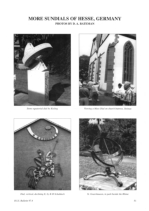
This section provides photographs of various sundials in Hesse, Germany, including a stone equatorial dial by Kieling, a vertical declining dial by Schaldach, a mass dial on a church buttress in Steinau, and a sundial in a park in St. Goarshausen.
Dials: Equatorial, Dials: Mass Dials, Dials: Vertical, Historical Dials