- Home
- /
- Sundial Encyclopaedia
- /
- J. P. Lester
J. P. Lester
June 2021
Page 36
Page 36
Discusses the content related to sundials found in Book IX of De Architectura by the Roman author Vitruvius (c. 80–15 BC). Chapter VII provides a general discussion on dialling, while Chapter VIII credits various ancient figures—including Berosus, Aristarchus, and Apollonius—with inventing different types of early dials like the Hemicyclium, Bowl, and Plinthium.
Book Reviews, Dials: Hemispherical, Historical Dials
December 2021
Page 19
Page 19
Discusses Pliny the Elder's account of early Roman sundials, extracted from Natural History, Book VII. It cites the first recorded sundial and the first public dial brought from Sicily in 264 BC. The article notes that this inaccurate Sicilian dial was used for nearly a century before being superseded by more accurate devices, including a water-clock.
Historical Dials
June 2018
Page 9
Page 9
Laments the absence of a comprehensive Mass Dial Register, similar to the existing Fixed Dial Register. The letter notes that raw data exists at the Borthwick Institute and proposes creating either a full Mass Dial Register or an abridged version to list church locations, dedications, and the number of mass dials.
Dials: Mass Dials, The BSS and Members
June 2017
Page 48
Page 48
This short entry references John Lester's presentation at the Oxford Conference, showcasing his delightful collection of wooden portable sundials.
DIY Sundial Projects, Dials: Portable
June 2016
Page 39
Page 39
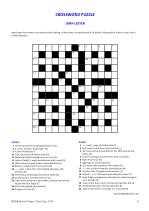
A crossword puzzle provided for the enjoyment of members. Most answers relate to sundialling concepts, makers, and terminology, with five answers unconnected to the subject.
The BSS and Members
June 2016
Page 44
Page 44
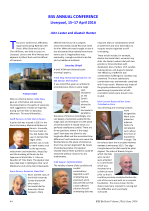
A report on the 2016 Conference talks, including Geoff Parsons on a polar dial in Darwin, Fred Sawyer on self-orientating dials, John Davis on the Bulletin, and Seb Falk on medieval astronomical instruments. Also covered are the Sundial Awards and Photographic Competition results.
The BSS and Members
December 2016
Page 10
Page 10
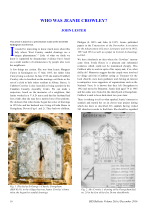
An analysis of the life of Jeanie Crowley (1885–1965), who compiled eight sketchbooks containing drawings and descriptions of 216 West Country sundials. The article outlines her family life in Devon, details her methods using measuring rods and field glasses, and suggests further research into her life. She primarily focused on vertical dials.
Dials: Vertical, Historical Dials
June 2015
Page 41
Page 41
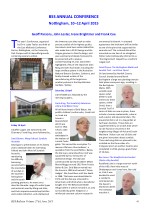
A comprehensive report on the conference sessions, including talks on Australian sundials, the history of Enid Blyton's dial, the Burlingham Sundial Trail, Mike Groom's heliochronometer, and site visits to Bromley House Library and Green's Mill.
Construction Projects, Historical Dials, The BSS and Members
March 2014
Page 43
Page 43
John Lester inquires about further references to sundials in English literature beyond those by Lamb, Marvell, and Chaucer. Douglas Bateman reports that the brass meridian line at Bromley House, Nottingham, mentioned in a 1999 article, has been fully revealed during recent renovations.
Dials: Noon Lines, Historical Dials
September 2014
Page 29
Page 29
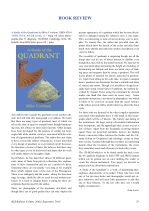
A review of 'A Study of the Quadrant' by Mike Cowham (2014). The monograph is highly recommended, covering the many types and functions of quadrants, including timekeeping, setting out hour-angle dials, and solving trigonometrical problems, all explained with clarity.
Book Reviews, Dialling Tools, Mathematics of Dialling
June 2013
Page 7
Page 7
A study of references to sundials and gnomonics in Pliny the Elder’s *Natural History*, examining Roman understanding of solar geometry, planetary motion, and the evolution of timekeeping in the ancient world.
Historical Dials, How Sundials Work, Mathematics of Dialling
December 2012
Page 9
Page 9
This article discusses lichens on stone sundials, defining them as symbiotic organisms and classifying their external forms. It explores their slow growth, substrate preferences, reproduction, and sensitivity to pollution. The author considers whether lichens enhance antiquity or are a disfigurement, touching on removal methods for restorers.
Historical Dials, Restoration projects
December 2011
Page 22
Page 22
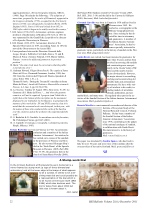
This short piece describes a stump-work mirror frame from about 1650 in Montacute House, Somerset, which features an image appearing to be a declining west sundial. It possibly represents a dial found on the house itself. Little else is known about this embroidered dial, highlighting an unusual artistic representation of a sundial.
Dials: Unusual, Dials: Vertical, Historical Dials
June 2009
Page 8
Page 8
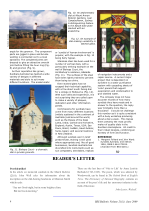
A letter identifying the poet Anna Laetitia Barbauld as the source of an inscription, ‘Say not Good-night, but in some brighter clime Bid me Good-morning’, on a memorial sundial at Mawnan Smith, previously mentioned in the March 2009 Bulletin.
Mottoes, The BSS and Members
December 2009
Page 23
Page 23
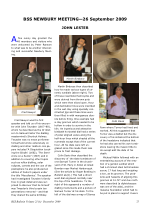
A summary of the autumn meeting of the British Sundial Society. The report covers the day's lectures on a variety of topics, including diallists John Twysden and Robert Cutbush, the creation of ceramic sundials, and Roman dials in Britain, as well as exhibits shared by members.
The BSS and Members
June 2008
Page 82
Page 82
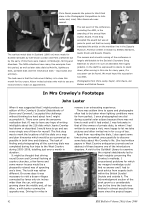
John Lester describes his extensive project to edit Mrs Crowley's Sundial Sketchbooks of Devon and Cornwall, which involved visiting and photographing all 216 recorded dials. He details the challenges of surveying in the West Country and his efforts to uncover facts about Mrs Crowley's life and methods, resulting in a published edition.
Book Reviews, Historical Dials
December 2007
Page 151
Page 151
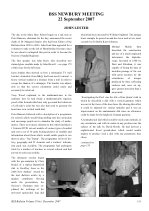
This report summarises the British Sundial Society's Newbury meeting, which began with a tribute to the late Dr. Margaret Stanier. Presentations included stained-glass sundials, mounting a vertical sundial with a TV bracket, mathematical proofs for hour lines, a schools programme for dialling, universal equinoctial ring dials, dipleidoscopes, dials with vertical gnomons, and hemispherical dials.
Dialling Tools, How Sundials Work, Sundial Design & Layout, The BSS and Members
December 2007
Page 173
Page 173
This section contains various letters from readers. Frans W. Maes discusses Lambert circles and seasonal markers on analemmatic sundials. Roger Bailey provides corrections and recommendations for seasonal markers. Frank King confirms a relationship for seasonal marker distance. Ken Head replies to Maes and Bailey. John Lester solves the mystery of a partial sundial motto. Malcolm Barnfield describes the making of a noon cannon sundial.
Dials: Analemmatic, Sundial Design & Layout, DIY Sundial Projects, The BSS and Members
September 2006
Page 109
Page 109
This section features diverse reader contributions. Topics include an anticlockwise convention for Roman numerals on old dials, warnings about Pearson-Page sundial replicas that can cause historical errors, the disappearance of a modern sundial at St. Gregory’s Minster, and a sceptical view on theories regarding continental cathedral meridian lines.
Historical Dials
December 2005
Page 168
Page 168
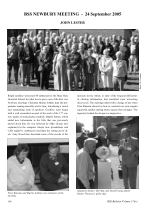
This report describes the BSS Newbury meeting on September 24, 2005, attended by 48 enthusiasts. The program included talks on 17th-century stained-glass sundial maker Baptist Sutton, spreadsheets and CAD for dial setting, museum surveys, and origami equatorial sundials. Exhibits featured sunspot observations, Mike Cowham's new book, high-quality sundial work, and intricate Meccano mechanisms.
The BSS and Members
June 2003
Page 61
Page 61
A collection of letters from readers discussing various topics, including a churchyard sundial at Hernhill, correcting an article on Piazzi and his meridian line, and a historical sundial pillar at Little Wenlock.
June 2003
Page 87
Page 87
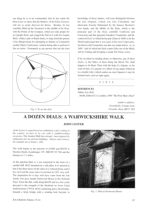
A guide to a walking tour in Warwickshire to see a number of sundials. It describes the locations and characteristics of several dials along the route.
Historical Dials
September 2002
Page 129
Page 129
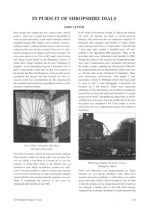
A personal account of locating and documenting sundials in Shropshire, discussing stylistic features, history, and condition.
Dials: Horizontal, Dials: Vertical, Historical Dials
February 2000
Page 16
Page 16
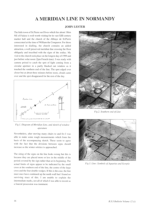
Describes a visit to a church in Normandy with a meridian line inscribed on the floor, with zodiac signs and associated solar observations.
Historical Dials
February 2000
Page 19
Page 19
Report of a BSS group meeting to document mass dials at churches in three counties, including visits and findings.
Dials: Mass Dials, The BSS and Members
June 2000
Page 73
Page 73
Reports a field trip to document surviving mass dials in Normandy and compares them with English examples.
Dials: Mass Dials
June 1996
Page 34
Page 34
Reflections on historic sundials mentioned in Arthur Mee’s ‘The King’s England’, with commentary on their cultural and historical context.
Historical Dials
October 1995
Page 35
Page 35
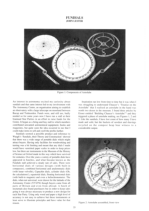
A creative examination of 'fundials', a whimsical category of dials built with humour, novelty, or playfulness in mind. The piece blends observation and storytelling with examples.
Dials: Unusual