- Home
- /
- Sundial Encyclopaedia
- /
- June 2009
June 2009
The articles link to the specific page in a PDF optimised for speed. If you want the whole issue, you can download it here, but the files from earlier years can be quite large.
June 2009
Page 1
Page 1
The mini-theme for this issue is sundials within the Tropics; articles by Malcolm Barnfield and Mike Cowham deal with a topic which we rarely think about but which is a good test for how well we really understand the apparent movement of the sun across the globe’s surface. The page numbering of this and subsequent bulletins will restart with each issue rather than being sequential within each volume. The 2008 Accounts will be printed with the September issue.
The BSS and Members
June 2009
Page 2
Page 2
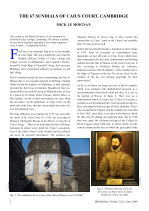
An exploration of the sundials at Gonville & Caius College, Cambridge. It details the six dials on the Gate of Honour, a lost fantastical column with 60 dials by the architect Theodore Haveus, and a rediscovered ‘great mural dial’ on the Chapel wall.
Dials: Multi Faced, Dials: Vertical, Historical Dials
June 2009
Page 5
Page 5
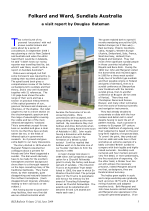
A report on a visit to Sundials Australia, run by Margaret Folkard and John Ward. It covers their design philosophy favouring cast relief dials for longevity, and manufacturing process using photopolymers. The article highlights their diverse work, including horizontal dials, armillary spheres, and international commissions.
Dials: Horizontal, Dials: Vertical, Dials: Armillary Sphere
June 2009
Page 8
Page 8
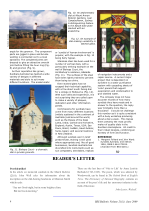
A letter identifying the poet Anna Laetitia Barbauld as the source of an inscription, ‘Say not Good-night, but in some brighter clime Bid me Good-morning’, on a memorial sundial at Mawnan Smith, previously mentioned in the March 2009 Bulletin.
Mottoes, The BSS and Members
June 2009
Page 9
Page 9
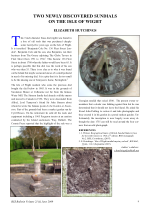
Describes two horizontal dials found on the Isle of Wight. One is a 7-inch brass dial by Benjamin Cole (c. 1751-1766). The other is a Georgian sundial dated 1735, originally from Swainston Manor, which was purchased at auction in 1985.
Dials: Horizontal, Historical Dials
June 2009
Page 10
Page 10
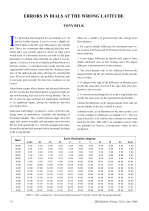
An analysis of the time-telling errors that occur when a horizontal or vertical non-declining sundial is used at a latitude different from its design latitude. The article provides tables and graphs illustrating the magnitude of these errors at different times of day and for different solar declinations.
Dials: Horizontal, Dials: Vertical, How Sundials Work, Mathematics of Dialling
June 2009
Page 11
Page 11
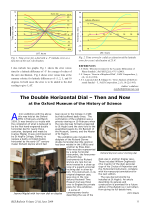
Reports on a mini-exhibition at the Oxford Museum of the History of Science featuring a new hand-engraved double horizontal dial by Joanna Migdal. The exhibition also included historical examples by Richard Glynne and Elias Allen, and related contemporary books.
Historical Dials, Dials: Double Horizontal
June 2009
Page 12
Page 12
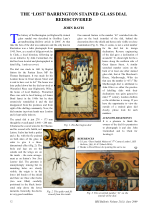
Announces the rediscovery of the Barrington (or Highworth) stained glass sundial, made in 1641 by Baptist Sutton. Previously thought lost, the dial was located with a private owner. The article details its features, including its coat of arms, a 3D-effect fly, and a scratched declination number.
Dials: Vertical, Historical Dials, Dials: Stained Glass
June 2009
Page 13
Page 13
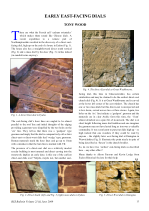
Discusses two potentially very early examples of direct east-facing vertical sundials. One is carved into the stonework of a house in Eydon, Northamptonshire. The other is carved on the church at Great Washbourne, Gloucestershire, and may be the earliest of its type.
Dials: Mass Dials, Dials: Vertical, Historical Dials
June 2009
Page 14
Page 14
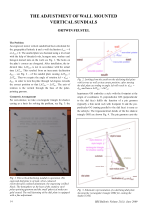
A technical article presenting a detailed mathematical method for correcting the alignment of a wall-mounted vertical sundial that has been installed with an inaccurate declination. It provides the necessary formulae and a worked example to calculate the required angle of rotation for adjustment.
Dials: Vertical, Mathematics of Dialling, Sundial Design & Layout
June 2009
Page 18
Page 18
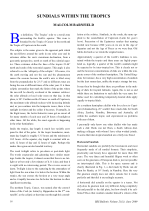
An overview of designing and using sundials in tropical regions. It discusses the suitability and challenges of various dial types, including horizontal, armillary, polar, and vertical, noting issues like noon-line crowding on horizontal dials and the advantages of other formats.
Dials: Horizontal, Dials: Vertical, Dials: Polar, Dials: Astrolabe, Dials: Armillary Sphere
June 2009
Page 24
Page 24
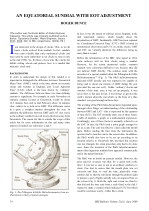
Details the design and construction of an equatorial sundial that directly indicates clock time (UTC). It incorporates a mechanical cam to automatically apply the Equation of Time correction, and includes adjustments for latitude and longitude. An appendix explains how to design the cam.
Construction Projects, Dials: Equatorial, Equation of Time, Sundial Design & Layout
June 2009
Page 31
Page 31
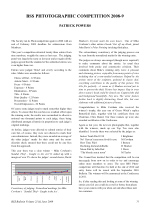
A report on the society's 2008-9 photographic competition, announcing the winner, Mike Cowham, and runners-up. It details the judging process and criteria and showcases several of the winning and highly-rated entries, while also noting the competition will become biennial.
The BSS and Members
June 2009
Page 34
Page 34
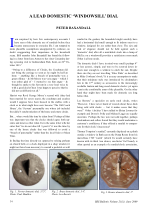
An analysis of a fragmented lead horizontal 'windowsill' sundial found in Dorset. The author reconstructs its likely original octagonal design, discussing its features, numeral conventions, and a possible skewed layout to compensate for magnetic variation, suggesting a date of around 1710.
Dials: Horizontal, Historical Dials, Restoration projects
June 2009
Page 40
Page 40
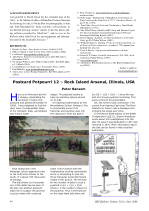
Features a 1909 postcard depicting a horizontal sundial at Rock Island Arsenal, Illinois, which was dedicated in 1877. The author comments on the dial's pedestal, the surrounding cannonball piles, and a personal connection to the location through a Johnny Cash song.
Dials: Horizontal, Historical Dials
June 2009
Page 41
Page 41
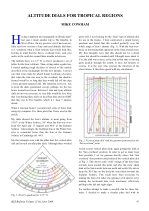
Explores the design of fixed-latitude altitude dials for use in tropical regions, specifically The Gambia (13.5° N). The article presents computer-generated plots for various types, including the horary quadrant and vertical plate dial, highlighting the unique behaviour of the hour lines as the sun passes overhead.
Dials: Portable, How Sundials Work, Sundial Design & Layout
June 2009
Page 43
Page 43
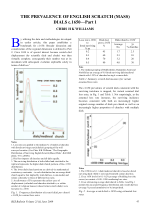
Establishes a benchmark for the number of mass dials in England around 1650, when their use was at its peak. Using data on surviving dials and estimated loss rates, the author models the original frequency distribution, suggesting there were on average two to three dials per church.
Historical Dials, Dials: Mass Dials
June 2009
Page 44
Page 44
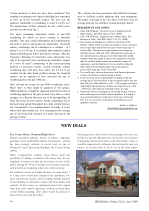
Describes two new dials. The first is a vertical declining dial with symbolic hour marks created using incised plasterwork (pargeting) in Wanstead. The second is a new globe moondial in stainless steel which shows time by the moon for nine days around the full moon.
Dials: Unusual, Dials: Vertical, Sundial Design & Layout
June 2009
Page 46
Page 46
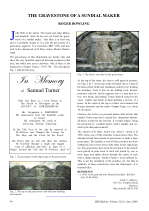
Identifies the gravestone of Samuel Turner (1716-1784), a shepherd who became a dial-maker and engraver. The slate memorial in Market Harborough, likely self-designed, features an engraved west-facing sundial and tells his life story.
Dials: Vertical, Historical Dials
June 2009
Page 47
Page 47
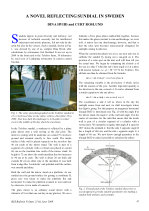
Describes a unique reflecting sundial where a flat mirror reflects a sunbeam onto a curved wall that serves as the dial plate. The article explains the geometry, calculations, and calibration process for this artistic and scientific instrument located at Tolefors Farm, Sweden.
Dials: Reflected, Dials: Unusual, Sundial Design & Layout
June 2009
Page 48
Page 48
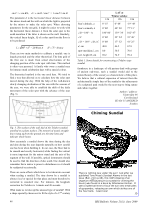
A short note featuring a 1645 drawing by Athanasius Kircher of an ‘Organum Heliocausticum’. This is a sundial designed to chime the hours by using a spherical lens to focus sunlight onto gunpowder, which in turn releases an arm to strike a bell.
Dials: Unusual, Historical Dials