- Home
- /
- Sundial Encyclopaedia
- /
- December 2019
December 2019
The articles link to the specific page in a PDF optimised for speed. If you want the whole issue, you can download it here, but the files from earlier years can be quite large.
December 2019
Page 1
Page 1
The December issue covers reports from the Newbury meeting, highlighting the successful restoration of a painted stone sundial based on three talks. It also notes new sundial articles from various geographical locations and includes an obituary for Andrew James.
The BSS and Members
December 2019
Page 2
Page 2
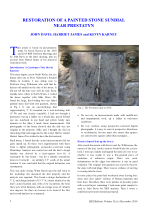
This article details the complex restoration of a large, venerable painted stone sundial near Prestatyn. After initial miscalculations, detailed analysis confirmed its 18th-century origin and correct design latitude. Scientific paint analysis suggested an original smalt blue and gilded finish. The sundial was subsequently restored, repainted, gilded, and reinstalled, canted correctly for its location.
Dials: Vertical, Historical Dials, Restoration projects, Sundial Design & Layout
December 2019
Page 9
Page 9
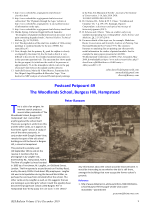
Discussion of a postcard featuring The Woodlands School, Burgess Hill, Hampstead, believed to be a pre-War girls' school. The author seeks information about the school's history and whether the sundial visible in the image still exists among the current buildings on the former grounds.
Historical Dials, The BSS and Members
December 2019
Page 10
Page 10
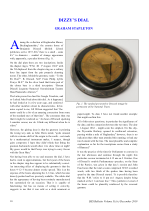
Analysis of a small, peculiar sundial presented to Benjamin Disraeli in 1862 by Philip Lybbe Powys. The article discusses its Latin motto and strange configuration (reversed gnomon). It concludes the dial was likely a customised desk ornament rather than a functional timepiece, relating its creation to Powys's attempts to curry favour during his troubled years.
Dials: Portable, Dials: Unusual, Historical Dials, Mottoes
December 2019
Page 11
Page 11
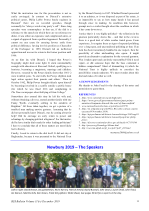
A group photograph of the speakers who presented at the Newbury One-Day Meeting on 21 September 2019, taken by Mike Shaw.
The BSS and Members
December 2019
Page 12
Page 12
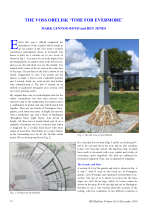
This article details the design and installation of a 3-metre tall obelisk sundial in Cornwall. The obelisk has an equilateral triangular cross-section, featuring two declining/reclining dials engraved on granite and slate, plus a simplified EoT correction table on the north face. Precise GPS alignment and a custom stainless steel turntable were used during installation to achieve high accuracy.
Construction Projects, Dials: Multi Faced, Mathematics of Dialling, Sundial Design & Layout
December 2019
Page 16
Page 16
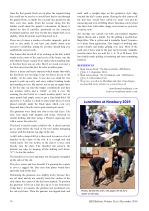
A brief mention of the long lunch break provided at the Newbury One-Day Meeting on 21 September 2019, which allowed attendees time to view the various exhibits inside the hall and outside in the sunshine.
The BSS and Members
December 2019
Page 17
Page 17
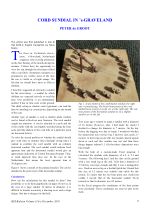
Description of the design and construction of a large, interactive combination sundial located at the ’s-Graveland observatory in the Netherlands. The 5.5-metre dial combines a cord sundial, indicating local apparent time, with a horizontal sundial, showing Central European Summer Time. The article details the mathematical calculations, material choices (Robinia wood), and implementation steps for this educational project.
Construction Projects, DIY Sundial Projects, Dials: Horizontal, Dials: Unusual
December 2019
Page 22
Page 22
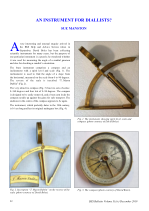
An investigation into a 19th-century brass instrument by T. Mason Dublin, combining a compass and an inclinometer, whose purpose is uncertain. The author reviews several possibilities for its use, such as adjusting a sundial's latitude or measuring gnomon angles, but ultimately suggests it was more likely intended for surveying or geological measurements.
Dialling Tools, Historical Dials
December 2019
Page 24
Page 24
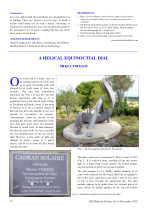
Description of a recently constructed, large helical equinoctial dial located in Fouzilhon, France. Made of Vosges granite, the dial features a gnomon with a unique helical slot that projects a strip of light onto the hour scale engraved inside the helical chapter ring. The design also incorporates zodiac signs and information on Equation of Time corrections.
Dials: Equatorial, Dials: Unusual, Sundial Design & Layout, Construction Projects
December 2019
Page 26
Page 26
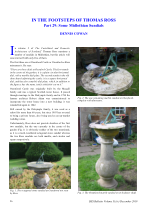
The 29th part of a series documenting sundials mentioned by Thomas Ross, focusing on five examples in Midlothian. The author traces the status and location of three dials at Oxenfoord Castle, a 1745 vertical dial in Dalkeith, and the relocation of a rare lectern sundial from Mid Calder House to Culzean Castle in Ayrshire.
Dials: Cube, Dials: Multi Faced, Dials: Vertical, Historical Dials
December 2019
Page 31
Page 31
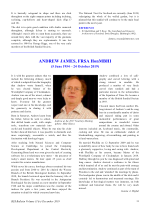
An obituary for Andrew James (1954–2019), former Master of the Worshipful Company of Clockmakers. He was celebrated for his immense knowledge of horology, his career as a chief scientist for a meter manufacturer, and his significant contributions to sundialling, including carving slate dials and expertise in the technicalities of the Equation of Time.
The BSS and Members
December 2019
Page 32
Page 32
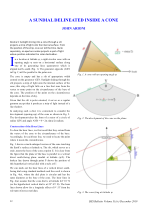
A technical article detailing the design and mathematics of a sundial delineated inside a right circular cone. Sunlight passing through a polar-oriented slit projects a time-telling strip of light onto the interior surface. An aperture nodus simultaneously projects a spot indicating the solar declination. The article includes formulae for deriving hour lines and the characteristic closed-curve calendar lines.
Dials: Unusual, How Sundials Work, Mathematics of Dialling, Sundial Design & Layout
December 2019
Page 37
Page 37
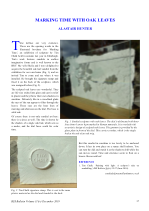
A description of an oak leaf sundial sculpture acquired from an exhibition by Tim Chalk. The piece features life-size oak leaves etched into glass and cast in plaster, creating the hour lines using their shadows. A single oak bud acts as a nodus to show solar time, making it both an artistic and scientific piece.
Construction Projects, Dials: Unusual, Sundial Design & Layout
December 2019
Page 38
Page 38
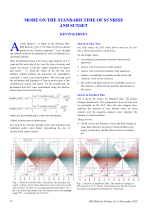
An expansion on the study of sunrise and sunset times, providing systematic calculations across all latitudes. Using a two-step iterative calculation, the author compares the symmetrical results found in Solar Time against the asymmetrical results in Standard Time, demonstrating how the Equation of Time (EoT) dramatically perturbs the earliest and latest sunrise/sunset days across various latitudes.
Equation of Time, How Sundials Work, Mathematics of Dialling
December 2019
Page 39
Page 39
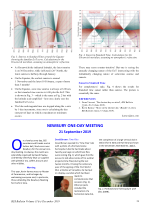
A comprehensive report detailing the presentations given at the annual BSS Newbury meeting. Topics included David Brown's project updates, Frank King's heliodrome concept, Ben Green's heliochronometer, David Burstall’s glass equatorial dial, discussions on the Fixed Dial Register, portable dials, and Martins Gills' new Latvian sundials and the Sundials Atlas website update.
Construction Projects, Historical Dials, Sundial Design & Layout, The BSS and Members