- Home
- /
- Sundial Encyclopaedia
- /
- Anthony Turner
Anthony Turner
December 2022
Page 30
Page 30
Suggests interpretations for the terms "Areis" and "Stylis" mentioned by Uffenbach regarding the Whitehall dial. Areis might refer to the dial ground or open space, and Stylis to the gnomons.
Historical Dials
September 2021
Page 44
Page 44
Reviews "Le Gnomon du Méridien Cassini", a book detailing the history, theory, calculation, and construction of a meridian line in Perinaldo, Italy. The line, built as a gigantic camera obscura in the birthplace of G.D. Cassini, was completed in 2007.
Book Reviews, Dials: Noon Lines
September 2020
Page 26
Page 26
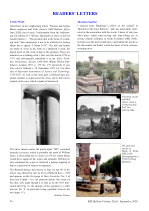
Anthony Turner clarifies that a portable dial signed J Mann 1679 should not be attributed to Joshua Mann. John Foad compares the association of the Thornton sundial with stocks to a similar instance in Ripley, North Yorkshire.
Dials: Portable, Historical Dials
September 2020
Page 27
Page 27
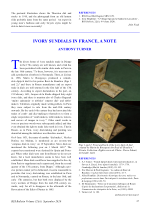
Examines the manufacture and export of ivory sundials in France, historically linked to Dieppe. Provides evidence for production in Rouen during the first half of the 17th century and mentions a notable diptych dial made in Lisieux in 1598.
Dials: Portable, Historical Dials
September 2018
Page 2
Page 2
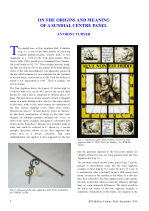
Investigates the history and iconography of the central rectangular image of a putto holding a dial, found on a c. 1670 painted-on-glass window dial by Henry Gyles (York). The source is traced back to a Venetian painting, 'The little tambourine player,' which was transformed into a *memento mori* by engraver Jacob Matham, including symbols of vanity like an hourglass and arrow.
Dials: Stained Glass, Historical Dials, Sundial Design & Layout
June 2016
Page 15
Page 15
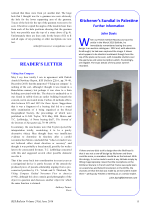
The author supports the view that the purported ‘Viking sun compass’ is not a navigational device. Summarizing historical analyses from 1954, the object found in Greenland rubble was rejected as inaccurate likely purely decorative, with suggestions that it might have been a bread mould.
December 2014
Page 2
Page 2
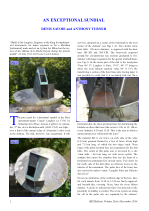
This article describes a unique horizontal sundial/meridian instrument constructed by Claude Langlois in 1741 for Alexandre de la Rochefoucauld at the château de la Roche-Guyon. The instrument features a large brass box gnomon with a slit and seven eyelets, allowing the spots of light to correspond to significant dates, such as the solstices and the entry of the sun into zodiac signs.
Dials: Horizontal, Dials: Noon Lines, Dials: Unusual, Historical Dials
March 2013
Page 24
Page 24
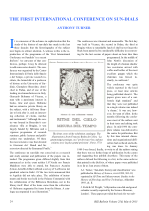
An account of the first international conference devoted to sundials, organised in Italy in the 1980s. Turner outlines its origins, participants, and its influence on dialling scholarship.
Historical Dials, The BSS and Members
December 2011
Page 47
Page 47
This section contains letters from readers discussing various sundial topics. These include formulae for horizontal shadow length, a query about the oldest scientific sundial in the British Isles, sundials in family crests, proposed organisational changes within the BSS, and the historical transmission of scratch dials and water-clock functionality. It highlights ongoing member engagement and research interests.
Mathematics of Dialling, Historical Dials, The BSS and Members, Mottoes