- Home
- /
- Sundial Encyclopaedia
- /
- Dialling Tools
Dialling Tools
June 2023
Page 2
Page 2
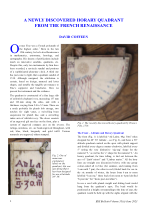
Details the discovery of an ivory horary quadrant by Oronce Fine, dated 1518, designed for 48° 30ʹ latitude. The quadrant features straight hour lines and an elaborate carved leather case bearing the coat of arms of Michel Boudet, Fine’s protector. It is noted as being remarkably similar to the quadrant seen in Holbein’s "Les Ambassadeurs".
Dials: Portable, Mathematics of Dialling, Dialling Tools, Historical Dials
June 2023
Page 31
Page 31
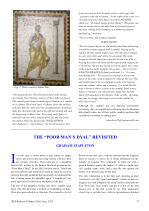
Revisits Sir Samuel Morland's 1689 pamphlet promoting his non-extant "Poor Man’s Dyal." Analysis suggests it was a modest, four-inch diameter horizontal dial, possibly pewter or brass, sold with an instrument for establishing the East-West line, reflecting Morland’s efforts to raise funds through inexpensive items.
Dialling Tools, Dials: Horizontal, Historical Dials
December 2023
Page 30
Page 30
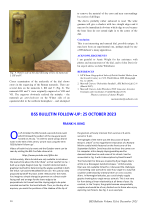
A report on the second BSS Zoom event (renamed 'BSS Bulletin Follow-up'). The event included discussions on the Erfurt Rule and a demonstration of chiselling during the restoration of a Melvin sundial, alongside a theoretical look at converting solar azimuth to solar hour angle for different latitudes.
Dialling Tools, How Sundials Work, Restoration projects, The BSS and Members
December 2023
Page 37
Page 37
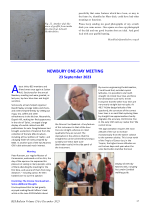
An extensive report detailing the annual BSS Newbury meeting. Topics covered included the Oronce Fine Quadrant, Isle of Wight dials, methods for finding True North, the Sundial Atlas, John Lester's obituary, unusual scratch dials, a London sundial walk, and updates on the Hythe 'Undial' and BSS governance challenges.
Dialling Tools, Historical Dials, Mathematics of Dialling, The BSS and Members
March 2022
Page 34
Page 34
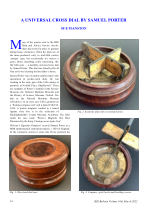
Description of a unique portable, universal cross dial made by Samuel Porter, a London mathematical instrument maker (c. 1824). The dial, found in a clearance, features a pivoted cross for latitude setting, a 16-point compass, spirit levels, and an Equation of Time table printed inside the lid.
Dialling Tools, Dials: Portable, Equation of Time, Historical Dials
December 2022
Page 25
Page 25
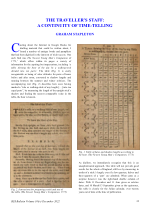
Explores 18th-century printed tables intended for travellers to estimate time using solar altitude and a divided walking stick. The calculations were based on Julian calendar dates and approximated the latitude of Coventry, prioritising simplicity over accuracy.
Dialling Tools, Dials: Portable, Historical Dials
December 2021
Page 13
Page 13
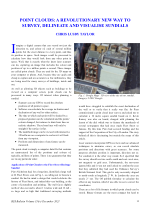
Explores the use of laser scanners and point clouds as a revolutionary method for surveying and designing sundials, accurate to a few millimetres. The technique was used on the Fleet Street dial to determine precise coordinates, declination, and inclination, allowing designers to calculate hour lines and model shadows regardless of surface irregularities.
Construction Projects, Dialling Tools, Mathematics of Dialling, Sundial Design & Layout
September 2020
Page 23
Page 23
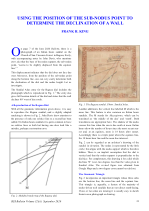
Presents a gnomonic method using the ratio of the horizontal distance between the sub-nodus point, the noon line, and the equinox line to determine a wall's declination. The technique, illustrated using the Ragusa dial, also allows calculation of the nodus height for a vertical dial.
Dialling Tools, Dials: Vertical, How Sundials Work, Mathematics of Dialling
December 2020
Page 42
Page 42
A Beginner’s Guide to Delineation: deriving the Lennox-Boyd ‘y’ formula using a gnomonic tetrahedron
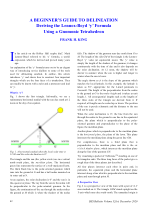
An explanation of Mark Lennox-Boyd's 'y' formula (the length of the shadow of the gnomon nodus from the gnomon root). The formula is derived using spherical trigonometry simplified into four interconnected right-angled triangles forming a 'gnomonic tetrahedron'. This methodology is presented as a helpful tool for novice diallists learning delineation.
Dialling Tools, How Sundials Work, Mathematics of Dialling, Sundial Design & Layout
December 2019
Page 22
Page 22
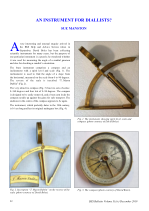
An investigation into a 19th-century brass instrument by T. Mason Dublin, combining a compass and an inclinometer, whose purpose is uncertain. The author reviews several possibilities for its use, such as adjusting a sundial's latitude or measuring gnomon angles, but ultimately suggests it was more likely intended for surveying or geological measurements.
Dialling Tools, Historical Dials
March 2018
Page 33
Page 33
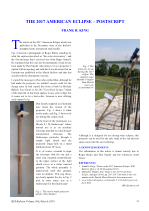
A correction and postscript clarifying the designer and constructor of a solar projector used during the 2017 American Eclipse. The device was constructed by Don Snyder based on a design by Michael Bakich. It uses a finderscope to project the image and an alignment peg that serves as a temporary gnomon.
Construction Projects, Dialling Tools
December 2017
Page 6
Page 6
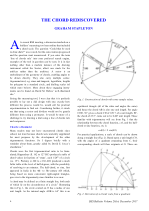
Examines how a chord scale (such as on a Sector instrument or line of chords rule) can be used for geometrically laying out a dial design. The article discusses the historical use and trigonometry of chords and compares the process to using a protractor.
Dialling Tools, Mathematics of Dialling, Sundial Design & Layout
December 2017
Page 12
Page 12
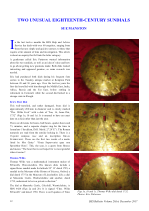
Investigates two antique dials: a damaged brass horizontal dial signed by Thomas Wilks and dated 1732, featuring a Jerusalem time ring and Horace motto; and an unsigned, rare, early 18th-century horizontal dial believed to be part of a declinatory instrument.
Dialling Tools, Dials: Horizontal, Dials: Unusual, Historical Dials
September 2016
Page 22
Page 22
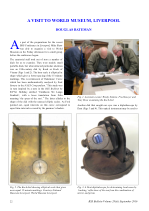
A report on a BSS visit to World Museum, Liverpool, to view their collection of dials. Highlights included an 18th-century Koch dial from Vienna featuring an elliptical scale for better spacing of 15-minute markings, and a Dent dipleidoscope, an instrument used for precisely determining apparent noon.
Dialling Tools, Dials: Portable, Historical Dials, How Sundials Work
December 2016
Page 27
Page 27
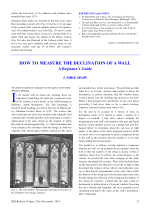
A guide detailing a method for accurately measuring wall declination, based on a talk at Newbury (2016). It involves using a plumb line, mirror, and white board to determine the exact moment the sun is perpendicular to the wall. The subsequent azimuth is derived easily using the 'Sun Seeker' mobile application.
Dialling Tools, Mathematics of Dialling
June 2015
Page 21
Page 21
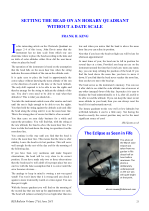
Addressing the lack of a date scale on the Chetwode Quadrant, this piece explains a practical method for setting the sliding bead on an horary quadrant string. The user relies on frequent observations around noon to refine the bead's position relative to the noon hour line.
Dialling Tools, How Sundials Work, Mathematics of Dialling
September 2015
Page 8
Page 8
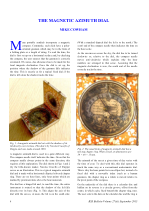
This article explores the design and function of magnetic azimuth dials, where the compass needle indicates the time. Using historical examples by Nicolas Crucefix and Charles Bloud, it details methods for calibration, dealing with magnetic declination, and construction techniques suitable for portable instruments.
Dialling Tools, Dials: Portable, How Sundials Work, Mathematics of Dialling
September 2015
Page 42
Page 42
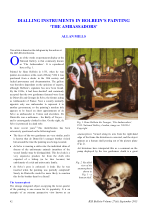
Analysis of the dialling and astronomical instruments depicted in Hans Holbein's 1533 painting, ‘The Ambassadors’. Instruments covered include the torquetum, shepherd’s dial, universal equatorial dial, horary quadrant, and polyhedral dial, noting potential artistic inaccuracies.
Dialling Tools, Dials: Equatorial, Dials: Portable, Historical Dials
December 2015
Page 35
Page 35
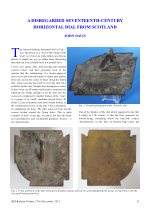
Describes a battered brass horizontal dial acquired via auction, dating to the 17th century based on inward-facing numerals and hammered plate thickness. Discusses its specialized cast gnomon and metallurgy, suggesting a Glasgow–Edinburgh origin.
Dialling Tools, Dials: Horizontal, Historical Dials
March 2014
Page 22
Page 22
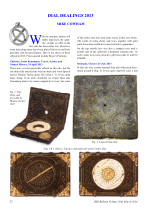
This review covers noteworthy sundials sold at auction in 2013. Highlights include a valuable ebony and ivory diptych dial by Thomas Tucher (1612, £20,000) and a fine late 17th-century silver dial by Henry Wynne (£6,875). Other instruments featured were a declinatory dial by Nicholas Bion and an oval Butterfield-type dial by Choizy.
Dialling Tools, Dials: Portable, Historical Dials
March 2014
Page 32
Page 32
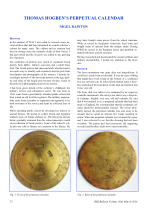
Research into a rare brass perpetual calendar attributed to Thomas Hogben (1702–1774), a surveyor and dialmaker from Kent. The instrument comprises three concentric disks engraved with dates, months, and astronomical signs, and features windows showing day length and sunrise/sunset times. Its construction around 1752 coincided with Britain's adopting the Gregorian calendar.
Dialling Tools, Historical Dials, How Sundials Work
March 2014
Page 36
Page 36
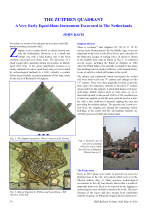
A copper-alloy quadrant excavated in Zutphen is securely dated to c.1300–1320, pushing back the date of known equal-hour quadrants in Europe by nearly a century. The instrument is engraved with an altitude scale, date/declination arcs, and hour lines for equal hours, implying a design latitude of approximately 52.0° N. This find reflects the increasing need for standardised time linked to the spread of tower clocks.
Dials: Astrolabe, Mathematics of Dialling, Dialling Tools, Historical Dials
September 2014
Page 29
Page 29
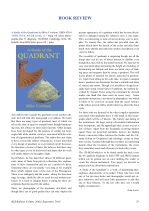
A review of 'A Study of the Quadrant' by Mike Cowham (2014). The monograph is highly recommended, covering the many types and functions of quadrants, including timekeeping, setting out hour-angle dials, and solving trigonometrical problems, all explained with clarity.
Book Reviews, Dialling Tools, Mathematics of Dialling
March 2013
Page 37
Page 37
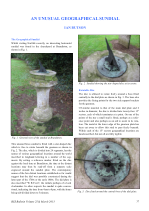
A technical description of a complex slate sundial featuring a rotatable star-shaped disc engraved with worldwide place names. The author explains its design, restoration, and probable use.
Dialling Tools, Dials: Horizontal, Dials: Unusual
September 2013
Page 29
Page 29
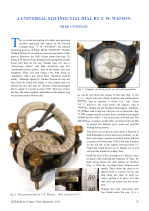
Description of a nice precision portable equatorial dial, circa 1880, by T.W. Watson. It is designed for use in both hemispheres and includes specialized chapter ring and compass card layouts, featuring both an Equation of Time chart and a separate map of Isogonic Lines for 1877 for precise time setting.
Dialling Tools, Dials: Equatorial, Dials: Portable, Equation of Time
September 2013
Page 32
Page 32
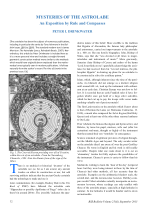
An exposition on the history and components of the astrolabe, including its two faces (sighting bar/calendar and matrix/rete/plates). The article details a geometric construction method using rule and compasses to lay out the template for the rete and the individual plates via stereographic projection.
Dialling Tools, Dials: Astrolabe, How Sundials Work, Mathematics of Dialling
December 2013
Page 21
Page 21
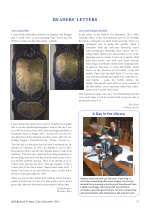
Contains letters regarding: (1) a "three-plate" dial found at a pub in Goudhurst, Kent, signed Jas Smythe 1692, suspected to be a fake; and (2) a systematic procedure for levelling universal equinoctial dials using three adjusting screws.
Dialling Tools, Historical Dials
December 2013
Page 45
Page 45
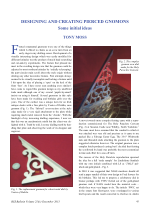
Details the author's development of ornamental, fretted, and pierced gnomons, noting his unofficial trade mark—a spur on the heel of the front 'foot'. He describes techniques using a clockmaker's fretsaw, Thiel filing machine, and flexible-shaft machine, often featuring interlaced initials.
Construction Projects, DIY Sundial Projects, Dialling Tools, Sundial Design & Layout
September 2012
Page 20
Page 20
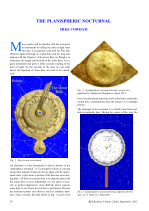
This article describes the planispheric nocturnal, an instrument for telling time at night by aligning a rotating star chart with actual stars. It functions as an alternative to a traditional nocturnal and can be found on the reverse of some quadrants, offering timekeeping to within 15 minutes without requiring Equation of Time correction.
Dialling Tools, How Sundials Work, Dials: Nocturnals
March 2011
Page 11
Page 11
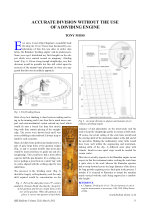
The author explores methods for accurately dividing sundial scales without modern dividing engines. He proposes a compact, semi-mechanical system using pivot pins and a straightedge, designed to fit on a bench, and notes its superiority over Ramsden's engine in terms of user comfort.
Construction Projects, Dialling Tools, Sundial Design & Layout
March 2011
Page 34
Page 34
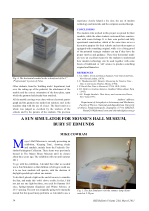
This article describes the creation of a motorised sun simulator for a museum exhibition, designed to demonstrate how sundials work by speeding up daylight duration. It features three lights for different seasons and allows visitors to test card sundial kits.
Construction Projects, Dialling Tools, How Sundials Work
June 2011
Page 8
Page 8
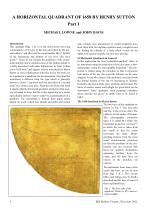
This article describes a unique 17th-century horizontal quadrant by Henry Sutton, detailing its stereographic projection, various scales for altitude, azimuth, time, and astronomical functions. It explains how the instrument, acting as a mechanical analogue computer, finds time from the sun's altitude.
Dialling Tools, Dials: Horizontal, Historical Dials, Mathematics of Dialling
June 2011
Page 20
Page 20
This article explores the military use of solar compasses, particularly during World War II, for navigation in unmapped desert terrains. It describes several models, including the Burt, Abrams, Cole Universal, Bagnold, and Union Observatory sun compasses, highlighting their principles and operational advantages.
Dials: Analemmatic, Dials: Portable, Dialling Tools, Historical Dials
September 2011
Page 34
Page 34
William Watson describes a new instrument for finding a meridian line to aid in sundial making, using two tubes aligned with Polaris and Capella. Michael Lowne comments on the necessity of accounting for Polaris's displacement from the true pole and the stars' right ascension difference for correct alignment, noting potential inaccuracies in Watson's original design and challenges in its use.
How Sundials Work, Mathematics of Dialling, Dialling Tools
March 2010
Page 24
Page 24
Discusses two sets of playing cards published in 1701 by instrument maker Thomas Tuttell, which functioned as a trade catalogue. The cards illustrate instruments like elliptical dials, dialling globes, and projections of the sphere used in dialling.
Dialling Tools, Historical Dials
June 2010
Page 42
Page 42
This article describes a DIY instrument for establishing a meridian line, developed for aligning large sundials. It uses two mirrors set at right angles to each other to project a spot of sunlight that remains directly beneath the sun horizontally, regardless of the instrument's heading. The device, a variant of a corner reflector, allows for precise tracking of the sun's path along the horizon.
DIY Sundial Projects, Dialling Tools, Sundial Design & Layout
June 2010
Page 43
Page 43
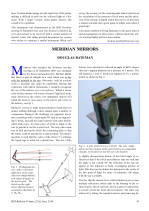
This article presents an alternative construction for Michael Maltin's meridian instrument, which uses two orthogonal mirrors to establish a meridian line. The author describes using an engineering V-block as a ready-made 90-degree angle, adding small mirrors and a spirit level for accurate setup. It discusses refinements like front-silvered mirrors and a hinge for precise spot overlap, highlighting its simplicity and accuracy for determining the sun's azimuth.
DIY Sundial Projects, Dialling Tools, Sundial Design & Layout
September 2010
Page 35
Page 35
This section contains two letters: Maurice J. Kenn congratulates Michael Maltin on his 'Novel Meridian Finder' and discusses the dipleidoscope; Roger Bowling queries if anyone has seen Haidinger’s brushes and the perception of polarised light.
How Sundials Work, Dialling Tools
March 2008
Page 14
Page 14
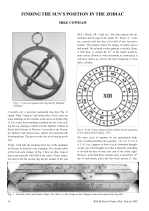
This article explains how to use Solar Course diagrams found on historical instruments, such as an Edmund Culpeper universal equinoctial ring dial and Italian quadrants, to determine the sun's position in the Zodiac. It details calculation methods, including adjustments for Old Style and New Style calendars, and notes rare instances of early Gregorian calendar pre-emption.
Dialling Tools, Historical Dials, How Sundials Work, Mathematics of Dialling
March 2008
Page 43
Page 43
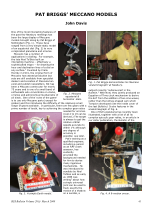
Showcases Pat Briggs' Meccano models, ranging from simple equatorial dials to complex planetaria and astronomical clocks. It highlights his ingenious mechanisms, including a universal joint for shadow tracking, an Equation of Time clock, and a 'Meccano Analemmagraph' for drawing the analemma, using cunningly-designed gear ratios.
Dials: Equatorial, Equation of Time, Dialling Tools, DIY Sundial Projects
September 2008
Page 130
Page 130
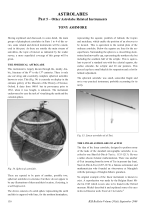
This part of the Astrolabes series covers instruments related to, but distinct from, planispheric astrolabes. It discusses the rare spherical and linear astrolabes, monumental and domestic astrolabe clocks, mariner's astrolabes (not true astrolabes), and various types of quadrants, including horary and astrolabe quadrants, detailing their history and use.
Dials: Astrolabe, Dialling Tools, Historical Dials, How Sundials Work
December 2008
Page 166
Page 166
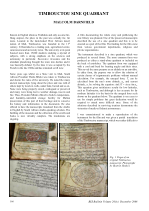
This article details the reproduction of a sine quadrant from a preserved Timbouctou manuscript for a documentary film. It describes the instrument's function in solving trigonometric problems without manual calculation, like determining unequal hours, and its historical context as a teaching tool in Islamic astronomy. The author discusses the challenges of interpretation and the modern construction using laser-cut perspex.
Construction Projects, Dialling Tools, Historical Dials, Mathematics of Dialling
December 2008
Page 188
Page 188
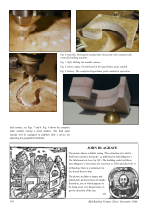
This short note features an illustration from John Blagrave's "The Mathematical Jewel" showing a diallist determining wall declination. It briefly mentions Blagrave's life in Reading and the various tools depicted in the drawing, such as a square, plumb-bob, and simple theodolites.
Dialling Tools
March 2007
Page 24
Page 24
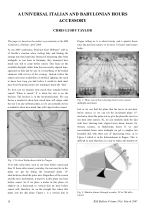
This paper introduces a simple accessory, a three-quarters CD, that can be used with existing horizontal sundials to signify Italian and Babylonian hours. It explains how these hour systems differ from conventional timekeeping and how the accessory allows us to read these hours, using the shadow of the CD.
Dials: Horizontal, How Sundials Work, Dialling Tools, DIY Sundial Projects
March 2007
Page 27
Page 27
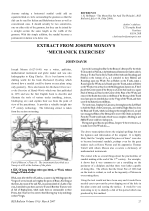
John Davis presents an extract from Joseph Moxon's 1678 book, 'Mechanick Exercises,' detailing a method for laying moldings on round brass pieces without a lathe, invented after the Fire of London. This technique is suggested to have been used for horizontal sundials, offering insight into 17th-century sundial making practices and Moxon's ingenuity.
Dialling Tools, Historical Dials
September 2007
Page 118
Page 118
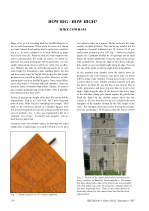
This article presents practical, simple methods for measuring the height and size of sundials, especially those high on church towers. It describes using a homemade shadow square for height, relating dial dimensions to known object sizes from photographs, and employing a marked tripod. Computer software techniques for perspective correction are also discussed to improve accuracy.
Construction Projects, Dialling Tools
September 2007
Page 137
Page 137
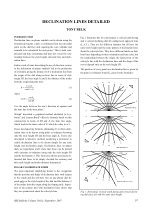
This article offers detailed methods for drawing declination lines on planar sundials using polar and Cartesian coordinates, or a graphical protractor, all based on the dial's style height and nodus distance. It also provides formulas for calculating hour line angles for various dial types and a simple method to check existing dials for accuracy.
Construction Projects, Dialling Tools, Mathematics of Dialling, Sundial Design & Layout
December 2007
Page 151
Page 151
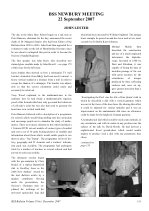
This report summarises the British Sundial Society's Newbury meeting, which began with a tribute to the late Dr. Margaret Stanier. Presentations included stained-glass sundials, mounting a vertical sundial with a TV bracket, mathematical proofs for hour lines, a schools programme for dialling, universal equinoctial ring dials, dipleidoscopes, dials with vertical gnomons, and hemispherical dials.
Dialling Tools, How Sundials Work, Sundial Design & Layout, The BSS and Members
February 2006
Page 3
Page 3
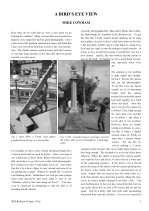
This piece addresses the challenges of photographing high-mounted or horizontal sundials. The author presents a practical solution involving an elevated digital camera on an extended tripod with a remote shutter release, enabling bird's eye views while ensuring the photographer's safety and optimal framing without including themselves in the shot.
Dialling Tools, DIY Sundial Projects
September 2006
Page 142
Page 142
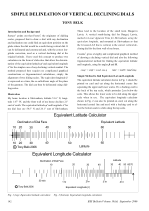
This article introduces a user-friendly method for delineating vertical declining sundials using bespoke slide rule-like calculators. These tools determine equivalent latitude and longitude, simplifying the process by eliminating complex trigonometry. The article explains how to use these calculators with standard dialling scales to accurately plot hour and sub-style lines.
Dialling Tools, Dials: Vertical, Mathematics of Dialling, Sundial Design & Layout
December 2006
Page 167
Page 167
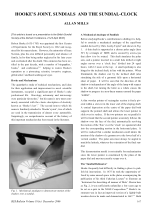
Allan Mills explores Robert Hooke's "Sundial Delineator," an instrument using a cross-shaped interior member (similar to a Hooke's joint) to simulate gnomon shadow motion for sundial delineation. The article details how Hooke's joint can be applied to delineate sundials and, when driven by a clock, create a "sundial-clock," explaining the underlying mathematical principles.
Sundial Design & Layout, Dialling Tools, Historical Dials
June 2005
Page 63
Page 63
Letter recommending WinEphem software for calculating moon transit times useful for moondials. Notes features such as rise/set/transit data and accuracy for dialling purposes.
Dialling Tools, Dials: Nocturnals
March 2004
Page 38
Page 38
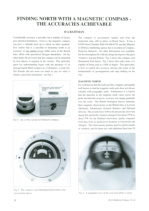
This article details the practical limitations and achievable accuracies when using a magnetic compass to determine true north, especially for diallists. It explains how Earth's magnetic field variations, crustal and external influences, and man-made objects affect compass readings, and provides methods, including online tools, for accurate magnetic variation calculation to assist sundial alignment.
Dialling Tools
June 2004
Page 47
Page 47
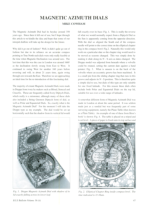
Historical and technical discussion of magnetic azimuth dials from the 17th century, including Dieppe ivory examples, London surveying instruments, and design considerations for modern reconstructions.
Dialling Tools, Dials: Unusual, Historical Dials
June 2004
Page 69
Page 69
Discussion on the challenges of aligning large sundials to true north, focussing on accuracy and discrepancies in tools to calculate solar azimuth
Dialling Tools, Sundial Design & Layout
September 2003
Page 91
Page 91
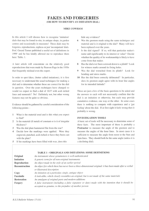
This article discusses how to recognise fake or imitation sundials. It provides a list of points to consider, such as the material used, how the markings were applied (engraved, punched, or etched), and the presence of suspicious mottoes or dates. The author also suggests tools for investigation and discusses common errors made by both forgers and legitimate makers.
Dialling Tools, Historical Dials
March 2002
Page 35
Page 35
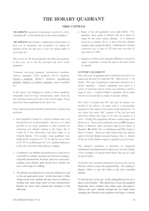
Overview of the design and historical use of various horary quadrants.
Dialling Tools, Historical Dials
June 2002
Page 74
Page 74
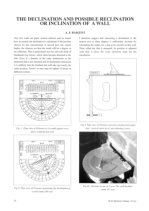
Discussion of geometric methods for determining wall orientation for accurate dial design.
Dialling Tools
June 2002
Page 81
Page 81
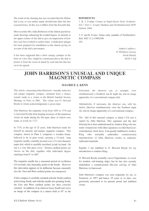
Examines a rare compass designed by Harrison, with discussion of its function and potential sundial applications.
Dialling Tools, Dials: Portable
June 2001
Page 56
Page 56

John Davis introduces his design for a flexible, wallet-sized gnomon protractor, aimed at overcoming difficulties in measuring gnomon angles on buttressed sundials. The device expands the scale for better precision within typical UK angles and can be photocopied by readers to create their own. He details its construction from laminated paper and auxiliary scales.
DIY Sundial Projects, Dialling Tools
June 2001
Page 83
Page 83
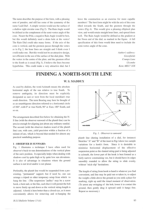
W.S. Maddux describes precise techniques for accurately establishing a true north-south line, essential for sundial installation. He outlines two methods using a plumb line and its shadow: one for general alignment and another for achieving high precision, detailing practical steps for observing and marking the meridian.
Dialling Tools, Sundial Design & Layout
October 2000
Page 115
Page 115
Practical guide to photographing various types of sundials, including exposure, lenses, framing, and lighting for effective recording and archival use.
Dialling Tools
February 1999
Page 9
Page 9
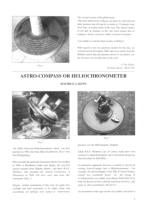
This article references the Gibbs Universal Heliochronometer, patented in 1906, and its presence at the 1998 BSS Conference. It suggests converting existing Astro-Compasses into heliochronometers by adding self-adhesive hour-labels, providing an affordable way to indicate local sun time with reasonable accuracy.
Dialling Tools, DIY Sundial Projects, Dials: Heliochronometer
February 1999
Page 33
Page 33
This section contains diverse reader correspondence, including a tribute to Charles Aked, discussions on the Equation of Time and Bernhardt dials, explanations of the Lluc sundial in Mallorca, a comparison of Eureka compass cards, reflections on restoration, and a submission on 'Tipple Times'.
Dials: Unusual, Equation of Time, Dialling Tools, The BSS and Members
June 1999
Page 62
Page 62
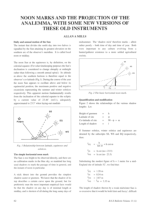
This article explores noon marks and the analemma, detailing how the sun's daily and annual motion is used to determine local noon and time of year. It discusses simple horizontal and vertical noon marks, the use of aperture gnomons, and the historical and modern application of the analemma for time correction. New designs for polar and vertical analemmatic noon marks, including sculptural forms, are also presented.
Dialling Tools, Dials: Noon Lines, Equation of Time, Sundial Design & Layout
June 1999
Page 96
Page 96
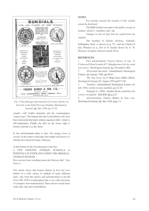
This technical article presents a method for estimating the declination of vertical sundials, particularly useful for dials high on buildings. Rather than measure the 'substyle distance' (angle between the gnomon and the noon line) one reads off the 'time' on the dial the gnomon is pointing to. This can be looked up in a precalculated table for a given latitude to give the degrees of declination of the dial.
Dialling Tools, Dials: Vertical, Mathematics of Dialling
October 1999
Page 144
Page 144
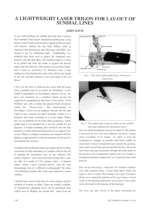
This article describes the design and construction of a lightweight laser trigon for accurately laying out sundial lines. Inspired by difficulties with traditional string methods, the author developed a compact perspex instrument that uses a laser pointer to project declination and hour lines onto any dial surface. The design addresses issues of gnomon flexing and portability, and uniquely proposes linking the trigon's axes to trace analemmas mechanically, offering a universal tool for precise dial delineation.
DIY Sundial Projects, Dialling Tools
June 1998
Page 37
Page 37
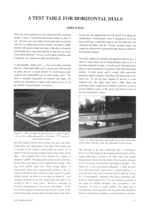
This article describes how to build a simple, portable test table for horizontal sundials using a photographic tripod. The table allows for fine adjustments to be made to test dials for different latitudes without needing to find a perfectly horizontal surface.
DIY Sundial Projects, Dialling Tools
October 1998
Page 10
Page 10
This report summarises the BSS Newbury meeting on the eve of the Summer Solstice. It covers talks on Hampshire sundials, raised horizontal dials, astro-compass conversions, and a sun compass. The event also featured an exhibition of various sundials and computer programs, highlighting members' ingenuity and the collaborative spirit of the society.
DIY Sundial Projects, Dialling Tools, Historical Dials, The BSS and Members
October 1998
Page 24
Page 24
This section features a collection of correspondence from readers covering diverse topics. These include the origin of Bernhardt Dials, methods for finding the meridian, updates on Newbury BSS meetings, a problematic sundial in Lluc, Mallorca, discussions on the 'Eureka' credit card compass, and inquiries about spherical and 'problematic' Italian dials.
Dialling Tools, Dials: Unusual, Historical Dials, The BSS and Members
January 1997
Page 37
Page 37
A method for telling time using moonlight and sundial principles. Explains necessary calculations, lunar phases, and adjustments for accuracy.
Dialling Tools, How Sundials Work
April 1997
Page 33
Page 33
An overview of the emerging presence of sundial resources and communities online, highlighting websites, digital tools, and opportunities for dial enthusiasts to connect.
Dialling Tools
July 1997
Page 9
Page 9
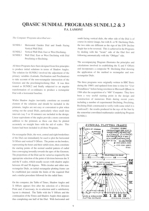
This article describes three QBASIC computer programs for designing sundials. The programs can be used for plotting horizontal garden dials and various types of vertical wall dials.
Dialling Tools, Sundial Design & Layout
July 1997
Page 13
Page 13
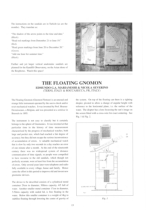
Describes the making of an unusual device for regulating watches following a design from 1895. It finds solar noon, by measuring the times the sun is at the same elevation just before and after noon, using a sighting mechanism floating in a can of water to ensure it is horizontal.
Dials: Unusual, Dialling Tools, DIY Sundial Projects
July 1997
Page 18
Page 18
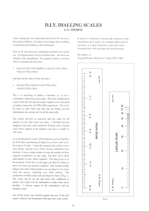
Guide to producing printed dialling scales using spreadsheet calculations and desktop publishing, enabling accurate layout of sundials.
DIY Sundial Projects, Dialling Tools, Mathematics of Dialling
October 1997
Page 3
Page 3
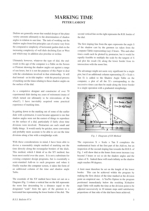
This article describes the "XY method", a practical process for marking time divisions on sundials. It details how to calculate shadow angles from first principles for various dial types and then plot them directly along rectangular borders using a graduated straightedge, acting as an "Add-on" to computer design programs. The method was adapted for complex declining/proclining dials and can also be applied to circular or octagonal dials.
Dialling Tools, Mathematics of Dialling, Sundial Design & Layout
June 1996
Page 16
Page 16
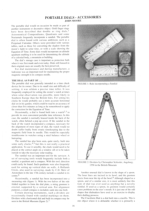
Examines the features and design variations of historical portable sundials, discussing integrated instruments, storage cases, and accessories like compasses and perpetual calendars.
Dialling Tools, Dials: Portable, Historical Dials
October 1996
Page 26
Page 26
A description of a software program developed to assist in sundial design and layout, explaining its capabilities and potential benefits to amateur and professional diallists.
Dialling Tools
October 1996
Page 52
Page 52
Describes a set of dialling scales produced by Lindisfarne Sundials (a version of the Serle Ruler) to allow the easy laying out of sundials without calculations or measurements of angles.
Sundial Design & Layout, Dialling Tools, DIY Sundial Projects
February 1995
Page 51
Page 51
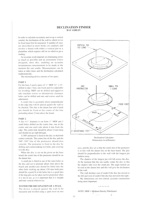
Introduction to a simple tool or method for determining the declination of a sundial wall, enhancing the accuracy of vertical dial construction.
Dialling Tools
June 1995
Page 32
Page 32
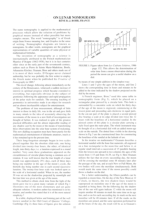
A mathematical examination of lunar nomograms and their use in timekeeping, possibly as an analytical or design tool involving the moon's cycles.
Dialling Tools, Mathematics of Dialling
October 1994
Page 18
Page 18
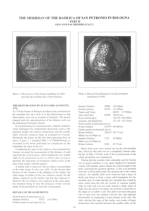
This article introduces a new sundial design that combines the simplicity of a Capuchin dial with the universality of a Regiomontanus dial through the use of nomograms. It explains the principles of subtraction and multiplication nomograms, demonstrating how they are integrated into the dial's coordinate system to calculate solar declination and latitude. The article details how to read the time by aligning a thread and bead, and notes its ability to show sunrise/sunset times and day length. The design aims for an acceptably accurate, universal dial that is easier to construct than other universal types.
DIY Sundial Projects, Dialling Tools, Mathematics of Dialling
October 1994
Page 35
Page 35
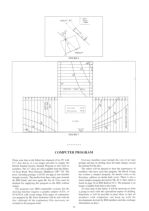
This section provides an update on the availability of the British Sundial Society's (BSS) sundial program. It announces that the 5¼" disc version is no longer available, but the 3½" discs can still be purchased from the editor, with profits supporting BSS funds. The program runs on IBM compatible systems and requires a graphic adapter for drawing. It also mentions a simpler program by Mr. David Young and another by Mr. H.C. Parr (no longer available in disc form), and suggests the future formation of a group to address specialized aspects of dialling and pool ideas for computer use among members.
Dialling Tools, The BSS and Members
February 1993
Page 32
Page 32
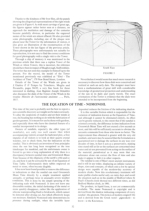
This tongue-in-cheek article introduces 'Nonomoil,' a new product designed to simplify sundial readings by reducing the friction of the shadow on the sundial surface, thus avoiding the discrepancies between sundial time and Greenwich Mean Time. It explains how this annual treatment enhances accuracy and avoids sarcastic comments from onlookers unfamiliar with the Equation of Time.
Dialling Tools, Equation of Time, How Sundials Work
June 1993
Page 21
Page 21
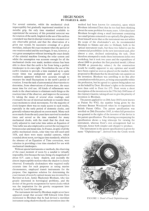
This article discusses historical methods for determining exact noon, crucial for regulating early mechanical clocks. It highlights the challenges of precise noon observation with traditional sundials and describes the Dipleidoscope, an ingenious optical instrument invented by James Mackenzie Bloxham and later patented by Dent. This device used prisms or mirrors to achieve accurate noon determination through the visual coincidence of two sun images.
Dialling Tools
October 1993
Page 13
Page 13

This article explores using spreadsheet programs to design and create shepherds' dials, simplifying the complex calculations and plotting involved. It details the process of determining the sun's altitude using a mathematical formula and setting up a spreadsheet to generate the necessary data for plotting hour lines on a cylindrical dial, facilitating DIY dial construction.
DIY Sundial Projects, Dialling Tools, Dials: Cylindrical, Mathematics of Dialling
February 1992
Page 18
Page 18
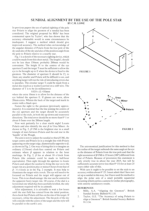
The article proposes an improved method for aligning a sundial gnomon using Polaris, building on previous discussions by Mills and Taylor. It suggests a sighting device made from sheet metal with an eye aperture and a circular target. The method relies on knowing Polaris's angular distance from the true pole and its position relative to the star Beta Ursa Minor (f3 UMi), aiming for an accuracy within 0.25 degrees by aligning Polaris on the target edge opposite f3 UMi.
Construction Projects, Dialling Tools, Mathematics of Dialling
February 1992
Page 22
Page 22
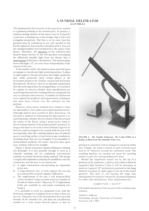
This article introduces a portable sundial delineator that simulates the sun's movement using a point-source lamp to project shadows. It allows for plotting hour lines on any surface, including irregular ones, by setting the gnomon at the correct latitude and revolving the lamp at 15-degree intervals. The device, suitable as a teaching aid, can also simulate declination for "dial furniture" like equinoxes and solstices by adjusting the lamp's height.
Dialling Tools, Sundial Design & Layout
June 1992
Page 3
Page 3
This lecture explores the practical aspects of 16th and 17th-century navigation, highlighting the crucial role of sundials and similar instruments for determining time at sea. Mariners used celestial observations for latitude, magnetic compasses for direction, and various tools like traverse boards, sand-glasses, nocturnals, astrolabes, and cross-staves for navigation and timekeeping.
Dialling Tools, Dials: Portable, Historical Dials, Dials: Nocturnals
October 1992
Page 28
Page 28
This article describes a Meccano jig designed by Noel Ta'Bois for drawing hour and declination lines on sundial plates of any shape, including curved surfaces. The instrument features a telescopic arm, set by calibrated dials for latitude, declination, and hour angle, which is extended to mark the shadow position of the nodus. It eliminates the need for complex calculations, making it useful for irregular surfaces.
Dialling Tools, Mathematics of Dialling, Sundial Design & Layout
October 1992
Page 36
Page 36
This entry announces the availability of a computer program by Mr Fer de Vries for sundial calculations, sold to BSS members with proceeds benefiting the Society. Compatible with IBM systems and requiring a graphic adapter for drawing, it comes with explanatory text and is available on disc. An older, simpler program by Mr H.C. Parr is no longer available but its listing can be found in a previous Bulletin issue.
Dialling Tools, Mathematics of Dialling
February 1991
Page 10
Page 10
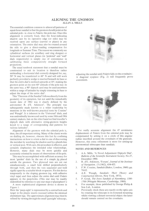
Addresses the critical step of setting up an equal-hour sundial and suggests that aligning by observing Polaris, the pole star, can be a quicker and more accurate method. Simple tools like a peep-sight or telescope can be used for this purpose.
How Sundials Work, Dialling Tools
July 1991
Page 1
Page 1
This section compiles news and updates from various sundial societies. It covers new bulletin issues from De Zonnewijzerkring (Dutch) and La Busca de Paper (Catalan), including mathematical dialling, celestial mechanics, and specific sundial descriptions. It also announces the founding of an Austrian Sundial Society and details a rare sun chronometer in Baden, Vienna, designed by Gibbs.
Book Reviews, Dialling Tools, Dials: Heliochronometer, The BSS and Members
July 1991
Page 22
Page 22
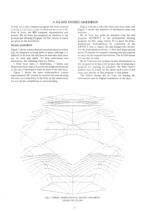
This note introduces F.J. de Vries' new computer program for designing a three-dimensional dodecahedron multi-faced sundial, imagined as made of glass to display various dial lines. The ZONWPLT program interfaces with ACAD to convert dial designs and generate complex geometric models. The article details the computational process, noting the time and files required for the example dodecahedron, and mentions de Vries' subsequent astrolabe program project.
Construction Projects, Dialling Tools, Dials: Multi Faced, Sundial Design & Layout
July 1991
Page 38
Page 38
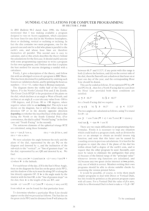
This article presents the theoretical basis for a computer program designed to calculate hour lines for various northern hemisphere sundials (direct, declining, vertical, reclining, inclining). It outlines using spherical trigonometry formulas to determine dial plane elements and hour line angles. The author emphasizes robust programming to handle issues like division by zero and inverse trigonometric ambiguities, providing simplified BBC Basic and design guidance.
Dialling Tools, Mathematics of Dialling, Sundial Design & Layout
October 1991
Page 36
Page 36
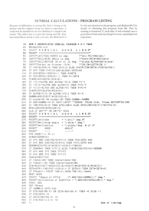
This section provides a listing of a BASIC computer program by H.C. Parr for calculating sundial hour lines, intended to accompany a previous article. The program is designed to save time and prevent errors in sundial computations. Details for obtaining the program on a 5 1/4 inch disk and information about inputting latitude, reclining angle, and declination are included.
Dialling Tools, Mathematics of Dialling