- Home
- /
- Sundial Encyclopaedia
- /
- September 2013
September 2013
The articles link to the specific page in a PDF optimised for speed. If you want the whole issue, you can download it here, but the files from earlier years can be quite large.
September 2013
Page 1
Page 1
Announcement and congratulation for Christopher Daniel, President of the BSS, on being awarded the MBE for services to timekeeping and sundials. The award was noted by the press, highlighting the importance of his work in dialling.
The BSS and Members
September 2013
Page 2
Page 2
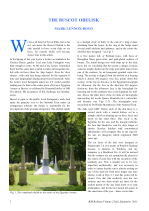
Detailed account of designing and constructing a five-metre tall hexagonal obelisk for Buscot Park to celebrate Queen Elizabeth's Diamond Jubilee. It features seven dials on six slate faces, adjusted for the equation of time and longitudinal displacement, reading GMT, and incorporating Egyptian hieroglyphs.
Construction Projects, Dials: Multi Faced, Sundial Design & Layout
September 2013
Page 5
Page 5
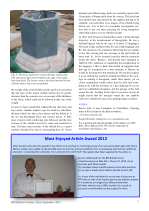
Report on Peter Kunath winning the award for his article on the Henry Moore sundial. He received a certificate and a reproduction astrolabe, which proved useful as he had been asked to explain the operation of a c. 1400 astrolabe at the Cologne City Museum.
Dials: Astrolabe, The BSS and Members
September 2013
Page 6
Page 6
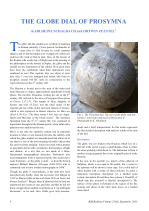
Detailed description and analysis of a solid white marble globe sundial from antiquity (c. 100 BC) found near Heraion. It uses the terminator (boundary of light and shadow) for time indication and features complex line systems representing hours, seasons, and zodiacal signs.
Dials: Hemispherical, Dials: Unusual, Historical Dials, Mathematics of Dialling
September 2013
Page 12
Page 12
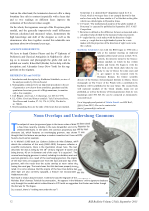
Examines the feature of noon overlaps in sundials, contrasting with the usual gnomon gap. A much earlier example than modern proprietary dials is described: an 18th-century bronze dial by engraver D Coster (dated 1715) with an unusual overhanging gnomon that results in overlapping hour scales at noon.
Dials: Horizontal, Historical Dials, How Sundials Work
September 2013
Page 13
Page 13
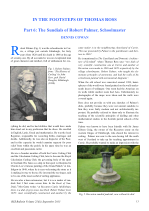
A biography of Robert Palmer (1828–1868), schoolmaster and astronomer, and a survey of his known sundials. Details are given of three scientifically constructed dials: one lost from Riccarton Castle, the detailed Currie dial (1836) with noon markings for global locations, and the Kirkbean dial (1826) containing equation of time details.
Dials: Horizontal, Dials: Unusual, Equation of Time, Historical Dials
September 2013
Page 15
Page 15
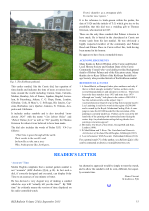
Response regarding the accuracy of garden sundials, stating that a correctly designed dial can display Solar Time to within one minute. The author argues that sundials should be trusted to tell their own accurate time, rather than attempting to match modern radio-controlled watches.
Equation of Time, How Sundials Work
September 2013
Page 16
Page 16
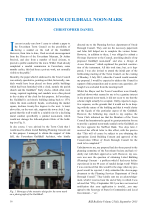
Account of securing Listed Building Consent for a painted noon-mark on the historic Faversham Guildhall, celebrating the Queen's Diamond Jubilee. The design features a gilded meridian line and a nodus on a gilded sun image, which projects a light spot to indicate the instant of Local Apparent Noon.
Construction Projects, Dials: Noon Lines, Dials: Vertical, Sundial Design & Layout
September 2013
Page 19
Page 19
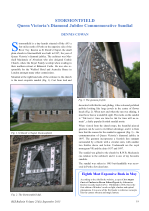
A description of the exquisite lead sundial installed on St David’s Chapel, Stormontfield, built in 1897 to commemorate Queen Victoria’s Diamond Jubilee. It is decorated with gilding and polished pebbles, featuring a pierced gnomon showing the royal monogram VR and the dates 1837/1897, alongside a Scottish motto.
Dials: Vertical, Historical Dials, Mottoes
September 2013
Page 20
Page 20
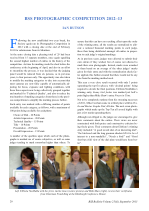
Review of the BSS Photographic Competition 2012–13, detailing the scoring changes and normalization process used for judging. Elzbieta Niedbalka won first place with ‘Sunny bird feeder’, Mike Shaw was second, and Mike Cowham took third place.
The BSS and Members
September 2013
Page 24
Page 24
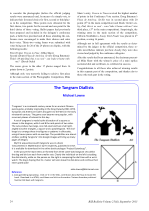
Introduction to Tangrams, an ancient Chinese puzzle game originating in the Song Dynasty (960-1279), involving seven geometric pieces derived from a square dissection. The article relates this puzzle to dialling illustrations, depicting figures formed from Tangram sets observing a sundial.
Dials: Unusual, Sundial Design & Layout
September 2013
Page 25
Page 25
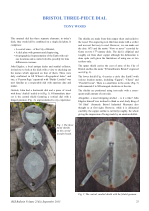
Examination of an intriguing three-piece artefact from 1675, attributed to R Smurthwaite, Bristol, possibly an amateur work. It consists of the Bristol Coat of Arms shield, a vertical dial with a hinged gnomon, and a topographical representation of the Earth with overseas locations, suggesting a possible nautical link.
Dials: Portable, Dials: Unusual, Dials: Vertical, Historical Dials
September 2013
Page 27
Page 27
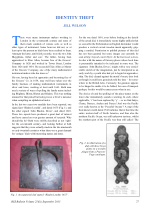
Investigates two pseudo-antique sundials recently reported, falsely signed with variations of the 17th-century maker name Bladon and dated 1610 and 1655. Examination of features, mottoes (one invented in 1860), and catalogue evidence strongly suggests they were manufactured much later, possibly by Pearson Page, as fake antique pieces.
Dials: Equatorial, Dials: Portable, Historical Dials, Mottoes
September 2013
Page 27
Page 27
A description of the sundial at St Mary and All Saints Church, Conway, recorded from an early 1910 postcard. The dial, dated 1765 and signed by Mereidh Hughes, is still extant but heavily pitted. It is noted for its proximity to the gravestone that allegedly inspired Wordsworth's poem ‘We are seven’.
Dials: Vertical, Historical Dials
September 2013
Page 29
Page 29
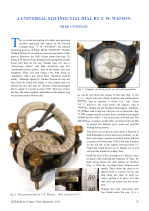
Description of a nice precision portable equatorial dial, circa 1880, by T.W. Watson. It is designed for use in both hemispheres and includes specialized chapter ring and compass card layouts, featuring both an Equation of Time chart and a separate map of Isogonic Lines for 1877 for precise time setting.
Dialling Tools, Dials: Equatorial, Dials: Portable, Equation of Time
September 2013
Page 32
Page 32
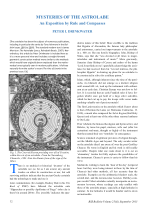
An exposition on the history and components of the astrolabe, including its two faces (sighting bar/calendar and matrix/rete/plates). The article details a geometric construction method using rule and compasses to lay out the template for the rete and the individual plates via stereographic projection.
Dialling Tools, Dials: Astrolabe, How Sundials Work, Mathematics of Dialling
September 2013
Page 36
Page 36
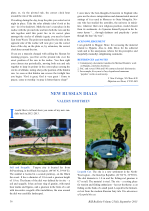
Showcase of several new sundials recently built in Russia (2012–2013). Examples include the maritime-themed ‘Sail and Seagulls’ in Tuapse, the ‘Leopold Cat’ dial designed for fishing enthusiasts in Kareliya, and the ‘Solar Flower’ in Toksovo, themed around cultivation.
Construction Projects, Dials: Horizontal, Dials: Unusual
September 2013
Page 38
Page 38
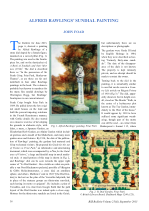
Investigation into a sundial featured in an Alfred Rawlings painting (1914), originally cited as being at Friar Park. The identical-looking dial was photographed at Reigate Priory in 1918, prompting inquiry into whether two versions existed or if the monument was transported between the two sites around the time of the First World War.
Historical Dials, Mottoes
September 2013
Page 40
Page 40
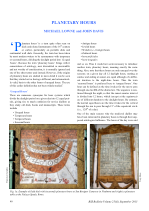
Detailed study differentiating ‘planetary hours’ from seasonal hours. Historically, planetary hours were defined by the time taken for 15-degree intervals of the ecliptic to rise (Sacrobosco’s definition), resulting in hours of unequal duration throughout the day, which are complex to delineate on sundials compared to the simpler seasonal definition.
Historical Dials, How Sundials Work, Mathematics of Dialling, Sundial Design & Layout
September 2013
Page 48
Page 48
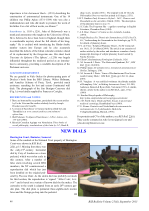
Report on the installation of a reproduction horizontal dial at Barrington Court, Somerset, commissioned by the National Trust. The new dial, created by Flowton Dials, replaces an early-19th-century horizontal dial by Cary of London that had been stolen. It is signed “After CARY, LONDON”.
Construction Projects, Dials: Horizontal, Restoration projects