- Home
- /
- Sundial Encyclopaedia
- /
- December 2020
December 2020
The articles link to the specific page in a PDF optimised for speed. If you want the whole issue, you can download it here, but the files from earlier years can be quite large.
December 2020
Page 1
Page 1
The December issue reports the cancellation of the Newbury Meeting due to Covid-19. It introduces three new authors: Anne Guest (cyanotype art based on diagrams), Geoff Thurston (analysing a Graeco-Roman dial's arcs), and Pete Caldwell (a vertical declining sundial project during lockdown). It also notes obituaries for Michael Lowne and David Le Conte.
December 2020
Page 2
Page 2
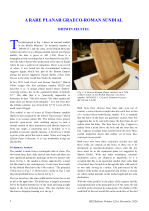
This article describes and analyses an unusual Roman sundial in the British Museum (1884,0615.1), likely originating from Egypt. It examines the dial’s equinoctial planar design, estimating the design latitude (27.3° N) and nodus height using physical measurements and a graphical approach. It challenges the idea that the declination arcs correspond to zodiac cusps.
Dials: Equatorial, Historical Dials, How Sundials Work, Mathematics of Dialling
December 2020
Page 9
Page 9
John Moir recounts collaborating on a quirky equatorial dial for Mudchute Farm. Julian Greenberg corrects an obituary detail for David Young. Pete Caldwell asks readers to shed light on the proper pronunciation (Greek vs English) of the word 'gnomon'.
Dials: Equatorial, How Sundials Work, The BSS and Members
December 2020
Page 10
Page 10
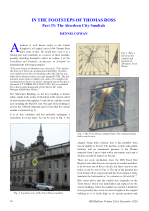
Part 33 explores three Aberdeen sundials mentioned by Thomas Ross in 1890. These include the vertical declining dial on the Municipal Building (Town House), two cubic dials on Andrew Begg's shop dated 1694, and the dial at King’s College Chapel, potentially Scotland’s oldest. The author doubts the 1494 dating of the latter.
Dials: Cube, Dials: Multi Faced, Dials: Vertical, Historical Dials
December 2020
Page 13
Page 13
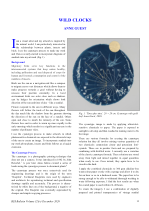
A visual artist describes her artwork inspired by the relationship between nature, the sun, and time. She uses the cyanotype process (a non-camera photographic technique creating white lines on a blue background, similar to blueprints) to incorporate diagrams of properly delineated sundials alongside plants, insects, and birds. Gold leaf is often added to represent the sun.
Dials: Unusual, Sundial Design & Layout
December 2020
Page 15
Page 15
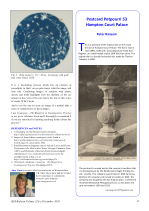
This instalment of Postcard Potpourri features a postcard of the original double horizontal dial at Hampton Court Palace, made by Thomas Tompion in 1690. The dial is now in storage, replaced by an undelineated replica. Based on the printer information, the unused postcard is dated between 1926 and 1932.
Historical Dials, Dials: Double Horizontal
December 2020
Page 16
Page 16
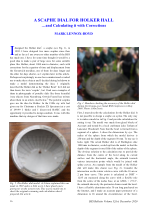
The author details the design and calculation of the Holker Hall scaphe dial (a spherical bowl dial). He explains the trigonometric formulae, derived using his 'y' formula, necessary for plotting points on the curved surface using distance and azimuth. He also proposes making a pair of large scaphe dials incorporating corrections for the Equation of Time (EoT) and longitude displacement.
Construction Projects, Dials: Scaphe, Equation of Time, Mathematics of Dialling
December 2020
Page 19
Page 19
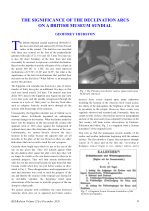
This article follows Ortwin Feustel’s analysis of the British Museum sundial (1884,0615.1) to determine the meaning of its declination arcs. By calculating the corresponding solar declinations, the author correlates them with agriculturally significant events recorded in the ancient Egyptian Geminos parapegma, such as the rising of Sirius and the setting/rising of the Pleiades.
Dials: Equatorial, Historical Dials, How Sundials Work, Mathematics of Dialling
December 2020
Page 22
Page 22
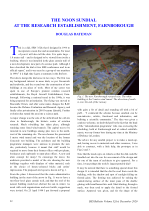
Description of a large aperture nodus noon dial designed by the author and installed in a glass curtain wall at the Farnborough research site in 1996. The 1.8-metre tall dial declines 13.5° west of south and incorporates a gilded analemma calculated for 1999, which allows it to show both the date and mean time noon.
Construction Projects, Dials: Noon Lines, Dials: Vertical, Equation of Time
December 2020
Page 28
Page 28
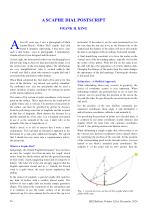
A commentary on Mark Lennox-Boyd's scaphe dial article, providing an alternative, simpler mathematical derivation for plotting points on the spherical surface using horizon coordinates (altitude and azimuth). It also explores the design geometry, showing how the appearance of the dial markings changes based on the ratio of the sphere radius to the rim radius.
Dials: Scaphe, How Sundials Work, Mathematics of Dialling, Sundial Design & Layout
December 2020
Page 31
Page 31
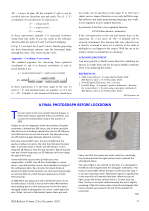
A brief note describing a visit to the Stock Exchange noon mark on 29 February 2020 (a leap year), managing to capture a photograph despite heavy rain. The spot of light aligned with the special thin strip for 29 February, marking GMT noon.
Dials: Vertical, Dials: Noon Lines
December 2020
Page 32
Page 32
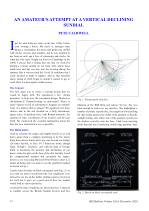
The author details his DIY project to design and install a polished slate vertical declining sundial on his house wall during the 2020 lockdown. The final design, featuring Roman numerals, the Equation of Time, and a musical 'treble clef' gnomon, was achieved through self-calculation (graphical method) and professional craftsmanship for cutting and fixing.
Construction Projects, DIY Sundial Projects, Dials: Vertical, Equation of Time
December 2020
Page 36
Page 36
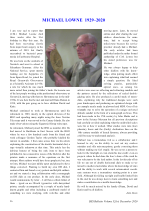
Obituary for Michael Lowne (BSS member 404), who worked at the Royal Greenwich Observatory from 1950 to 1989. Known for his patience and problem-solving, he contributed articles on double horizontal dials, reflecting and refracting sundials, moondials, and solving the operation of a unique 17th-century universal altitude sundial.
Dials: Reflected, Historical Dials, Dials: Double Horizontal
December 2020
Page 37
Page 37
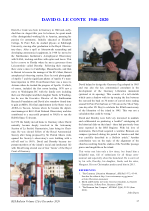
Obituary for David O. Le Conte, an astronomer who spent much of his distinguished career tracking satellites for NASA and working on the Hubble Space Telescope. He was a key figure in Guernsey's astronomical and social life, designing the Guernsey Liberation monument and collaborating on a booklet cataloguing the island’s historical sundials.
Dials: Unusual, Historical Dials
December 2020
Page 38
Page 38
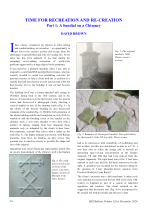
The author describes helping a client re-create a vertical sundial on a 16th-century Wiltshire mill cottage chimney stack, which had been lost around 1900. The design incorporated findings from original fragments, including a unique concatenation of Roman numerals. A separate slate plaque with an Equation of Time correction, featuring a millstone image, was also added.
Construction Projects, Dials: Vertical, Equation of Time, Restoration projects
December 2020
Page 41
Page 41
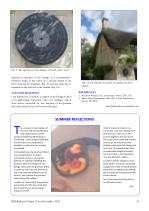
A short piece describing the author’s process of checking the delineation of a simple horizontal sundial by rotating it in the sun to confirm the shadow direction. The text is accompanied by an unusual photograph caught by a "stray click" showing a reflection in sunglasses.
Dials: Horizontal, How Sundials Work, Sundial Design & Layout
December 2020
Page 42
Page 42
A Beginner’s Guide to Delineation: deriving the Lennox-Boyd ‘y’ formula using a gnomonic tetrahedron
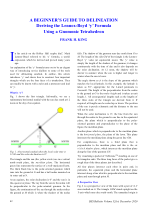
An explanation of Mark Lennox-Boyd's 'y' formula (the length of the shadow of the gnomon nodus from the gnomon root). The formula is derived using spherical trigonometry simplified into four interconnected right-angled triangles forming a 'gnomonic tetrahedron'. This methodology is presented as a helpful tool for novice diallists learning delineation.
Dialling Tools, How Sundials Work, Mathematics of Dialling, Sundial Design & Layout
December 2020
Page 48
Page 48
Chris Lusby Taylor provides research into Thomas Stringer, the dedicatee of a book referred to in a previous Bulletin. Stringer was steward to the Earl of Shaftesbury and was knowledgeable about sundials, dividing them into Astronomical, Italick, Babilonick, Antient, or Judaick hours.
How Sundials Work, Historical Dials