- Home
- /
- Sundial Encyclopaedia
- /
- Michael J. Harley
Michael J. Harley
September 2022
Page 26
Page 26
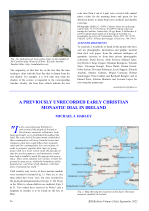
Documents the identification of a previously unrecorded Early Christian monastic dial at Molua graveyard, Co. Limerick. These stone dials, characteristic of 7th–10th century Ireland, were used by monks to regulate times for canonical prayers.
Dials: Mass Dials, Historical Dials
March 2018
Page 21
Page 21
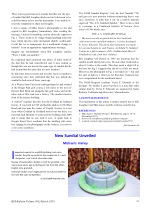
A short, humorous piece detailing the author's 80th birthday 'sundial', actually a chocolate cake in the shape of a sundial. The cake was dedicated by his granddaughter, whom he hopes might make an entry for a BSS cake competition.
Dials: Unusual, The BSS and Members
September 2017
Page 46
Page 46
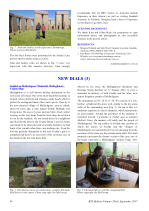
This describes a memorial in Mullaghmore, Ireland, commemorating forgotten villagers, featuring a six-foot sandstone capstone incorporating a limestone sundial. The dial, designed by Christian Meyer, indicates local sun-time and features a stainless steel gnomon with Celtic interlacery. The sundial symbolises the passing of time.
Construction Projects, Dials: Horizontal, Sundial Design & Layout
March 2014
Page 21
Page 21
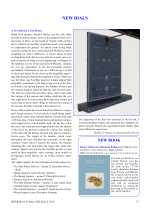
The author designed a vertical, direct south-facing sundial made of unpolished black marble for his new home in Northern Ireland. The dial uses a horizontal gnomon rod, and the length of the shadow cast at noon indicates the eight traditional calendric events that divide the year, such as the solstices and equinoxes, marked by Neolithic spiral motifs.
Construction Projects, Dials: Vertical, Sundial Design & Layout
June 2012
Page 52
Page 52
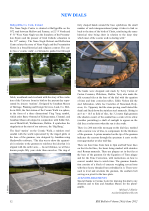
This article describes a stainless steel sundial at the Nano Nagle Centre in Ballygriffin, Ireland, which is the final 'station' of a 'cosmic walk'. Designed by Jonathan Mason, it features a 3.2-meter high gnomon with a central slit, a 200mm noon gap, and a prism for season indication. It also includes the world represented by a ringed globe and forty clasped hands symbolising intergenerational links.
Construction Projects, Dials: Equatorial, Dials: Unusual, Sundial Design & Layout
December 2011
Page 23
Page 23
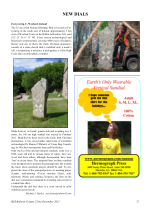
This article describes a newly erected 180 cm high granite sundial in the Irish National Heritage Park, Ferrycarrig, weighing over 2 tonnes. Modelled on ancient monastic sundials, its temporal lines were designed to mark canonical prayer times rather than passing hours. Only twelve such ancient monastic sundials survive, making this reconstruction an important addition.
Construction Projects, Dials: Mass Dials, Dials: Unusual, Historical Dials
September 2009
Page 10
Page 10
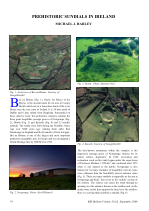
Explores potential prehistoric sundials within the megalithic passage tombs of Brú na Bóinne in Ireland, including Newgrange, Dowth, and Knowth. The article examines specific stone carvings, such as the 'Stone of the Seven Suns' and Kerbstones K7 and K15 at Knowth, discussing theories that they may be sundials or calendars.
Dials: Unusual, Historical Dials, How Sundials Work
December 2007
Page 146
Page 146
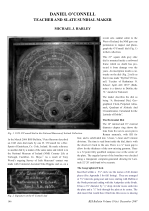
This article details an 1853 slate sundial by Daniel O’Connell, a teacher from Rathmines National School, Dublin, later of Shrule, Co. Mayo. The elaborate dial, now in the National Museum of Ireland, functions as a horizontal dial, geographical clock, perpetual almanac, quadrant of altitude, and circumferentor. It is considered a teaching aid and highlights O'Connell's master engraving skills.
Dials: Horizontal, How Sundials Work, Historical Dials
September 2004
Page 110
Page 110
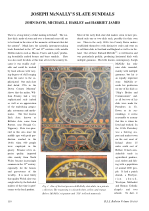
Survey of Joseph McNally’s early 19th-century slate dials (mainly Portaferry area): characteristics of multiple-gnomon plates, chapter rings with alternate longitudes, mottos, colouring evidence and the regional slate-working/dial-making context.
Dials: Vertical, Historical Dials
December 2004
Page 163
Page 163
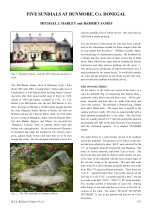
Survey of five McClintock sundials at Dunmore estate, including the 1843 Melville slate dial and its 2003 restoration, the 1936 vertical dial, the 1939 heliochronometer, construction details, inscriptions, and the estate's dial-making history.
Dials: Heliochronometer, Dials: Horizontal, Dials: Multi Faced, Historical Dials, Restoration projects