- Home
- /
- Sundial Encyclopaedia
- /
- September 2007
September 2007
The articles link to the specific page in a PDF optimised for speed. If you want the whole issue, you can download it here, but the files from earlier years can be quite large.
September 2007
Page 97
Page 97
The editorial discusses the added interest and design lift that declination lines bring to sundials, noting that this issue features two papers offering different, simpler methods for laying them out, encouraging designers to use them more. It also announces a new semi-regular feature on 'New Dials', inviting contributions from professional and amateur makers.
The BSS and Members
September 2007
Page 98
Page 98
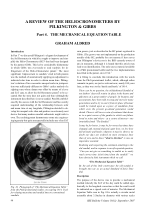
This article reviews Pilkington's Mechanical Equation Table a device for converting sundial time to mean time, detailing its two versions. It covers the design evolution, Pilkington's reluctant use of Gibbs' cam mechanism due to practical limitations, and their patent disputes.
Equation of Time, Dials: Heliochronometer
September 2007
Page 102
Page 102
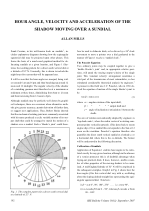
This paper applies Hooke's joint equation of motion to sundials to calculate the hour angle, angular velocity, and acceleration of the shadow. It provides formulas and graphs for a direct south vertical dial at 52° N latitude, showing how these parameters vary throughout the day, with angular velocity minima at noon/midnight and maxima at 6 am/pm.
How Sundials Work, Mathematics of Dialling
September 2007
Page 104
Page 104
This obituary commemorates Edward Martin (1925-2007), founder of the British Sundial Society's Mass Dial Group. It highlights his pioneering work in collecting and computerising information on mass and Saxon dials, leading to a National Register. Martin's vision and enthusiasm for recording dials nationwide are praised as a significant legacy to the Society.
Dials: Mass Dials, The BSS and Members
September 2007
Page 105
Page 105
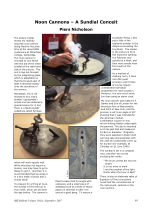
This article discusses noon cannons, devices that fire at solar noon using a magnifying glass to ignite powder. It describes preparing and firing a cannon, noting it's more for fun than accuracy. It also mentions historical examples from the mid-17th and 18th centuries, modern versions, and current licensing restrictions in England. A specific F. Barker and Son cannon is detailed.
Dials: Noon Lines, Dials: Unusual, Historical Dials
September 2007
Page 107
Page 107
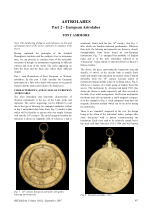
This second part details the characteristics and scales of European astrolabes. It covers the use of Latin script and numerals, simple throne designs (with some Flemish exceptions), and variable rete strapwork. The article also explains the zodiac/calendar scales, shadow squares for surveying, and three methods for determining unequal (planetary) hours found on these instruments.
Dials: Astrolabe, Historical Dials, How Sundials Work
September 2007
Page 111
Page 111
This section features three letters: Robert Scott Simon identifies a dial he made. John Wall comments on a bizarre sundial plot in a TV series, where a pivoted gnomon reveals gold. Graham Aldred discusses corrosion on sundial plates and P&G heliochronometers, suggesting material substitutions and their implications.
Dials: Heliochronometer, Restoration projects, The BSS and Members
September 2007
Page 112
Page 112
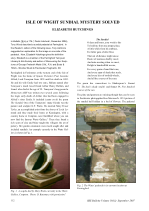
This article solves the mystery of a sundial pedestal at Farringford, Alfred, Lord Tennyson's home. It was designed by Mary Seton Watts, wife of the painter G.F. Watts, likely as a memorial for Tennyson and his wife Emily. The pedestal features carvings related to Tennyson's poem The Sundial and a motto.
Historical Dials, Mottoes, Dials: Scaphe
September 2007
Page 113
Page 113
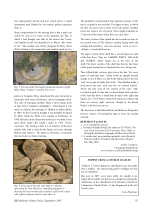
A brief note from a church leaflet describes a medieval churchyard cross in Llanarmon, North Wales, that was converted into a sundial in 1772 for three shillings. Sadly, the sundial has since disappeared, leaving the cut-down cross bare in the churchyard.
Historical Dials
September 2007
Page 114
Page 114
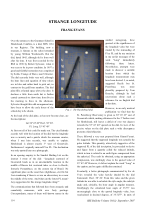
This article investigates a peculiar Pl. Long. inscription on the 1845 Hawkshead Grammar School sundial. Through extensive correspondence, Pl Long was identified as The Plane's Longitude referring to the hour angle in angular measure when the sun is directly over the style, rather than a geographical longitude.
Dials: Vertical, How Sundials Work, Sundial Design & Layout
September 2007
Page 116
Page 116
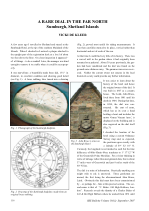
This article details a rare 1890 brass sundial from the Sumburgh Hotel, Shetland. Commissioned by Laird John Bruce and made by C. Baker, it features a peripheral calendar combining longitude and equation of time corrections, plus unusual additional instructions. It is noted as the most northerly dial in the BSS Register.
Dials: Horizontal, Equation of Time, Historical Dials
September 2007
Page 118
Page 118
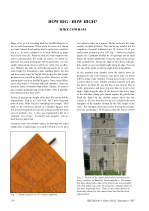
This article presents practical, simple methods for measuring the height and size of sundials, especially those high on church towers. It describes using a homemade shadow square for height, relating dial dimensions to known object sizes from photographs, and employing a marked tripod. Computer software techniques for perspective correction are also discussed to improve accuracy.
Construction Projects, Dialling Tools
September 2007
Page 122
Page 122
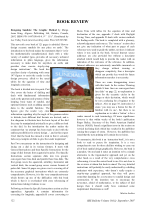
This review covers Designing Sundials: The Graphic Method by Margo Anne King, aimed at mathematically unsophisticated readers. It praises the comprehensive graphical instructions but criticises the lack of inspirational examples and tedious cross-referencing. A significant error in the vertical declining dials section required an errata sheet, impacting its utility for beginners.
Book Reviews, Sundial Design & Layout
September 2007
Page 123
Page 123
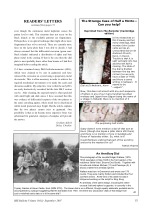
This short piece features a 1928 photograph of novelist Edgar Wallace with a rather fine armillary sphere in his garden. It questions whether this dial, or one of the same design with an unusual bell-and-sphere supporter, dating from 1730 at Hever Castle, are unique or part of a production series from such an early date.
Historical Dials, Dials: Armillary Sphere
September 2007
Page 123
Page 123
This article describes an unrecorded, vertically split sundial on St Andrew's Church, Kenn, Devon, with its left half missing. Only a partial date (??83) and motto fragment (...eagum) are visible, which doesn't match known mottoes. The author seeks help from members to solve this mystery and complete the record.
Historical Dials, Mottoes
September 2007
Page 124
Page 124
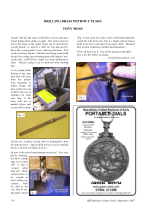
This article provides a simple modification to standard drills to safely and effectively drill brass, which is often described as a greedy metal that can cause drills to dig-in aggressively. The technique involves blunting the drill's cutting edge to a vertical flat so it scrapes rather than cuts, requiring a separate set of modified drills.
DIY Sundial Projects
September 2007
Page 125
Page 125
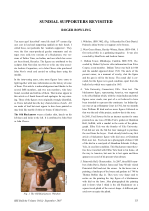
This article updates a previous account of 18th-century lead figures, known as sundial supporters attributed to sculptors John Nost or Andries Carpentiere. It identifies nine newly found figures (Old Blackamoor, Indian, Father Time types) and provides more historical details. These mass-produced garden ornaments show varying locations of extant and lost examples.
September 2007
Page 128
Page 128
This article explores declination lines on sundials as conic sections and details methods for their delineation. It examines two 17th-century horizontal dials by Isaac Symmes (Science Museum, Oxford), noting errors in their declination lines and the presence of seasonal hours and lunar volvelles. A new graphical method for drawing declination lines is also presented.
Historical Dials, How Sundials Work, Mathematics of Dialling, Sundial Design & Layout
September 2007
Page 134
Page 134
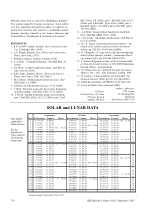
This entry provides a table of solar and lunar data for September, October, and November. It includes daily values for declination and transit times, as well as lunar quarter and new/full moon phases. This data is useful for sundial calibration and understanding celestial movements.
Equation of Time, How Sundials Work
September 2007
Page 135
Page 135
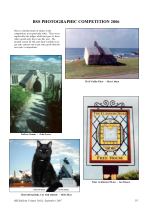
This section presents a batch of unplaced entries from the 2006 BSS Photographic Competition, highlighting the high quality of submissions. It includes titles and photographers for various sundial images, encouraging members to submit more photos for next year's competition.
The BSS and Members
September 2007
Page 137
Page 137
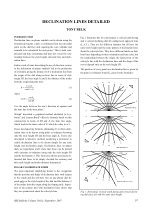
This article offers detailed methods for drawing declination lines on planar sundials using polar and Cartesian coordinates, or a graphical protractor, all based on the dial's style height and nodus distance. It also provides formulas for calculating hour line angles for various dial types and a simple method to check existing dials for accuracy.
Construction Projects, Dialling Tools, Mathematics of Dialling, Sundial Design & Layout
September 2007
Page 141
Page 141
This article examines the biblical Dial of Ahaz where a shadow reversed ten degrees or steps. It explores the linguistic ambiguity and historical interpretations, including a 1578 replica claiming to demonstrate the miracle via water refraction, a claim experimentally disproven. The text discusses if it was a primitive dial or a scientific instrument.
Historical Dials
September 2007
Page 144
Page 144
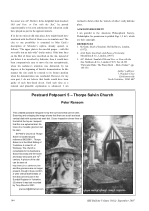
This entry describes an undated postcard featuring St Peter’s Church at Thorpe Salvin, Yorkshire. It highlights the church's south, east, and presumed west vertical dials, as well as a spherical dial on the ball at the top, noting that gnomons are no longer present. The church is also known for its Saxon doorway and 12th-century structures.