- Home
- /
- Sundial Encyclopaedia
- /
- Dials: Horizontal
Dials: Horizontal
March 2023
Page 22
Page 22
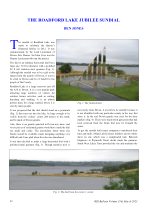
Details the construction of the large 30-foot diameter horizontal dial with a 20-foot stainless-steel gnomon, created for the Queen’s Diamond Jubilee. To ensure public utility, the hour lines were designed to allow for longitude, making the dial read close to clock time, despite the resulting asymmetry.
Construction Projects, Dials: Horizontal, Equation of Time, Sundial Design & Layout
June 2023
Page 9
Page 9
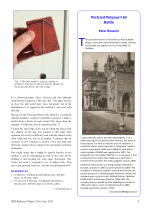
Discusses a postcard featuring a horizontal sundial at Battle Abbey, East Sussex, the historic site of the Battle of Hastings. The postcard, identified as a Valentine’s “Sepiatype” Series with number 95078, is estimated to date from the mid to late 1920s, likely January 1928, and the dial is unrecorded in the Fixed Dial Register.
Dials: Horizontal, Historical Dials
June 2023
Page 10
Page 10
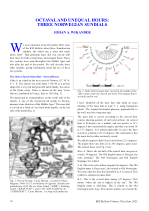
Describes three historic Norwegian sundials (Giske Church Mass Dial, Kråkvåg Horizontal Sundial, Mandal Horizontal Sundial) demonstrating the use of octaval hours (eight parts of the day) and unequal hours (15 degrees). The study details how the octaval system gave way to unequal hours during a transition period, and uses compass history to estimate ages.
Dials: Horizontal, Dials: Mass Dials, Historical Dials, How Sundials Work
June 2023
Page 14
Page 14
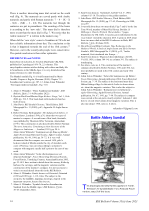
Features a drawing by Dorothy Hartley from "Ye Sundial Booke" showing the Battle Abbey Sundial, supplementing the Postcard Potpourri entry on page 9.
Dials: Horizontal
June 2023
Page 24
Page 24
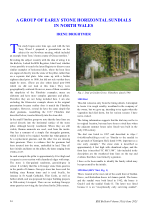
Investigates a distinctive group of early stone horizontal sundials in the former county of Flintshire, North Wales, dating from 1588 to 1637. These dials are characterised by having hour lines carved directly into the surface of the stone pillar (likely Gwespyr stone) and may be derived from cut-down churchyard crosses.
Dials: Horizontal, Dials: Unusual, Historical Dials
June 2023
Page 28
Page 28
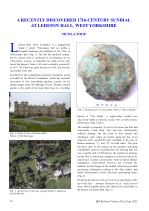
Describes the discovery and subsequent conservation of a damaged octagonal copper-alloy sundial at Ledston Hall. The inscription "Antonius Thompson Fecit" and the Lewis coat of arms indicate it was made by Anthony Thompson between 1653 and 1665, commissioned by Sir John Lewis, then owner of the Hall.
Dials: Horizontal, Historical Dials, Restoration projects
June 2023
Page 31
Page 31
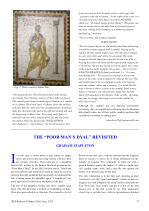
Revisits Sir Samuel Morland's 1689 pamphlet promoting his non-extant "Poor Man’s Dyal." Analysis suggests it was a modest, four-inch diameter horizontal dial, possibly pewter or brass, sold with an instrument for establishing the East-West line, reflecting Morland’s efforts to raise funds through inexpensive items.
Dialling Tools, Dials: Horizontal, Historical Dials
September 2023
Page 11
Page 11
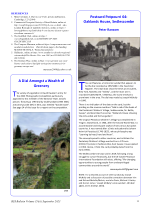
Discusses a postcard, likely dating from the early 1960s, featuring a horizontal sundial (likely SRN 5883) at Oaklands House, Sedlescombe. The dial, made by Joseph McNally in 1840, is notable for having small dials showing times for Jerusalem, New York, Natchez and “Sidney”.
Dials: Horizontal, Dials: Multi Faced, Historical Dials
September 2023
Page 15
Page 15
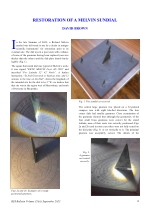
Describes the restoration of a square horizontal slate sundial made by Richard Melvin in 1856 (For Latitude 52° 42ʹ North). The work involved correcting the geometry and seating of the five gnomons, re-incising the details, and finishing the surface by painting the incisions light matt grey enamel and sealing the slate with oil.
Dials: Horizontal, Dials: Multi Faced, Restoration projects
September 2023
Page 26
Page 26
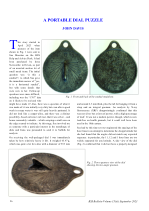
Investigates a heavy, pewter portable horizontal dial medallion, initially thought to be silver, dated “1707” with a gnomon angle of 38°. XRF analysis confirmed it as lead-heavy pewter. Detective work revealed the reverse side used a modified die from an 1855 Paris Exposition Universelle medal, making the 1707 date false.
Dials: Horizontal, Dials: Portable, Historical Dials
December 2023
Page 10
Page 10
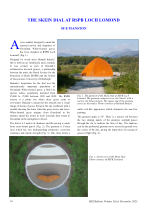
A report on a 6.3-metre diameter horizontal sundial/art installation at RSPB Loch Lomond, designed by Hannah Imlach, which marks the migration windows of Greenland White-fronted geese. The gnomon is formed by the slit between two sheets of Corten steel with piercings that give the impression of migrating geese in flight, and coloured bands mark the Autumn and Spring arrival/departure periods.
Construction Projects, Dials: Horizontal, Dials: Unusual, Sundial Design & Layout
December 2023
Page 12
Page 12
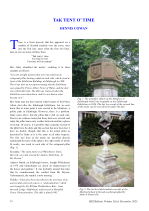
A survey of various Scottish sundials featuring the Scots proverb motto “Tak tent o’ time Ere time be tint For time will no remain,” translating to “Make the most of our time as we don’t know how long we have.” Examples include armillary spheres, multi-faced dials, and vertical dials.
Dials: Armillary Sphere, Dials: Horizontal, Dials: Multi Faced, Historical Dials, Mottoes
December 2023
Page 18
Page 18
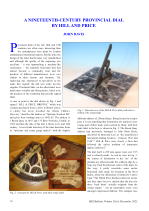
A study of a robust 10-inch square horizontal brass dial signed by Hill & Price of Bristol (working 1842–83). The dial exhibits idiosyncratic provincial features, such as delineation errors for 'back hours' and the use of brass produced by the cementation technique, despite signs of modern manufacturing.
Dials: Horizontal, Historical Dials, Sundial Design & Layout
March 2022
Page 8
Page 8
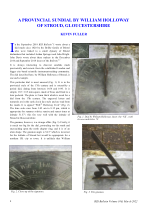
Description of a brass sundial (c. 1658–1693) made by clockmaker William Holloway of Stroud. It is provincial in style, featuring crude engraving and an incorrect replacement gnomon angle of 54.5°. Holloway's workshop location still stands in Stroud.
Dials: Horizontal, Historical Dials, Restoration projects, Sundial Design & Layout
March 2022
Page 20
Page 20
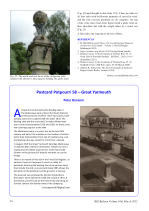
Analysis of a postcard featuring a simple horizontal sundial located next to the Boating Lake in the Great Yarmouth Venetian Waterways. Although the waterways were restored recently, the sundial appears to have vanished or was not repaired, as suggested by earlier photos showing a missing gnomon.
Dials: Horizontal, Historical Dials, Restoration projects
March 2022
Page 24
Page 24
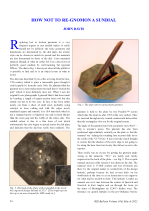
An examination of an old horizontal sundial (c. late 17th/early 18th century) highlighting mistakes made during a poor gnomon replacement. Errors included cutting the angle incorrectly (40.0° instead of the design latitude 52.5° marked on the back), using mild steel that rusted, and using modern Pozidriv screws for attachment.
Dials: Horizontal, Mathematics of Dialling, Restoration projects, Sundial Design & Layout
March 2022
Page 26
Page 26
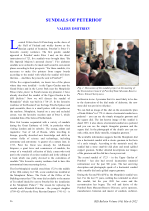
A historical account and description of the 2021 reconstruction project of the horizontal sundial for the Monplaisir Palace at Peterhof, residence of Peter the Great. The new marble dial, with a gilded bronze gnomon, was installed in the location of the lost 18th-century predecessor. The article also touches on Peterhof's museum collection, including a 1715 John Rowley dial.
Construction Projects, Dials: Horizontal, Historical Dials, Restoration projects
June 2022
Page 16
Page 16
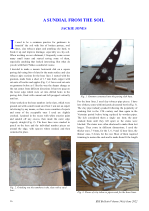
This describes a DIY horizontal mosaic sundial constructed on a paving slab using found materials, specifically slate for the surface and pieces of clay tobacco pipe stems for the hour lines. The piece features a copper gnomon with decorative cut-outs and was successfully tested as a moon dial in the garden.
Construction Projects, DIY Sundial Projects, Dials: Horizontal, Dials: Unusual
June 2022
Page 18
Page 18
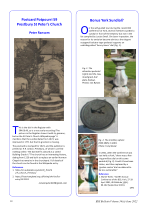
This note records the finding of a previously unlisted sundial on the York Deanery grounds during the BSS conference tour. The current 'Sunny Hours' dial sits on a fine pedestal and appears to be a replacement for a five-ring armillary dial recorded there in 2001.
Dials: Horizontal, Historical Dials, The BSS and Members, Dials: Armillary Sphere
June 2022
Page 18
Page 18
A discussion of the Prestbury St Peter’s Church sundial (SRN 0149), based on a 1923 postcard. The dial, a Grade II Listed Building, originated in 1672 and was improved in 1771, though its gnomon is noted as missing.
Dials: Horizontal, Restoration projects, Historical Dials
September 2022
Page 2
Page 2
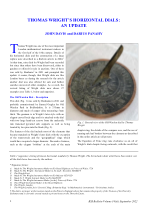
Updates the known catalogue of 18th-century mathematical instrument maker Thomas Wright’s horizontal dials, increasing the count to 27. Provides details, metallurgy, and provenance for recently examined examples, including the Old Warden dial, the Wrexham dial, and the Lisbon College dial (now at Ushaw College).
Dials: Horizontal, Equation of Time, Historical Dials, Restoration projects
September 2022
Page 38
Page 38
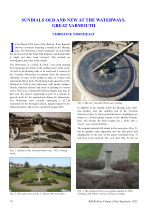
Investigates the sundials at The Waterways in Great Yarmouth after its £2.7 M restoration. Describes the replacement of two historical dials with new horizontal dials, likely made by Brad Dillon, featuring inscriptions related to writers Anna Sewell and Charles Dickens.
Dials: Horizontal, Historical Dials, Restoration projects
December 2022
Page 14
Page 14
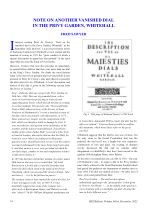
Follow-up to a previous article, suggesting the dial seen by Uffenbach in 1710 was likely the remains of Gunter’s great stone horizontal sundial (originally 1622) rather than the fragile, short-lived pyramidal dial by Francis Hall.
Dials: Horizontal, Dials: Multi Faced, Historical Dials
December 2022
Page 16
Page 16
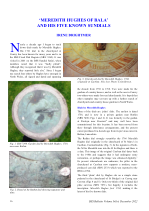
Research into the 18th-century Welsh dial maker, Meredith Hughes, a land surveyor and scientist. Describes his five known dials, including two complex ones incorporating the Equation of Time and geographical features, possibly outsourced for engraving.
Dials: Horizontal, Dials: Unusual, Equation of Time, Historical Dials
December 2022
Page 35
Page 35
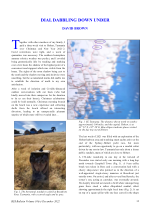
Account of a three-week sundial safari in Hobart, Tasmania. Examines several dials including the Transit of Venus commemorative dial and a complex mechanism at UTAS. Ends with discovery of the 'Sundial Sea Shell'.
Dials: Horizontal, Dials: Unusual, Historical Dials, The BSS and Members
March 2021
Page 10
Page 10
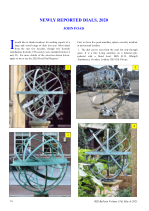
A selection of sundials reported in 2020 and entered into the Fixed Dial Register. The list includes armillary spheres, equatorial dials, various vertical dials (like the one at Staple Inn), several horizontal dials (such as the large Solum dial), and multiple or special dials.
Dials: Armillary Sphere, Dials: Equatorial, Dials: Horizontal, Dials: Vertical
March 2021
Page 22
Page 22
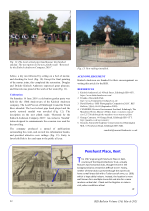
A short note highlighting a 1747 engraving of Penshurst Place in Kent which depicts two horizontal sundials. Neither of these dials is present today, though the location features a multiple stone dial and a modern vertical dial.
Dials: Horizontal, Historical Dials
March 2021
Page 31
Page 31
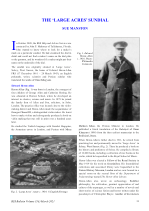
An investigation into the maker of a horizontal brass dial (1907) from 'Large Acres', the home of Edward Heron-Allen. Based on the decorative features, gnomon shape, Equation of Time ring layout, and specific wording, the evidence suggests the dial was custom-made by Francis Barker & Son.
Dials: Horizontal, Historical Dials, Mottoes
June 2021
Page 2
Page 2
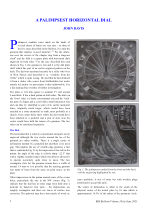
An investigation into a rare horizontal sundial made on a re-used brass plate (a palimpsest). The reverse side reveals an earlier engraving from a memorial brass, identified as a "waster" from the Southwark workshops (c.1600). Metallurgical analysis shows the plate is made of imported high-zinc brass, and the dial's delineation matches the latitude of Southwark.
Dials: Horizontal, Historical Dials, Sundial Design & Layout
June 2021
Page 7
Page 7
Discusses a specific postcard from the 1908 Franco-British Exhibition in London, featuring a floral sundial in the Garden of Progress. The dial includes a prominent statue of a lady holding the gnomon. The exhibition celebrated the Entente Cordiale.
Dials: Horizontal, Dials: Unusual, Historical Dials
June 2021
Page 8
Page 8
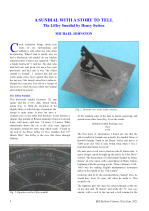
Chronicles the investigation into a horizontal sundial inherited by the author, inscribed as being found in the River Liffey in 1866 and signed "H:Sutton 1654". Analysis confirmed the design latitude matches Dublin (53.35° N), authenticating it as a work by Henry Sutton, a leading 17th-century instrument maker. Explores its provenance and possible link to the Down Survey of Ireland.
Dials: Horizontal, Historical Dials
June 2021
Page 31
Page 31
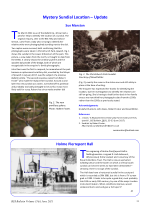
Discusses an engraving of Holme Pierrepont Hall showing a vertical south sundial on a demolished tower. Mentions a surviving horizontal sundial in the courtyard, likely dating from the late 18th or early 19th century, and requests further investigation.
Dials: Horizontal, Dials: Vertical, Historical Dials
September 2021
Page 2
Page 2
Examines ten mosque sundials signed by al-Mansur and dated 1671–1681 AD. These instruments feature epigraphic anomalies and non-functional gnomonic layouts, including inaccurate hour lines and prayer indications. The authors conclude these sophisticated yet flawed dials are likely modern ‘fakes’.
Dials: Horizontal, Mathematics of Dialling, Historical Dials
September 2021
Page 43
Page 43
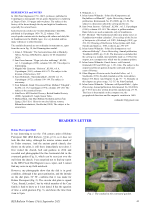
A letter describing a horizontal sundial found in the courtyard garden of Holme Pierrepont Hall. The dial plate is signed "Cary, Strand, London," shows the latitude 52° 58ʹ, and includes the equation of time. The author notes the challenge in dating the dial precisely due to the lack of a date and multiple Cary family makers.
Dials: Horizontal, Equation of Time, Historical Dials
December 2021
Page 2
Page 2
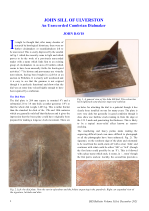
Analyses a newly discovered, unrecorded 17th-century horizontal Cumbrian dial by John Sill, dated 1737. It describes the dial plate specifications, unusual thickness, features (such as oak leaf borders), and XRF materials analysis, identifying copper sources and the controversial use of a selenium-based artificial patina during a past restoration.
Dials: Horizontal, Historical Dials, Restoration projects, Sundial Design & Layout
December 2021
Page 30
Page 30
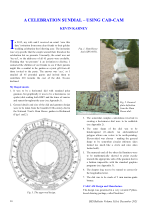
Details the design and CAD-CAM manufacture of a complex hendecagonal hectemoros horizontal sundial for a Golden Wedding anniversary gift. The process used Python graphics (Nodebox) and water-jet cutting to create a bronze plate indicating GMT, sunrise, and sunset, featuring custom algorithms for precise font skewing.
DIY Sundial Projects, Dials: Horizontal, Mathematics of Dialling, Sundial Design & Layout
March 2020
Page 10
Page 10
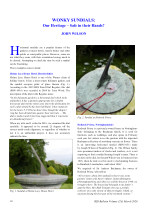
Discusses several examples of horizontal sundials found in public places (Holme Lacy House Hotel, Hodsock Priory, Canons Ashby) that are poorly aligned and useless for telling time. The author carries a compass to check sundial alignment, noting that badly set-up dials discredit those interested in them. The Hodsock Priory dial is attributed to Joseph Wilson of Stamford, circa 1818–1860.
Dials: Horizontal, Sundial Design & Layout, Historical Dials
March 2020
Page 14
Page 14
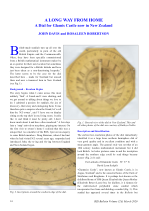
Investigates a brass northern hemisphere dial found in New Zealand, identified by its inscription as made for Glamis Castle, Scotland (Latitude 56° 37′ N) and signed 'David Lyon Sculpsit'. Detailed analysis of the Coat of Arms and Equation of Time scale dates the dial to between 1710 and 1752, likely commissioned around the 1725 marriage of the 6th Earl of Strathmore, Charles Lyon, to Susan Cochrane. The dial was never installed at Glamis.
Dials: Horizontal, Equation of Time, Historical Dials, Mottoes
June 2020
Page 2
Page 2
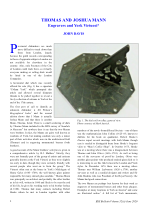
This article researches the work of late 17th-century York artisans Thomas and Joshua Mann, who, though primarily known for architecture and engraving, were also notable sundial makers. The article details several of their horizontal, vertical, and portable dials.
Dials: Horizontal, Dials: Vertical, Dials: Portable, Historical Dials
June 2020
Page 8
Page 8
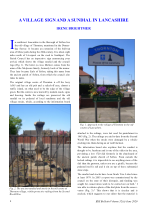
This article describes the ancient, Jacobean sundial in Thornton, Lancashire, which is featured on the village sign and stands near the old village stocks. The dial is Grade Two Listed, but its cracked plate and heavy patina obscure the maker and date. Repairs were undertaken on the stocks, but the sundial itself remains untouched since 1891.
Dials: Horizontal, Historical Dials, Restoration projects
June 2020
Page 24
Page 24
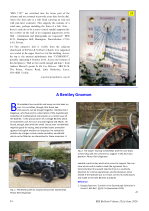
This short piece highlights a unique modification made to a vintage Bentley: a custom-made central stay for a secondary windshield, designed to function visually like a gnomon for a horizontal dial.
Dials: Horizontal, Dials: Unusual, Sundial Design & Layout
June 2020
Page 31
Page 31
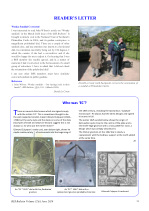
The author recounts an instance at Pitmedden Castle in 2006 where, using his status as a BSS member, he quickly corrected the orientation of a horizontal sundial that was misaligned by 180 degrees.
Dials: Horizontal, How Sundials Work, The BSS and Members
June 2020
Page 31
Page 31
This piece investigates the identity of the sundial maker marked with the initials 'EC' on dials dated 1625 and 1642. It notes that the style and date pre-date the well-known London instrument maker Edmund Culpeper, suggesting an earlier, unidentified artisan.
Dials: Horizontal, Historical Dials
September 2020
Page 2
Page 2
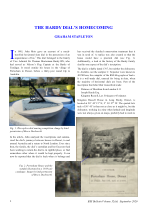
A horizontal slate dial, reliably dated 1767, belonging to Vice Admiral Sir Thomas Masterman Hardy, is tracked through its travels from Dorset to Australia and back to London. The article concludes with the dial's conservation and placement inside Portesham House, alongside a replica placed outside.
Dials: Horizontal, Historical Dials, Restoration projects, The BSS and Members
September 2020
Page 5
Page 5
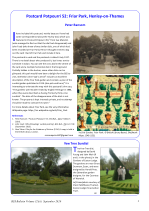
A postcard, postmarked 1917, is presented showing the Ye Dial Garden at Friar Park, which contains a cross dial and a multiple horizontal dial. The gardens were described in 1984 as having formerly contained thirty-nine sundials, though their disappearance date is unknown.
Dials: Horizontal, Dials: Multi Faced, Dials: Unusual, Historical Dials
September 2020
Page 9
Page 9
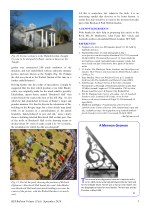
Describes an unusual 18th-century horizontal dial, signed Edward Hunter Fecit, which features a pierced gnomon depicting a merman. Hunter is identified as an Irish maker.
Dials: Horizontal, Dials: Unusual, Historical Dials
September 2020
Page 15
Page 15
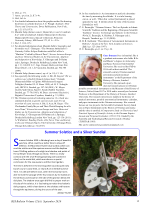
Details the performance of the Macmillan Hunter dual sundial, Dihelion, during the Summer Solstice 2020 in Edinburgh. The metal dial has a silver finish and features a horizontal rod that marks the passage of the four seasons by its shadow on a curved scale.
Dials: Horizontal, Dials: Unusual, How Sundials Work
September 2020
Page 16
Page 16
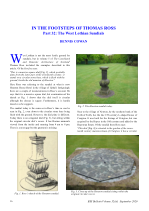
Examines sundials in West Lothian mentioned by Thomas Ross, including those at Houston House Hotel, Craigton, and Hopetoun House. Comparisons are drawn between Ross’s sketches and the dials' current condition, such as the mass dial at St Michael’s church, Linlithgow.
Dials: Horizontal, Dials: Mass Dials, Historical Dials
September 2020
Page 19
Page 19
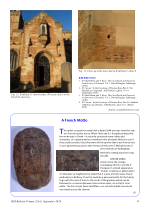
Concerns a horizontal dial dated 1644 seen at a French auction. The motto was deciphered as “CHEVER NOBLE,” possibly a personal motto associated with the family name Chever from Brittany.
Dials: Horizontal, Historical Dials, Mottoes
September 2020
Page 28
Page 28
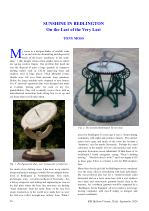
The author recounts the design and project management of his final large sundial: a horizontal mean time dial for his hometown of Bedlington. The stainless steel dial incorporates local history, featuring winding gear designs in the base and a Bedlington Terrier gnomon.
Dials: Horizontal, Sundial Design & Layout, Construction Projects
September 2020
Page 30
Page 30
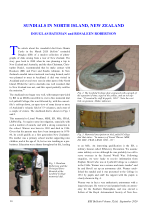
Reports on a tour detailing various sundials across New Zealand's North Island, including a memorial dial at Lynfield College. Describes a commemorative dial at the Treaty of Waitangi Grounds and the analemmatic 'Sundial of Human Involvement' in Wellington Botanic Garden.
Dials: Horizontal, Dials: Analemmatic, Historical Dials, Dials: Armillary Sphere
September 2020
Page 36
Page 36
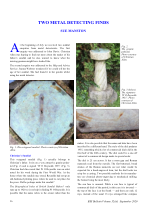
Reports on two sundial finds by metal detectorists. The first is an octagonal horizontal dial signed ‘W O Reynolds 1935’ with the motto 'Sole orto spes; decedente pax'. The second is a square dial inscribed 'Raymond Surrey', possibly made by a clockmaker.
Dials: Horizontal, Historical Dials, Mottoes
December 2020
Page 41
Page 41
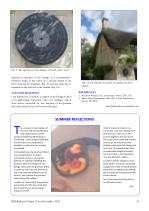
A short piece describing the author’s process of checking the delineation of a simple horizontal sundial by rotating it in the sun to confirm the shadow direction. The text is accompanied by an unusual photograph caught by a "stray click" showing a reflection in sunglasses.
Dials: Horizontal, How Sundials Work, Sundial Design & Layout
March 2019
Page 12
Page 12
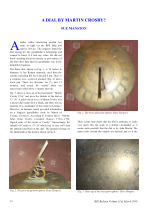
Investigates a 1766 brass horizontal sundial found via the BSS Help and Advice Service. Although signed 'Martin Crosby', the latitude (53° 30ʹ) suggests the maker was likely John Martin of Great Crosby, Liverpool, a known clockmaker. The dial is notable for its minute-interval 'vernier' transversals and pierced gnomon.
Dials: Horizontal, Historical Dials, Sundial Design & Layout
March 2019
Page 22
Page 22
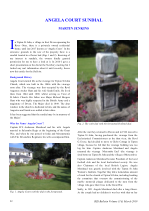
Investigation into the sundial at Angela Court (now Sundial House), East Devon. The assembly consists of an older cube dial topped by a brass Dollond horizontal dial plate engraved with an incorrect latitude (51° 15ʹ). The base has mysterious Latin inscriptions (SOLE, QUARE, SPLENDIDIUS, NECASTI) which are speculated to mean, "Why did you kill the sunshine?" suggesting the dial is a memorial.
Dials: Cube, Dials: Horizontal, Historical Dials, Mottoes
June 2019
Page 28
Page 28
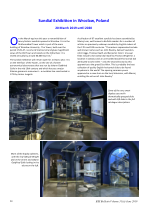
Reports on a new exhibition of 87 historic sundials, assembled by Maciej Lose, in the Mathematical Tower of Wrocław University. The collection includes a rare double horizontal dial by John Allen, and is considered the best collection of quality English horizontal dials globally.
Dials: Double Horizontal, Dials: Horizontal, Historical Dials
June 2019
Page 30
Page 30
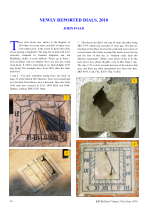
Presents 18 selected entries from the more than 100 dials added to the Fixed Dial Register in 2018. Examples include historical dials by George Adams and Heath and Wing, a Dollond cube dial, a vertical slate dial from 1698, and modern ground-level and wall dials.
Construction Projects, Dials: Equatorial, Dials: Horizontal, Dials: Vertical, Historical Dials
September 2019
Page 15
Page 15
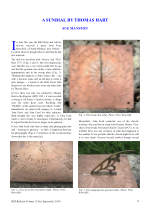
The article details the investigation into a dial inscribed 'Jwade' and 'Thos. Hart 1773', which was found to be the genuine article stolen from All Saints’ Church in Iwade. The investigation concurrently identified eight other similar dials (like one at Wilton House Museum) bearing the 20th-century “Brazen-Faced Old Optimist” motto, believed to be later replicas.
Dials: Horizontal, Historical Dials, Restoration projects
December 2019
Page 17
Page 17
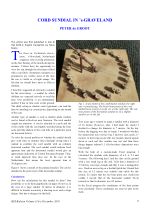
Description of the design and construction of a large, interactive combination sundial located at the ’s-Graveland observatory in the Netherlands. The 5.5-metre dial combines a cord sundial, indicating local apparent time, with a horizontal sundial, showing Central European Summer Time. The article details the mathematical calculations, material choices (Robinia wood), and implementation steps for this educational project.
Construction Projects, DIY Sundial Projects, Dials: Horizontal, Dials: Unusual
March 2018
Page 2
Page 2
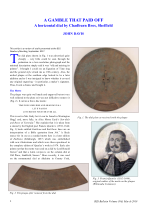
Describes the acquisition and scholarly investigation of a 19th-century horizontal dial plate. Removing a later plaque revealed the signature of previously unrecorded sundial makers, Chadburn Bros, Sheffield. The dial features an Equation of Time ring, and its composition (naval brass) and craftsmanship are analyzed, filling a gap in the history of regional makers.
Dials: Horizontal, Historical Dials, Mottoes
March 2018
Page 13
Page 13
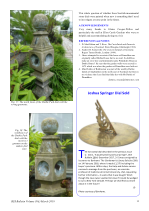
Reports on the auction sale of a Joshua Springer horizontal dial for £1,375. The purchaser, based in the USA, subsequently contacted the BSS Help-and-Advice service seeking information on adjusting the dial for a New York latitude.
Dials: Horizontal, Historical Dials, The BSS and Members
March 2018
Page 16
Page 16
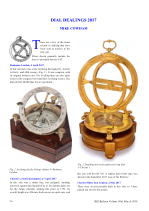
A summary of sundial-related items sold at auction in 2017, including prices achieved. Noteworthy sales include an inclining dial by G. Adams, a rare universal equinoctial ring dial pre-1752, a horizontal garden dial by George Adams Senior featuring an Equation of Time scale, and a sophisticated declinatory dial by R. Glynne.
Dials: Horizontal, Dials: Portable, Historical Dials
March 2018
Page 26
Page 26
Examines the dedication of the octagonal bronze sundial at Moray Golf Club in Lossiemouth, Scotland. The dial, featuring the motto 'Docet Umbra', commemorates cousins George Eric Edwards (DSO recipient) and Sergeant Alexander Edwards (VC recipient) of the Seaforth Highlanders, both of whom perished in the First World War. The memorial was unveiled in 1931.
Dials: Horizontal, Historical Dials
June 2018
Page 13
Page 13
Reports on over one hundred dials added to the Fixed Dial Register in 2017, presenting 18 selected examples. These include a historical horizontal dial, a Francis Barker cross dial, a moon dial, an armillary sphere, and a stained glass millennium dial. Dials by makers Thomas Woodcock and John Bird are highlighted.
Dials: Armillary Sphere, Dials: Horizontal, Dials: Polar, Dials: Stained Glass, Dials: Vertical, Historical Dials
June 2018
Page 24
Page 24
A valedictory article detailing the author's final metal sundial commissions for Newcastle High School for Girls. He recounts the challenges of etching brass and ultimately hand-engraving the lines to ensure durability. The article marks the conclusion of his two decades of intensive dial production.
Construction Projects, Dials: Horizontal, The BSS and Members
September 2018
Page 6
Page 6
Reports on several dial makers exhibiting at the Chelsea Flower Show. David Harber featured the 'Aeon' sunburst sculpture and an armillary dial. Border Sundials displayed eight pieces, winning a 4-star trade stand award. Martin Cook Studio showed slate dials focusing on calligraphy, and Caroline Dear of Stonecraft displayed dials on Portland stone pedestals.
Dials: Armillary Sphere, Dials: Horizontal, Dials: Vertical
September 2018
Page 8
Page 8
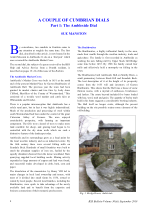
Details an octagonal brass sundial (c. 1651) now in the Armitt Museum, Ambleside. Originally belonging to Gawen Braithwaite, the dial post bears the inscription ‘GB’ and the motto ‘VITA VT HERBA’. Analysis of the punched numerals, hatched segments, and metallurgy suggests it is a very early dial, likely made by a goldsmith or silversmith, G. Hayton.
Dials: Horizontal, Historical Dials
September 2018
Page 16
Page 16
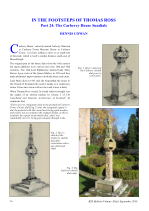
Examines two historical sundials at Carberry House, East Lothian. The first is a hollow obelisk dial capital, restored according to Thomas Ross's sketch. The second, missing for a time but now in the National Museum of Scotland, is a unique 13-dial structure featuring a female bust support, combining upright, reclining, and horizontal dials.
Dials: Horizontal, Dials: Multi Faced, Historical Dials
September 2018
Page 19
Page 19
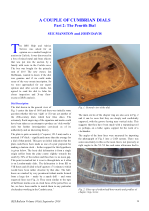
Describes a 1695 brass horizontal dial bought at auction in Carlisle, designed for latitude 54°. The florid motto ‘Ut Hora Sic Vita’ and signature Lawrance Swarbricke, an excise officer in Penrith, suggest he customized a dial commissioned from a clockmaker. Metallurgical analysis reveals a mid-zinc leaded brass composition typical of the period.
Dials: Horizontal, Historical Dials
September 2018
Page 26
Page 26
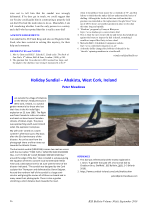
Describes a horizontal sundial (SRN 3936) located in a garden memorial at Ahakista, West Cork, Ireland, dedicated to those who died in the 1985 Air India flight explosion. Designed by Ken Thompson and delineated by Owen Deignan, the dial features the motto 'TIME FLIES...' and a plaque giving the Equation of Time.
Dials: Horizontal, Historical Dials
September 2018
Page 28
Page 28
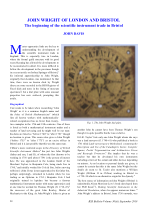
Investigates John Wright, a London-trained instrument maker who initiated Bristol’s scientific instrument trade in 1756. A rare, well-preserved horizontal dial plate signed 'Jo Wright London' is analysed, showing fine engraving and wax infill. The plate features unusual slots around the compass rose whose purpose, possibly related to magnetic variation or EoT, remains an open puzzle.
Dials: Horizontal, Historical Dials, Sundial Design & Layout
September 2018
Page 34
Page 34
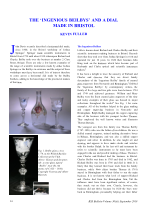
Presents a rare horizontal brass dial signed 'Beilby Bristol,' made by Richard and Charles Beilby who ran the instrument business (1810-1820) after Joshua Springer. The Beilbys are descendants of the famed 'Ingenious Beilby' family of enamel engravers from Newcastle. The dial follows a standard London design but features a unique unpierced gnomon set at 52°.
Dials: Horizontal, Historical Dials
December 2018
Page 2
Page 2
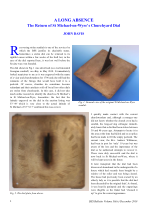
Details the successful recovery of a substantial 1796 brass horizontal churchyard dial from St Michael-on-Wyre, Lancashire, after it was stolen decades prior and listed on eBay in 2018. The dial is exceptional due to its engraved transversals, reflecting the influence of London instrument makers. Its metallurgy, gnomon angle, and mottoes are analysed.
Dials: Horizontal, Historical Dials
December 2018
Page 18
Page 18
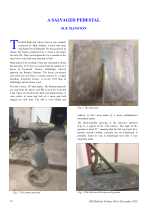
Describes a 1675 brass horizontal dial found atop a broken, ornate pedestal in Edinburgh. The dial, designed for London's latitude (51°), features a 17th-century thick-and-thin pierced gnomon. The date appears genuine, though the pedestal is likely later.
Dials: Horizontal, Historical Dials
March 2017
Page 2
Page 2
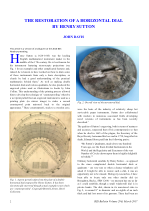
This article details the restoration of a rare, 1652 circular horizontal dial by Henry Sutton, a leading 17th-century instrument maker. Analysis revealed its accuracy but also a beginner’s delineation mistake (wrong centres used for back-hours). The brass plate showed remarkably uniform thickness and bore a unique motto: “As shade doth pass from line to line...”. A replacement gnomon was manufactured.
Dials: Horizontal, Historical Dials, Mathematics of Dialling, Mottoes, Restoration projects
March 2017
Page 8
Page 8
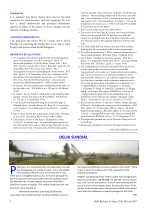
A large sundial in Delhi is reported to be one of the largest scientifically accurate sundials in the world, although the author expresses doubt regarding this claim. Access to the site is difficult due to its location in a complex of flyovers, and poor air quality often means the dial rarely sees the sun.
Dials: Horizontal, Dials: Unusual
March 2017
Page 10
Page 10
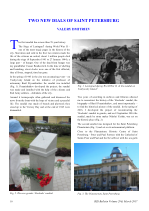
This piece details the history and 2016 granite reconstruction of a 1943 'blockade' sundial, originally made of wood and plywood during the Siege of Leningrad. Additionally, a new horizontal sundial designed with celestial spheres imagery was installed on the astronomical platform of the Saint Petersburg Planetarium.
Construction Projects, Dials: Equatorial, Dials: Horizontal, Historical Dials
March 2017
Page 24
Page 24
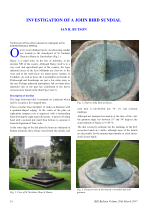
Investigation of a large, corroded horizontal dial by precision instrument maker John Bird (c. 1709–1776) at Haxey, Lincolnshire. By analyzing the division markers, the Equation of Time scale was determined to be applicable to the post-1752 Gregorian calendar era. The dial is likely associated with Dr William Cotton, vicar from 1754 to 1762.
Dials: Horizontal, Equation of Time, Historical Dials
March 2017
Page 29
Page 29
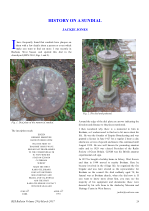
An account of a memorial horizontal dial in Bosham, West Sussex, dedicated to radio pioneer Eugen Gerald Marcuse (1886–1961), G2NM. Marcuse was noted for the first shortwave broadcast programmes to the Commonwealth (1927) and achieving the first radio telephone contact with New Zealand.
Dials: Horizontal, Historical Dials
March 2017
Page 40
Page 40
Review of Robert Ovens’ article in the 'Rutland Record' on the Isaack Symmes (c.1580–1622) Ridlington Sundial (1614). Notes the small horizontal dial's old-fashioned design and the detailed biography of Symmes. The dial's back is literally covered in trial engravings, including the words “Ridlington” and “Church”.
Book Reviews, Dials: Horizontal, Historical Dials
June 2017
Page 8
Page 8
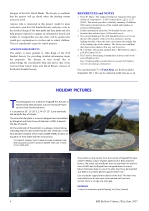
This entry features a photograph of a colourful mosaic sundial located on Flagstaff Hill, Russell, in New Zealand. Designed in 1990, it commemorates the centenary of the New Zealand Institute of Surveyors and bears an Equation of Time table.
Dials: Horizontal, Equation of Time, Historical Dials
June 2017
Page 29
Page 29
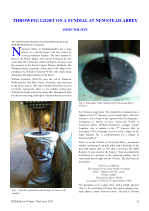
This article investigates an unusual mid-19th century sundial located in the Cloister of Newstead Abbey. The dial plate, inscribed ‘Osmond Sarum’, is mounted on a marble capital presented to Mrs F. Webb in 1856, which was originally from the Temple of Venus in Piraeus.
Dials: Horizontal, Historical Dials
June 2017
Page 34
Page 34
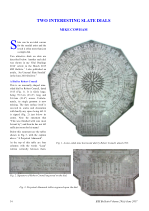
The article details two large slate horizontal dials. The first is Robert Connell's nine-sided 1815 dial featuring a perpetual almanac and a global time ring. The second is Richard Melville's 1848 square dial, which displays eight subsidiary dials for various world locations.
Dials: Horizontal, Dials: Unusual, Historical Dials
September 2017
Page 16
Page 16
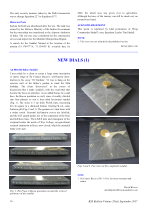
This describes a 40cm square, diamond-format horizontal sundial made of Welsh slate, featuring a brass gnomon with a nodus notch. It includes an EoT graph and declination curves. The inscription uses four phrases from Sir Francis Bacon’s essay ‘Of Gardens’ and was commissioned as an 80th birthday gift.
Dials: Horizontal, Sundial Design & Layout
September 2017
Page 19
Page 19
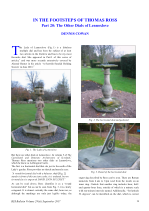
This article examines the other dials at Lennoxlove, Scotland, besides the famous multiple dial. It covers an octagonal horizontal dial engraved by David Lyon (possibly 18th century), a south and east vertical dial (1644), and a similar south and west vertical dial previously unknown to Ross.
Dials: Horizontal, Dials: Multi Faced, Dials: Vertical, Historical Dials
September 2017
Page 24
Page 24
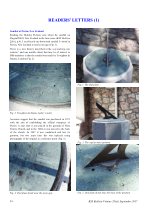
The letter discusses a horizontal sundial in Picton, New Zealand, manufactured by Troughton & Simms in London in 1871. It was restored in 1989 after the gnomon was vandalised. The dial's current placement is unsatisfactory as it is often obscured by shadows from an oak tree and the adjacent building.
Dials: Horizontal, Historical Dials, Restoration projects
September 2017
Page 28
Page 28
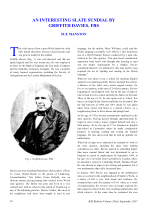
This biography recounts the life of actuary Griffith Davies, FRS, who won a silver medal in 1820 for a complex slate sundial. His 27-inch square horizontal dial, designed for London, displayed 14 different pieces of information, including time in London and Pekin, sun altitude/azimuth, and the Equation of Time.
Dials: Horizontal, Historical Dials
September 2017
Page 32
Page 32
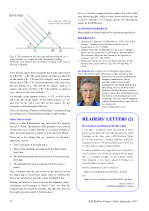
Responding to a previous article on Richard Melville’s slate dial, the author clarifies that Port Jackson refers to Sydney Harbour. She notes that the dial maker made a mistake in showing Port Jackson and Syndney as being an hour apart.
Dials: Horizontal, Historical Dials
September 2017
Page 46
Page 46
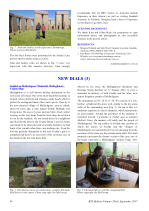
This describes a memorial in Mullaghmore, Ireland, commemorating forgotten villagers, featuring a six-foot sandstone capstone incorporating a limestone sundial. The dial, designed by Christian Meyer, indicates local sun-time and features a stainless steel gnomon with Celtic interlacery. The sundial symbolises the passing of time.
Construction Projects, Dials: Horizontal, Sundial Design & Layout
December 2017
Page 2
Page 2
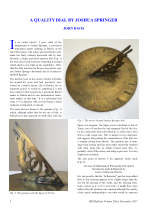
Describes a large, superior, 18th-century horizontal dial by provincial Bristol maker Joshua Springer, which features a pierced gnomon engraved with the figure of Triton and a ring listing 28 geographical locations. The craftsmanship of this dial elevates Springer's perceived standing.
Dials: Horizontal, Historical Dials
December 2017
Page 12
Page 12
Investigates two antique dials: a damaged brass horizontal dial signed by Thomas Wilks and dated 1732, featuring a Jerusalem time ring and Horace motto; and an unsigned, rare, early 18th-century horizontal dial believed to be part of a declinatory instrument.
Dialling Tools, Dials: Horizontal, Dials: Unusual, Historical Dials
December 2017
Page 15
Page 15
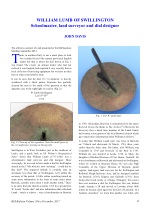
Discusses a weathered horizontal dial from 1765 found in Turin, signed by Yorkshire dial designer William Lumb (1737–1801). Analysis revealed the dial plate was good brass, but the gnomon was cast from an extraordinary alloy of copper, lead, and high tin content, likely recycled pewter.
Dials: Horizontal, Historical Dials
December 2017
Page 29
Page 29
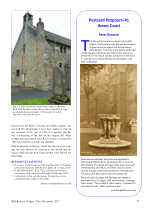
Features a postcard image of the horizontal 18th-century sundial (SRN 2196) located in Amen Court, London. The dial's gnomon bears the Deanery of St Paul’s motif (D and crossed swords) and is sometimes attributed to Christopher Wren.
Dials: Horizontal, Historical Dials
December 2017
Page 34
Page 34
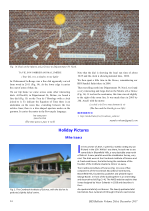
Presents two unusual sundials seen in Bloomfield Hills, USA: an equatorial dial of cast bronze at the Cranbrook Institute of Science with an analemma; and a horizontal dial at Cranbrook House designed in the shape of a swan, where the tail serves as the gnomon.
Dials: Equatorial, Dials: Horizontal, Dials: Unusual, Equation of Time
December 2017
Page 40
Page 40
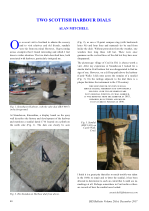
Details a heavily weathered cube dial (1710) with a 32-point compass ring at Stonehaven Harbour, and the remains of a 17th-century dial located on Castle Walk, Crail, which was repaired and moved in the 1880s but is now highly deteriorated.
Dials: Cube, Dials: Horizontal, Historical Dials
March 2016
Page 10
Page 10
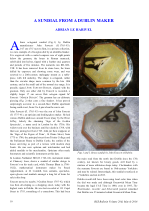
A description of a rare octagonal brass horizontal sundial made by John Fawcett of Dublin, who worked primarily as an optician and instrument maker between 1765 and 1793. The dial features a compass rose and an elaborately pierced gnomon.
Dials: Horizontal, Historical Dials
March 2016
Page 11
Page 11
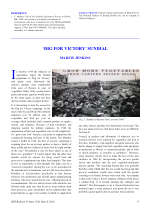
Examines a photograph from 1940 showing a classical horizontal sundial located amongst rows of vegetables at Carter’s Seed Company during the ‘Dig for Victory’ campaign. The article poses the question regarding the current location and fate of this particular dial.
Dials: Horizontal, Historical Dials
March 2016
Page 26
Page 26
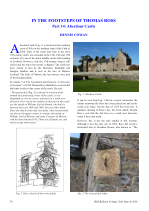
This article traces the historical sundials documented by Thomas Ross at Aberdour Castle. It describes a vertical dial (1635), a horizontal dial, and a multi-faceted dial moved from Castle Wigg, noting that the latter's Equation of Time table uses the Julian calendar appropriate for the early 18th century.
Dials: Horizontal, Dials: Multi Faced, Dials: Vertical, Equation of Time, Historical Dials
March 2016
Page 29
Page 29
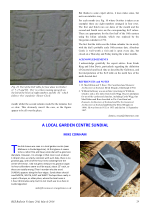
A humorous critique of a poorly laid out slate horizontal dial seen in a Cambridgeshire garden centre. The dial incorrectly shows equal 15° hour calibrations, lacks a gnomon gap, and displays noon at 1:40 pm, rendering it useless as a timekeeper.
Dials: Horizontal, Dials: Unusual
March 2016
Page 30
Page 30
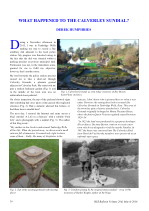
The search for a missing sundial from Calverley Grounds in Tunbridge Wells. The author confirms that a sundial was installed in 1924, but subsequent photographs from the 1960s show the pedestal broken and the dial missing, likely due to vandalism.
Dials: Horizontal, Historical Dials
March 2016
Page 33
Page 33
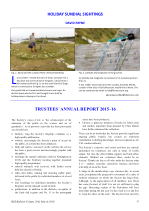
An account of finding a horizontal sundial on Gugh in the Isles of Scilly, which appeared approximately seven years ago. The dial's wooden gnomon is inscribed with its latitude and longitude, and the author notes the local museum is seeking information regarding the builder, thought to be holiday-makers.
Dials: Horizontal
June 2016
Page 2
Page 2
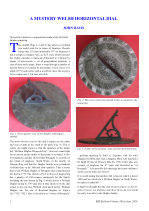
Investigation into a rare 1775 brass horizontal dial commissioned by William Hughes of Bryngola, Anglesey. The dial features complex furniture (EoT scale, transversals, geographical locations) and a questionable coat of arms. Metallurgical analysis suggests it was a custom cast piece, possibly engraved by a specialist working for the Owen clockmaking dynasty in Llanrwst.
Dials: Horizontal, Historical Dials
June 2016
Page 6
Page 6
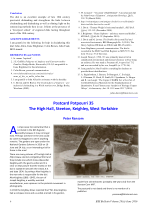
Examination of a postcard featuring an impressive horizontal dial, not listed in the BSS Register, at The High Hall. The dial likely dates to 1934 and carries the motto "summer time" and the initials A.K., suggesting it was the work of pioneer photographer Alex Keighley, using old millstones.
Dials: Horizontal, Historical Dials
June 2016
Page 26
Page 26
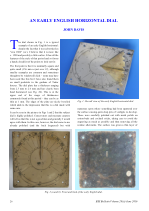
Examination of a small, nominally square horizontal dial believed to date from circa 1590, despite being advertised as circa 1800. Features typical of the period include hand-hammered brass, inward-facing, punched numerals, quarter-hour dots, and a latitude set for London (51.5°), though the delineation suggests 55.9°.
Dials: Horizontal, Historical Dials
June 2016
Page 29
Page 29
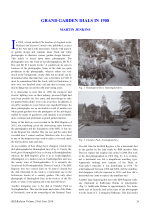
Review of photographs from a 1908 book, The Gardens of England, illustrating grand sundials in prominent gardens. Many featured pedestal dials, which appear to have since vanished or been moved, highlighting the disappearance of such features due to changing fashion, damage, or theft. Locations include Clumber Park (armillary sphere) and Guy’s Cliff.
Dials: Armillary Sphere, Dials: Horizontal, Historical Dials
June 2016
Page 34
Page 34
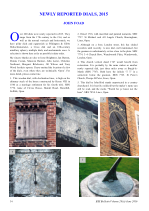
A list of over 200 sundials newly reported to the BSS Register in 2015, ranging from the 17th to 21st centuries. Examples include a 1540 wooden dial, a 1799 horizontal dial by Liverpool clockmaker Thomas Harrison, an exquisite square dial installed for Queen Victoria’s Diamond Jubilee, and a modern spiral analemmatic dial.
Dials: Heliochronometer, Dials: Horizontal, Dials: Multi Faced, Dials: Unusual, Dials: Vertical, Historical Dials, The BSS and Members
September 2016
Page 2
Page 2
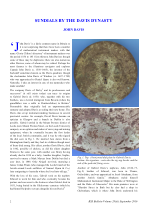
Investigates two horizontal sundials made by the instrument makers Gabriel Davis (c. 1820) and John Davis (c. 1850) of Derby. The article compares their engraving styles and uses X-ray fluorescence (XRF) and thickness profiling to analyse the metallurgy of the plates, revealing differences in casting and manufacturing technology between the two periods.
Dials: Horizontal, Historical Dials
September 2016
Page 7
Page 7
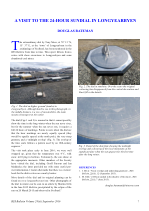
A report on a visit to the unusual 24-hour sundial designed by Tony Moss in Longyearbyen, Svalbard (78° N). Key features noted include the steep gnomon, nearly equally spaced hour lines, and a ‘midnight overlap’.
Dials: Horizontal, Dials: Unusual, Historical Dials
September 2016
Page 8
Page 8
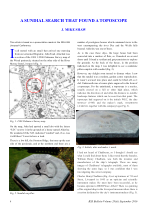
Following an enquiry about a suspected sundial marked on a 1909 map in the Wirral, the author found a pillar topped by a modern 'garden centre' dial. Underneath was a 1945 bronze toposcope (showing directions of visible geographic features) made by Chadburns of Liverpool, likely a gift for William E. Corlett, the company’s solicitor, following the relocation of the bombed factory.
Dials: Horizontal, Historical Dials
September 2016
Page 11
Page 11
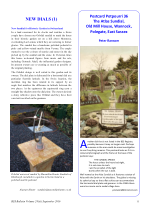
Examines a postcard image of the ‘Atlas Sundial’, unlisted in the BSS Register. It features a statue of Atlas supporting a horizontal dial plate on his shoulders. The pedestal carries the motto: “The hours unless the hours be bright, It is not mine to mark”.
Dials: Horizontal, Historical Dials, Mottoes
September 2016
Page 21
Page 21
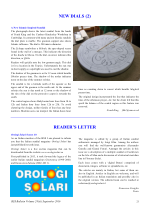
Describes a new 500 mm marble horizontal sundial designed with Islamic influences for a tropical location. Features include a low gnomon angle, a Mihrab-inspired carved Ω shape showing Qibla (direction to Mecca), and Babylonian/Italian hour lines to help Muslim users determine prayer times (Dhuhur and Maghrib).
Construction Projects, Dials: Horizontal, Dials: Unusual, Sundial Design & Layout
September 2016
Page 23
Page 23
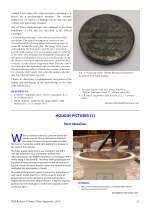
Describes a modern horizontal ‘Flat Sundial’ installed in 2011 outside the Nautical Museum of Crete in Chania. The pedestal provides Equation of Time corrections in six languages, though the author notes the original elegant gnomon appears to have been damaged and replaced by a simpler version.
Dials: Horizontal, Historical Dials
September 2016
Page 28
Page 28
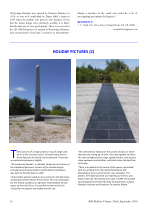
Features photographs of a large horizontal sundial/calendar built in 1995 on Parnidis Dune, Lithuania. The obelisk-style gnomon, originally 12 metres high, was knocked down by a hurricane in 1999. The steps leading up to noon signify hours, equinoxes and solstices.
Dials: Horizontal, Sundial Design & Layout
December 2016
Page 6
Page 6
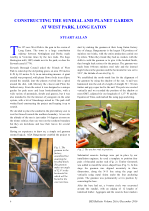
Details the construction of a giant horizontal sundial and accompanying planet garden. The stainless steel rod gnomon was set at the site's 52.9° latitude. The dial uses mosaic tesserae to mark GMT and BST hours, and incorporates solstice markers and an equinox arch.
Construction Projects, Dials: Horizontal, Sundial Design & Layout
December 2016
Page 12
Page 12
A study of Joshua Springer (1732–1812), a prosperous Bristol mathematical instrument maker. Detailed analysis, including XRF metallurgy, is provided for one of his c. 1800 brass horizontal dials, showing London-style influence and local brass origin. Springer was also involved in freemasonry and unsuccessful ballooning plans.
Dials: Horizontal, Historical Dials
December 2016
Page 18
Page 18
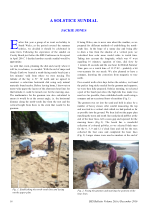
An account of creating a temporary, solar-time horizontal sundial on a South Wales beach for the summer solstice. Natural materials, like sticks for the gnomon and coloured pebbles for the hour lines, were used. Careful calculations were made for alignment and time correction, educating curious passersby.
DIY Sundial Projects, Dials: Horizontal
December 2016
Page 21
Page 21
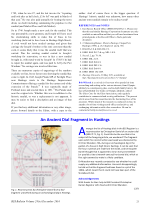
Investigation of a reconstructed sixteenth or seventeenth-century horizontal dial fragment (SRN 7171) found in Hastings. The fragment was recovered from a pit dating to the 1660s, confirming it could not be part of the historic Stonebeach dial discussed elsewhere.
Dials: Horizontal, Historical Dials
March 2015
Page 10
Page 10
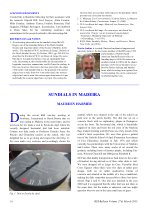
A report surveying several sundials encountered across Madeira. These include David Brown's horizontal slate dial at Escola da Apel, two less impressive dials in Red Cross Square, a horizontal W. Page & Co. dial at Liceu de Jaime Moniz, a large analemmatic dial on the Funchal seafront, a direct south vertical dial by Sampaio E Mello, and a Brookbrae horizontal dial in Palheiro Gardens.
Dials: Analemmatic, Dials: Horizontal, Dials: Vertical, Historical Dials
March 2015
Page 25
Page 25
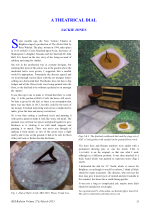
Description of the process of designing and constructing a horizontal sundial to be used as a prop in a theatrical production of "The Herbal Bed", set in the garden of Hall’s Croft in 1613. The dial, based on the Hall’s Croft original, was crafted from painted cardboard for the stage set and accurately delineated for the latitude of Brighton.
Dials: Horizontal, DIY Sundial Projects, Mottoes
March 2015
Page 41
Page 41
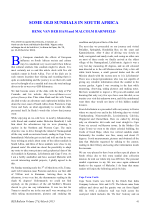
Report detailing a long research trip (4250 km) to record five historical sundials in South Africa. The dials documented include the two vertical dials at Cape Town Castle (1787); the 1828 octagonal horizontal dial at Leliefontein, notable for its Etruscan numbering; and the 1831 horizontal slate dial at the Kuruman Mission station.
Dials: Horizontal, Dials: Vertical, Historical Dials, Mottoes
March 2015
Page 45
Page 45
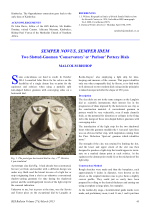
An article detailing the construction of two prototype horizontal pottery dials using a tent-shaped hollow gnomon with a slot. The design is inspired by the rare 18th-century Langlois dial, using a traversing light strip for time measurement during obscured hours and for seasonal indication relative to a fixed datum point. The dials are deemed successful, despite the material's crudity.
Construction Projects, DIY Sundial Projects, Dials: Horizontal, Dials: Unusual
June 2015
Page 6
Page 6
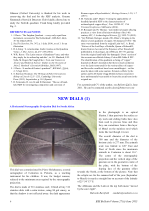
This details the commissioning and construction of a horizontal stereographic projection dial made of stainless steel for Pierre Holtzhausen in Centurion, Pretoria, South Africa, intended as a teaching instrument.
Construction Projects, Dials: Horizontal, Sundial Design & Layout
June 2015
Page 31
Page 31
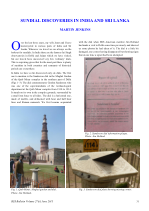
A report on sundials discovered during travels in India and Sri Lanka over three years. Finds include the Sanderson horizontal marble dial in Delhi, a Shimla bronze dial listing railway time, an analemmatic dial in Leh, and an unusual modern dial in Sri Lanka.
Dials: Analemmatic, Dials: Horizontal, Dials: Unusual, Historical Dials
June 2015
Page 36
Page 36
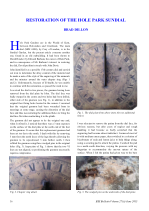
Details the restoration work on a probable 17th-century brass dial found at Hole Park Gardens, Kent, originally identified by John Davis. The work involved straightening the warped plate, realigning the assumed replacement gnomon, cleaning the surface, and applying a mid-brown patina.
Dials: Horizontal, Historical Dials, Restoration projects
September 2015
Page 17
Page 17
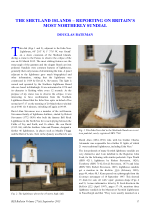
Report on the discovery and registration (SRN 7704) of a lighthouse sundial adjacent to the Esha Ness Lighthouse (60° 29.3′ N). It discusses the dial's distinctive fluted cast iron pedestal and its link to the famous Stevenson family of lighthouse builders.
Dials: Horizontal, Dials: Unusual, Historical Dials
September 2015
Page 19
Page 19
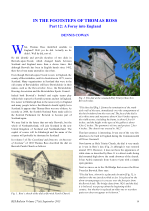
Discusses Thomas Ross's sketches and descriptions of two sundials found in Berwick-upon-Tweed (Holy Trinity Church and the Old Bridge). The article explores the historical ambiguity of Berwick's status between Scotland and England and recent restorations of the dials.
Dials: Horizontal, Dials: Vertical, Historical Dials
December 2015
Page 6
Page 6
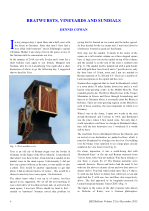
An account of a trip through Germany, specifically Trier and the Moselle wine region, detailing visits to five sundials. Dials included the Trier market cross dial, the Cusanus glass dial in Bernkastel-Kues, and various vertical dials in Wehlen, Zeltingen, and Urzig.
Dials: Horizontal, Dials: Vertical, Historical Dials
December 2015
Page 10
Page 10
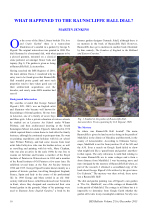
Investigates the horizontal dial shown in a 1908 watercolour by George S. Elgood, supposedly located at Raunscliffe Hall, Leicestershire. The mystery reveals that Elgood intentionally used misleading names for his own garden dial at 'The Cot, Markfield' to secure family privacy.
Dials: Horizontal, Historical Dials
December 2015
Page 12
Page 12
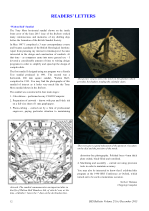
Includes three letters: Norbert Halama discusses his horizontal ‘Walton Hall’ dial; Alison Morrison-Low details James Clark’s horizontal Niddrie Marischal dial, now missing; Dennis Cowan updates on the failed Kirktonhall Project and clarifies the modern Dunphail obelisk dial's origin.
Dials: Horizontal, Construction Projects, Historical Dials
December 2015
Page 14
Page 14
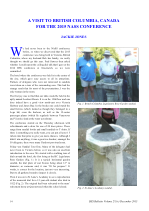
A report on the 2015 NASS Conference in Victoria, BC, Canada, which included presentations on gnomonics and sundial tours. The tour featured several dials, including the Orca totem dial and the impressive Ogden Point analemmatic dial.
Dials: Analemmatic, Dials: Horizontal, Dials: Vertical, The BSS and Members
December 2015
Page 28
Page 28
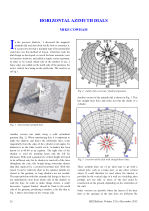
Discusses the construction and layout of horizontal azimuth dials, which use a vertical cylindrical gnomon instead of a polar-aligned one. Various decorative shapes and layouts are explored, noting the complexity of reading the time compared to normal horizontal dials.
Dials: Horizontal, How Sundials Work, Sundial Design & Layout, DIY Sundial Projects
December 2015
Page 35
Page 35
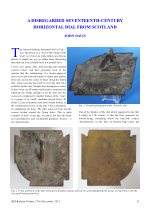
Describes a battered brass horizontal dial acquired via auction, dating to the 17th century based on inward-facing numerals and hammered plate thickness. Discusses its specialized cast gnomon and metallurgy, suggesting a Glasgow–Edinburgh origin.
Dialling Tools, Dials: Horizontal, Historical Dials
December 2015
Page 42
Page 42
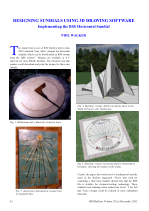
Explains how 3D drawing software (Trimble's Sketchup Make) can be used for sundial design and virtual shadowing. Details the process of creating a physical BSS horizontal dial using a laser-etched plastic plate and a 3D printed gnomon from Shapeways.
DIY Sundial Projects, Dials: Horizontal, Sundial Design & Layout
March 2014
Page 10
Page 10
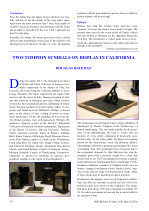
This report discusses two of Thomas Tompion’s rare horizontal sundials displayed at a symposium in California. Only ten Tompion dials are recorded; these included a square dial (c. 1705, latitude 50° 54') and the large circular former Wrest Park dial (c. 1700, adjustable for two latitudes).
Dials: Horizontal, Equation of Time, Historical Dials
March 2014
Page 25
Page 25
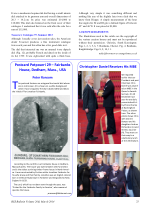
This entry features a postcard depicting an octagonal horizontal dial, dated 1650, bearing the initials IF for Jonathan Fairbanks. The dial is located at Fairbanks House in Dedham, Massachusetts.
Dials: Horizontal, Historical Dials
March 2014
Page 44
Page 44
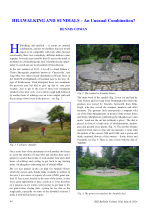
The author combines hillwalking trips in Scotland with sundial observation. Examples include the giant 35-foot gnomon-based dial at Attadale House (2009), a historic horizontal pedestal dial at Attadale made by Gilbert, Wright and Hooke (1794–1805), and a late 18th-century stumpy octagonal facetted dial at Glengarry Castle Hotel.
Dials: Horizontal, Dials: Multi Faced, Historical Dials
June 2014
Page 48
Page 48
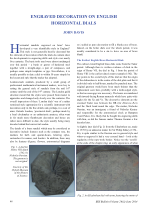
Traces the evolution of decorative styles on English horizontal brass dials from the Tudor era through to the 19th century, contrasting the restrained 'London pattern' with provincial styles. It details decorative elements such as pierced gnomons, the use of oakleaf borders, and the introduction of the Equation of Time scales.
Dials: Horizontal, Equation of Time, Historical Dials, Sundial Design & Layout
September 2014
Page 13
Page 13
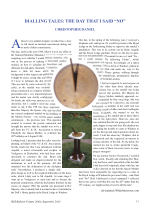
An anecdote about being commissioned in 1980 to delineate a horizontal sundial plate, constructed by silversmith Brian Asquith, as a surprise 80th birthday gift for Queen Elizabeth, the Queen Mother, followed by the author's humorous reflection on declining a suggested installation date.
Dials: Horizontal, The BSS and Members
September 2014
Page 18
Page 18
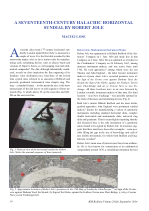
Analysis of a rare 17th-century horizontal brass sundial by London maker Robert Jole, notable for being his only recorded gnomonic instrument. It includes Jewish (Halachic/seasonal) hour-lines, astronomical hours, and declination arcs, designed for a London latitude, catering to the needs of the early Jewish community.
Dials: Horizontal, Dials: Unusual, Historical Dials, Mathematics of Dialling
September 2014
Page 23
Page 23
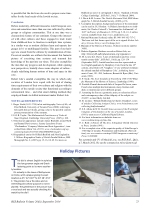
A short note describing a horizontal sundial in Rethymnon, Crete, with a low gnomon angle and Greek lettering, where a local gentleman was seen checking his watch against the dial.
Dials: Horizontal
September 2014
Page 39
Page 39
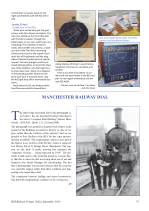
A brief note identifying a large horizontal dial shown in a 1936 photograph as the one previously described by Roger Bowling, located at Liverpool Road Railway Station, Manchester. The photograph shows the dial being inspected as it was taken out of use.
Dials: Horizontal, Historical Dials
December 2014
Page 2
Page 2
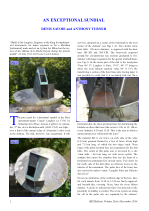
This article describes a unique horizontal sundial/meridian instrument constructed by Claude Langlois in 1741 for Alexandre de la Rochefoucauld at the château de la Roche-Guyon. The instrument features a large brass box gnomon with a slit and seven eyelets, allowing the spots of light to correspond to significant dates, such as the solstices and the entry of the sun into zodiac signs.
Dials: Horizontal, Dials: Noon Lines, Dials: Unusual, Historical Dials
December 2014
Page 8
Page 8
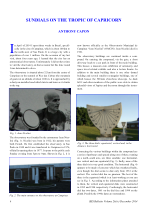
An account of sundials found in and around Campinas, Brazil, specifically mentioning the Observatorio Municipal de Campinas, founded by Jean Nicolini. The observatory site holds three dials (horizontal, vertical, and equatorial), though their condition varies. Other documented dials include one in Parque Taquaral (1962) and two at the Americana Observatory.
Dials: Horizontal, Dials: Vertical, Dials: Equatorial
December 2014
Page 24
Page 24
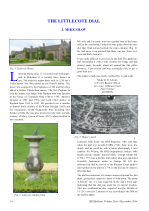
The discovery and dating of a horizontal sundial at Littlecote House, made by George Adams Snr, instrument maker to George III. Analysis of the maker’s mark and the 'Æquation of Natural Days' table (which uses pre-1752 Julian calendar dates) helped date the dial to the 14-year period between 1738 and 1752.
Dials: Horizontal, Equation of Time, Historical Dials
December 2014
Page 26
Page 26
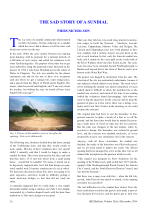
This is a story of a sundial commission which started out full of promise, but has ended up as a sundial which has never had a chance to tell the time, and which now never sees the sun.
Dials: Horizontal, Sundial Design & Layout, Construction Projects
March 2013
Page 8
Page 8
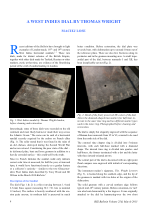
A detailed investigation of a rare eighteenth-century sundial made by Thomas Wright for use in the West Indies. The author compares design features with other known examples and clarifies maker attribution through stylistic and documentary evidence.
Dials: Horizontal, Historical Dials, Restoration projects
March 2013
Page 15
Page 15
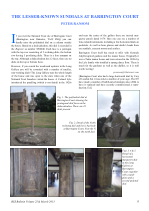
An illustrated survey of several overlooked sundials at Barrington Court. The article documents their styles, inscriptions, and historical setting, adding new information to the site’s known dial heritage.
Dials: Horizontal, Dials: Vertical, Historical Dials, Restoration projects
March 2013
Page 18
Page 18
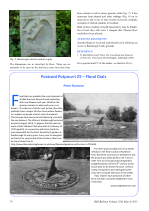
A light-hearted illustrated collection of sundials decorated with floral motifs. The article shares examples and stories from various gardens and public places where plants and flowers form part of the dial design.
Dials: Horizontal, Dials: Unusual, Mottoes
March 2013
Page 28
Page 28
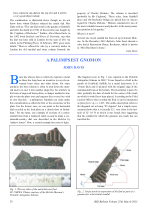
An account of a sundial whose gnomon and markings show evidence of multiple historical restorations. The author describes methods used to reveal earlier engravings and reconstruct its history.
Dials: Horizontal, Historical Dials, Restoration projects
March 2013
Page 30
Page 30
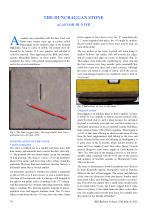
An examination of a carved stone from Scotland believed to be a very early horizontal sundial. The article describes its discovery, measurements, and restoration.
Dials: Horizontal, Historical Dials, Restoration projects
March 2013
Page 37
Page 37
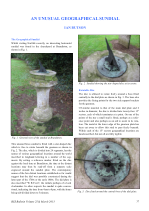
A technical description of a complex slate sundial featuring a rotatable star-shaped disc engraved with worldwide place names. The author explains its design, restoration, and probable use.
Dialling Tools, Dials: Horizontal, Dials: Unusual
March 2013
Page 39
Page 39
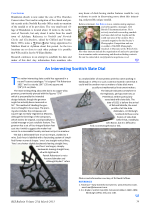
A short report describing a newly found Scottish slate sundial of unknown maker. The author analyses its construction and markings and appeals for comparative examples.
Dials: Horizontal, Historical Dials, Restoration projects
March 2013
Page 45
Page 45
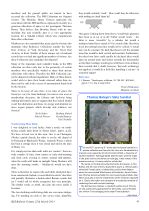
An illustrated study of a sixteenth-century slate sundial connected to the Boleyn family. Davis documents its restoration, symbolism, and stylistic features.
Dials: Horizontal, Historical Dials, Restoration projects
June 2013
Page 10
Page 10
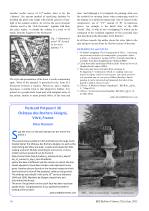
A short illustrated feature on a postcard depicting a multifaceted sundial at a French château, discussing its design features, historical background, and a humorous note about an inverted gnomon.
Dials: Horizontal, Dials: Multi Faced, Dials: Vertical
June 2013
Page 12
Page 12
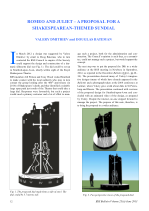
An artistic proposal for a monumental sundial inspired by *Romeo and Juliet*, designed for Stratford-upon-Avon. The article describes its symbolism, geometry, and design for public installation.
Dials: Horizontal, Dials: Vertical, Sundial Design & Layout, The BSS and Members
June 2013
Page 18
Page 18
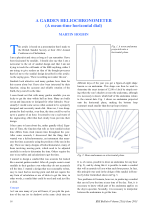
A personal account of designing and constructing a mean-time garden sundial capable of reading clock time directly. The author explains the concept, geometry, and testing of his heliochronometer.
DIY Sundial Projects, Dials: Heliochronometer, Dials: Horizontal, Mathematics of Dialling
June 2013
Page 36
Page 36
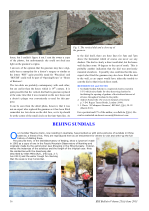
A short pictorial note on examples of ancient and modern sundials located in Beijing, illustrating the global reach of gnomonic design.
Dials: Horizontal, Dials: Vertical, Historical Dials
June 2013
Page 37
Page 37
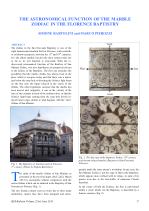
An analytical study of the marble zodiac design within the Florence Baptistry, explaining how it functions as an astronomical instrument marking the sun’s passage and key calendar dates.
Dials: Horizontal, Historical Dials, How Sundials Work, Mathematics of Dialling
June 2013
Page 44
Page 44
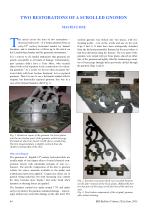
An illustrated technical report on restoring ornate scrolled gnomons from eighteenth-century dials, describing metalwork, conservation, and reinstallation.
Dials: Horizontal, Historical Dials, Restoration projects
June 2013
Page 48
Page 48
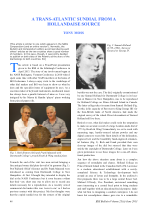
A historical investigation into a sundial design that travelled between Holland and America, tracing its manufacture, inscriptions, and stylistic influences.
Dials: Horizontal, Dials: Portable, Historical Dials
September 2013
Page 12
Page 12
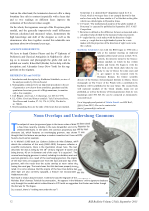
Examines the feature of noon overlaps in sundials, contrasting with the usual gnomon gap. A much earlier example than modern proprietary dials is described: an 18th-century bronze dial by engraver D Coster (dated 1715) with an unusual overhanging gnomon that results in overlapping hour scales at noon.
Dials: Horizontal, Historical Dials, How Sundials Work
September 2013
Page 13
Page 13
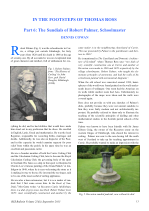
A biography of Robert Palmer (1828–1868), schoolmaster and astronomer, and a survey of his known sundials. Details are given of three scientifically constructed dials: one lost from Riccarton Castle, the detailed Currie dial (1836) with noon markings for global locations, and the Kirkbean dial (1826) containing equation of time details.
Dials: Horizontal, Dials: Unusual, Equation of Time, Historical Dials
September 2013
Page 36
Page 36
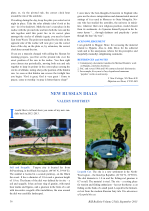
Showcase of several new sundials recently built in Russia (2012–2013). Examples include the maritime-themed ‘Sail and Seagulls’ in Tuapse, the ‘Leopold Cat’ dial designed for fishing enthusiasts in Kareliya, and the ‘Solar Flower’ in Toksovo, themed around cultivation.
Construction Projects, Dials: Horizontal, Dials: Unusual
September 2013
Page 48
Page 48
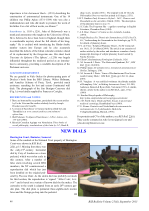
Report on the installation of a reproduction horizontal dial at Barrington Court, Somerset, commissioned by the National Trust. The new dial, created by Flowton Dials, replaces an early-19th-century horizontal dial by Cary of London that had been stolen. It is signed “After CARY, LONDON”.
Construction Projects, Dials: Horizontal, Restoration projects
December 2013
Page 7
Page 7
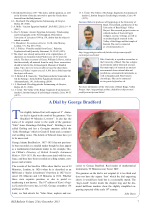
Analysis of a slightly battered 9" diameter horizontal dial signed by George Bradford of London (w. 1817–1851), who was a mathematical instrument maker. The article discusses his association with his son Isaac, his addresses, and notes that the gnomon is not original.
Dials: Horizontal, Historical Dials
December 2013
Page 14
Page 14
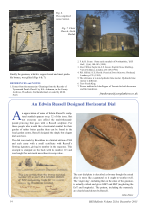
Describes a simple, elegant horizontal sundial designed by Edwin Russell, produced by Brookbrae in a limited edition of 500. The cast dial-plate is gunmetal, with etched 'engraving' for GMT and BST, neglecting the EoT and longitude.
Dials: Horizontal, Sundial Design & Layout
December 2013
Page 16
Page 16
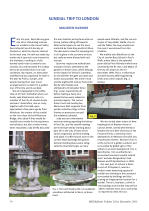
An account of a guided trip to London sundials, visiting the noon mark dial in Paternoster Square, a horizontal dial at Amen Court (attributed to Wren), the polar dial by Piers Nicholson, dials at Cheapside and St Katherine Cree, and the large horizontal dial over Tower Hill Underground Station.
Dials: Horizontal, Dials: Polar, Dials: Vertical, The BSS and Members
December 2013
Page 28
Page 28
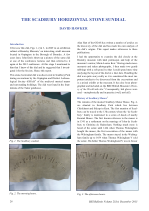
A report on a rare, unfinished, broken stone horizontal dial found in the foundations of the Tudor gatehouse at Scadbury Park, Kent. Dated circa 1550, its calculated hour lines suggest delineation for a significantly higher latitude (possibly 56°) than its find location (51.4° N).
Construction Projects, Dials: Horizontal, Historical Dials, Mathematics of Dialling
December 2013
Page 34
Page 34
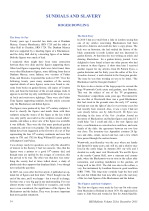
Explores the history and significance of lead Blackamoor and Indian figures supporting sundials in Georgian gardens, associating them with the wealth derived from the Atlantic slave trade. There is an inventory of known figures and their sculptors (John Nost I/II, Carpentiere, Cheere).
Dials: Horizontal, Historical Dials, The BSS and Members
December 2013
Page 44
Page 44
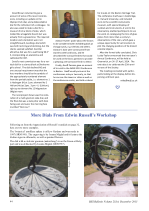
Presents two additional examples of Edwin Russell’s work: the ‘botanical’ armillary sphere at Kew Gardens (engraving by Joanna Migdal), and a horizontal dial featuring a cricketer gnomon on the Green at Holyport (delineated by Joanna Migdal).
Dials: Armillary Sphere, Dials: Horizontal, Sundial Design & Layout
March 2012
Page 2
Page 2
This article investigates three London instrument makers named Samuel Saunders from the first half of the 18th century, with no direct family or professional relationships. It focuses on attributing gnomonic instruments to the correct maker through comparative analysis of signatures and engraving styles, and discusses specific horizontal dials.
Dials: Horizontal, Historical Dials
June 2012
Page 12
Page 12
This article presents and translates a c.1440 manuscript from Aberdeen University Library, which contains what may be the earliest known description of how to make a horizontal sundial in English. It details a simple geometric construction method, discusses the design's unique features, and explores the type of gnomon described, providing insight into early scientific dials in England.
Dials: Horizontal, Historical Dials, Mathematics of Dialling, Sundial Design & Layout
June 2012
Page 34
Page 34
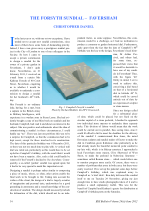
This article describes a custom-designed 'garden' sundial commissioned as a 40th birthday gift for Campbell Forsyth of Faversham. It is an inclining horizontal dial for latitude 40°N, tilted 11.5° southwards, with a unique gilded 'box' feature that indicates the exact date and time (8 December, 12 noon) on his birthday. The dial is a work of scientific art by Ben Jones, with a pedestal by Clive Sherwood.
Construction Projects, Dials: Horizontal, Dials: Unusual, Sundial Design & Layout
December 2012
Page 5
Page 5
The article describes a 1591 horizontal sundial from Haddon Hall, Derbyshire, now in the Hall museum. Likely made by a clockmaker to regulate an early clock, the 300mm diameter dial displays hours and half-hours with its delineation origin correctly centred, correcting a historical misrepresentation in a previous sketch.
Dials: Horizontal, Historical Dials
December 2012
Page 26
Page 26
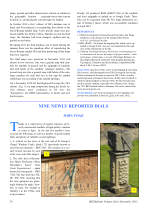
This article reports on nine previously unrecorded or undocumented sundials. Highlights include a 1723 vertical dial at Windsor Castle, a Scottish-style cube dial at Restoration House, a pre-1752 horizontal dial by John Davis of Windsor, and various vertical, geographical, and unusual fixed horizontal analemmatic dials across England.
Dials: Cube, Dials: Horizontal, Dials: Vertical, Historical Dials
December 2012
Page 40
Page 40
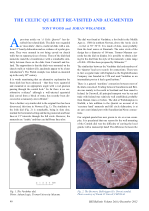
This article revisits the Celtic Quartet of medieval mass dials, noting their unusual carving on separate stones. It introduces a newly discovered, similar slate dial from Vardøhus, Norway, dated 1480–1550, expanding the Quartet to six or seven examples and highlighting historical maritime trade connections between the regions where these dials are found.
Dials: Horizontal, Dials: Portable, Historical Dials, Dials: Mass Dials
December 2012
Page 46
Page 46
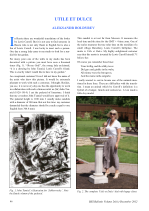
The author recounts creating a limestone sundial for a customer near Moscow, inspired by John Tenniel's illustration for Lewis Carroll's Jabberwocky. The dial, one English foot in diameter, measures local time and GMT + 4, and includes a scale for true solar time on the meridian of Lewis Carroll’s birthplace.
Construction Projects, Dials: Horizontal, Mottoes
March 2011
Page 16
Page 16
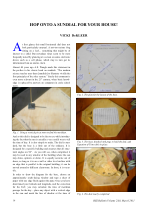
This article provides instructions for making a simple, fun, and versatile horizontal sundial for educational purposes, particularly for young people. It explains how to determine the meridian line, layout the base, and incorporate an Equation of Time table for accurate civil time.
DIY Sundial Projects, Dials: Horizontal, Equation of Time, Sundial Design & Layout
March 2011
Page 32
Page 32
This article details the construction and placement of four horizontal sundials in Greek schoolyards between 1995 and 2008. It highlights student involvement, the evolution of precision in Equation of Time corrections, and the use of modern technology in their design and carving.
Dials: Horizontal, Construction Projects, Equation of Time, DIY Sundial Projects
March 2011
Page 39
Page 39
This article describes a collection of miniature crested 'Goss' china sundial ornaments produced from the 1880s. These decorative horizontal dials, typically featuring local heraldic arms, were collected as souvenirs and are now considered rare treasures, despite often having incorrect hour-line delineations.
Dials: Horizontal, Dials: Portable, Dials: Unusual, Historical Dials
June 2011
Page 8
Page 8
This article describes a unique 17th-century horizontal quadrant by Henry Sutton, detailing its stereographic projection, various scales for altitude, azimuth, time, and astronomical functions. It explains how the instrument, acting as a mechanical analogue computer, finds time from the sun's altitude.
Dialling Tools, Dials: Horizontal, Historical Dials, Mathematics of Dialling
June 2011
Page 51
Page 51
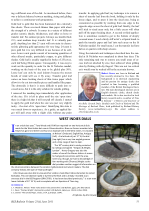
This piece reports on two horizontal sundials found in the West Indies. One at Nelson's Dockyard, Antigua, dated 18th-century and signed Gregory & Wright London, provides new information on makers' interconnections. Another by Henry Pyefinch in Barbados is also mentioned.
Dials: Horizontal, Historical Dials
September 2011
Page 15
Page 15
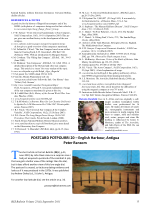
This short article shares a postcard of a low-angle sundial at English Harbour, Antigua, previously discussed by John Davis. The author notes that the postcard, likely from the 1970s, offers another view of this dial, and references a related article about another low-latitude dial.
Dials: Horizontal, Historical Dials
September 2011
Page 22
Page 22
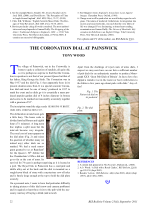
This article describes a souvenir Coronation dial in Painswick, commemorating King George VI's coronation in May 1937. The bronze garden dial, 8 inches in diameter, features a gnomon of 52° and the royal coat of arms. Its location at The Royal Oak pub and its 74-year survival are noted, along with the author's personal challenges in photographing it.
Dials: Horizontal, Historical Dials
September 2011
Page 27
Page 27
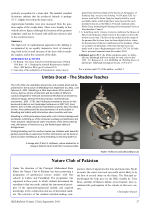
This report highlights a successful gnomonical science studies programme by the Nature Club of Pakistan in Lahore and Faisalabad schools with support from the BSS.
Dials: Horizontal, Dials: Equatorial, How Sundials Work, DIY Sundial Projects, The BSS and Members
September 2011
Page 36
Page 36
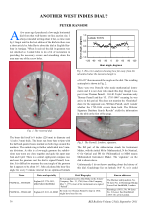
Peter Ransom discusses a 9-inch brass horizontal dial, signed 'Parnell, London,' which he acquired online. The dial, optimized for a latitude of approximately 16.05° N (suggesting a potential link to Guadeloupe), features hours from 6 am to 6 pm, half and quarter-hour marks, and a central compass rose. The gnomon was detached upon acquisition and later restored.
Dials: Horizontal, Restoration projects, Historical Dials
December 2011
Page 38
Page 38
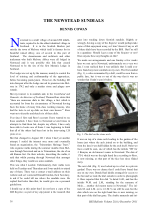
This article describes the author's quest to find and document sundials in Newstead, Scotland, following Thomas Ross's 19th-century account. It details several discoveries, including a cube dial, a semi-cylindrical dial, and other single-faced dials, some in private gardens, highlighting their historical significance and the challenges of locating them. The search continues for missing dials or fragments.
Dials: Horizontal, Dials: Multi Faced, Dials: Vertical, Historical Dials
March 2010
Page 41
Page 41
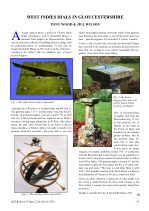
Describes two 18th-century horizontal sundials, now in Gloucestershire, originally made for West Indies plantations. One by John Fowler was designed for St Kitts (17.5° latitude) and the other by his apprentice Henry Gregory for a latitude of around 13°.
Dials: Horizontal, Historical Dials
March 2010
Page 44
Page 44
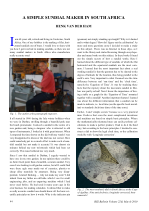
A personal account of making accurate horizontal brass sundials. The process began with a practical, non-mathematical method of marking hour lines and evolved into a small business creating personalised dials, including the most southerly dial in South Africa at Cape Agulhas.
Dials: Horizontal, Sundial Design & Layout, DIY Sundial Projects
March 2010
Page 47
Page 47
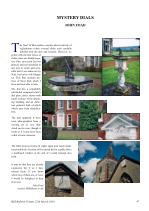
A request for help in identifying three sundials from an unidentified roll of film found in the Noel Ta'Bois archive. The images include a substantial octagonal dial, another photographed from a moving car, and a canted dial in a gable.
Dials: Horizontal, Dials: Vertical
June 2010
Page 10
Page 10
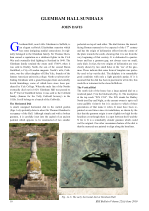
This article explores several sundials associated with Glemham Hall. It details a small, unsigned 17th-century horizontal dial, a large painted vertical dial from 1769, and discusses the 'Elihu Yale's sundial' mounted on a John Nost lead figure, whose current whereabouts are unknown but was possibly seen at Yale University. A modern 'Three Graces' horizontal dial is also mentioned.
Dials: Horizontal, Dials: Vertical, Historical Dials
June 2010
Page 16
Page 16
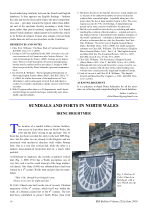
This article explores three instances of sundials located within former fortifications in North Wales. It describes a recently repainted vertical dial on St Cybi’s Church in Holyhead, a modern cast dialplate at St Mary’s churchyard in Caerhun, and a vertical declining dial from 1898 at Fort Belan.
Dials: Horizontal, Dials: Vertical, Historical Dials
June 2010
Page 41
Page 41
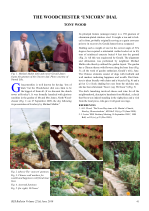
This article describes the formal launch of the 'Unicorn dial' at North Woodchester, Gloucestershire. It features a massive 17ft helical gnomon made of chromium-plated stainless steel, weighing a ton, and held at a 51¾-degree angle. The gnomon was aligned by Michael Maltin, outlining the garden layout which incorporates Chinese themes and floral hour lines.
Construction Projects, Dials: Horizontal, Dials: Unusual, Sundial Design & Layout
September 2010
Page 8
Page 8
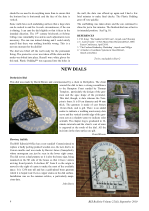
This section describes two new sundials: a 50 cm diameter slate horizontal dial by David Brown for a client in Derbyshire, resembling the Hampton Court sundial and featuring a nodus and coat of arms; and a Carrera marble house sign sundial by Harriet James for the BSS Editorial Office.
Construction Projects, Dials: Horizontal, Sundial Design & Layout
September 2010
Page 18
Page 18
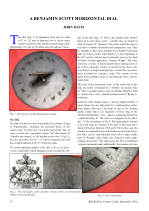
This article describes a small horizontal dial by Benjamin Scott, believed to have been made for Lochnaw Castle, Scotland. It features transversals for minute resolution, an Equation of Time ring, and specific gnomon supporters, linking Scott to John Rowley and discussing its provenance.
Dials: Horizontal, Equation of Time, Historical Dials
September 2010
Page 26
Page 26
This note describes a horizontal sundial in the Netherlands with a pole-style gnomon shaped as a farm labourer holding a hoe, designed and constructed in Cor-Ten steel as a community project.
Construction Projects, Dials: Horizontal, Dials: Unusual, Sundial Design & Layout
September 2010
Page 40
Page 40
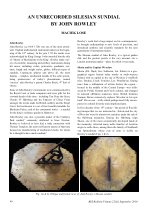
This article describes an unrecorded octagonal brass horizontal sundial by John Rowley (early 18th century), commissioned for the Neidhardt von Spattenbrunn family in Silesia. It details the dial's features, engraving styles, geographical rings, and discusses the possibility of it being a royal gift, while also comparing its gnomon to one by Thomas Tompion.
Dials: Horizontal, Historical Dials, Sundial Design & Layout
September 2010
Page 46
Page 46
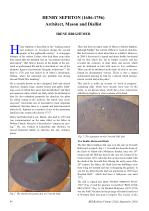
This article examines Henry Sephton, an 18th-century Liverpool architect and mason, as a significant provincial diallist. It describes several dials attributed to him, including signed double horizontal dials at Croxteth Hall and Knowsley Hall, a horizontal dial at Ince Blundell Hall, vertical dials on churches, and two globe dials, highlighting his characteristic transversals and artistic style.
Dials: Horizontal, Construction Projects, Historical Dials, Dials: Double Horizontal
December 2010
Page 12
Page 12
This report details four sundials in Adelaide. It includes the Olde Adelaide Sundial at Carrick Hill House with a unique equation of time reflecting South Australia's time zone, two dials at Seymour College, and an unusual polar meantime dial by Government Astronomer Charles Dodwell in the Pioneer Women’s Memorial Garden.
Dials: Horizontal, Dials: Polar, Dials: Vertical, Historical Dials
December 2010
Page 38
Page 38
This article analyses Dante Gabriel Rossetti's painting Beata Beatrix focusing on the symbolic significance of the sundial depicted with its shadow on the hour nine. It delves into Rossetti's personal connection to the number nine, drawing parallels between Dante's love for Beatrice and Rossetti's relationship with Lizzie Siddal, and offers an interpretation of the sundial's deeper meaning within the artwork.
Dials: Horizontal
March 2009
Page 8
Page 8
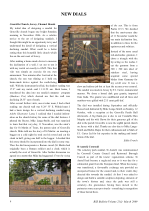
This section features descriptions of three new sundial projects. Eddie French details the creation of a vertical declining dial in Grouville Church, Jersey, Channel Islands. Bradley Dillon describes the construction of a large horizontal cemetery park sundial in St Austell. There is also an account of Valery Dmitriev's "Angel playing a harp" sundial in St Petersburg.
Dials: Horizontal, Dials: Vertical, Construction Projects
March 2009
Page 22
Page 22
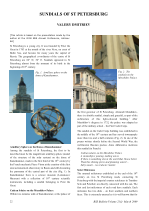
This article explores the history of sundials in St Petersburg, Russia, from the early 18th century. It describes various notable examples, including the armillary sphere on the Kunstkammer, the double sundial on the Menshikov Palace, solar milestones, and dials in Peterhof, Gatchina, Pavlovsk Park, and Demidov’s manors, as well as modern additions.
Dials: Horizontal, Dials: Vertical, Historical Dials, Dials: Armillary Sphere
March 2009
Page 27
Page 27
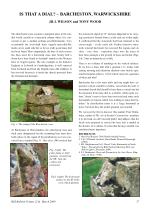
This article describes the discovery of a unique sundial carved into the base of a former churchyard cross at Barcheston, Warwickshire. The stonework was trimmed to a 52° slope on the south side, with recessed flat regions revealing traces of hour lines. It is classified as a large horizontal in stone with a notably wide gnomon.
Dials: Horizontal, Dials: Unusual, Historical Dials
March 2009
Page 32
Page 32
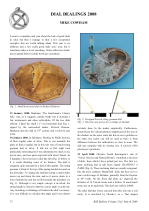
This article reviews notable sundials and scientific instruments seen in sales throughout 2008. Highlights include an 18th-century horizontal dial by Richard Hintonn, a French silver string gnomon dial, a gilt inclining dial by Chapotot, a rare 16th-century Nuremberg star-shaped polyhedral dial, an ivory diptych dial by Lienhart Miller, a Butterfield universal equinoctial ring dial, and a Gunter quadrant by Nathanaell Heighemore.
Dials: Horizontal, Dials: Multi Faced, Dials: Portable, Historical Dials
June 2009
Page 5
Page 5
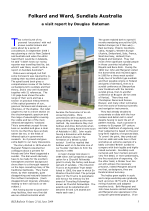
A report on a visit to Sundials Australia, run by Margaret Folkard and John Ward. It covers their design philosophy favouring cast relief dials for longevity, and manufacturing process using photopolymers. The article highlights their diverse work, including horizontal dials, armillary spheres, and international commissions.
Dials: Horizontal, Dials: Vertical, Dials: Armillary Sphere
June 2009
Page 9
Page 9
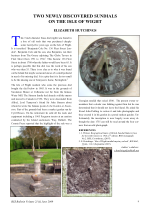
Describes two horizontal dials found on the Isle of Wight. One is a 7-inch brass dial by Benjamin Cole (c. 1751-1766). The other is a Georgian sundial dated 1735, originally from Swainston Manor, which was purchased at auction in 1985.
Dials: Horizontal, Historical Dials
June 2009
Page 10
Page 10
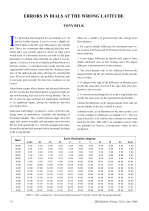
An analysis of the time-telling errors that occur when a horizontal or vertical non-declining sundial is used at a latitude different from its design latitude. The article provides tables and graphs illustrating the magnitude of these errors at different times of day and for different solar declinations.
Dials: Horizontal, Dials: Vertical, How Sundials Work, Mathematics of Dialling
June 2009
Page 18
Page 18
An overview of designing and using sundials in tropical regions. It discusses the suitability and challenges of various dial types, including horizontal, armillary, polar, and vertical, noting issues like noon-line crowding on horizontal dials and the advantages of other formats.
Dials: Horizontal, Dials: Vertical, Dials: Polar, Dials: Astrolabe, Dials: Armillary Sphere
June 2009
Page 34
Page 34
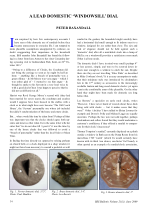
An analysis of a fragmented lead horizontal 'windowsill' sundial found in Dorset. The author reconstructs its likely original octagonal design, discussing its features, numeral conventions, and a possible skewed layout to compensate for magnetic variation, suggesting a date of around 1710.
Dials: Horizontal, Historical Dials, Restoration projects
June 2009
Page 40
Page 40
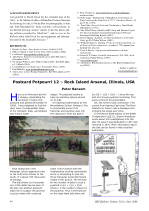
Features a 1909 postcard depicting a horizontal sundial at Rock Island Arsenal, Illinois, which was dedicated in 1877. The author comments on the dial's pedestal, the surrounding cannonball piles, and a personal connection to the location through a Johnny Cash song.
Dials: Horizontal, Historical Dials
September 2009
Page 8
Page 8
A report on a British Sundial Society visit to Bramshill House, a Jacobean mansion in Hampshire. The article describes the tour of the house, which was the former National Police Staff College, and the various timepieces examined, including a noon mark, a horizontal dial, a stone polyhedron, and a vertical dial.
Dials: Horizontal, Dials: Noon Lines, Dials: Vertical, The BSS and Members
September 2009
Page 46
Page 46
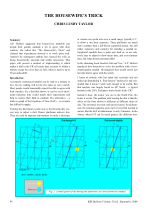
Re-evaluates A.P. Herbert's suggestion of turning a horizontal sundial to make it agree with mean time. While previously dismissed as inaccurate, this article presents a theoretical analysis and a practical implementation showing that, for UK latitudes, the 'trick' can keep the dial accurate to within a minute for most of the year.
Dials: Horizontal, Equation of Time, How Sundials Work, Mathematics of Dialling
December 2009
Page 14
Page 14
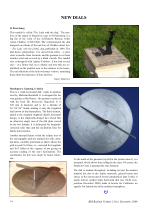
This section presents two new dials. The first is a stone vertical dial near St Petersburg with a theme from a Chekhov story. The second is a 'triple horizontal dial' made of stainless steel for a garden in South Africa, which includes a nocturnal and family anniversary lines.
Dials: Horizontal, Dials: Unusual, Dials: Nocturnals
December 2009
Page 20
Page 20
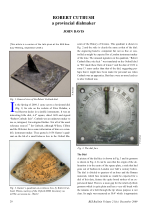
An investigation tracing the history of a 1699 horizontal dial signed by Robert Cutbush. The author identifies the maker as part of a family of Kent clockmakers and discovers that the dial was stolen from Ightham churchyard before 1978. The article concludes with the dial's successful return.
Dials: Horizontal, Historical Dials, Restoration projects
March 2008
Page 18
Page 18
Describes the design, creation, and dedication of a large horizontal sundial by Tony Moss, commemorating the 400th anniversary of the Jamestown settlement. The unique 'navette' shaped dial incorporates Anglo-American symbolism, funded by the Sawyer Dialling Prize and sponsors, and was installed at Turner Farm Park.
Dials: Horizontal, Sundial Design & Layout, Construction Projects, The BSS and Members
March 2008
Page 22
Page 22
A personal report on the 13th NASS Conference in McLean, Virginia, covering presentations on various sundial topics, a bus tour to significant dials like the Lyman Briggs Memorial Dial and the Gaithersburg Latitude Observatory, and the dedication of the Jamestown Commemorative Sundial. It also details the Sawyer Dialling Prize presentation and practical workshops.
Dials: Horizontal, Dials: Polar, The BSS and Members
March 2008
Page 28
Page 28
This section features descriptions of recently unveiled sundials. It includes a large nodal dial in Blackrock, Co. Louth, Ireland, and a vertical sundial in Stouffville, Ontario, Canada, the latter using High Density Urethane material. It also mentions a large horizontal dial in a community garden in Barrow-upon-Soar, Lincolnshire.
Dials: Horizontal, Dials: Vertical
March 2008
Page 42
Page 42
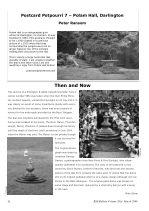
Features a c.1920 postcard depicting a large horizontal sundial at Polam Hall, an independent girls' school in Darlington. The author notes the presence of scholars in the image and expresses uncertainty about whether the dial is still in place.
Dials: Horizontal, Historical Dials
March 2008
Page 47
Page 47
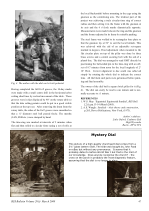
Presents a photograph from an old glass lantern slide of a high-quality churchyard dial, believed to date before World War I. The author seeks help in identifying the church, noting a cross on the porch as a potential diagnostic feature.
Dials: Horizontal, Historical Dials
June 2008
Page 60
Page 60
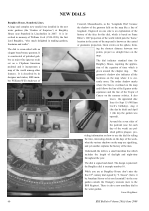
This section introduces new sundials, including the 'Longitude Dial' at Burghley House, designed by William Andrewes, which incorporates a world map and indicates standard time and noon locations. It also describes a brass sundial made by Valery Dmitriev in Russia, designed in a traditional English style using CNC milling.
Dials: Horizontal, Sundial Design & Layout
June 2008
Page 64
Page 64
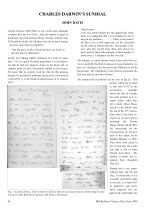
This article details Charles Darwin's horizontal sundial at Down House, used for regulating his clocks. It describes the dial's unpretentious design, its historical context, and recent restoration efforts after two accidents, including the discovery that the gnomon was a replacement.
Dials: Horizontal, Historical Dials, Restoration projects
September 2008
Page 102
Page 102
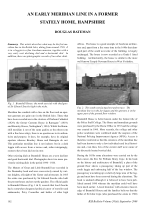
This article describes a meridian line at Bramshill House, Hampshire, believed to be the earliest in the British Isles, dating to around 1720. It also describes a west declining dial and a now-missing horizontal dial.
Dials: Horizontal, Dials: Vertical, Historical Dials, Dials: Noon Lines
September 2008
Page 107
Page 107
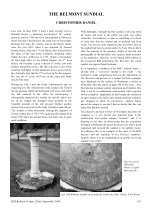
This article recounts the theft and subsequent recovery of a brass horizontal sundial by George Adams Jnr from Belmont House. A BSS member, Andrew James, identified the stolen dial on a dealer's website, leading to its return. The piece highlights the crucial value of the BSS Register and members' expertise in recovering stolen historical dials.
Dials: Horizontal, Historical Dials, The BSS and Members
September 2008
Page 136
Page 136
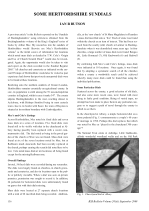
This article details a survey of sundials in Hertfordshire, reporting 56 fixed dials, 24 missing pedestals, and 68 mass dials across 27 church locations. The author highlights various interesting examples, including commemorative dials, vertical dials on cottages, historic horizontal dials, and unusual designs like a pestle and mortar scaphe dial.
Dials: Horizontal, Dials: Mass Dials, Dials: Vertical, Historical Dials
September 2008
Page 144
Page 144
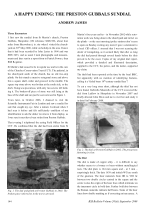
Andrew James recounts the recovery of a stolen 1638 copper alloy sundial from St Martin’s church, Preston Gubbals. He identified the dial for sale, leading to its return. The article details the dial's early 'centred' design and the unique significance of its gnomon supporter being cut from a 15th-16th century memorial brass.
Dials: Horizontal, Restoration projects, Historical Dials
December 2008
Page 157
Page 157
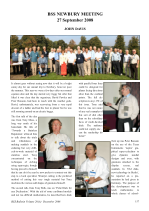
A report on the BSS Newbury meeting on 27 September 2008, detailing talks on stainless steel sundials, polar dials, dynamic sundial design using calculators, and 3-D modelling for overshadowing. It also covers a survey of early horizontal dials in Flintshire, exhibits, and presentations on paper sundials and dials in Mexico and the southern hemisphere.
Dials: Horizontal, Dials: Polar, Sundial Design & Layout, The BSS and Members
December 2008
Page 176
Page 176
This article complements a previous one on the Liverpool Road Station sundial, Manchester. It discusses the dial's positioning at first-floor level, its installation in 1833, and its crucial role in regulating train timings by local apparent time before the introduction of uniform Railway Time in the 1840s, highlighting the sundial's importance in early railway operations.
Dials: Horizontal, Historical Dials
March 2007
Page 11
Page 11
This contribution presents an excerpt from G.K. Chesterton's Father Brown story, 'The strange crime of John Boulnois'. The excerpt provides a vivid description of a garden sundial set on a mound, where a man's figure is seen clinging to it for a moment before falling.
Dials: Horizontal, Book Reviews
March 2007
Page 24
Page 24
This paper introduces a simple accessory, a three-quarters CD, that can be used with existing horizontal sundials to signify Italian and Babylonian hours. It explains how these hour systems differ from conventional timekeeping and how the accessory allows us to read these hours, using the shadow of the CD.
Dials: Horizontal, How Sundials Work, Dialling Tools, DIY Sundial Projects
September 2007
Page 116
Page 116
This article details a rare 1890 brass sundial from the Sumburgh Hotel, Shetland. Commissioned by Laird John Bruce and made by C. Baker, it features a peripheral calendar combining longitude and equation of time corrections, plus unusual additional instructions. It is noted as the most northerly dial in the BSS Register.
Dials: Horizontal, Equation of Time, Historical Dials
December 2007
Page 146
Page 146
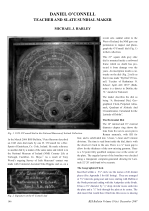
This article details an 1853 slate sundial by Daniel O’Connell, a teacher from Rathmines National School, Dublin, later of Shrule, Co. Mayo. The elaborate dial, now in the National Museum of Ireland, functions as a horizontal dial, geographical clock, perpetual almanac, quadrant of altitude, and circumferentor. It is considered a teaching aid and highlights O'Connell's master engraving skills.
Dials: Horizontal, How Sundials Work, Historical Dials
December 2007
Page 161
Page 161
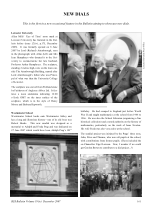
This section showcases several newly completed sundials. It features a memorial dial at Westminster School for Adolph and Freda Prag, an elliptical dial carved in Portland stone, a unique double horizontal dial for the southern hemisphere on Okatjorute Farm in Namibia, a late Saxon memorial sundial for a dog in Macclesfield, and a large analemmatic dial in Pollagh, Co. Galway, Ireland, at Brigit's Garden.
Dials: Horizontal, Dials: Analemmatic, Dials: Double Horizontal
December 2007
Page 172
Page 172
This article discusses the historical connection between clocks, watches, and sundials, referencing an example on the cover. It examines images from J.W. Benson Ltd catalogues featuring sundials, including a horizontal sundial with a truncated gnomon creating a nodus. The author speculates whether these depicted dials are real or artistic creations.
Dials: Horizontal, Historical Dials, How Sundials Work
December 2007
Page 187
Page 187
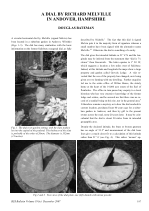
This article describes a rare circular horizontal sundial by Richard Melville (signed Melvin) found in Andover, Hampshire. The dial, dated to around 1860, is unusual for Melville's work due to its circular shape and its mention of a son. It discusses the discrepancy between the declared latitude and the gnomon angle, suggesting mass production, and notes an engraving error and weathering on the dial plate.
Dials: Horizontal, Historical Dials, Sundial Design & Layout
February 2006
Page 20
Page 20
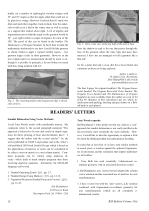
This section contains various reader contributions. Hal Brandmaier and Tony Wood discuss vector methods for sundial delineation. Patrick Powers and Douglas Bateman exchange views on a longitude error on the Kew Garden Cross Dial inscription. Norman Darwood briefly comments on the potential effects of changes in Earth's rotation on sundials.
Dials: Horizontal, Mathematics of Dialling, Equation of Time
February 2006
Page 23
Page 23
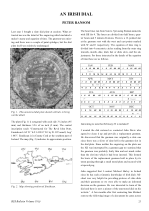
This article documents the restoration and analysis of an octagonal slate sundial plate from 1843, made by D. O’Connell for Revd John Pratt of Enniskean. It details the dial's engraved features, including an equation of time ring, gnomon restoration, and a geometric analysis confirming the remarkable accuracy of its construction for the specified latitude.
Dials: Horizontal, Sundial Design & Layout, Restoration projects, Historical Dials
February 2006
Page 48
Page 48
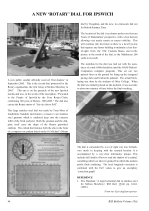
This article announces the installation of a new large stainless steel public sundial on Ipswich marina, sponsored by Rotary clubs to commemorate their centenary. Designed by Tony Moss, the horizontal dial features a massive gnomon, Rotary emblems, a British Summer Time scale, and an informative plaque with a combined longitude/Equation of Time correction graph.
Dials: Horizontal, Construction Projects, Equation of Time
June 2006
Page 75
Page 75
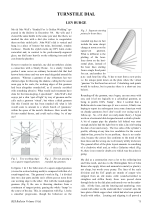
This article describes the design and construction of a horizontal sundial with a cylindrical gnomon, which the author calls a "Turnstile Dial." It explains how the shadow is cast from a continuum of tangent points on the rounded gnomon, the practical aspects of its construction using copper, and the plotting of hour lines tangential to a central ellipse.
Construction Projects, DIY Sundial Projects, Dials: Horizontal, Sundial Design & Layout
September 2006
Page 99
Page 99
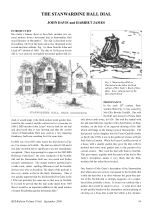
This article details the rediscovery of a rare 1560 English horizontal garden sundial, previously mentioned in Mrs Gatty's book and thought lost. It describes the dial's physical characteristics, unique mottoes, heraldic engravings, and the historical context of its ownership by the Corbet family, discussing its provenance, repairs, and original location.
Dials: Horizontal, Historical Dials, Mottoes
September 2006
Page 112
Page 112
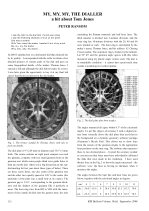
This article delves into a high-quality horizontal sundial by the renowned optical, mathematical, and philosophical instrument maker Thomas Jones (1775-1852). It details the dial's precise engraving, hour divisions, and accurate delineation, alongside biographical information about Jones's career, other notable instruments, and his significant contributions to science.
Dials: Horizontal, Sundial Design & Layout, Historical Dials
September 2006
Page 114
Page 114
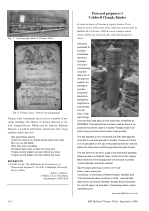
This entry features a postcard depicting a horizontal sundial at Coldwell Clough, Kinder, in Derbyshire, a dial currently unrecorded in the BSS register. The author provides a description of its apparent design and speculates on its date based on postal information, also researching the historical family connections of the postcard's publisher.
Dials: Horizontal, Historical Dials
December 2006
Page 156
Page 156
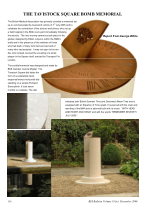
The British Medical Association has privately unveiled a memorial set up to commemorate the bus-bomb victims of 7th July 2005 and to celebrate the contribution of the doctors and others, who set up a field hospital in the BMA court-yard. The Tavistock Square dial takes the form of a substantial handengraved bronze horizontal dial standing on a simple Portland Stone plinth.
Dials: Horizontal
June 2005
Page 60
Page 60
Accounts the design and installation of twin sundials—horizontal and vertical—on a basalt boulder at the Scots Hotel in Tiberias. Includes design features, analemmas, inscriptions, and collaborative process between designer and hotel staff.
Construction Projects, Dials: Horizontal, Dials: Vertical, Sundial Design & Layout
June 2005
Page 75
Page 75
Observations about a photo in the Register that happens to capture a fly on a horizontal dial, echoing the flies often depicted on stained glass window dials.
Dials: Horizontal
December 2005
Page 160
Page 160
This article details the discovery and reconstruction of a unique 1683 combined horizontal equinoctial sundial at Lyme Hall. The author describes deciphering the inscription "R Legh 1683," examining its robust bronze construction and innovative two-hole sight/screen system. The article also explores the dial's historical context, its owner Richard Legh, and a possible link to George Gibbs's Helio-Chronometer.
Dials: Equatorial, Dials: Horizontal, Dials: Unusual, Historical Dials, Restoration projects, Sundial Design & Layout
December 2005
Page 170
Page 170
This article details the design and construction of a sundial for the Elias Fries School in Hyltebruk, Sweden. The sundial, made from a large stone cut in half, features a polar-axis aligned shadow pin and a dial plate raised 20 degrees from the ground. It is designed to be an artistic and educational tool demonstrating the sun's daily and seasonal movements without indicating precise clock time.
Construction Projects, Dials: Horizontal, Sundial Design & Layout
March 2004
Page 7
Page 7
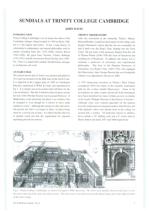
Provides a comprehensive overview of sundials and related astronomical instruments at Trinity College, Cambridge, highlighting the college's rich history in mathematics and natural philosophy. It describes early dials, the Trinity Observatory's instruments including those by Henry Sutton and John England, and more recent installations like the First World War Memorial dial.
Dials: Horizontal, Historical Dials
June 2004
Page 49
Page 49
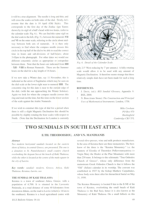
Survey of two modern horizontal sundials in Greece: one at St. Pantelehemon's church in Kaki Thalassa and another in Lavrio's central square, with historical, geographical, and design details.
Dials: Horizontal
June 2004
Page 57
Page 57
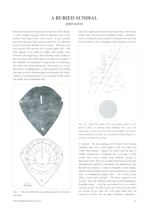
Description and analysis of a small 1652 copper horizontal sundial found buried in a Suffolk house, possibly commemorating a solar eclipse, with historical and design observations.
Dials: Horizontal, Historical Dials
June 2004
Page 79
Page 79
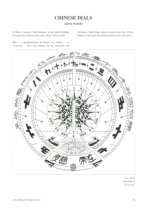
June 2004
Page 88
Page 88
Short piece with three photos of the Blenheim Palace sundial, referencing its role in the Oxford AGM events.
Dials: Horizontal
September 2004
Page 103
Page 103
Description of a multi-plane stone dial ensemble that shows Babylonian and Italian hours by day and acts as a moon dial at night; discusses decorative Earth/moon motifs, orientation relative to local and Basel reference planes and how the lunar readout is used.
Dials: Horizontal, Dials: Unusual, How Sundials Work
December 2004
Page 135
Page 135
Study of Thomas Wright's horizontal dial work (c.1718–1747). Analyses design features such as transversals, equation-of-time rings, geographical place-name rings, gnomon forms, engraving patterns and lettering. Includes a table of known surviving dials, drawings, a modern replica and assessment of Wright's sources.
Dials: Horizontal, Historical Dials
December 2004
Page 163
Page 163
Survey of five McClintock sundials at Dunmore estate, including the 1843 Melville slate dial and its 2003 restoration, the 1936 vertical dial, the 1939 heliochronometer, construction details, inscriptions, and the estate's dial-making history.
Dials: Heliochronometer, Dials: Horizontal, Dials: Multi Faced, Historical Dials, Restoration projects
December 2004
Page 172
Page 172
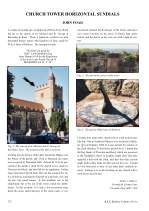
Survey and technical notes on horizontal sundials placed on church towers for regulating the church clock
Dials: Horizontal, Historical Dials
March 2003
Page 6
Page 6
A historical study of mathematical instrument makers affiliated with the Grocers' Company, focusing on 18th-century horizontal and geographical dials and their design traditions.
Dials: Horizontal, Historical Dials, Sundial Design & Layout
March 2003
Page 24
Page 24
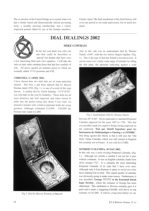
Annual round-up of notable sundials discovered or reported in 2002, highlighting interesting examples and unusual features.
Dials: Horizontal, Dials: Unusual
March 2003
Page 29
Page 29
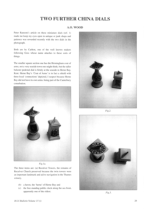
Description of two additional China sundials, extending previous findings with observations on layout and form.
Dials: Horizontal, Dials: Vertical, Historical Dials
June 2003
Page 85
Page 85
An article based on a historical text about a specific type of portable ring sundial. It provides a detailed account and instructions on how to use it, emphasizing its historical significance and practicality.
Dials: Horizontal, Historical Dials
September 2003
Page 124
Page 124
An article describing a large horizontal sundial made of stainless steel for Melton Mowbray Rotary Club. It highlights the dial's features, including an explanatory plaque with instructions on how to read the dial and correct for 'watch time' using the equation of time.
Construction Projects, Dials: Horizontal
September 2003
Page 128
Page 128
This entry describes a large horizontal sundial in San Francisco, California. Built in 1913 as a 'come-on' for a new housing development.
Dials: Horizontal, Historical Dials
December 2003
Page 148
Page 148
Analysis of a 1721 dial with unusual semicircular scales used to estimate sunrise and sunset times; includes mathematical reconstruction of how the dial may have been intended to work.
Dials: Horizontal, Historical Dials, How Sundials Work
December 2003
Page 169
Page 169
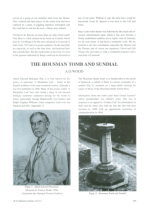
A short study of the tomb sundial of poet A. E. Housman, reflecting on its layout, symbolism, and poetic associations.
Dials: Horizontal, Historical Dials, Mottoes
March 2002
Page 7
Page 7
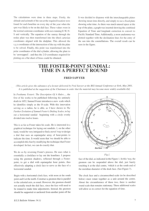
Explains the design of a novel sundial based on Samuel Foster's 17th-century concepts, with modern adaptations and detailed geometry, incorporating latitude, longitude, equation of time and daylight savings time adjustments.
Dials: Horizontal, How Sundials Work, Mathematics of Dialling
June 2002
Page 58
Page 58
Documents rare horizontal scratch dials found in Scottish churchyards and compares them to a similar English example, discussing their form and function.
Dials: Horizontal, Historical Dials, Dials: Mass Dials
June 2002
Page 67
Page 67
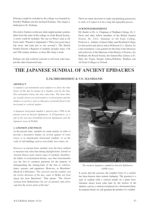
Study of a Greek sundial gifted to Epidaurus by the Japanese town of Nishiki, exploring ancient cross-cultural astronomical instrumentation.
Dials: Horizontal, Dials: Unusual
June 2002
Page 85
Page 85
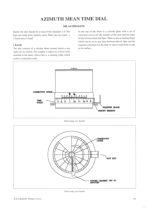
Technical description of a dial type that uses azimuth angle to determine mean time, with design suggestions.
Dials: Heliochronometer, Dials: Horizontal, Sundial Design & Layout
September 2002
Page 91
Page 91
The author explores four distinctive sundials across New Zealand, discussing their design, settings, and local cultural influences, with special focus on Ray Sanson’s dials.
Dials: Horizontal, Dials: Unusual, Dials: Vertical, Historical Dials
September 2002
Page 109
Page 109
Continuation of a study cataloguing archaeological sundials discovered in various parts of Israel outside Jerusalem, detailing design, materials, and historical significance.
Dials: Horizontal, Dials: Unusual, Historical Dials
September 2002
Page 126
Page 126
Technical and historical study of a well-preserved ancient Greek horizontal sundial located in Athens, analysing its construction and use.
Dials: Horizontal, Historical Dials
September 2002
Page 129
Page 129
A personal account of locating and documenting sundials in Shropshire, discussing stylistic features, history, and condition.
Dials: Horizontal, Dials: Vertical, Historical Dials
September 2002
Page 131
Page 131
Proposal for a design enhancement to the azimuth dial, aiming to improve readability and construction precision.
Dials: Horizontal, Dials: Unusual
December 2002
Page 150
Page 150
Scholarly study of a rare palimpsest dial-plate from Dinton, including historical context, inscriptions, and its re-attribution from 1395 to late 16th century.
Dials: Horizontal, Historical Dials
December 2002
Page 167
Page 167
Announcement and brief description of a sundial installed in a school setting, promoting educational and public engagement.
Dials: Horizontal, Restoration projects
March 2001
Page 32
Page 32
Instructions for making a simple horizontal garden sundial using copying and laminating techniques. It offers a basic design computed for latitude 52.5°N, longitude zero, and explains how to adjust it for different locations by tilting.
DIY Sundial Projects, Dials: Horizontal
March 2001
Page 38
Page 38
Describes the creation of a mosaic sundial for Ebrington, Gloucestershire, as a Millennium celebration project. Initially planned for the churchyard, it was relocated due to committee concerns. The final design features a mosaic pavement with a parish map, brass lettering, global coordinates, and a sidereal sundial marked in hours and half-hours. The article details the design and construction process, aiming for a permanent and unique village monument.
Construction Projects, Dials: Horizontal
June 2001
Page 82
Page 82
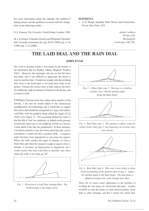
John Foad proposes new categories for sundials designed to prevent rain accumulation: the "Laid Dial," a reclining dial with an "Angle of Lie," and the "Rain Dial", featuring a conical raised centre. He discusses the practical advantages of these forms in preserving dial plates and enhancing readability, and the pleasing play on words.
Dials: Horizontal, Dials: Unusual, Sundial Design & Layout
September 2001
Page 92
Page 92
This article explores three freestanding stone "Father Time" statues in Britain, each incorporating a horizontal sundial. All are attributed to sculptor John Nost from the early 18th century and feature sundial plates by Thomas Heath. The article discusses the origin of the Father Time iconography and notes the uniqueness of these statues in depicting him with a sundial rather than an hourglass.
Dials: Horizontal, Dials: Unusual, Historical Dials
September 2001
Page 127
Page 127
Originally published in "The Countryman" in 1948, this article describes a highly accurate horizontal sundial built by the author while interned in a Japanese camp in China. Constructed from scrap materials using improvised tools and limited references, this unique dial provided correct clock time with built-in Equation of Time correction, serving as the camp's only reliable timepiece.
DIY Sundial Projects, Dials: Horizontal, Dials: Unusual, Equation of Time
September 2001
Page 130
Page 130
This article presents the design for a horizontal sundial usable anywhere in the UK to show GMT, requiring only a slight tilt adjustment for specific latitudes. It employs a gnomon rod mounted at a 53-degree angle and concentric circles on the dial plate represent different longitudes. A formula for calculating hour lines is provided.
DIY Sundial Projects, Dials: Horizontal, Mathematics of Dialling, Sundial Design & Layout
December 2001
Page 169
Page 169
This article, the second part on railway-related sundials, describes two identical horizontal sundials commissioned in 1992. They commemorate the centenary of the Rochers de Naye mountain railway in Switzerland. These bronze dials feature a cogwheel design, an Equation of Time graph, and separate hour lines for summer and winter. The author notes that electric clocks are still preferred for official timekeeping, and clarifies the one-hour time zone difference between UK and Switzerland.
Dials: Horizontal, Equation of Time, Historical Dials
February 2000
Page 17
Page 17
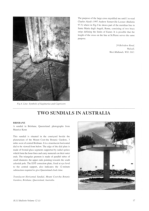
Brief photographic descriptions of a translucent horizontal dial in Brisbane and a camel-shaped sundial in Marree made from railway sleepers.
Dials: Horizontal, Dials: Unusual
February 2000
Page 51
Page 51
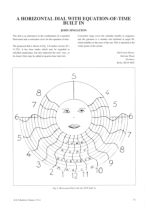
Describes the construction and principle of a horizontal dial that incorporates the equation of time.
DIY Sundial Projects, Dials: Horizontal, Equation of Time
October 2000
Page 125
Page 125
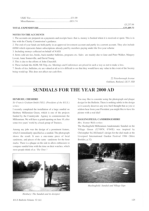
Showcase of sundials commissioned or constructed to commemorate the millennium year.
Dials: Analemmatic, Dials: Equatorial, Dials: Horizontal, Dials: Vertical, The BSS and Members
February 1999
Page 4
Page 4
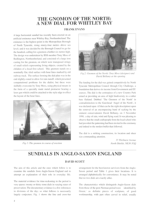
Details the erection of a large horizontal sundial near Whitley Bay, designed by Tony Moss. Named 'The Gnomon of the North', it features a six-metre-high iron gnomon with reliefs created by local schoolchildren, and its hour lines are marked by old railway track on a slightly coned surface.
Dials: Horizontal, Construction Projects
February 1999
Page 11
Page 11
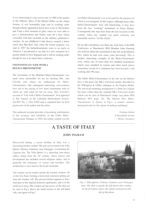
This article describes a utilitarian kitchen sundial found at Villa Quirici in Pedona, Italy, which is accurately delineated from 6 a.m. to 6 p.m. Despite its practicality, its position suggested it was overshadowed until late morning, raising questions about its original function for timing meals.
Dials: Horizontal, Historical Dials
February 1999
Page 12
Page 12
During restoration of the "Heaven's Gate" folly at Highclere Castle, two surprises were uncovered: a chimney flue in the pediment and a sundial engraved on the underside of an urn lid, dated 1737. The author theorizes the sundial was made by masons to regulate their workday.
Dials: Horizontal, Historical Dials
February 1999
Page 25
Page 25
This article introduces refractive sundials made from transparent solids like glass, specifically glass paperweight sundials for window sills. The nodus is an 'aperture' on the top of the paperweight, casting a spot on a dial card on the bottom, with a more compact pattern than in air.
Dials: Horizontal, Dials: Portable, Dials: Unusual, Sundial Design & Layout, DIY Sundial Projects
June 1999
Page 92
Page 92
This article investigates sundials manufactured by Francis Barker & Son, a renowned London-based firm (1850-1926) specializing in horizontal garden dials. It describes specific examples, like one at the RHS Wisley, and discusses their promotion through "advertising tie-ins" in the Horological Journal. The article highlights two notable designs: one showing distances to various places and another displaying local time at different latitudes globally, showcasing their quality and elaborate engraving.
Dials: Horizontal, Historical Dials
October 1999
Page 115
Page 115
This article presents a design for a horizontal sundial adjustable for the Equation of Time and longitude by rotation around an axis parallel to the gnomon's style-edge. The design features a dial-face and gnomon-spine on a head, connected to a base with scales for longitude and a twelve-month Equation of Time adjustment. The offset bearing configuration and a Vernier-like scale simplify operations, allowing users to set the dial for different longitudes and regular Equation of Time corrections.
Dials: Horizontal, Equation of Time, Mathematics of Dialling, Sundial Design & Layout
October 1999
Page 135
Page 135
This article discusses millennium projects, highlighting two commissions. One is a 10ft tall horizontal dial sculpture for the Harborough canal basin, costing £15,000 with Lottery Funds. The other is a memorial in Rimpton Parish, Dorset, consisting of two 8ft high standing slabs with a 50mm slot aligned to sunrise on 1st January 2000. Despite likely cloudy weather, the intention is to attend annually for a champagne ritual, establishing a new English tradition.
Construction Projects, Dials: Horizontal, Dials: Unusual
October 1999
Page 139
Page 139
This article surveys 214 fixed sundials in the former SFR Yugoslavia, now divided into multiple new states. It highlights a Roman spherical dial from Sremska Mitrovica, the oldest Serbian sundial at Studenica Monastery (12th century), and the horizontal dial at Belgrade Observatory. It notes the scarcity of sundials in Macedonia and Bosnia and Herzegovina due to Turkish reign, and discusses Italian-influenced medieval stone dials on the Croatian Adriatic coast, including one in Dubrovnik with both contemporary and old Italian hour scales.
Dials: Horizontal, Dials: Portable, Dials: Scaphe, Dials: Vertical, Historical Dials
February 1998
Page 19
Page 19
Describes the Poulton Hall dial on the Wirral peninsula: setting, design features and inscriptions, with observations on the equation of time using the pre-Gregorian calendar, an the lack of a noon gap.
Dials: Horizontal, Historical Dials
February 1998
Page 28
Page 28
Field note on a simple home-made vernacular horizontal dial from outback Australia, describing fabric, gnomon form and scale, with comments on accuracy of delineation and local use.
DIY Sundial Projects, Dials: Horizontal, Historical Dials
June 1998
Page 9
Page 9
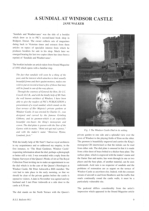
This article details a sundial located on the North Terrace of Windsor Castle, commissioned by Charles II and crafted by Grinling Gibbons. It describes the intricate engravings on the gnomon, featuring the King's monogram, and the dial-plate with the Garter Star and motto. It also touches upon the challenges of its conservation.
Dials: Horizontal, Historical Dials
April 1997
Page 37
Page 37
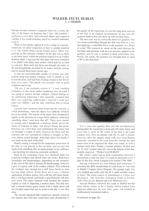
An investigation into a Dublin-made sundial by the maker Walker, examining its craftsmanship, historical significance, and distinguishing features.
Dials: Horizontal, Historical Dials
July 1997
Page 3
Page 3
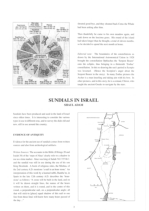
This article provides a historical overview of sundials in Israel, from ancient biblical references and archaeological artifacts to sundial makers of the 20th century. It describes various types of dials, including hemicycliums, portable stone dials, and modern vertical and horizontal dials.
Dials: Hemispherical, Dials: Horizontal, Dials: Vertical, Historical Dials
July 1997
Page 34
Page 34
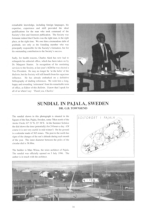
Description of a very large, notable sundial in Pajala, Sweden, north of the Arctic Circle.
Dials: Horizontal, Dials: Unusual
February 1996
Page 28
Page 28
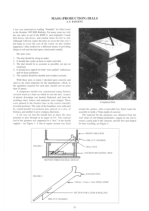
A discussion on industrially manufactured sundials and their place in contemporary and historical contexts.
DIY Sundial Projects, Dials: Horizontal, Sundial Design & Layout
June 1996
Page 9
Page 9
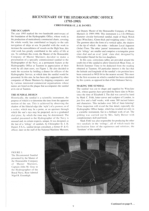
Commemorates the 200th anniversary of the Hydrographic Office with the unveiling of a specially commissioned horizontal sundial, exploring its design, construction, and maritime symbolism.
Dials: Horizontal
June 1996
Page 10
Page 10
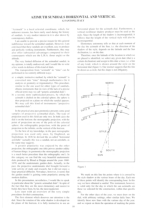
An in-depth exploration of azimuth sundials, comparing projection methods, construction techniques, and their advantages, with historical and modern examples.
Dials: Horizontal, Dials: Vertical, How Sundials Work, Mathematics of Dialling
June 1995
Page 27
Page 27
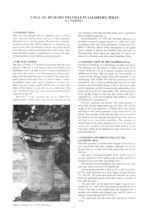
A report on a vertical sundial attributed to Richard Melville in Salisbury, with discussion of its features, condition, and historical context.
Dials: Horizontal, Historical Dials
February 1994
Page 44
Page 44
Announcement of a commemorative sundial plate issued by the National Trust for Scotland.
Dials: Horizontal
June 1993
Page 26
Page 26
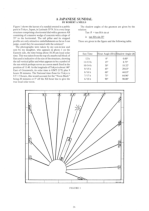
This article describes a large horizontal sundial monument erected in a public park in Tokyo, Japan, at 35°N latitude. It details the sundial's design, including a massive concrete wedge gnomon with a 35° slope, and discusses the calculation of shadow angles. The text explains how the sundial's Noon Mark accounts for the 20-minute difference between Tokyo's local solar time and its national time zone.
Dials: Horizontal
October 1993
Page 20
Page 20
This article surveys various sundials across Cambridgeshire, including church wall dials, horizontal garden dials, and armillary spheres. It highlights specific examples, discussing their dates, inscriptions, restoration efforts, and the materials used. The text also notes the ongoing loss of old dials due to weathering but also the creation of new commemorative ones.
Dials: Armillary Sphere, Dials: Horizontal, Dials: Mass Dials, Dials: Multi Faced, Dials: Vertical, Historical Dials
October 1993
Page 39
Page 39
This article describes the design of a horizontal dial commissioned in memory of a police constable and placed in Swindon Town Gardens. The author details the process of laying out hour lines and setting up in the absence of sunshine. It also describes the installation of an analemmatic sundial at Leicester, a photograph shows the preliminary layout, with the observer acting as the gnomon, demonstrating the dial's function in determining time.
Dials: Analemmatic, Dials: Horizontal, Sundial Design & Layout
February 1992
Page 19
Page 19
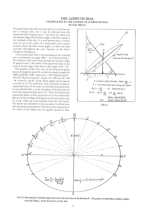
This article describes the azimuth dial, a type of horizontal dial with a vertical style, derived from the equatorial dial formula. It explains that while a vertical style at the center of a horizontal circle cannot show time correctly throughout the year due to declination changes, projecting an equatorial circle onto a horizontal plane forms an ellipse for the hour lines. The article provides the formula for the shadow angle and suggests this as a useful project for understanding geometry and for practical marking in playgrounds or gardens.
DIY Sundial Projects, Dials: Analemmatic, Dials: Equatorial, Dials: Horizontal, Mathematics of Dialling
July 1991
Page 34
Page 34
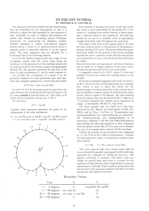
This article introduces the equant dial, a horizontal sundial design inspired by Ptolemaic astronomy, addressing uneven hour spacing in classical dials. It describes how a specific curve is drawn on the dial face, against which an equi-spaced hour-line circle is rotated. This mechanism enables manual adjustments for the equation of time and other corrections, simplifying time reading on such a dial.
Dials: Horizontal, Equation of Time, Mathematics of Dialling, Sundial Design & Layout
October 1990
Page 15
Page 15
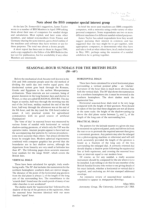
This article explains seasonal hours, a duodecimal system of dividing daylight used before mechanical clocks. It provides accurate patterns for horizontal and vertical seasonal-hour sundials suitable for latitudes 50-60° in the British Isles, noting that hour lines are shallow curves rather than straight.
Dials: Horizontal, Dials: Vertical, Sundial Design & Layout
October 1990
Page 31
Page 31
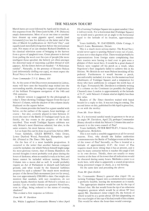
This article humorously discusses a correspondence in The Times concerning an April Fool proposal to turn Nelson's Column and Trafalgar Square into a giant sundial commemorating the Battle of Trafalgar. The correspondence critiques the impracticality of such a design based on gnomonic principles, while also providing historical details on timekeeping during the battle.
Dials: Horizontal, Historical Dials, How Sundials Work