- Home
- /
- Sundial Encyclopaedia
- /
- June 2006
June 2006
The articles link to the specific page in a PDF optimised for speed. If you want the whole issue, you can download it here, but the files from earlier years can be quite large.
June 2006
Page 49
Page 49
The new Editor of the Bulletin thanked his predecessors. He stated that any future changes to the Bulletin would depend on an analysis of the recent Readership Survey. He encouraged new authors to submit articles for the Bulletin.
June 2006
Page 50
Page 50
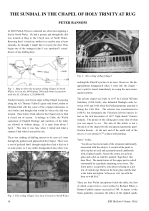
This article investigates an unusual 17th-century wall painting in Rug Chapel, North Wales, which features a dial. It details the analysis of the dial's geometry and hour lines using digital tools, comparing measured angles to calculated values for a 53° North latitude, and discusses the unexpected accuracy for a painting, suggesting sophisticated planning.
Dials: Vertical, Historical Dials, Mathematics of Dialling, Sundial Design & Layout
June 2006
Page 54
Page 54
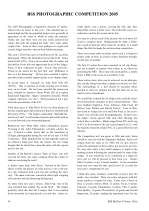
This report details the results of the 2005 British Sundial Society Photographic Competition, highlighting the winners, runners-up, and highly commended entries. It includes judges' comments, discusses criteria like artistic merit and overall impression, and announces plans for the 2006 competition.
The BSS and Members
June 2006
Page 60
Page 60
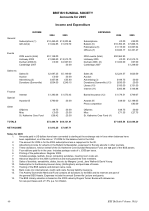
This section provides the British Sundial Society's income and expenditure report for the year 2005. It details financial figures for subscriptions, gift aid, publications, events, sales, interest, and various expenses, along with notes explaining the figures and an auditor's comments on the accounts' clarity and accuracy.
The BSS and Members
June 2006
Page 61
Page 61
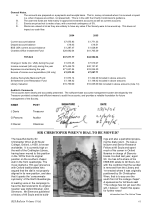
This article discusses the potential relocation of a sundial designed by Sir Christopher Wren at All Souls’ College, Oxford. It details the long-standing grievance of traditionalists about its current misaligned position and the condition in a will left by Oxford librarian John Simmons for its return to its original location.
Historical Dials, Restoration projects
June 2006
Page 63
Page 63
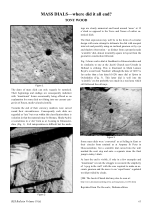
This article explores the indistinct end of mass dials, discussing "transitional" forms that bridge medieval and scientific dials. It notes the appearance of numerals (Roman, Hindu-Arabic, or dot form) around the circumference of later mass dials, indicating a shift towards 12 o'clock noon, and touches on conversions to scientific dials.
Dials: Mass Dials, Dials: Scaphe, Historical Dials, Sundial Design & Layout
June 2006
Page 68
Page 68
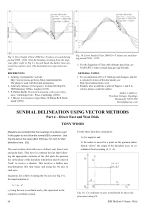
This fourth part of a series focuses on the delineation of direct east and west vertical dials using vector methods. It details the coordinate transformations, equations for hour lines, declination lines, sub-style angles, and gnomon characteristics for these specific dial types, also covering their illumination times.
Mathematics of Dialling, Sundial Design & Layout
June 2006
Page 75
Page 75
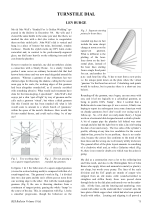
This article describes the design and construction of a horizontal sundial with a cylindrical gnomon, which the author calls a "Turnstile Dial." It explains how the shadow is cast from a continuum of tangent points on the rounded gnomon, the practical aspects of its construction using copper, and the plotting of hour lines tangential to a central ellipse.
Construction Projects, DIY Sundial Projects, Dials: Horizontal, Sundial Design & Layout
June 2006
Page 78
Page 78
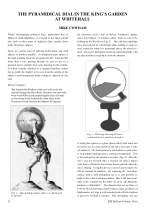
This article reconstructs the spherical dials from the complex 1669 Pyramidical Dial in Whitehall, based on descriptions by William Leybourn. It details various glass sphere dials, including those showing time by heat ("fire"), water, optical alignment ("air"), and terrestrial globes ("earth"), and discusses their delicate construction and short lifespan.
Dials: Hemispherical, Dials: Unusual, Historical Dials
June 2006
Page 91
Page 91
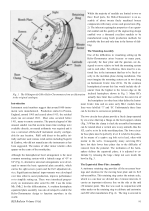
This first part of a review examines the design and accuracy of the Pilkington & Gibbs Helio-Chronometer, an equatorial sundial known for its mean time accuracy. It details the instrument's components, mounting assembly, sight screen system, and the mechanism for integrating the Equation of Time using a cam, and discusses factors affecting its long-term accuracy, such as wear and calibration.
Dials: Heliochronometer, Equation of Time, How Sundials Work, Sundial Design & Layout
June 2006
Page 96
Page 96
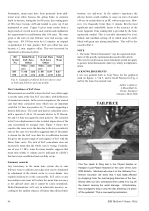
This short note reports that the Heath & Wing dial in the Tiltyard Garden at Hampton Court Palace was badly damaged by contractors who dropped a lopped tree branch onto its pedestal. The dial is now awaiting restoration.
Historical Dials, Restoration projects