- Home
- /
- Sundial Encyclopaedia
- /
- July 1991
July 1991
The articles link to the specific page in a PDF optimised for speed. If you want the whole issue, you can download it here, but the files from earlier years can be quite large.
July 1991
Page 1
Page 1
This section compiles news and updates from various sundial societies. It covers new bulletin issues from De Zonnewijzerkring (Dutch) and La Busca de Paper (Catalan), including mathematical dialling, celestial mechanics, and specific sundial descriptions. It also announces the founding of an Austrian Sundial Society and details a rare sun chronometer in Baden, Vienna, designed by Gibbs.
Book Reviews, Dialling Tools, Dials: Heliochronometer, The BSS and Members
July 1991
Page 3
Page 3
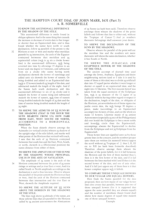
This article, written in 1631, details using John Marr’s Hampton Court Dial. It explains determining celestial metrics like ascensionall difference, azimuth, amplitude, sun's altitude and declination, and Judaical hours. It also covers comparing unequal to equal hours, finding the day of the month, and predicting London Bridge tides via the dial's shadows, showcasing its comprehensive historical applications.
Historical Dials, How Sundials Work, Mathematics of Dialling, Sundial Design & Layout
July 1991
Page 5
Page 5
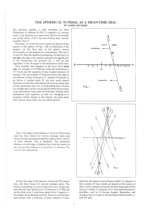
Building on Peter Drinkwater's work, this article explores adapting a spherical sundial to indicate mean time for six months of the year, by offsetting the hour marks away from the equator. This is possible because the slanting terminator at different solar declinations, adjusted for corresponding equation of time, happen to fall very close to one of two circles (within 1.5 minutes). The author also discusses using surface texture, like paint brush marks, to significantly improve the dial's readability and precision.
DIY Sundial Projects, Dials: Unusual, Equation of Time, Sundial Design & Layout
July 1991
Page 8
Page 8
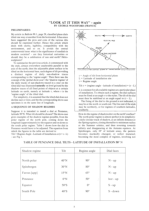
This article re-examines plane dials tilted from the horizontal, focusing on clarity, legibility, and environmental compatibility. It explains 'shadow regimes,' how tilt relates to equivalent latitude, and the impact on sun-shadow patterns. Key considerations include local horizons and the 'night factor'—periods where the dial cannot register time. It highlights the clarity of polar regime dials, despite seasonal limitations, for educational and aesthetic purposes.
Dials: Polar, How Sundials Work, Mathematics of Dialling, Sundial Design & Layout
July 1991
Page 13
Page 13
This essay explores the Northern Hemisphere bias in gnomonics and common perceptions, such as clockwise movements. The author describes his quest for Southern Hemisphere sundial information, noting the lack of specific literature and the 'anticlockwise' appearance of the sun and shadows there. He recounts finding an 'upside down' map of New Zealand, illustrating the profound difference in perspective for Southern Hemisphere dwellers.
How Sundials Work, The BSS and Members
July 1991
Page 14
Page 14
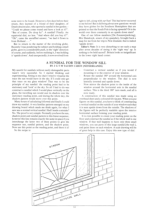
This article presents a novel DIY sundial for a window sill, featuring a stationary reading point. The author explains the construction process: delineating a vertical sundial as if for exterior mounting, then rotating it 180 degrees about the horizontal axis perpendicular to the window. Read the time by watching the shadows of the hour lines pass a stationary reading point 'nodus' on a horizontal surface. Mirroring the hour figures allows them to be read legibly.
DIY Sundial Projects, Dials: Unusual, Dials: Vertical, Sundial Design & Layout
July 1991
Page 15
Page 15
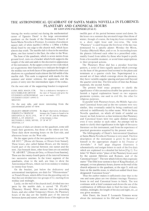
This essay details Egnazio Danti's large astronomical quadrant on Florence’s Santa Maria Novella facade (1572). It describes the instrument's design, inscriptions, and multiple hour systems including Italian, Bohemian, Astronomical, and French hours. It particularly focuses on a unique double tracing for Planetary and Canonical hours, clarifying their historical distinction and practical differences resulting from their construction methods.
Historical Dials, Mathematics of Dialling, Sundial Design & Layout
July 1991
Page 20
Page 20
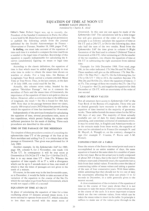
This article, translated by Charles K. Aked, explains the equation of time and its importance for comparing sundial readings to legal time and for drawing analemmas. It outlines three calculation procedures: consulting ephemerides for meridian passage, calculating at 0h UT for precision, and using or constructing tables of mean values. A method for building updated tables is provided, ensuring sufficient precision for dialling needs.
Equation of Time, Mathematics of Dialling
July 1991
Page 22
Page 22
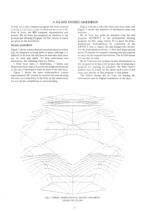
This note introduces F.J. de Vries' new computer program for designing a three-dimensional dodecahedron multi-faced sundial, imagined as made of glass to display various dial lines. The ZONWPLT program interfaces with ACAD to convert dial designs and generate complex geometric models. The article details the computational process, noting the time and files required for the example dodecahedron, and mentions de Vries' subsequent astrolabe program project.
Construction Projects, Dialling Tools, Dials: Multi Faced, Sundial Design & Layout
July 1991
Page 24
Page 24
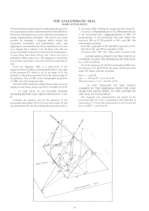
Mark Lennox-Boyd presents a trigonometric proof for the correctness of the equations for laying out an analemmatic dial, aiming to clarify Rene Rohr's complex explanations. Using a diagram relating equatorial, horizontal, and analemmatic dials, he derives three key formulae: one defining the elliptical shape of the dial, and two describing the vertical gnomon's displacement and the hour points angles. The diagram simultaneously provides a proof for the horizontal dial.
Dials: Analemmatic, Mathematics of Dialling
July 1991
Page 25
Page 25
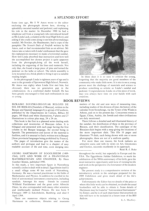
This article celebrates Linda Lack, an 18-year-old schoolgirl who, advised by S.W. Amos, successfully designed and constructed a horizontal sundial and its pedestal. Her impressive enthusiasm and craftsmanship in engraving, turning the pedestal on a lathe, and mounting the assembly are highlighted as an outstanding achievement for a young person, showcasing positive engagement with materials and science.
Construction Projects, DIY Sundial Projects
July 1991
Page 25
Page 25
This section features reviews of three books. 'Bizkaiko Eguzski-Erlojuak' is a bilingual catalogue of Biscayan sundials. 'Georg Hartmann of Eggolsheim' studies a Franconian mathematician and instrument-maker. 'Sundials' by Mayall and Mayall, reviewed by Gordon E. Taylor, notes updates but also highlights production errors and a persistent 'howler' regarding moon dial observation, emphasizing revision importance.
Book Reviews
July 1991
Page 27
Page 27
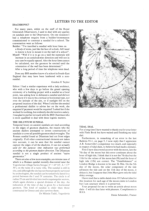
This section compiles letters on diverse sundial topics. Gordon E. Taylor recounts issues with sundial projects undertaken by the uninformed, while Denis Schneider discusses possible errors in tidal dial information and moon dial prospects. J.G. Freeman provides a crucial formula for wall orientation calculations. Allan Mills proposes using N and S extensions to the polar axes of a spherical model earth as gnomons, bringing the noon mark to where it would be expected (rather than at the terminator).
The BSS and Members
July 1991
Page 30
Page 30
This article provides specific corrections and clarifications for Albert E. Waugh's book 'Sundials, Their Theory and Construction.' It addresses errors in rules, footnotes, hour line diagrams (particularly for gnomon placement and shadow radiation), table values, and potential confusions in figure labelling, aiming to improve the accuracy and usability of the gnomonic text.
Book Reviews
July 1991
Page 31
Page 31
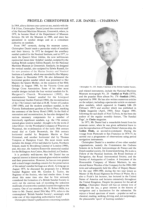
This profile highlights Christopher St. J.H. Daniel, the Chairman of the British Sundial Society. It details his career from the National Maritime Museum, his specialization in sundial design and consultation, and his numerous notable designs and restoration projects (including the 'dolphin' sundial for the Queen's Silver Jubilee). It also mentions his keen interest in preserving the national sundial heritage and his extensive publications and affiliations within the gnomonic and navigation communities.
The BSS and Members
July 1991
Page 32
Page 32
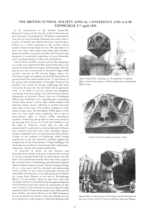
This report details the 1991 British Sundial Society Annual Conference and AGM in Edinburgh. It highlights a coach tour of Scottish dials, featuring restorations and unique designs, alongside numerous lectures by notable members on historical dials, Newton's work, and educational initiatives. The event also included visits to city dials and museums, emphasizing good fellowship, information sharing, and the BSS's strong foundation.
The BSS and Members
July 1991
Page 34
Page 34
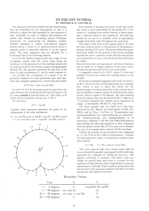
This article introduces the equant dial, a horizontal sundial design inspired by Ptolemaic astronomy, addressing uneven hour spacing in classical dials. It describes how a specific curve is drawn on the dial face, against which an equi-spaced hour-line circle is rotated. This mechanism enables manual adjustments for the equation of time and other corrections, simplifying time reading on such a dial.
Dials: Horizontal, Equation of Time, Mathematics of Dialling, Sundial Design & Layout
July 1991
Page 35
Page 35
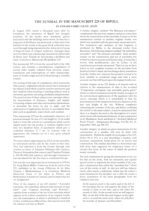
This article examines a horizontal sundial described in Manuscript Rivipullensi 225, a 10th-century compilation from Ripoll monastery. The manuscript provides didactic instructions for laying out the dial with concentric circles for months and temporary hour divisions. The author reconstructs two versions, discussing its function, orientation, and unique characteristics, suggesting Latin or Ripollan origins distinct from Arabic sundials of the period.
Historical Dials, Mathematics of Dialling, Sundial Design & Layout
July 1991
Page 37
Page 37
This brief item announces a newly published catalogue of Austrian sundials, compiled by Karl Schwarzinger, Chairman of the 'Arbeitsgruppe Sonnenuhren.' The comprehensive catalogue features approximately 1,940 fixed sundials with locations, important features, and historical context. It includes basic gnomonic details to aid usability, along with photographic illustrations, and provides information for advance purchase and group membership.
Book Reviews
July 1991
Page 38
Page 38
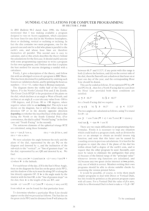
This article presents the theoretical basis for a computer program designed to calculate hour lines for various northern hemisphere sundials (direct, declining, vertical, reclining, inclining). It outlines using spherical trigonometry formulas to determine dial plane elements and hour line angles. The author emphasizes robust programming to handle issues like division by zero and inverse trigonometric ambiguities, providing simplified BBC Basic and design guidance.
Dialling Tools, Mathematics of Dialling, Sundial Design & Layout
July 1991
Page 40
Page 40
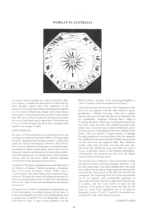
Charles Aked discusses a John Worgan sundial, a 17th-century London instrument-maker, found in Australia by Mrs. Faye Starkey. The article provides Worgan's biographical details, his instruments, and pamphlets. It describes the specific dial, engraved for London latitude with two noon marks, noting its current damaged state from family use, its historical journey, and its inoperability in the Southern Hemisphere.
Historical Dials