- Home
- /
- Sundial Encyclopaedia
- /
- December 2013
December 2013
The articles link to the specific page in a PDF optimised for speed. If you want the whole issue, you can download it here, but the files from earlier years can be quite large.
December 2013
Page 1
Page 1
This editorial encourages readers to vote for their 'Most Enjoyed Article' from the four 2013 issues, noting that the last year's competition was won by a single vote. It announces this as a 'bumper Christmas issue'.
The BSS and Members
December 2013
Page 2
Page 2
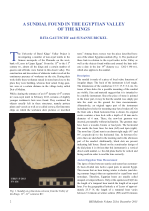
Describes a vertical direct south sundial made of ochre limestone found in workmen's huts in the Valley of the Kings, dated to the late 19th dynasty (ca. 1202–1190 BC). It discusses its dimensions, features, and the low precision inherent in ancient Egyptian temporal hours and canonical design.
Dials: Portable, Dials: Vertical, Historical Dials, Mathematics of Dialling
December 2013
Page 7
Page 7
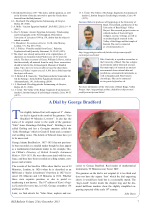
Analysis of a slightly battered 9" diameter horizontal dial signed by George Bradford of London (w. 1817–1851), who was a mathematical instrument maker. The article discusses his association with his son Isaac, his addresses, and notes that the gnomon is not original.
Dials: Horizontal, Historical Dials
December 2013
Page 8
Page 8
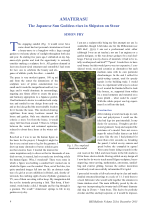
Describes the design and construction of a unique sculpture/sundial combining the figure of the Japanese Sun Goddess, Amaterasu, using her raised leg as the gnomon. The author details the materials used (cement/bronze effect, gold leaf), challenges faced in construction, and the astronomical details included on the plinth.
Construction Projects, DIY Sundial Projects, Dials: Unusual, Equation of Time
December 2013
Page 12
Page 12
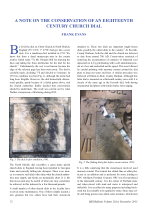
Details the conservation work performed on an 18th-century sandstone dial (1793) at Christ Church in North Shields, which was declining 7°E. The process involved cleaning, removal of cement, consolidation using lime mortar and grout, weatherproofing, and gilding the copper-based gnomon.
Dials: Vertical, Historical Dials, Restoration projects
December 2013
Page 14
Page 14
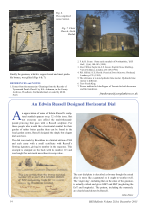
Describes a simple, elegant horizontal sundial designed by Edwin Russell, produced by Brookbrae in a limited edition of 500. The cast dial-plate is gunmetal, with etched 'engraving' for GMT and BST, neglecting the EoT and longitude.
Dials: Horizontal, Sundial Design & Layout
December 2013
Page 15
Page 15
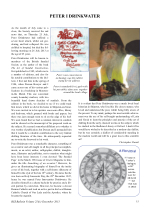
An obituary for Peter Drinkwater (1947–2013), author of *The Art of Sundial Construction* (1985). He was an eccentric, self-taught author, artist, and diallist who studied classical works at the Bodleian Library.
The BSS and Members
December 2013
Page 16
Page 16
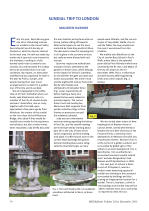
An account of a guided trip to London sundials, visiting the noon mark dial in Paternoster Square, a horizontal dial at Amen Court (attributed to Wren), the polar dial by Piers Nicholson, dials at Cheapside and St Katherine Cree, and the large horizontal dial over Tower Hill Underground Station.
Dials: Horizontal, Dials: Polar, Dials: Vertical, The BSS and Members
December 2013
Page 18
Page 18
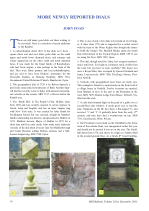
A selection of recent additions to the Sundial Register, including a cuboctahedron (1823), a geographical dial (1720) by Robert Spurrell, the restored 'Smith Dial' (1858), a river bridge dial (1770), and various vertical, cube, and pillar dials across England and Scotland.
Dials: Cube, Dials: Multi Faced, Historical Dials, The BSS and Members
December 2013
Page 20
Page 20
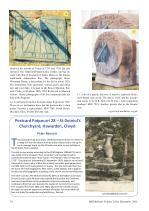
Discusses a postcard (postmarked 1903) showing a dial from St Deiniol’s Churchyard, Hawarden, Clwyd (SRN 6671), which is now missing. The dial was dated 1735 and signed "Geo: Jones del" and inscribed with the names of the church wardens.
Historical Dials, The BSS and Members
December 2013
Page 21
Page 21
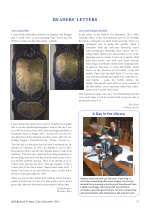
Contains letters regarding: (1) a "three-plate" dial found at a pub in Goudhurst, Kent, signed Jas Smythe 1692, suspected to be a fake; and (2) a systematic procedure for levelling universal equinoctial dials using three adjusting screws.
Dialling Tools, Historical Dials
December 2013
Page 22
Page 22
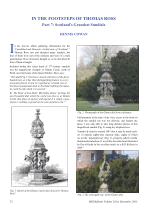
Explores four magnificent 17th-century Scottish sundials documented by Thomas Ross: the complex multi-faced dials at Glamis Castle (stellar rhombicuboctahedron), Drummond Castle (obelisk, 1630), Holyroodhouse Palace (polyhedral, 1633), and the fountain/dial at Dundas Castle (lectern type, 1623).
Dials: Multi Faced, Dials: Scaphe, Historical Dials, Sundial Design & Layout
December 2013
Page 27
Page 27
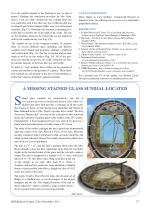
Reports the location of the "Roy Grosvenor Thomas" stained glass sundial, previously considered lost. Designed for latitude 51.5° and declination 16° W, it is tentatively dated to 1652 and carries the motto *Tempus Edax Rerum*.
Dials: Vertical, Historical Dials, Mottoes
December 2013
Page 28
Page 28
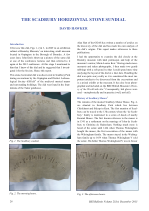
A report on a rare, unfinished, broken stone horizontal dial found in the foundations of the Tudor gatehouse at Scadbury Park, Kent. Dated circa 1550, its calculated hour lines suggest delineation for a significantly higher latitude (possibly 56°) than its find location (51.4° N).
Construction Projects, Dials: Horizontal, Historical Dials, Mathematics of Dialling
December 2013
Page 31
Page 31
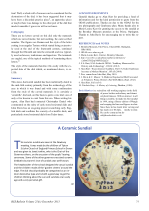
Describes a decorative, indoor ceramic sundial made by children of Tipton St John Church of England Primary School, given to Janet Jenkins. The headteacher designed the dial, and the children created the garden creatures around the edge.
DIY Sundial Projects, Dials: Unusual
December 2013
Page 32
Page 32
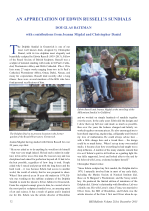
An appreciation of the late sculptor Edwin Russell (1939–2013), Fellow of the Royal Society of British Sculptors and Artistic Director of Brookbrae Ltd. It highlights his collaborations, notably the Dolphin Sundial in Greenwich (1978), and his dedication to perfection, inspiring his student Joanna Migdal.
Sundial Design & Layout, The BSS and Members, Dials: Armillary Sphere
December 2013
Page 34
Page 34
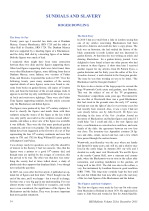
Explores the history and significance of lead Blackamoor and Indian figures supporting sundials in Georgian gardens, associating them with the wealth derived from the Atlantic slave trade. There is an inventory of known figures and their sculptors (John Nost I/II, Carpentiere, Cheere).
Dials: Horizontal, Historical Dials, The BSS and Members
December 2013
Page 40
Page 40
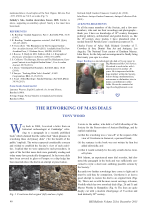
Discusses the controversial practice of reworking or re-cutting old mass dials. The British Sundial Society's policy is against restoration, suggesting a copy dial be carved nearby instead. Examples of reworked dials at Crewkerne, Lamas, and Martyr Worthy are provided.
Dials: Mass Dials, Restoration projects, The BSS and Members
December 2013
Page 42
Page 42
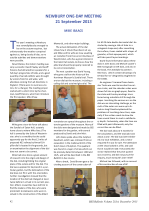
Report on the BSS Newbury meeting held on the autumn equinox. Talks included the Sundials of Eaton Hall, the Horniman Museum trail, the Zutphen Quadrant, and construction projects like David Brown's M-29 double horizontal dial and Mike Lee's Sun Clock.
Construction Projects, Dials: Double Horizontal, Dials: Heliochronometer, The BSS and Members
December 2013
Page 44
Page 44
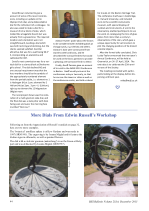
Presents two additional examples of Edwin Russell’s work: the ‘botanical’ armillary sphere at Kew Gardens (engraving by Joanna Migdal), and a horizontal dial featuring a cricketer gnomon on the Green at Holyport (delineated by Joanna Migdal).
Dials: Armillary Sphere, Dials: Horizontal, Sundial Design & Layout
December 2013
Page 45
Page 45
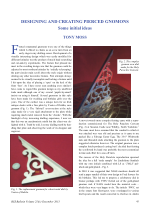
Details the author's development of ornamental, fretted, and pierced gnomons, noting his unofficial trade mark—a spur on the heel of the front 'foot'. He describes techniques using a clockmaker's fretsaw, Thiel filing machine, and flexible-shaft machine, often featuring interlaced initials.
Construction Projects, DIY Sundial Projects, Dialling Tools, Sundial Design & Layout
December 2013
Page 50
Page 50
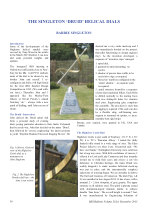
Provides personal insights and updates on the Singleton helical sundial, nicknamed ‘Druid’ (Daytime Readout Universal Imaging Device). It details the patented innovations, including the spiral dial structure and 'three bar' numerals, culminating in the fully funded installation at Highclere Castle in 2013.
Construction Projects, Dials: Unusual, Equation of Time, Sundial Design & Layout
December 2013
Page 52
Page 52
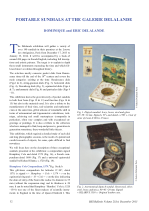
Previews an exhibition of over 140 pocket dials (Renaissance to late 18th century) held in Paris. It describes three exceptional examples: a complex Humphrey Cole gilt-brass compendium (1579), a French diptych compendium (1608), and a universal equinoctial sundial by Richard Glynne (c.1720).
Dials: Equatorial, Dials: Portable, Historical Dials