- Home
- /
- Sundial Encyclopaedia
- /
- March 2016
March 2016
The articles link to the specific page in a PDF optimised for speed. If you want the whole issue, you can download it here, but the files from earlier years can be quite large.
March 2016
Page 1
Page 1
A circa 1913 Francis Barker gnomon, which was severely twisted and bent, required straightening. The author commissioned Mark Clarke, an expert who usually works on historic aircraft components at the Imperial War Museum Duxford, to straighten the piece, finding the task straightforward given his experience.
Historical Dials, Restoration projects
March 2016
Page 1
Page 1
This section notifies readers that the Trustees’ Annual Report and Accounts for 2015 are published in this issue, as required by the new Constitution. It asks members to submit their votes for their three most enjoyed articles of 2015. It also announces the transitioning of Bulletin production staff, with David and Jen Brown joining the team.
The BSS and Members
March 2016
Page 2
Page 2
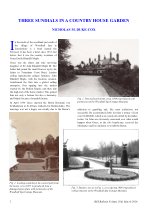
An investigation into three historical sundials located at Petwood, a country house in Lincolnshire. The article details the garden's history, designed by William Goldring and later Harold Peto, and describes the ‘little boy’ dial, the classical baluster dial, and an unusual pillar dial supported by four Atlases.
Dials: Unusual, Historical Dials
March 2016
Page 6
Page 6
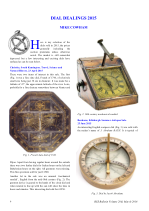
A selection of sundials sold at auction during 2015. Featured dials include a French slate dial (1746), an English mechanical dial, a compass dial by J. Abraham Bath, an ivory crucifix dial with concealed cavities, a horizontal dial by R. Glynne, and a silver Butterfield dial.
Dials: Portable, Historical Dials
March 2016
Page 9
Page 9
This letter addresses the move to abolish leap seconds, which are introduced to keep UTC (GMT) linked to to mean solar time. The author argues that abolition would cause accurately constructed fixed sundials, such as the Dolphin Dial at Greenwich, to become increasingly inaccurate over decades. Happily the 2015 World Radiocommunication Conference postponed any decision until 2023.
March 2016
Page 10
Page 10
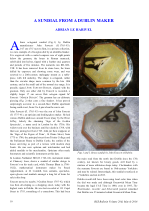
A description of a rare octagonal brass horizontal sundial made by John Fawcett of Dublin, who worked primarily as an optician and instrument maker between 1765 and 1793. The dial features a compass rose and an elaborately pierced gnomon.
Dials: Horizontal, Historical Dials
March 2016
Page 11
Page 11
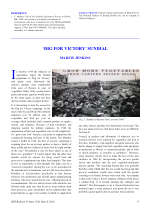
Examines a photograph from 1940 showing a classical horizontal sundial located amongst rows of vegetables at Carter’s Seed Company during the ‘Dig for Victory’ campaign. The article poses the question regarding the current location and fate of this particular dial.
Dials: Horizontal, Historical Dials
March 2016
Page 12
Page 12
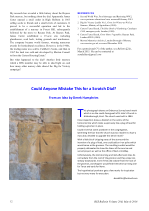
A short discussion hypothesizing that a blemish on an Ordnance Survey bench mark at St John’s Church, Hildenborough, might be an attempt by a ‘prankster’ to create a scratch dial. The resulting lines, however, would be highly inaccurate for tracking church services.
Dials: Mass Dials, Dials: Unusual
March 2016
Page 13
Page 13
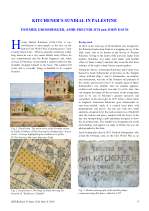
Details the sophisticated east–west sundial presented by Horatio Herbert Kitchener in Haifa in 1875 to his host, Jacob Schumacher. The dial uses a vertical brass plate with apertures to cast light spots onto a bottom plate marked with a split analemma to show local mean time.
Dials: Noon Lines, Equation of Time, Historical Dials, Sundial Design & Layout
March 2016
Page 17
Page 17
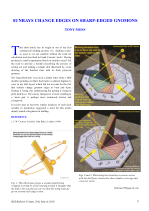
Discusses a common error made by beginners in sundial design concerning how sunrays change edges on sharp-edged gnomons at 6 am and 6 pm, in addition to the more widely known ‘noon gap’. Getting this aspect wrong results in incorrect dial layouts.
How Sundials Work, Mathematics of Dialling, Sundial Design & Layout
March 2016
Page 18
Page 18
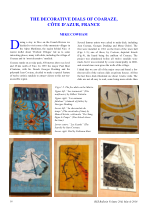
A report on the artistic sundials of the village of Coaraze, initiated in 1959 by the mayor and artists, including Jean Cocteau, to attract tourism. The dials, often made of painted tiles, are noted for being more artistic and decorative than practical timekeepers.
Dials: Unusual, Dials: Vertical, Historical Dials
March 2016
Page 20
Page 20
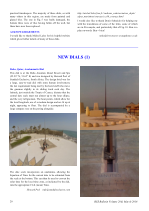
Description of a large, modern, analemmatic dial designed by Howard Peel for the Doha Anantara Island Resort and Spa. The dial's design requires the hotel staff to move the gnomon daily and incorporates an analemma scale for estimating the Equation of Time.
Dials: Analemmatic, Equation of Time, Sundial Design & Layout
March 2016
Page 21
Page 21
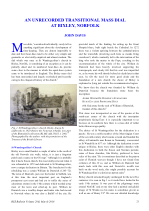
Historical investigation into a transitional mass dial at St Wandregesilius’s church, Bixley, dated after 1272. The numbered hour-lines (VI-XII-VI) suggest it pre-dates scientific dials and provides insight into the introduction of the equal-hour system in medieval England, possibly linked to Norwich's early clock usage.
Dials: Mass Dials
March 2016
Page 25
Page 25
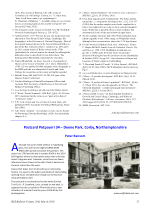
Analysis of a postcard featuring a vertical dial at Deene Park, dated 1769. The author argues that the dial declines to the east, based on the delineation of fewer afternoon hours, correcting a potential error in the BSS Register description.
Dials: Vertical, Historical Dials
March 2016
Page 26
Page 26
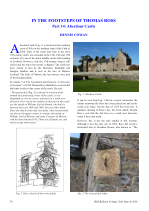
This article traces the historical sundials documented by Thomas Ross at Aberdour Castle. It describes a vertical dial (1635), a horizontal dial, and a multi-faceted dial moved from Castle Wigg, noting that the latter's Equation of Time table uses the Julian calendar appropriate for the early 18th century.
Dials: Horizontal, Dials: Multi Faced, Dials: Vertical, Equation of Time, Historical Dials
March 2016
Page 29
Page 29
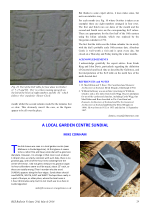
A humorous critique of a poorly laid out slate horizontal dial seen in a Cambridgeshire garden centre. The dial incorrectly shows equal 15° hour calibrations, lacks a gnomon gap, and displays noon at 1:40 pm, rendering it useless as a timekeeper.
Dials: Horizontal, Dials: Unusual
March 2016
Page 30
Page 30
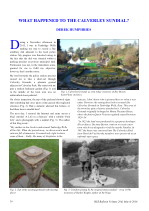
The search for a missing sundial from Calverley Grounds in Tunbridge Wells. The author confirms that a sundial was installed in 1924, but subsequent photographs from the 1960s show the pedestal broken and the dial missing, likely due to vandalism.
Dials: Horizontal, Historical Dials
March 2016
Page 31
Page 31
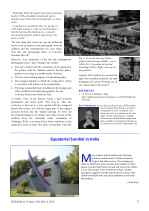
A brief note on an equatorial sundial located on the campus of the University at Pune, India. This variant of the famous large Indian masonry dials was constructed in concrete and steel in the 1980s.
Dials: Equatorial
March 2016
Page 32
Page 32
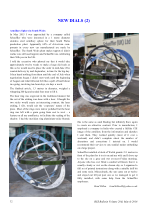
Describes the construction and installation of a 1.3-metre diameter stainless steel armillary sphere commissioned by Schaeffler for their South Wales plant. The sphere features engraved traditional hour rings contrasted with laser-etched elements for a corporate look.
Construction Projects, Dials: Armillary Sphere
March 2016
Page 33
Page 33
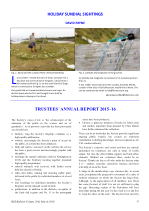
An account of finding a horizontal sundial on Gugh in the Isles of Scilly, which appeared approximately seven years ago. The dial's wooden gnomon is inscribed with its latitude and longitude, and the author notes the local museum is seeking information regarding the builder, thought to be holiday-makers.
Dials: Horizontal
March 2016
Page 33
Page 33
This report details the Society's efforts in public education, including the Bulletin, enhanced website, schools outreach, conferences, and dial recording. It notes a decline in membership due to an ageing structure and the progressive retirement of stalwart volunteers.
The BSS and Members
March 2016
Page 36
Page 36
The formal financial statements and accounts for the British Sundial Society for the year ended 31st December 2015.
The BSS and Members