- Home
- /
- Sundial Encyclopaedia
- /
- Peter I. Drinkwater
Peter I. Drinkwater
March 2013
Page 44
Page 44
A collection of letters discussing Society matters, mass-dial archives, and north-facing dials. Contributors debate historical interpretations and the future of BSS collections.
Dials: Mass Dials, Historical Dials, The BSS and Members
June 2013
Page 2
Page 2
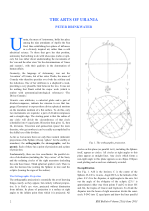
A philosophical and mathematical essay exploring the classical projections of the celestial sphere—orthographic, stereographic, and gnomic—and their relation to sundial design, astronomy, and the history of dialling geometry.
Dials: Analemmatic, Historical Dials, How Sundials Work, Mathematics of Dialling
September 2013
Page 32
Page 32
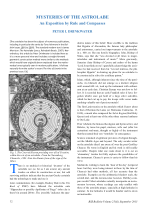
An exposition on the history and components of the astrolabe, including its two faces (sighting bar/calendar and matrix/rete/plates). The article details a geometric construction method using rule and compasses to lay out the template for the rete and the individual plates via stereographic projection.
Dialling Tools, Dials: Astrolabe, How Sundials Work, Mathematics of Dialling
March 2012
Page 42
Page 42
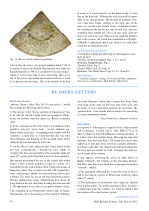
This section features letters from readers discussing various sundial topics. Peter Drinkwater discusses dial transmission and an Islamic scratch dial. Tony Wood offers insights into the progress of "scientific" sundials. John Moir describes "Suburban Reflections" from his front garden.
How Sundials Work, Historical Dials, The BSS and Members
June 2012
Page 46
Page 46
This section contains three letters from readers. Peter Drinkwater discusses a Canterbury pendant, questioning Arnaldi’s gnomon positions. Frank Coe references a Chichester Sun Compass. Sue Manston points out a potential error in the 'waxing' and 'waning' engravings on the Balliol Moondial's gnomon, to which David Harber responds confirming the mistake.
Dials: Portable, Dials: Unusual
September 2012
Page 6
Page 6
A letter speculating on the origins of the Hever Castle Dial, proposing it was a Sicilian-modelled Roman sundial made for a Northern European patron.
Sundial Design & Layout, Historical Dials
June 2011
Page 36
Page 36
This article argues that medieval 'scratch dials' were serious timekeepers, not just symbolic. It describes their basic form, historical context of temporal hours, and connections to early Church observances and Islamic prayer times, asserting their utility at high latitudes.
Dials: Mass Dials, Historical Dials, How Sundials Work, Mathematics of Dialling
September 2011
Page 37
Page 37
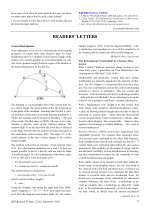
This section compiles several letters from readers. Michael Lowne provides a complex formula for calculating shadow length from gnomon angle. Chris Williams praises Peter Drinkwater's article on scratch dials, linking them to medieval manuscripts. Peter Drinkwater responds on the transmission of scratch dial technology and the function of water clocks. David Young corrects a historical detail about BSS conference venues.
Dials: Mass Dials, Historical Dials, Mathematics of Dialling, The BSS and Members
June 1996
Page 42
Page 42
An analytical discussion of the sundial-like instrument depicted in Dürer’s ‘Melancholia I’, considering artistic interpretation and gnomonic function.
Dials: Unusual
February 1994
Page 28
Page 28
Analysis of sundials and astronomical instruments in Holbein’s painting 'The Ambassadors', with insights into symbolism, usage, and historical context.
Historical Dials
February 1994
Page 33
Page 33
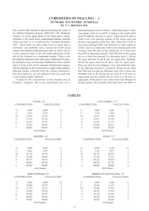
Describes construction of eccentric sundials with non-standard hour lines and geometries. Focuses on design theory and practical outcomes.
Dials: Unusual, Mathematics of Dialling
June 1993
Page 8
Page 8
This article critically examines polyhedral sundials designed by Nicholaus Kratzer, Henry VIII's diallist, comparing his work with that of Oronce Fine (Francis I of France's diallist). It describes surviving and recorded dials, including those in Holbein's paintings, and questions the practical functionality of Kratzer's polyhedral design due to apparent geometric inconsistencies and the use of the Ecliptic's obliquity angle in extraneous constructions.
Dials: Multi Faced, Sundial Design & Layout, Historical Dials
June 1993
Page 18
Page 18
This article explores Vitruvius's Analemma, a vital geometric construction from Roman architecture used for sundial design. It describes the step-by-step process of constructing the Analemma using only a ruler and compasses, explaining how it projects old Temporal Hours and can be adapted for modern hours. The text provides insights into ancient dialling techniques, their historical continuity, and potential links to medieval astrological traditions and later drawing methods.
Historical Dials, Mathematics of Dialling, Sundial Design & Layout
October 1993
Page 42
Page 42
This section contains letters from readers, including a discussion on "Neolithic Astronomy" and Stonehenge, suggesting early warning systems for climate change. It also features "Errors" pointing out misconceptions in a previous bulletin, and comments on "A Japanese Sundial", "Kircher's Sunflower Clock", and "Kratzer's 'Polyhedral' Sundial", along with a poem about rainbows.
The BSS and Members
February 1992
Page 24
Page 24
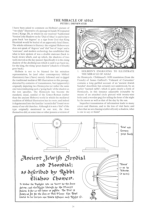
The article clarifies the Biblical account of the "Dial of Ahaz," explaining that the original Hebrew text refers to "steps" and a "staircase" rather than a sundial with "degrees." It discusses how medieval illustrations, like Holbein's, misinterpreted this, depicting a hemicycle-like device. The author also notes an adjustable Jewish hemicycle described in a 1650 translation, which could tell time by both the sun and the moon.
Dials: Hemispherical, Historical Dials
October 1991
Page 31
Page 31
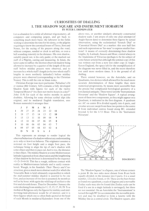
Peter Drinkwater explores historical methods of time determination, focusing on the "Shadow Square" and "Instrumentum Horarum" found on astrolabes and quadrants. He discusses ancient shadow scales, like those from Palladius, and how they were used to estimate time by shadow length, noting the practical, though often imprecise, methods employed by medieval laborers and pilgrims without modern instruments.
How Sundials Work, Historical Dials
February 1990
Page 5
Page 5
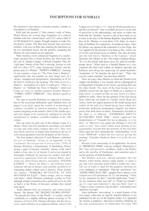
This article delves into the history and interpretation of mottoes (inscriptions) found on sundials, noting that their extensive use became popular with the advent of "modern" scientific sundials in the 15th century. It explores various Latin and Greek phrases, often derived from scriptures or classical texts, such as "TEMPVS VMBRA" and "SIC TRANSIT GLORIA MVNDI". The article also discusses how sundials often provide the "Emblem" for common mottoes and the inherent ambiguities in translating Latin inscriptions.
Mottoes
June 1990
Page 17
Page 17
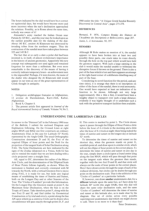
This article explains the construction and practical application of Lambertian Circles in analemmatic dials. These circles, plotted from a specific centre through the foci of the hour point ellipse, determine the times of sunrise and sunset for any given day, applicable across different latitudes.
Dials: Analemmatic, How Sundials Work, Mathematics of Dialling
October 1990
Page 12
Page 12
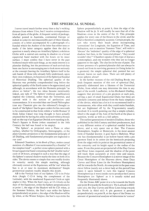
This article discusses various forms of spherical sundials, from simple painted stone spheres to the ancient concave hemisphere (Scaphe or Hemicycle) and the later, less effective, convex hemisphere. It also explores the projection of spherical coordinates onto a plane, linking them to the discovery of the analemmatic dial.
Dials: Hemispherical, Historical Dials, Dials: Scaphe, Dials: Armillary Sphere
October 1990
Page 14
Page 14
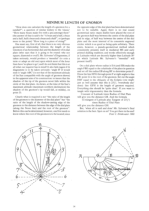
This article addresses the calculation of a gnomon's length for a sundial, clarifying that it's about the ratio of the shadow-casting edge to the distance from the root of the shadow casting edge to the dial plate's edge. It critiques Mr. Sylvester's diagram, presents a pseudo-geometrical medieval method, and provides trigonometric formulas for calculation.
Mathematics of Dialling, Sundial Design & Layout
July 1989
Page 12
Page 12
Contrasts the "true" time indicated by sundials with the artificial time of clocks (GMT, BST) and advocates living in accordance with the sun's rhythm.
Equation of Time
November 1989
Page 2
Page 2
The author explores applying the analemmatic dial principle to vertical planes, contrasting it with the more common horizontal version. The article provides the trigonometric calculations necessary for constructing such a dial on a vertical declining plane, detailing how to find the sub-style to meridian, the dial's "latitude," and the difference of meridians. It describes the layout process involving primary and minor axis circles to generate hour points and arcs for zodiacal signs, explaining why a movable gnomon is impractical for vertical planes and instead a horizontal rod is used. The dial is presented as a philosophical exercise, a functional piece for those interested in the Zodiac, or an aesthetic wall ornament.
Dials: Vertical, Dials: Analemmatic, Mathematics of Dialling