- Home
- /
- Sundial Encyclopaedia
- /
- December 2016
December 2016
The articles link to the specific page in a PDF optimised for speed. If you want the whole issue, you can download it here, but the files from earlier years can be quite large.
December 2016
Page 1
Page 1
The editorial notes the Newbury Meeting report and upcoming articles. It welcomes submissions and wishes readers well for the New Year. It also announces two full-page advertisements and highlights articles concerning Mrs Crowley and BSS Monograph 11, which features astonishing quality photographs of mass dials in Somerset.
Book Reviews, The BSS and Members
December 2016
Page 2
Page 2
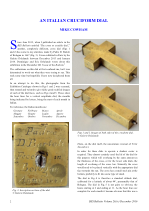
Analysis of a 1667 cruciform dial by Padre D. Bartoli of Bologna, calibrated for latitude 44°. The author deciphered its complex deliniations, concluding it displays equal hours, unequal hours, Italian hours, and Babylonian hours. It functions as a standard altitude dial, likely using the lid or cross bars as a shadow caster.
Dials: Portable, Dials: Unusual, Historical Dials, How Sundials Work
December 2016
Page 6
Page 6
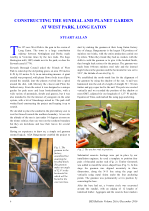
Details the construction of a giant horizontal sundial and accompanying planet garden. The stainless steel rod gnomon was set at the site's 52.9° latitude. The dial uses mosaic tesserae to mark GMT and BST hours, and incorporates solstice markers and an equinox arch.
Construction Projects, Dials: Horizontal, Sundial Design & Layout
December 2016
Page 8
Page 8
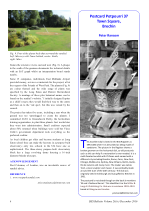
Details the multi-faceted sandstone sundial (SRN 1480) in Brechin, created by local sculptor James Tosh around 1900. It features 25 faces named after various cities. The postcard is useful as the BSS register notes a broken gnomon. The dial was gifted to Brechin from Edinburgh in 1961.
Dials: Multi Faced, Historical Dials
December 2016
Page 10
Page 10
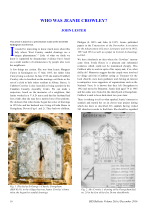
An analysis of the life of Jeanie Crowley (1885–1965), who compiled eight sketchbooks containing drawings and descriptions of 216 West Country sundials. The article outlines her family life in Devon, details her methods using measuring rods and field glasses, and suggests further research into her life. She primarily focused on vertical dials.
Dials: Vertical, Historical Dials
December 2016
Page 12
Page 12
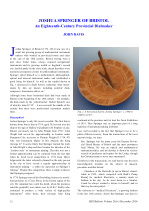
A study of Joshua Springer (1732–1812), a prosperous Bristol mathematical instrument maker. Detailed analysis, including XRF metallurgy, is provided for one of his c. 1800 brass horizontal dials, showing London-style influence and local brass origin. Springer was also involved in freemasonry and unsuccessful ballooning plans.
Dials: Horizontal, Historical Dials
December 2016
Page 16
Page 16
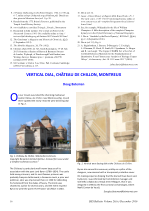
Description of a restored west-declining vertical dial found at the Château de Chillon. Though the castle is associated with Lord Byron, enquiries confirmed the dial was designed much later in 1905 by cantonal archaeologist Albert Naef.
Dials: Vertical, Historical Dials
December 2016
Page 18
Page 18
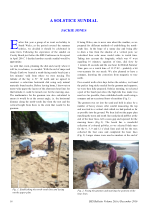
An account of creating a temporary, solar-time horizontal sundial on a South Wales beach for the summer solstice. Natural materials, like sticks for the gnomon and coloured pebbles for the hour lines, were used. Careful calculations were made for alignment and time correction, educating curious passersby.
DIY Sundial Projects, Dials: Horizontal
December 2016
Page 20
Page 20
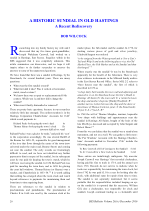
Summary of research uncovering a now-missing historic sundial near the Stonebeach in Old Hastings. Records mention maintenance from 1642. The author's ancestor, clockmaker Joseph Carswell, made a new brass gnomon (or 'cock') for the dial in 1746.
Historical Dials, The BSS and Members
December 2016
Page 21
Page 21
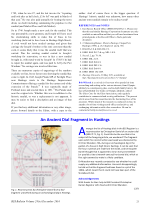
Investigation of a reconstructed sixteenth or seventeenth-century horizontal dial fragment (SRN 7171) found in Hastings. The fragment was recovered from a pit dating to the 1660s, confirming it could not be part of the historic Stonebeach dial discussed elsewhere.
Dials: Horizontal, Historical Dials
December 2016
Page 22
Page 22
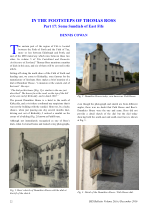
Covers six historical sundials in East Fife documented by Thomas Ross. Examples include the Path House dial (formerly Dunnikier House), the Muckle Yett dial with seven faces including scaphe dials, and cube dials at Kellie Castle (1722) and St Mary’s College (1664).
Dials: Cube, Dials: Multi Faced, Dials: Scaphe, Historical Dials
December 2016
Page 27
Page 27
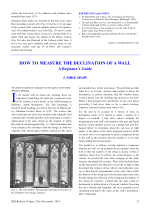
A guide detailing a method for accurately measuring wall declination, based on a talk at Newbury (2016). It involves using a plumb line, mirror, and white board to determine the exact moment the sun is perpendicular to the wall. The subsequent azimuth is derived easily using the 'Sun Seeker' mobile application.
Dialling Tools, Mathematics of Dialling
December 2016
Page 29
Page 29
Report covering talks from the 2016 Newbury Meeting. Highlights include John Bird dial investigation, Didsbury stained glass restoration updates, discussions on Wenger and Mojoptix dials, approaches to moon dials, modern sundial challenges, and the Easton Lodge restoration project.
Historical Dials, Restoration projects, Sundial Design & Layout, The BSS and Members
December 2016
Page 34
Page 34
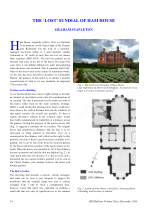
Proposes a reconstruction of the 'lost' great decliner mural sundial at Ham House, dated 162- (likely 1622) and rediscovered in 1965. The dial, positioned 16° north of east, was hidden when the house was extended in 1674. It carries the motto VIGILATE.
Dials: Vertical, Historical Dials, Mottoes
December 2016
Page 37
Page 37
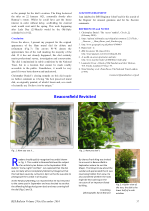
A brief follow-up noting that the foliage obscuring the Beaconsfield sundial, which had been cleared in April, had regrown significantly by September 2016, covering half of the dial. The issue was brought to the attention of the local Mayor.
Historical Dials
December 2016
Page 38
Page 38
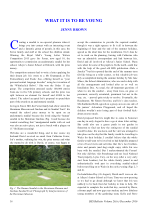
Account of the commission and installation of a Forest of Dean sandstone analemmatic sundial at Alleyn’s Junior School. The project was funded by 10-year-old Iris Ferrar, who won a national writing competition and wanted an active piece amalgamating maths and art. Iris subsequently became the sundial tour guide.
Construction Projects, Dials: Analemmatic
December 2016
Page 41
Page 41
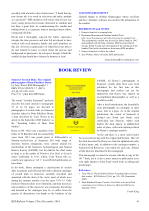
Review of BSS Monograph 11, 'Somerset Scratch Dials: The original photographs of Dom Ethelbert Horne' by Tony Wood. The monograph reproduces 53 pages of astonishing quality photographs of mass dials taken by Horne between 1911 and 1915, complementing his 1917 catalogue.
Book Reviews, Dials: Mass Dials, Historical Dials
December 2016
Page 42
Page 42
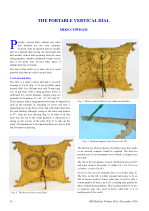
Examines two unusual portable vertical dials. The first is a c. 1600 gilt brass south dial calibrated for five latitudes, featuring a string gnomon and lunar time calculations on the reverse. The second is a small square pillar dial (c. 1567, likely Ulrich Schniep) showing two declining vertical dials and planetary hour tables.
Dials: Portable, Dials: Unusual, Historical Dials