- Home
- /
- Sundial Encyclopaedia
- /
- September 2023
September 2023
The articles link to the specific page in a PDF optimised for speed. If you want the whole issue, you can download it here, but the files from earlier years can be quite large.
September 2023
Page 1
Page 1
Discusses the reproduction of the BSS Conference sundial “examination” questions and answers in this issue, noting that no one achieved more than half marks at the Conference. It also mentions the lead article on the Medieval Rule of Erfurt, two articles on magnetic compasses, two articles on horizontal sundials with multiple gnomons, the 2023 Photographic Competition winners, and details about a Zoom event.
The BSS and Members
September 2023
Page 2
Page 2

Analyzes the Erfurt rule, a medieval method for designing south-facing wall sundials, found in a 15th–16th-century codex owned by Fra Giocondo of Verona. It discusses the rule's origins (Paris/Germany, c. 1334), its non-empirical numerical angular values for temporal hours, and its later modification to suit equal equinoctial hours.
Dials: Vertical, Historical Dials, Mathematics of Dialling, Sundial Design & Layout
September 2023
Page 9
Page 9
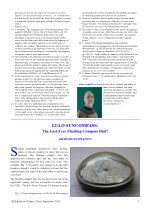
Examines the Li-Lo Suncompass, a floating compass dial made in Great Britain in the mid-1940s, possibly the last of iteration of its type. It discusses its plastic construction, dual time scales (Winter Time and Summer Time), the Li-Lo brand's history (owned by P.B. Cow & Co.), and its origin as the German 'Rüter Uhr' developed in 1945.
Dials: Portable, Dials: Unusual, Historical Dials
September 2023
Page 11
Page 11
A brief note highlighting an entry in the 2023 Photographic Competition titled “Garden Gate,” which featured a 1790 sundial by Dudley Adams (SRN 3301) at Scotney Castle (NT) in Kent. The variety of vegetation in the image was noted as particularly appealing.
The BSS and Members
September 2023
Page 11
Page 11
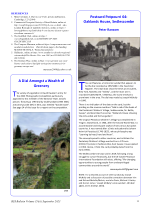
Discusses a postcard, likely dating from the early 1960s, featuring a horizontal sundial (likely SRN 5883) at Oaklands House, Sedlescombe. The dial, made by Joseph McNally in 1840, is notable for having small dials showing times for Jerusalem, New York, Natchez and “Sidney”.
Dials: Horizontal, Dials: Multi Faced, Historical Dials
September 2023
Page 12
Page 12
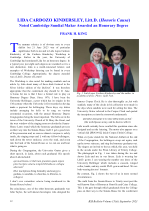
Reports on Lida Lopes Cardozo Kindersley, a renowned letterer and sundial maker, being awarded an honorary Doctor of Letters degree (Litt.D.) by the University of Cambridge on the summer solstice, 21 June 2023. The article notes her work on sundials, including those at Selwyn and Pembroke Colleges, and the inscription on the Corpus Clock.
Sundial Design & Layout, The BSS and Members
September 2023
Page 14
Page 14
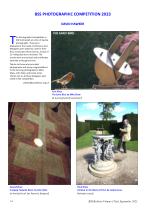
Reports the results of the 2023 BSS Photographic Competition, which attracted twelve entries and was voted on by delegates at the Exeter Conference. Winners included Mike Shaw (First Place, heliochronometer), John Allen (Second Place, Basilica of San Petronio), and Jackie Jones (Third Place, Polesden Lacey).
Dials: Heliochronometer, Dials: Noon Lines, The BSS and Members
September 2023
Page 15
Page 15
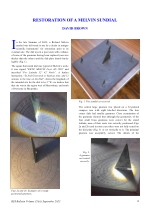
Describes the restoration of a square horizontal slate sundial made by Richard Melvin in 1856 (For Latitude 52° 42ʹ North). The work involved correcting the geometry and seating of the five gnomons, re-incising the details, and finishing the surface by painting the incisions light matt grey enamel and sealing the slate with oil.
Dials: Horizontal, Dials: Multi Faced, Restoration projects
September 2023
Page 18
Page 18
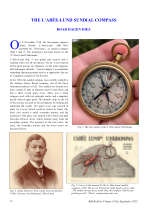
Details the history, design, and use of the Norwegian L’Abée-Lund Uhrkompas, patented in 1914. This brass, portable instrument was marketed using the figure of a red ant and includes scales for determining time based on solar azimuth, corrected for magnetic declination, longitude (8¾° east), and Equation of Time for a design latitude of 60° north.
Dials: Portable, Dials: Unusual, Historical Dials
September 2023
Page 25
Page 25
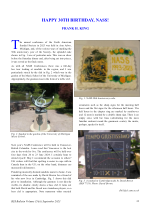
Reports on the North American Sundial Society’s (NASS) 30th Anniversary Conference held in Ann Arbor, Michigan, featuring a commemorative cake and a bus tour. The author notes a sundial in the University of Michigan Music School garden with a gnomon shaped as a treble clef, and mentions a music-themed bass clef dial by David Brown.
The BSS and Members
September 2023
Page 26
Page 26
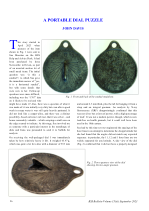
Investigates a heavy, pewter portable horizontal dial medallion, initially thought to be silver, dated “1707” with a gnomon angle of 38°. XRF analysis confirmed it as lead-heavy pewter. Detective work revealed the reverse side used a modified die from an 1855 Paris Exposition Universelle medal, making the 1707 date false.
Dials: Horizontal, Dials: Portable, Historical Dials
September 2023
Page 28
Page 28
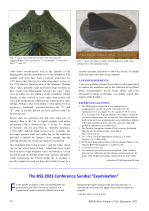
Reproduction of the sundial knowledge “examination” paper compiled by Martin Jenkins and distributed during the BSS 2023 Exeter Conference outing. The answers to this examination are provided later in the Bulletin on page 36.
The BSS and Members
September 2023
Page 33
Page 33
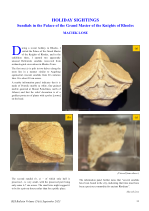
Reports on two Hellenistic sundial fragments observed in an exhibition in Rhodes Town. One fragment, about 30 cm across, is made of Pentelic marble and is split along the noon line. The second, much smaller fragment (6-7 cm across), may suggest use in a private home.
Historical Dials
September 2023
Page 34
Page 34
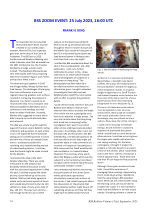
Reports on the inaugural quarterly BSS Sundial Zoom Event, inspired by Martins Gills and intended to review articles in the latest Bulletin. The event featured introductory comments by authors David Coffeen, Geoff Thurston, and Graham Stapleton, and proved successful despite initial timing uncertainties.
The BSS and Members
September 2023
Page 35
Page 35
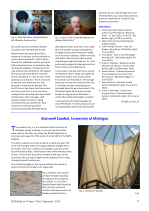
Describes a cylindrical sundial (Dial 1085 in the NASS Registry) located in a stairwell of the University of Michigan Energy Institute, seen during the NASS Conference bus tour. The nodus is formed by the centre of the eight radial arms supporting the skylight, and the markings include a toposcope.
Dials: Cylindrical, Dials: Unusual, Sundial Design & Layout
September 2023
Page 36
Page 36
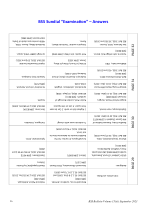
Provides the answers to the sundial knowledge “examination” questions that were compiled by Martin Jenkins for the BSS 2023 Exeter Conference. The full set of questions was reproduced on pages 29-32 of this Bulletin.
The BSS and Members