- Home
- /
- Sundial Encyclopaedia
- /
- Frank Evans
Frank Evans
December 2013
Page 12
Page 12
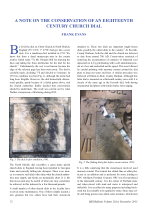
Details the conservation work performed on an 18th-century sandstone dial (1793) at Christ Church in North Shields, which was declining 7°E. The process involved cleaning, removal of cement, consolidation using lime mortar and grout, weatherproofing, and gilding the copper-based gnomon.
Dials: Vertical, Historical Dials, Restoration projects
September 2011
Page 28
Page 28
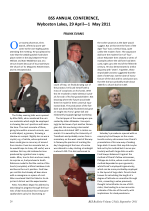
This report summarises the British Sundial Society's highly successful 2011 annual conference at Wyboston Lakes, attended by nearly 20% of its members. It covers various presentations, including Allan Mills on sun's position, Tony Moss on dial manufacture, Johan Wikander on a Norwegian soapstone dial, Fred Sawyer on Jean Picard's large dial layouts, and John Davis on the diffusion of scientific dials.
Historical Dials, Mathematics of Dialling, Sundial Design & Layout, The BSS and Members
September 2009
Page 42
Page 42
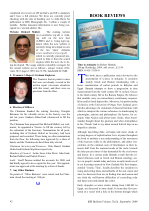
Features two reviews. The first covers "Time in Antiquity" by Robert Hannah, a book on Greek and Roman timekeeping. The second reviews Denis Savoie’s "Sundials: Design, Construction, and Use," a modern, practical text on constructing various types of sundials, translated from the French original.
Book Reviews
December 2009
Page 43
Page 43
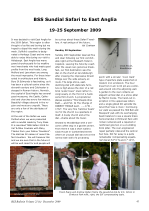
A multi-authored, day-by-day account of the society's annual week-long tour, this year through East Anglia. The report details the many historical and modern dials visited in Suffolk, Norwich, Essex, and surrounding areas, providing a travelogue of the group's discoveries and activities.
Historical Dials, The BSS and Members
September 2007
Page 114
Page 114
This article investigates a peculiar Pl. Long. inscription on the 1845 Hawkshead Grammar School sundial. Through extensive correspondence, Pl Long was identified as The Plane's Longitude referring to the hour angle in angular measure when the sun is directly over the style, rather than a geographical longitude.
Dials: Vertical, How Sundials Work, Sundial Design & Layout
March 2005
Page 23
Page 23
Narrates the British Sundial Society’s 2004 tour of Italy, detailing visits to Rome, Florence and Ravenna. Highlights significant sundials and meridian installations, including the Palazzo Spada ceiling dial, Pantheon meridian, San Petronio line, the La Meridiana villa and private designs. Describes historical context, local hosts, and field observations of classical gnomonic art.
The BSS and Members
March 2004
Page 21
Page 21
This article profiles Margaret Gatty (Mrs. Alfred Gatty), highlighting her diverse legacy in children's stories, seaweed studies, and her seminal work, 'The Book of Sundials'. It covers her early life, artistic talents, marriage, motherhood, and scientific interests, emphasising her dedication to collecting sundial mottoes which culminated in her famous book.
Historical Dials, Mottoes
June 2003
Page 74
Page 74
Two review of a book published by the British Sundial Society: 'Biographical Index of British Sundial Makers from the Seventh Century to 1920' by Jill Wilson.
Book Reviews
September 2003
Page 110
Page 110
A collection of letters from readers. Topics include a thank you for information on sundial makers for the 'Biographical Index of British Sundial Makers,' and some pub dial sightings.
The BSS and Members
December 2003
Page 165
Page 165
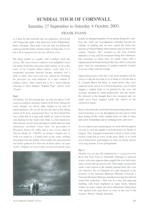
Travel report from the BSS Cornwall tour, describing dials visited, local history, scenic highlights, and member experiences.
The BSS and Members
June 2002
Page 80
Page 80
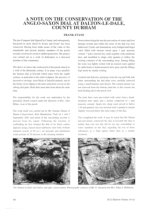
Brief report on preservation efforts for an early medieval dial, with notes on materials and techniques.
Dials: Mass Dials, Historical Dials
September 2002
Page 104
Page 104
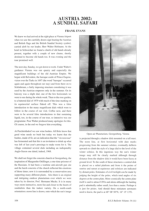
Travelogue of the BSS tour of Austria led by Walter Hofmann, visiting monasteries, public dials, and craftspeople; rich in descriptions of painted and sculptural dials.
Dials: Portable, Dials: Unusual, Dials: Vertical, The BSS and Members
October 2000
Page 129
Page 129
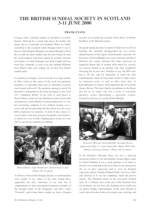
Trip report on a wet BSS expedition to Scotland documenting sundials, including locations, dial types, and travel experiences.
Historical Dials, The BSS and Members
February 1999
Page 4
Page 4
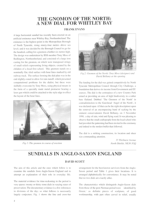
Details the erection of a large horizontal sundial near Whitley Bay, designed by Tony Moss. Named 'The Gnomon of the North', it features a six-metre-high iron gnomon with reliefs created by local schoolchildren, and its hour lines are marked by old railway track on a slightly coned surface.
Dials: Horizontal, Construction Projects
June 1999
Page 100
Page 100
This article classifies seventeen Anglo-Saxon sundials in Northumbria, categorizing them into four types based on design evolution from the 7th-8th century onwards. It details specific dials at Escomb, Dalton-le-Dale, Staindrop, Hart, and others, describing their physical characteristics, historical context, and erosion. The authors suggest a decline in construction delicacy over time and emphasize the need for conservation of these antiquities.
Historical Dials, Dials: Mass Dials
July 1997
Page 8
Page 8
A short piece about the south-facing sundial designed and built by George and Robert Stephenson in 1816, of which they were very proud, delineating it from first principles.
Dials: Vertical, Historical Dials
October 1994
Page 23
Page 23
This article describes the British Sundial Society's Mass Dial Group meeting held in Malton, North Yorkshire, in June 1994. It provides a light-hearted account of the attendees, their shared interest in dials, and their expedition to view numerous Anglo-Saxon and scratch dials in ancient churches. The author highlights the urgency of recording these crumbling historical artefacts due to environmental deterioration. The article also mentions a humorous discovery related to Shakespeare's "shepherds' dials" and references individuals like Robert Sylvester, Edward Martin (Mass Dial Group Co-ordinator), and Mrs. Alfred Gatty.
The BSS and Members
October 1993
Page 24
Page 24
This article tells the story of a sundial from the Neptune Shipyard in Walker, Newcastle-on-Tyne, founded by J. Wigham Richardson in 1860. It traces the dial's history, its motto, and its eventual restoration. The article highlights Richardson's skill as a geometrist and the involvement of his partner, Denham Christie, and describes the dial's characteristics and its journey to the Trinity Maritime Centre.
Dials: Vertical, Historical Dials, Restoration projects