- Home
- /
- Sundial Encyclopaedia
- /
- March 2010
March 2010
The articles link to the specific page in a PDF optimised for speed. If you want the whole issue, you can download it here, but the files from earlier years can be quite large.
March 2010
Page 1
Page 1
In this issue, we have articles from Greece, South Africa (two!) and Italy. Our members holiday abroad and are always on the lookout, camera in hand, for dials and here we have a collection from Spain, Russia, Switzerland and Italy. Added to all this, there are some dials currently in the UK but made for the West Indies.
The BSS and Members
March 2010
Page 2
Page 2
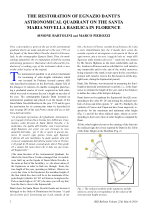
Describes the history and function of Egnazio Danti's 1572 astronomical quadrant in Florence. It details the five systems of time measurement it displayed and outlines the methodology used to re-compute the missing gnomons for a modern restoration and the creation of a working copy.
Dials: Vertical, Historical Dials, Restoration projects, Sundial Design & Layout
March 2010
Page 9
Page 9
A review of the BSS monograph 'The Double Horizontal Dial - and associated instruments' by J. Davis & M. Lowne. The book covers the history, geometry, design, manufacture, and engraving of double horizontal dials, horizontal instruments, and horizontal quadrants from the 17th century onwards.
Book Reviews, Dials: Double Horizontal, Historical Dials
March 2010
Page 10
Page 10
A collection of short articles describing new sundials. These include an equatorial 'solar acorn' dial in Solar, Russia; a vertical declining dial in Oxford inspired by Christopher Wren; and a mass-produced, flat-packed equatorial 'Sun Disc' from Australia designed for various latitudes.
Dials: Vertical, Dials: Equatorial, Dials: Unusual, Construction Projects
March 2010
Page 11
Page 11
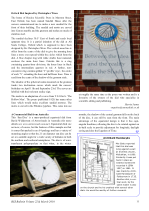
A brief note about the dial maker Archibald Handasyde of Fishberrow, who made a dial for Inveresk church, Midlothian, in 1735. The piece notes he is credited with several other dials and would be worthy of further research.
Historical Dials, The BSS and Members
March 2010
Page 12
Page 12
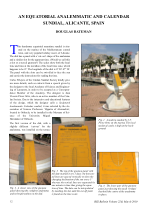
Describes a modern, equatorial meantime sundial on the marina in Alicante, Spain, designed by Juan Vicente Pérez Ortiz. The dial features a 'cut-out' analemma shape and a slot for apparent time, and has scales for both local and time zone time.
Dials: Analemmatic, Dials: Equatorial, Equation of Time
March 2010
Page 13
Page 13
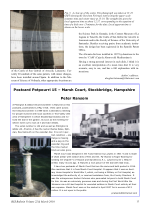
Features a Pilkington & Gibbs heliochronometer at Marsh Court, Stockbridge, Hampshire, as seen on a postcard postmarked 1916. The article provides details about the heliochronometer and the history of Marsh Court, which served as a hospital during World War I.
Historical Dials, Dials: Heliochronometer
March 2010
Page 14
Page 14
Discusses the challenges of studying early English mass dials due to limited surviving evidence, with only about 50 Saxon dials recorded. It argues that the predominance of timber for early churches means most dials were wooden and have not survived, proposing a hypothesis of near-universal dial use.
Dials: Mass Dials, Historical Dials
March 2010
Page 18
Page 18
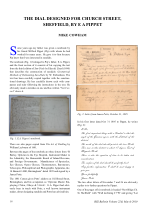
Explores the notebook of E.A. Pippet, detailing his original 1895 design for a west-declining vitreous enamel sundial for Cairns Chambers, Sheffield. It compares the design to the more modern stone dial currently on the building, which has a different declination.
Dials: Vertical, Historical Dials, Sundial Design & Layout
March 2010
Page 20
Page 20
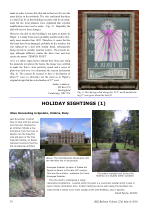
A brief travel report on two noon-mark sundials found in Spoleto, Umbria, Italy. One is located in the park of the Villa Pianciani Delizia and another, similar one at the Villa Redenta. Both are described as being in need of restoration.
Dials: Noon Lines, Historical Dials
March 2010
Page 21
Page 21
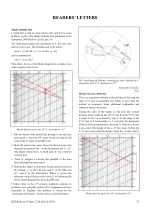
A collection of letters from readers. Topics include a simpler graphical method for using the John Marke altitude dial, a discussion on the nomenclature of mass dials, the 'Sun Position Compass', and the historical connection between clockmakers and dialmakers.
Dials: Mass Dials, Dials: Portable, Mathematics of Dialling, The BSS and Members
March 2010
Page 23
Page 23
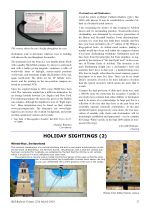
Features a vertical declining dial combined with a noon mark analemma on a church tower in Winterthur, Switzerland. The vertical dial is corrected for longitude, and the analemma is colour-coded for the two halves of the year.
Dials: Noon Lines, Dials: Vertical, Equation of Time
March 2010
Page 24
Page 24
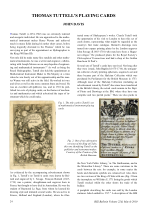
Discusses two sets of playing cards published in 1701 by instrument maker Thomas Tuttell, which functioned as a trade catalogue. The cards illustrate instruments like elliptical dials, dialling globes, and projections of the sphere used in dialling.
Dialling Tools, Historical Dials
March 2010
Page 28
Page 28
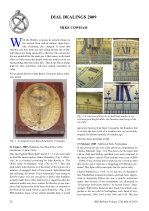
A review of sundials sold at auction in 2009. Notable items include a gilt brass compendium by Charles Whitwell dated 1608, a Panorganon by Joseph Wells, a Gunter's quadrant by Henry Wynne, and a silver Butterfield dial by Pierre le Maire.
Dials: Portable, Dials: Scaphe, Historical Dials, Dials: Nocturnals
March 2010
Page 32
Page 32
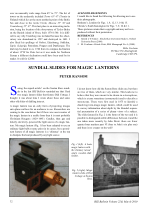
Discusses a collection of old magic lantern slides and glass negatives featuring sundials. The collection includes images of Dial Cottage at Seaton Ross, the multifaceted dial at Holyrood Palace from circa 1880, and a dial at Trinity College, Cambridge.
Dials: Multi Faced, Historical Dials
March 2010
Page 34
Page 34
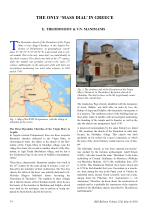
Describes what is believed to be the only mass dial in Greece, on the 12th-century Byzantine church in Chonikas. The dial likely dates to the early 17th century and is accompanied by carved inscriptions marking total solar eclipses in 1661 and 1760.
Dials: Mass Dials, Historical Dials
March 2010
Page 37
Page 37
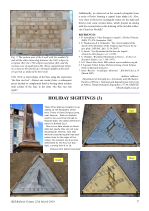
A photo feature of three dials on an obelisk at the Monastery of the Holy Trinity of Saint Sergius Lavra, near Moscow. The east-facing dial has declination lines for zodiac signs, while the west-facing dial shows the hours of daylight.
Dials: Multi Faced, Dials: Vertical, Historical Dials
March 2010
Page 38
Page 38
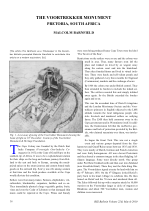
Describes how the Voortrekker Monument in Pretoria functions as a timekeeper. An aperture in the dome allows a ray of sunlight to illuminate a cenotaph at Local Solar Noon on 16th December each year, commemorating the 1838 Battle of Blood River.
Dials: Unusual, Sundial Design & Layout, Historical Dials, Dials: Noon Lines
March 2010
Page 41
Page 41
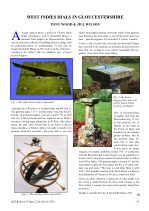
Describes two 18th-century horizontal sundials, now in Gloucestershire, originally made for West Indies plantations. One by John Fowler was designed for St Kitts (17.5° latitude) and the other by his apprentice Henry Gregory for a latitude of around 13°.
Dials: Horizontal, Historical Dials
March 2010
Page 42
Page 42
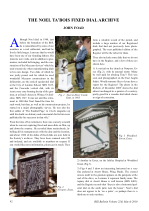
An overview of the photographic archive of Noel Ta'Bois, an early sundial enthusiast. The archive contains around 1,500 slides of fixed dials from the 1980s, which form a valuable record in the Society's collection and have helped identify unrecorded dials.
Historical Dials, The BSS and Members
March 2010
Page 44
Page 44
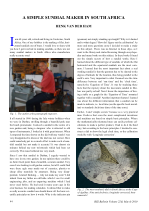
A personal account of making accurate horizontal brass sundials. The process began with a practical, non-mathematical method of marking hour lines and evolved into a small business creating personalised dials, including the most southerly dial in South Africa at Cape Agulhas.
Dials: Horizontal, Sundial Design & Layout, DIY Sundial Projects
March 2010
Page 46
Page 46
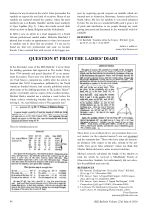
A follow-up to a previous article about dialling questions in 'The Ladies' Diary'. This piece presents the published solution to Question 87 from 1790, which asked for the area of the curve traced by a gnomon's tip on the winter solstice.
Mathematics of Dialling, Historical Dials
March 2010
Page 47
Page 47
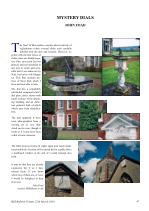
A request for help in identifying three sundials from an unidentified roll of film found in the Noel Ta'Bois archive. The images include a substantial octagonal dial, another photographed from a moving car, and a canted dial in a gable.
Dials: Horizontal, Dials: Vertical
March 2010
Page 48
Page 48
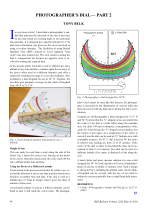
An extension of a previous article on a photographer's sundial. This part adds a scale to indicate the sun's altitude and provides a new design for use at 54° N, which, together with the original 51.5° N dial, covers all of England.
DIY Sundial Projects, How Sundials Work, Sundial Design & Layout