- Home
- /
- Sundial Encyclopaedia
- /
- Dials: Nocturnals
Dials: Nocturnals
June 2020
Page 43
Page 43
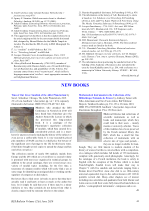
Reviews two books: "Time of Our Lives: Sundials of the Adler Planetarium" by Sara J. Schechner, cataloguing nearly 500 dials; and "Mathematical Instruments in the Collections of the Bibliothèque Nationale de France" by Anthony Turner et al., featuring 138 instruments including five sundials and nocturnals.
Dials: Portable, Book Reviews, Dials: Nocturnals
March 2017
Page 28
Page 28
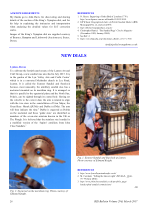
Description of the Exmoor Sundial and Starclock, an armillary sphere unveiled in 2015. Unusually, this stainless steel dial incorporates a nocturnal mounted on its meridian ring, allowing time measurement at night by sighting the North Star and guide stars in Ursa Major (The Plough).
Construction Projects, Dials: Armillary Sphere, Dials: Nocturnals
March 2017
Page 32
Page 32
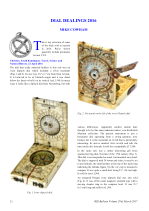
A selection of notable dials sold at auction in 2016. Highlights include a Flemish ivory diptych dial with a silver nocturnal (1590, sold for £17,500), a standing ring dial, a noon gun, an inclining dial by Benjamin Martin, and a silver Butterfield dial featuring Napoleon on the reverse.
Dials: Nocturnals, Dials: Portable, Dials: Unusual, Historical Dials
June 2016
Page 13
Page 13
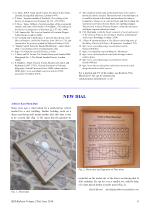
Description of a new direct east-facing moon dial commissioned for a client. The dial's gnomon is modelled on the nodus star of the Albi cathedral dial. It can function as a sundial using a chart located nearby, which also provides Equation of Time data.
Construction Projects, Dials: Nocturnals, Dials: Vertical, Equation of Time
September 2012
Page 20
Page 20
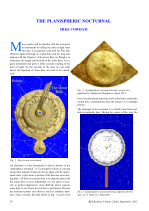
This article describes the planispheric nocturnal, an instrument for telling time at night by aligning a rotating star chart with actual stars. It functions as an alternative to a traditional nocturnal and can be found on the reverse of some quadrants, offering timekeeping to within 15 minutes without requiring Equation of Time correction.
Dialling Tools, How Sundials Work, Dials: Nocturnals
December 2012
Page 11
Page 11
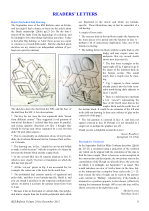
This section features two letters: Michael Lowne corrects a misconception regarding the alignment of the Plough's pointer stars with the pole star for planispheric nocturnals, impacting time readings. Steven Woodbury provides observations and a solution for the Dutch Polyhedral Dial drawing, noting its equatorial and polar dials and non-latitude specificity.
Dials: Multi Faced, Dials: Nocturnals
March 2010
Page 28
Page 28
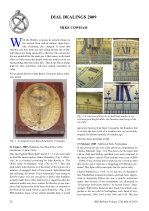
A review of sundials sold at auction in 2009. Notable items include a gilt brass compendium by Charles Whitwell dated 1608, a Panorganon by Joseph Wells, a Gunter's quadrant by Henry Wynne, and a silver Butterfield dial by Pierre le Maire.
Dials: Portable, Dials: Scaphe, Historical Dials, Dials: Nocturnals
September 2010
Page 10
Page 10
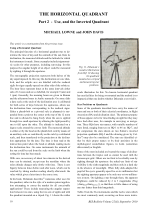
This article details the use of horizontal quadrants for time-finding and surveying, including a rare 'inverted' variant. It describes how to determine time from solar altitude and declination, and from stars at night, discussing the historical accuracy and limitations of these instruments.
How Sundials Work, Mathematics of Dialling, Historical Dials, Dials: Nocturnals
December 2009
Page 14
Page 14
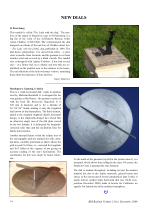
This section presents two new dials. The first is a stone vertical dial near St Petersburg with a theme from a Chekhov story. The second is a 'triple horizontal dial' made of stainless steel for a garden in South Africa, which includes a nocturnal and family anniversary lines.
Dials: Horizontal, Dials: Unusual, Dials: Nocturnals
December 2007
Page 189
Page 189
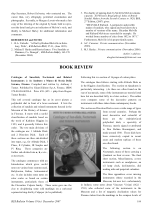
This is a review of 'Catalogue of Sun-dials, Nocturnals and Related Instruments in the Instituto e Museo di Storia Della Scienza, Firenze' by Anthony J Turner. The catalogue details Florence's collection of sundials, nocturnals, and other instruments, categorized using Higgins' classification. The reviewer praises the initiative but criticizes the illustration presentation, including identification, placement, size, and photographic angles.
Book Reviews, Dials: Multi Faced, Historical Dials, Dials: Nocturnals
February 2006
Page 6
Page 6
Drawing on Sappho's poem, this article explores the history of time measurement, from ancient astronomical principles to modern atomic clocks. It examines the evolution of the term 'hour,' different timekeeping systems (Babylonic, Italic, canonical, equal), and how celestial phenomena like moon phases and the Pleiades were interpreted to determine time and seasons.
How Sundials Work, Historical Dials, Dials: Nocturnals
February 2006
Page 14
Page 14
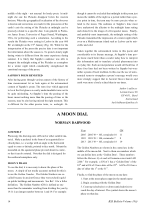
This article provides instructions for assembling and using a moon dial. It explains how to determine the moon's phase using the Golden Number and how to rotate the dial to find the current time. The author notes that this dial relies on estimating the moon’s direction rather than casting a visible shadow, due to the moon's light intensity.
Dials: Equatorial, Dials: Unusual, Construction Projects, DIY Sundial Projects, Dials: Nocturnals
March 2005
Page 3
Page 3
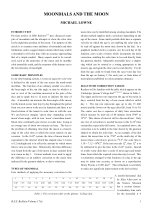
Explores principles and types of moondials, including tabular, volvelle, graphical and adjustable designs. Analyses moon’s orbital motion, parallax, illumination, and visual limitations under moonlight. Proposes improvements to enhance accuracy towards that of simple sundials, and presents prototype experimental dials demonstrating refined timekeeping performance.
Dials: Nocturnals
June 2005
Page 63
Page 63
Letter recommending WinEphem software for calculating moon transit times useful for moondials. Notes features such as rise/set/transit data and accuracy for dialling purposes.
Dialling Tools, Dials: Nocturnals
September 2005
Page 106
Page 106
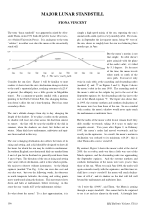
The author describes the term 'lunar standstill' coined by Alexander Thom, as analogous to a solstice. The article explains how the moon's declination affects its rising and setting points and how this affects the reading of 'moon time' from a sundial.
Dials: Nocturnals
June 2002
Page 76
Page 76
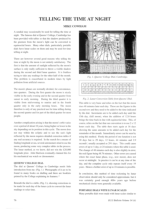
Explores historical and modern approaches to determining time after sunset using nocturnals and other devices.
Dials: Vertical, Dials: Portable, Dials: Astrolabe, Historical Dials, Dials: Nocturnals
December 2002
Page 135
Page 135
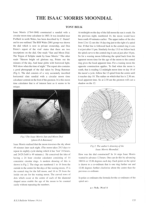
A detailed explanation of a unique 1803 sundial with a moon time calculator by Isaac Morris, exploring its design, mathematics, and possible use for tide prediction.
Historical Dials, Dials: Nocturnals
June 2001
Page 73
Page 73
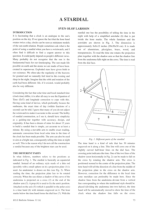
The article presents the Stardial, an innovative device functioning as an equatorial sundial by day and a simplified astrolabe by night. Designed for simplicity, accuracy, and originality, it enables automatic conversion from local solar time to clock time and provides methods for precise time-telling using bright stars and even the moon.
Dials: Equatorial, Dials: Unusual, Dials: Astrolabe, DIY Sundial Projects, Dials: Nocturnals
June 1993
Page 2
Page 2
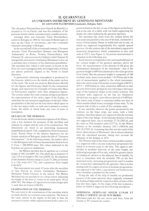
This article details the discovery and analysis of the 'Quarantale', a lost gnomonic instrument invented by Geminiano Montanari, found through manuscript inscriptions related to a meridian line in Bologna. It explains how the instrument was designed for stellar observations, covering a 140° meridian arc to cover two apertures, by using a unique optical sight and mathematical calculations based on similar triangles, restoring its historical context.
Dials: Noon Lines, Dials: Unusual, Historical Dials, Dials: Nocturnals
February 1992
Page 11
Page 11
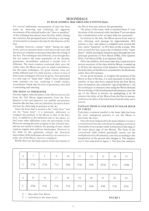
This article reviews historical techniques for telling time by the moon, noting their limited accuracy due to the moon's irregular movements and the need to convert lunar time to solar time. It describes methods like using correction tables (e.g., Queen's College, Cambridge, or Rene Rohr's diagram) and specific moondial instruments (Oronce Fine, Bion). The author also proposes a new model of lunar dial, adapting a horizontal sundial with "lunar hour lines" as spiral curves.
Dials: Unusual, Dials: Nocturnals, Sundial Design & Layout
June 1992
Page 3
Page 3
This lecture explores the practical aspects of 16th and 17th-century navigation, highlighting the crucial role of sundials and similar instruments for determining time at sea. Mariners used celestial observations for latitude, magnetic compasses for direction, and various tools like traverse boards, sand-glasses, nocturnals, astrolabes, and cross-staves for navigation and timekeeping.
Dialling Tools, Dials: Portable, Historical Dials, Dials: Nocturnals
June 1992
Page 38
Page 38
This article explores the concept of a tidal dial for estimating tidal times, acknowledging the moon's primary influence on tides over the sun. It discusses the 'Port Establishment' and 'Lunar Situation,' and how a specially designed watch or optical sight, combined with knowledge of the moon's age, could provide approximate tidal information globally, even correcting for hydrographic board errors.
Dials: Unusual, Dials: Nocturnals
October 1991
Page 16
Page 16
Rene R.-J. Rohr introduces the 18th-century Islamic instrument known as the "da'ire-yi mu'addil" (equatorial circle), used for determining daily and nightly prayer times. Driven by religious prescriptions, Islamic scientists developed sophisticated astronomical and mathematical methods. This instrument, although not mathematically precise, allows for the determination of prayer times, especially night prayers like isha and subh, through observation of the sun and moon's positions.
Dials: Equatorial, Historical Dials, Dials: Nocturnals