- Home
- /
- Sundial Encyclopaedia
- /
- June 1993
June 1993
The articles link to the specific page in a PDF optimised for speed. If you want the whole issue, you can download it here, but the files from earlier years can be quite large.
June 1993
Page 1
Page 1
This section reports on activities of the Hungarian Astronomical Association and the Sundial Working Group of the Austrian Astronomical Society, including meetings, museum visits, and lectures on various sundial topics like holographic sundials. It also covers De Zonnewijzerkring's excursions, exhibitions, and a historical account of time differences in the Netherlands, alongside mathematical articles and ongoing efforts to record sundials.
The BSS and Members
June 1993
Page 2
Page 2
This article details the discovery and analysis of the 'Quarantale', a lost gnomonic instrument invented by Geminiano Montanari, found through manuscript inscriptions related to a meridian line in Bologna. It explains how the instrument was designed for stellar observations, covering a 140° meridian arc to cover two apertures, by using a unique optical sight and mathematical calculations based on similar triangles, restoring its historical context.
Dials: Noon Lines, Dials: Unusual, Historical Dials, Dials: Nocturnals
June 1993
Page 8
Page 8
This article critically examines polyhedral sundials designed by Nicholaus Kratzer, Henry VIII's diallist, comparing his work with that of Oronce Fine (Francis I of France's diallist). It describes surviving and recorded dials, including those in Holbein's paintings, and questions the practical functionality of Kratzer's polyhedral design due to apparent geometric inconsistencies and the use of the Ecliptic's obliquity angle in extraneous constructions.
Dials: Multi Faced, Sundial Design & Layout, Historical Dials
June 1993
Page 11
Page 11
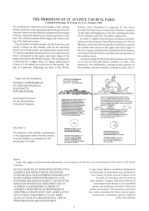
This is the second part of an article describing two meridians in St Sulpice Church, Paris, by Henry Sully and Charles Le Monnier. It details their purpose for time measurement and astronomical observations, discussing restoration efforts, challenges in conservation, and the historical context of time standardization. It also covers Le Monnier's observations and the meridian's condition through the French Revolution and later centuries.
Dials: Noon Lines, Equation of Time, Historical Dials
June 1993
Page 18
Page 18
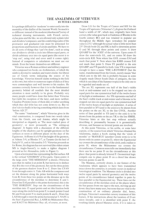
This article explores Vitruvius's Analemma, a vital geometric construction from Roman architecture used for sundial design. It describes the step-by-step process of constructing the Analemma using only a ruler and compasses, explaining how it projects old Temporal Hours and can be adapted for modern hours. The text provides insights into ancient dialling techniques, their historical continuity, and potential links to medieval astrological traditions and later drawing methods.
Historical Dials, Mathematics of Dialling, Sundial Design & Layout
June 1993
Page 21
Page 21
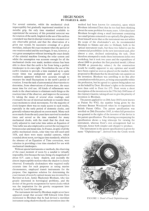
This article discusses historical methods for determining exact noon, crucial for regulating early mechanical clocks. It highlights the challenges of precise noon observation with traditional sundials and describes the Dipleidoscope, an ingenious optical instrument invented by James Mackenzie Bloxham and later patented by Dent. This device used prisms or mirrors to achieve accurate noon determination through the visual coincidence of two sun images.
Dialling Tools
June 1993
Page 25
Page 25
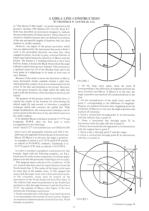
This article provides a graphical technique for constructing a qibla line on horizontal Arabic sundials, which indicates the prescribed direction of Mecca for Islamic prayer. It details the mathematical formula for determining the inhiraf angle and outlines a step-by-step construction procedure using a specific template. The article also notes the adaptability of this construction method for finding the azimuth of any other location.
DIY Sundial Projects, Mathematics of Dialling, Sundial Design & Layout
June 1993
Page 26
Page 26
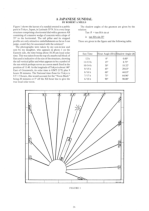
This article describes a large horizontal sundial monument erected in a public park in Tokyo, Japan, at 35°N latitude. It details the sundial's design, including a massive concrete wedge gnomon with a 35° slope, and discusses the calculation of shadow angles. The text explains how the sundial's Noon Mark accounts for the 20-minute difference between Tokyo's local solar time and its national time zone.
Dials: Horizontal
June 1993
Page 28
Page 28
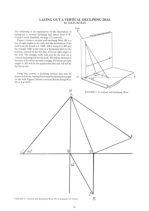
This article explains the geometric method for laying out a vertical declining sundial, drawing from F.W. Cousin's book Sundials. It details how to determine the style base, style height, equinoctial line, and noon line using a series of right angles and specific angles for latitude and wall declination. The process is illustrated with an example of a vertical dial declining West 30° at Latitude 50°N.
DIY Sundial Projects, Dials: Vertical, Mathematics of Dialling, Sundial Design & Layout
June 1993
Page 30
Page 30
The Chairman reflects on the importance of acknowledging errors in the field of dialling and maintaining high standards within the British Sundial Society. He shares personal anecdotes of past mistakes and discusses common misconceptions about sundials, such as their role in timekeeping, reasons for their decline, and the historical evolution of their appearance, emphasizing the need for accuracy and critical examination.
The BSS and Members
June 1993
Page 33
Page 33
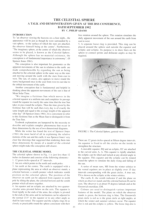
This article describes a three-dimensional model of the celestial sphere designed to clarify astronomical and gnomonic phenomena. It explains fundamental concepts like the apparent movements of the sun, mean solar time, and the components of the model, including great circles, axis, earth, and movable equator/ecliptic. The article demonstrates how the model illustrates the sun's rising and setting, and the factors contributing to the Equation of Time.
How Sundials Work
June 1993
Page 38
Page 38
This section contains reviews of three publications: Manuscritos Relojeros by Jose Luis Basanta Campos, detailing 45 historical dialling manuscripts; Se Ne Va il Tempo Come L'Ombra by Gianmarco Rebaudengo et al., a pictorial record of sundials in Asti, Italy; and Ivory Diptych Sundials 1570-1750 by Steven A. Lloyd, cataloguing Harvard University's collection with historical introductions.
Book Reviews
June 1993
Page 40
Page 40
This article describes the unusual sundial on the north wall of Merton College Chapel, Oxford, discussing its restoration and historical attribution to Henry Briggs or John Bainbridge. It analyses the confusing sets of lines, including declination and azimuth lines, and explains the dial's limited functionality (5.30 to 10.00 am in summer) due to its orientation and surrounding buildings, suggesting it was an academic exercise rather than a practical time indicator.
Dials: Unusual, Dials: Vertical, Historical Dials, Sundial Design & Layout
June 1993
Page 42
Page 42
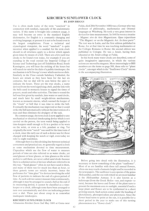
This article explores Athanasius Kircher's Sunflower Clock, a theoretical and whimsical device described in his 1641 treatise that uses a sunflower's heliotropic movement to indicate time. It discusses the technical and etymological inaccuracy of the term sunclock for sundials, explains the sunflower's mechanism (a pointer against a circular scale), and questions the practicality of such a clock given the plant's limited functional period.
Dials: Unusual
June 1993
Page 43
Page 43
The editor provides an apology for the late publication of the bulletin due to medical conditions and mislaid material. He also welcomes articles and letters from members, outlining publication standards, including formatting requirements, accuracy, copyright considerations, and the preference for English texts. He notes the positive feedback on the bulletin and the approval for reprinting earlier issues.
The BSS and Members