- Home
- /
- Sundial Encyclopaedia
- /
- March 2020
March 2020
The articles link to the specific page in a PDF optimised for speed. If you want the whole issue, you can download it here, but the files from earlier years can be quite large.
March 2020
Page 1
Page 1
Discussion of the March Bulletin content, noting that it contains formal material required for the AGM, including the Trustees’ Annual Report and Annual Accounts. It mentions articles focusing on Scottish sundials (Drummond Castle, Glamis Castle, Neidpath Castle) and Mike Cowham's Dial Dealings. It also reports the death of Karl Schwarzinger, founder of the Austrian Sundial Society.
March 2020
Page 2
Page 2
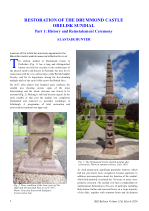
Details the history and recent restoration of the monumental obelisk sundial at Drummond Castle, Perthshire, originally dating from 1630. The article introduces the structure, the discovery of complex gnomonic features, and the reinstatement ceremony in June 2019. The restoration included replacing gnomons and correcting misconceptions about its function.
Dials: Multi Faced, Restoration projects, Historical Dials, The BSS and Members
March 2020
Page 9
Page 9
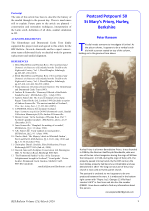
Describes a postcard of a vertical south dial at St Mary’s Priory, Hurley, Berkshire. The dial appears to feature a person seated on top of the column holding the gnomon. The author notes the need for further investigation into this dial and provides historical context about the priory.
Dials: Unusual, Dials: Vertical, Historical Dials
March 2020
Page 10
Page 10
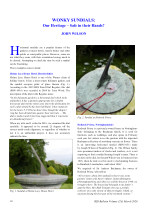
Discusses several examples of horizontal sundials found in public places (Holme Lacy House Hotel, Hodsock Priory, Canons Ashby) that are poorly aligned and useless for telling time. The author carries a compass to check sundial alignment, noting that badly set-up dials discredit those interested in them. The Hodsock Priory dial is attributed to Joseph Wilson of Stamford, circa 1818–1860.
Dials: Horizontal, Sundial Design & Layout, Historical Dials
March 2020
Page 11
Page 11
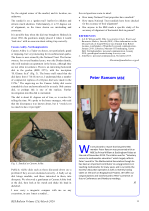
A congratulatory note reporting that long-time BSS member Peter Ransom was presented with an MBE by Prince William in November 2019 for voluntary service to mathematics education. He is noted for contributing to using gnomonics in teaching mathematics and currently serves as the Society’s Education specialist.
The BSS and Members
March 2020
Page 12
Page 12
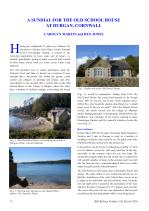
Describes the process of commissioning and constructing a diamond-shaped vertical dial on the Old School House at Durgan, Cornwall. The wall declination was measured at 17½ degrees east of south. The slate dial is adjusted for longitude to show 'Greenwich Apparent Time' and includes a small notch for local noon. It was a collaborative effort involving the National Trust and letter carver Ben Jones.
Construction Projects, Dials: Vertical, Mathematics of Dialling, Sundial Design & Layout
March 2020
Page 14
Page 14
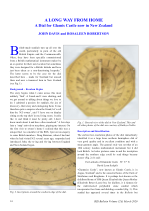
Investigates a brass northern hemisphere dial found in New Zealand, identified by its inscription as made for Glamis Castle, Scotland (Latitude 56° 37′ N) and signed 'David Lyon Sculpsit'. Detailed analysis of the Coat of Arms and Equation of Time scale dates the dial to between 1710 and 1752, likely commissioned around the 1725 marriage of the 6th Earl of Strathmore, Charles Lyon, to Susan Cochrane. The dial was never installed at Glamis.
Dials: Horizontal, Equation of Time, Historical Dials, Mottoes
March 2020
Page 21
Page 21
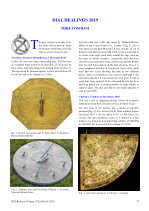
Reviews notable sundials sold at auction in 2019, including an octagonal brass double horizontal dial by Elias Allen (£3,300) and a multiple slate dial by Richard Melvin (£900). The highest price was £731,250 for a medieval astrolabe quadrant. Other items included a silver Butterfield dial, Augsburg dials by Vogler and Müller, and modern reproductions.
Dials: Astrolabe, Dials: Double Horizontal, Dials: Portable, Historical Dials
March 2020
Page 23
Page 23
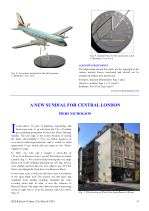
Describes the planning and design of the Fleet Street Heritage Sundial, a vertical dial facing a few degrees north of east, approved after 12 years. Located on the site of Richard Carlile's former publishing house (The Republican), the project commemorates Carlile and others who fought for the freedom of the press. The design incorporates hour lines (6 to 10 am) and newspaper mastheads, aiming to serve as a permanent heritage memorial.
Dials: Vertical, Sundial Design & Layout, Construction Projects
March 2020
Page 26
Page 26
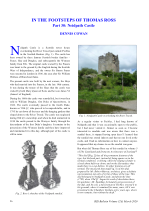
Focuses on the lectern-type sundial originally from Neidpath Castle. The article recounts the dial's history, noting it was saved by a gardener in 1795 and eventually returned to the castle in 1961. The dial is unusual as it is oblong and features a sloping hemi-cylinder ending halfway down with a cup-hollow underneath. It includes descriptions of the multiple faces, incorporating sunken, reclining, and proclining dials.
Dials: Multi Faced, Dials: Scaphe, Dials: Unusual, Historical Dials
March 2020
Page 29
Page 29
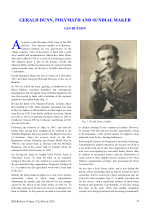
A biography of Gerald Raymond Dunn (1917–2002), detailing his military career, farming attempts, and later ventures, including tracing unclaimed estates and inventing the Cruiserfix solar navigator. He undertook metalwork training and became a sundial maker, specializing in equinoctial ring dials. He also supplied a simple solar compass for a Sahara expedition.
Construction Projects, Dials: Equatorial, Dials: Portable, The BSS and Members
March 2020
Page 33
Page 33
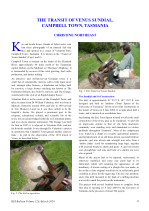
Describes an unusual agricultural-themed sundial designed and built by Anthony Sprent in 2004 to commemorate Campbell Town's role in observing the 1874 transit of Venus. The device, made mostly from old farm machinery parts, is a heliochronometer that uses a nodus (aperture) to project light onto an engraved analemma on a bronze plough disc.
Construction Projects, Dials: Heliochronometer, Dials: Unusual, Equation of Time
March 2020
Page 36
Page 36
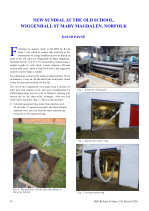
Details the construction of a large 3-metre diameter armillary dial made from surplus mild steel H-beam and stainless steel components. Constructed by TAM Engineering Services Ltd, the dial includes a central aluminum globe nodus and a stainless steel equatorial ring with laser-cut Roman numerals. It was built for the old school in Wiggenhall St Mary Magdalen.
Construction Projects, Dials: Armillary Sphere, Sundial Design & Layout
March 2020
Page 38
Page 38
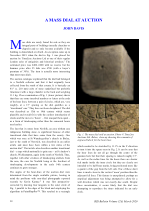
Examines a rare 8½-inch stone cube mass dial (13th or 14th century) sold at auction, originating from South Norfolk. Analysis shows it qualifies as a 'transitional dial' with roughly 15° spacing between lines, possibly reflecting the early use of unequal or equal hours related to clocks. Its existence, along with others in Norfolk, suggests the county was prominent in timekeeping developments in the early 14th century.
Dials: Cube, Dials: Mass Dials, Dials: Unusual, Historical Dials
March 2020
Page 40
Page 40
A review of Jill Wilson’s expanded third edition of the Biographical Index of British Sundial Makers, featuring nearly 1900 entries (330 more than the previous edition). The book is divided by century, includes illustrations, useful lists of references, and complementary material on London Guilds and apprenticeships.
Book Reviews, Historical Dials, The BSS and Members
March 2020
Page 40
Page 40
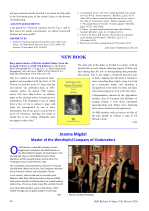
Reports that noted BSS member Joanna Migdal was installed as the 2020 Master of the Worshipful Company of Clockmakers on 28 January. In her speech, she referred to famous sundial makers and former Masters, Elias Allen and Henry Wynne. Two other BSS members attended the Installation Dinner.
The BSS and Members
March 2020
Page 41
Page 41

Formal material included in the March Bulletin as required by the BSS Constitution, presenting the Annual Report prepared by the Trustees.
The BSS and Members
March 2020
Page 47
Page 47
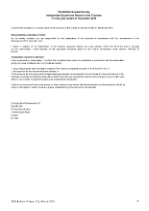
Formal financial material required by the BSS Constitution, providing the Annual Accounts for the year ending 31 December 2019, along with associated reports.
The BSS and Members