- Home
- /
- Sundial Encyclopaedia
- /
- March 2011
March 2011
The articles link to the specific page in a PDF optimised for speed. If you want the whole issue, you can download it here, but the files from earlier years can be quite large.
March 2011
Page 1
Page 1
A theme in this issue is polyhedral dials. There are examples of both portable and monumental dials as well as help in making them. This issue also sees the introduction of some portraits and short biographies of the authors.
March 2011
Page 2
Page 2
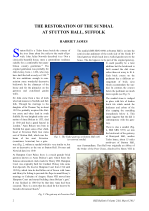
This article details the restoration of a Tudor sundial at Stutton Hall in Suffolk. It covers the history of the house and dial, archaeological findings suggesting its originality, and the methods used for cleaning, realigning the gnomon, and repainting based on known Tudor designs.
Dials: Vertical, Historical Dials, Restoration projects, Sundial Design & Layout
March 2011
Page 5
Page 5
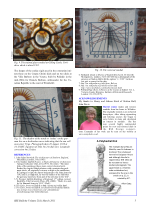
This entry briefly describes the multiple dial at Mount Melville, Scotland, identifying it as a rhombic cubo-octahedron rotated by 45 degrees, based on information from Gatty.
Dials: Multi Faced, Historical Dials, Sundial Design & Layout
March 2011
Page 6
Page 6
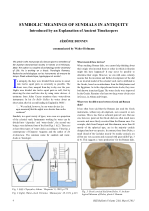
This article explores the symbolic meanings of sundials in antiquity, drawing on literary and epigraphical evidence from the Greco-Roman world. It also introduces ancient timekeepers, including clepsydra and various types of horologia, and discusses the differences between Greek and Roman dials.
How Sundials Work, Historical Dials
March 2011
Page 11
Page 11
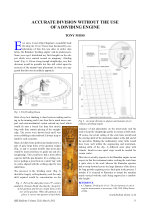
The author explores methods for accurately dividing sundial scales without modern dividing engines. He proposes a compact, semi-mechanical system using pivot pins and a straightedge, designed to fit on a bench, and notes its superiority over Ramsden's engine in terms of user comfort.
Construction Projects, Dialling Tools, Sundial Design & Layout
March 2011
Page 12
Page 12
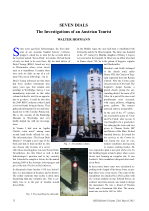
An Austrian tourist investigates the mystery of London's 'Seven Dials' monument. The article details the history of the area, the original Doric pillar with six sundials erected in 1693/94, its removal in 1773, its relocation to Weybridge, and the eventual erection of a new column with seven dials in 1989.
Dials: Multi Faced, Restoration projects, Historical Dials
March 2011
Page 14
Page 14
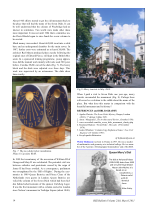
This entry briefly mentions the Holyrood Palace dial (SRN 1490), dating from 1633 and made by John Mylne, noting its basis on an icosahedron, a Platonic solid with 20 identical faces.
Dials: Multi Faced, Historical Dials
March 2011
Page 15
Page 15
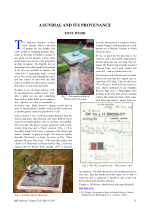
This article describes an equatorial sundial at Weston-under-Penyard, initially believed to be 17th-century due to its inscription. The author's investigation, including a 1932 sales receipt and a Christie's report, reveals it was made by Pearson Page in the early 20th century, highlighting the importance of provenance.
Dials: Equatorial, Historical Dials
March 2011
Page 16
Page 16
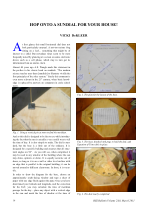
This article provides instructions for making a simple, fun, and versatile horizontal sundial for educational purposes, particularly for young people. It explains how to determine the meridian line, layout the base, and incorporate an Equation of Time table for accurate civil time.
DIY Sundial Projects, Dials: Horizontal, Equation of Time, Sundial Design & Layout
March 2011
Page 17
Page 17
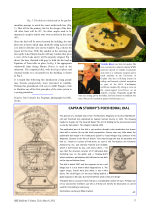
This article describes a polyhedral dial from Captain Samuel Sturmy's 1679 'The Mariners Magazine'. It's a rhombic cubo-octahedron dated 1667, said to have 27 individual dials, and features an unusual globe dial showing stars. The dial's current whereabouts are unknown.
Dials: Multi Faced, Historical Dials
March 2011
Page 18
Page 18
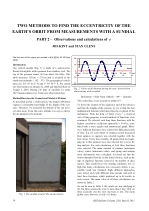
This second part details observations and calculations to determine Earth's orbit eccentricity using a sundial. It applies Ptolemy's geometrical model and an algebraic approach based on the Equation of Time, finding surprisingly accurate results despite the sensitivity of initial conditions.
Equation of Time, How Sundials Work, Mathematics of Dialling
March 2011
Page 20
Page 20
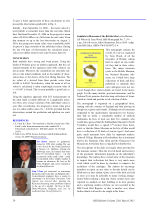
This section contains reviews of several books related to sundials and timekeeping, including 'Sundials in Museums of the British Isles' by Butson, Wilson & Wood, 'Tempus et Regula: orologi solari medievali Italiani' by Mario Arnaldi, and 'Cadrans Solaires de Bretagne' by J-P Cornec & P Labat-Segalen.
Book Reviews
March 2011
Page 22
Page 22
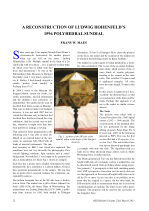
This article describes the reconstruction of Ludwig Hohenfeld’s 1596 polyhedral sundial, a 26-sided rhombic cubo-octahedron, using distorted photographs and image editing software. It details the process of rectifying the faces and analyzing the sundials inscribed on them to estimate the design latitude.
Dials: Multi Faced, Sundial Design & Layout, Construction Projects, DIY Sundial Projects, Historical Dials
March 2011
Page 27
Page 27
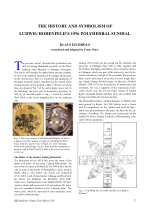
This article delves into the history of Ludwig Hohenfeld’s 1596 polyhedral sundial, identifying the maker and recipient (Prince Johann Friedrich of Württemberg). It also explores the rich symbolism of the images and maxims on the dial's faces, which convey themes of time and education.
Dials: Multi Faced, Historical Dials, Mottoes
March 2011
Page 31
Page 31
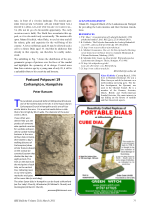
This entry describes a Saxon dial on Corhampton Church, Hampshire, one of four similar octaval dials in the area. The author wonders if they were products of a regional sundial-making business, noting their division of the day into eight periods based on tides.
Dials: Mass Dials, Dials: Vertical, Historical Dials
March 2011
Page 32
Page 32
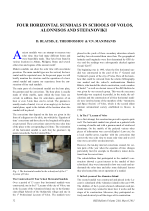
This article details the construction and placement of four horizontal sundials in Greek schoolyards between 1995 and 2008. It highlights student involvement, the evolution of precision in Equation of Time corrections, and the use of modern technology in their design and carving.
Dials: Horizontal, Construction Projects, Equation of Time, DIY Sundial Projects
March 2011
Page 34
Page 34
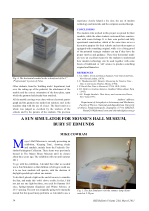
This article describes the creation of a motorised sun simulator for a museum exhibition, designed to demonstrate how sundials work by speeding up daylight duration. It features three lights for different seasons and allows visitors to test card sundial kits.
Construction Projects, Dialling Tools, How Sundials Work
March 2011
Page 36
Page 36
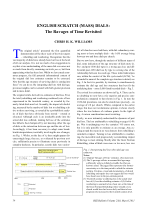
This article revisits previous estimates of scratch dial loss, incorporating dial age structure to provide more precise understanding of historical and future loss dynamics. It analyzes the impact of rebuilding and weathering, noting weathering's increasing dominance over time and the implications for conservation.
Restoration projects, Historical Dials, Dials: Mass Dials
March 2011
Page 39
Page 39
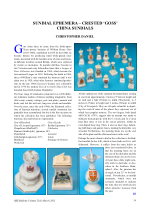
This article describes a collection of miniature crested 'Goss' china sundial ornaments produced from the 1880s. These decorative horizontal dials, typically featuring local heraldic arms, were collected as souvenirs and are now considered rare treasures, despite often having incorrect hour-line delineations.
Dials: Horizontal, Dials: Portable, Dials: Unusual, Historical Dials
March 2011
Page 41
Page 41
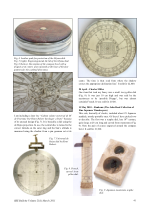
This article reviews notable sundials and related instruments sold at auction in 2010, including a silver pocket compass dial by Richard Glynne, a double inclining string gnomon dial by Jacques Le Maire, Japanese scaphe dials, and an ivory and silver compass dial by Elias Allen.
Dials: Portable, Dials: Unusual, Historical Dials
March 2011
Page 43
Page 43
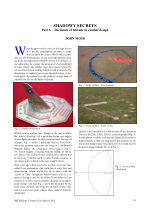
This article explores how artistic objectives and geographical latitude impose limits on sundial design. It provides examples like an 'Arrow of Time' dial and an 'Apple Tree' dial, illustrating how proportions and realism are affected by latitude, and introduces a 'geographically modified' armillary octahedron.
How Sundials Work, Sundial Design & Layout
March 2011
Page 45
Page 45
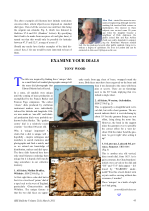
This article highlights three 'unique' sundials found in a collection of photographs, encouraging readers to identify similar features. It discusses a two-faced prism dial, a vertical dial with a bent gnomon, and a direct south dial with an unusual inscription, emphasizing the individuality of pre-mass production dials.
Dials: Multi Faced, Dials: Unusual, Dials: Vertical, Historical Dials
March 2011
Page 46
Page 46
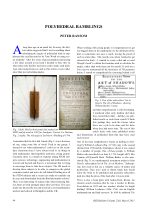
The author discusses the calculation of angles for polyhedral dials, drawing on historical texts like William Leybourn’s 'Dialling'. It covers Platonic and Archimedean solids, methods for finding dihedral angles, and illustrates how these concepts can be applied to sundial construction.
Dials: Multi Faced, Historical Dials, Mathematics of Dialling, Sundial Design & Layout