- Home
- /
- Sundial Encyclopaedia
- /
- How Sundials Work
How Sundials Work
June 2023
Page 8
Page 8
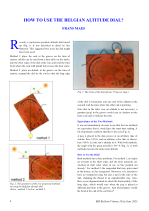
Reviews two methods suggested by Sue Manston for operating a portable altitude dial (a Hevelius dial). Geometric analysis confirms the two methods are equivalent, but practical tests suggest Method 1, using the shadow of a gnomon parallel to the short edge, is feasible for determining the time with 10–15 minutes accuracy.
Dials: Portable, How Sundials Work
June 2023
Page 10
Page 10
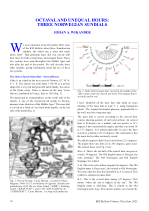
Describes three historic Norwegian sundials (Giske Church Mass Dial, Kråkvåg Horizontal Sundial, Mandal Horizontal Sundial) demonstrating the use of octaval hours (eight parts of the day) and unequal hours (15 degrees). The study details how the octaval system gave way to unequal hours during a transition period, and uses compass history to estimate ages.
Dials: Horizontal, Dials: Mass Dials, Historical Dials, How Sundials Work
December 2023
Page 30
Page 30
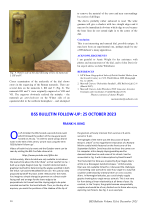
A report on the second BSS Zoom event (renamed 'BSS Bulletin Follow-up'). The event included discussions on the Erfurt Rule and a demonstration of chiselling during the restoration of a Melvin sundial, alongside a theoretical look at converting solar azimuth to solar hour angle for different latitudes.
Dialling Tools, How Sundials Work, Restoration projects, The BSS and Members
September 2022
Page 32
Page 32
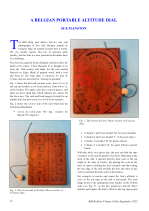
Examines a challenging 18th-century portable altitude dial from Belgium, made of painted wood. The article discusses the function of its sunrise and hour scales and proposes possible, albeit fiddly, methods of operation using a cord and bead, given the likely absence of a gnomon or alidade.
Dials: Portable, How Sundials Work
September 2022
Page 34
Page 34
A summary of recent international research into medieval sundials. Highlights the Fachkreis Sonnenuhren database (696 German objects) and debates whether scratch dials are pilgrim symbols. Mentions new findings on medieval texts describing unequal-hour sundials and the construction of polar style dials.
How Sundials Work, Historical Dials, Dials: Mass Dials
June 2021
Page 44
Page 44
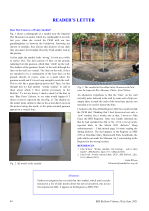
A reader discusses an unusual sundial near the Imperial War Museum, featuring hour lines on the ground that continue vertically up a wall. The author models the dial, hypothesizing that it functions like a giant diptych pocket dial or that the vertical markings are merely endpoints for the hour lines, noting its history in the Fixed Dial Register.
Dials: Portable, Dials: Unusual, How Sundials Work, Sundial Design & Layout
September 2021
Page 20
Page 20
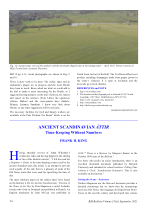
A guide to the ancient Scandinavian system of time-keeping using "áttir" (eighths of the horizon) and landmarks known as daymarks. It explains the Old Norse terminology (middag, miðnætti, undorn) and discusses why this non-numerical system was suitable for high latitudes where unequal hours were unviable.
How Sundials Work, Mathematics of Dialling, Historical Dials
June 2020
Page 7
Page 7
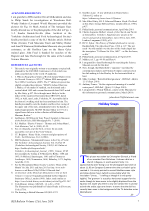
This short article presents a picture of a west-facing sundial on a church in Ragusa, Sicily. The dial is painted in normal Mediterranean style, shows Italian hours, and is notable for its gnomon which acts as a horizontal support for the nodus.
Dials: Vertical, Dials: Unusual, How Sundials Work
June 2020
Page 10
Page 10
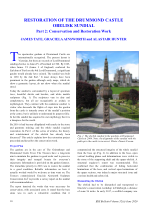
This is the second part detailing the conservation of the 1630 Drummond Castle obelisk sundial. The work involved dismantling the structurally unsound base and shaft, using laser scanning for documentation, and replacing all the gnomons with new, accurately calculated bronze parts, restoring the dial to full working order.
Dials: Multi Faced, How Sundials Work, Restoration projects, Historical Dials
June 2020
Page 31
Page 31
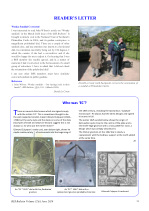
The author recounts an instance at Pitmedden Castle in 2006 where, using his status as a BSS member, he quickly corrected the orientation of a horizontal sundial that was misaligned by 180 degrees.
Dials: Horizontal, How Sundials Work, The BSS and Members
June 2020
Page 32
Page 32
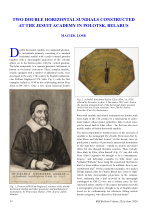
This article documents two sophisticated double horizontal sundials constructed in the early 19th century at the Jesuit Academy in Polotsk, Belarus, following the principles of William Oughtred and Jacques Ozanam. These instruments, built for Polotsk and St Petersburg, incorporated unique features like twilight circles and local noon times for global cities, but are no longer extant.
How Sundials Work, Mathematics of Dialling, Historical Dials, Dials: Double Horizontal
June 2020
Page 44
Page 44
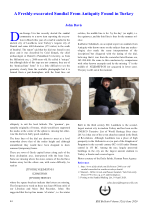
Reports on the March 2020 excavation of a marble "hemicyclium" sundial in the ancient city of Laodikeia, Turkey. The dial features Greek inscriptions for the winter solstice, equinox, and summer solstice, though its exact dating (Hellenistic vs. Roman era) is still debated.
Dials: Hemispherical, How Sundials Work, Historical Dials, Dials: Scaphe
September 2020
Page 6
Page 6
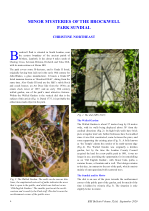
Examines a canted vertical limestone dial in Brockwell Park, dated 1775. The article focuses on translating the cryptic motto, “So Doct Ho In D,” suggesting the elegant interpretation “Sol Ducit Horas in Die” (the sun draws the hours in the day). The dial’s original location is questioned as it was designed for a wall declining approximately 38° west of south.
Dials: Vertical, How Sundials Work, Historical Dials, Mottoes
September 2020
Page 10
Page 10
Explores the terminology and history of cylinder dials ("al-ustuwana", "‘Asâ-yı Mûsâ") in the Ottoman Empire, where they were less common than astrolabes. Introduces two Ottoman manuscripts and discusses two surviving cylinder dials from the 18th and 19th centuries, both calculated for the latitude of Istanbul (41°).
Dials: Portable, How Sundials Work, Mathematics of Dialling, Historical Dials
September 2020
Page 15
Page 15
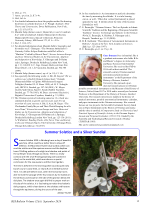
Details the performance of the Macmillan Hunter dual sundial, Dihelion, during the Summer Solstice 2020 in Edinburgh. The metal dial has a silver finish and features a horizontal rod that marks the passage of the four seasons by its shadow on a curved scale.
Dials: Horizontal, Dials: Unusual, How Sundials Work
September 2020
Page 23
Page 23
Presents a gnomonic method using the ratio of the horizontal distance between the sub-nodus point, the noon line, and the equinox line to determine a wall's declination. The technique, illustrated using the Ragusa dial, also allows calculation of the nodus height for a vertical dial.
Dialling Tools, Dials: Vertical, How Sundials Work, Mathematics of Dialling
September 2020
Page 40
Page 40
Explains the Italian terminology for 'Italian hours' (e.g., "ore italiche") and the two historical systems based on sunset. These are "ora italica comune" (geometric sunset) and "ore italiche da campanile" (half an hour after sunset, marked by the Angelus bell).
How Sundials Work, Mathematics of Dialling, Historical Dials
September 2020
Page 42
Page 42
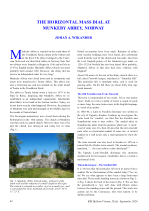
Investigates the remains of a large horizontal mass dial at the Cistercian Munkeby Abbey ruins, Norway. The term "Timstokk" (hour/rod) in Old Scandinavian refers to such a dial. Based on the alignment, the dial is estimated to date from the Middle Ages, possibly around 1350.
How Sundials Work, Historical Dials, Dials: Mass Dials
December 2020
Page 2
Page 2
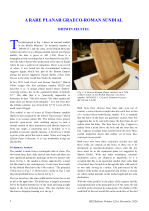
This article describes and analyses an unusual Roman sundial in the British Museum (1884,0615.1), likely originating from Egypt. It examines the dial’s equinoctial planar design, estimating the design latitude (27.3° N) and nodus height using physical measurements and a graphical approach. It challenges the idea that the declination arcs correspond to zodiac cusps.
Dials: Equatorial, Historical Dials, How Sundials Work, Mathematics of Dialling
December 2020
Page 9
Page 9
John Moir recounts collaborating on a quirky equatorial dial for Mudchute Farm. Julian Greenberg corrects an obituary detail for David Young. Pete Caldwell asks readers to shed light on the proper pronunciation (Greek vs English) of the word 'gnomon'.
Dials: Equatorial, How Sundials Work, The BSS and Members
December 2020
Page 19
Page 19
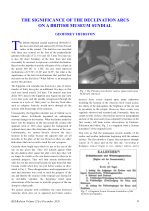
This article follows Ortwin Feustel’s analysis of the British Museum sundial (1884,0615.1) to determine the meaning of its declination arcs. By calculating the corresponding solar declinations, the author correlates them with agriculturally significant events recorded in the ancient Egyptian Geminos parapegma, such as the rising of Sirius and the setting/rising of the Pleiades.
Dials: Equatorial, Historical Dials, How Sundials Work, Mathematics of Dialling
December 2020
Page 28
Page 28
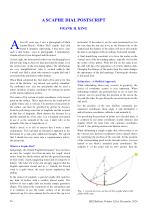
A commentary on Mark Lennox-Boyd's scaphe dial article, providing an alternative, simpler mathematical derivation for plotting points on the spherical surface using horizon coordinates (altitude and azimuth). It also explores the design geometry, showing how the appearance of the dial markings changes based on the ratio of the sphere radius to the rim radius.
Dials: Scaphe, How Sundials Work, Mathematics of Dialling, Sundial Design & Layout
December 2020
Page 41
Page 41
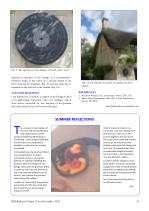
A short piece describing the author’s process of checking the delineation of a simple horizontal sundial by rotating it in the sun to confirm the shadow direction. The text is accompanied by an unusual photograph caught by a "stray click" showing a reflection in sunglasses.
Dials: Horizontal, How Sundials Work, Sundial Design & Layout
December 2020
Page 42
Page 42
A Beginner’s Guide to Delineation: deriving the Lennox-Boyd ‘y’ formula using a gnomonic tetrahedron
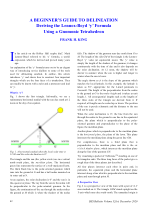
An explanation of Mark Lennox-Boyd's 'y' formula (the length of the shadow of the gnomon nodus from the gnomon root). The formula is derived using spherical trigonometry simplified into four interconnected right-angled triangles forming a 'gnomonic tetrahedron'. This methodology is presented as a helpful tool for novice diallists learning delineation.
Dialling Tools, How Sundials Work, Mathematics of Dialling, Sundial Design & Layout
December 2020
Page 48
Page 48
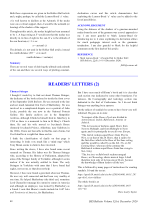
Chris Lusby Taylor provides research into Thomas Stringer, the dedicatee of a book referred to in a previous Bulletin. Stringer was steward to the Earl of Shaftesbury and was knowledgeable about sundials, dividing them into Astronomical, Italick, Babilonick, Antient, or Judaick hours.
How Sundials Work, Historical Dials
September 2019
Page 10
Page 10
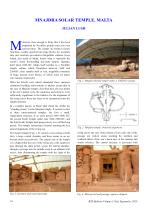
The article discusses the Neolithic Mnajdra temple complex in Malta, which flourished between 3600 and 2500 BC. The structure incorporates features marking key points in the sun’s annual cycle, aligning the rising sun at the equinoxes and solstices. This precision suggests Mnajdra may be the earliest known structure marking all four significant points in the solar cycle.
Historical Dials, How Sundials Work
September 2019
Page 20
Page 20
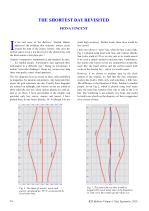
This follow-up article explains, using an astronomical perspective, why the earliest sunset and latest sunrise do not coincide exactly with the shortest day. The discrepancy arises because the Equation of Time causes the 'noon' line, measured by local mean time, to wander relative to the 12h line, shifting the symmetry of the sunrise and sunset curves.
Equation of Time, How Sundials Work, Mathematics of Dialling
September 2019
Page 33
Page 33
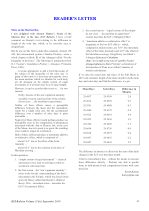
This letter comments on the study of the shortest day, noting that Claudius Ptolemy wrote about the 'Inequality in the Days' around 150 AD in "The Almagest". Ptolemy correctly identified the two causes—the Solar Anomaly (Eccentricity Effect) and the variation in Meridian crossing (Obliquity Effect)—demonstrating extraordinary precision in calculating the Equation of Time effects.
How Sundials Work, Mathematics of Dialling, Equation of Time
December 2019
Page 32
Page 32
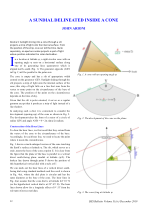
A technical article detailing the design and mathematics of a sundial delineated inside a right circular cone. Sunlight passing through a polar-oriented slit projects a time-telling strip of light onto the interior surface. An aperture nodus simultaneously projects a spot indicating the solar declination. The article includes formulae for deriving hour lines and the characteristic closed-curve calendar lines.
Dials: Unusual, How Sundials Work, Mathematics of Dialling, Sundial Design & Layout
December 2019
Page 38
Page 38
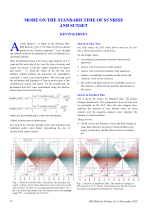
An expansion on the study of sunrise and sunset times, providing systematic calculations across all latitudes. Using a two-step iterative calculation, the author compares the symmetrical results found in Solar Time against the asymmetrical results in Standard Time, demonstrating how the Equation of Time (EoT) dramatically perturbs the earliest and latest sunrise/sunset days across various latitudes.
Equation of Time, How Sundials Work, Mathematics of Dialling
June 2018
Page 41
Page 41
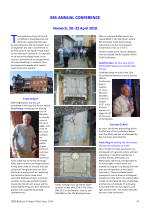
Report on the conference, including presentations on modelling the Earth's terminator, developments in double horizontal dials, Brian Huggett's heliochronometer (Mark II), and research on sundial patentee E.G. Hewitt. The conference also featured tours of local historical dials and the Andrew Somerville Memorial Lecture.
Historical Dials, How Sundials Work, Sundial Design & Layout, The BSS and Members
December 2018
Page 52
Page 52
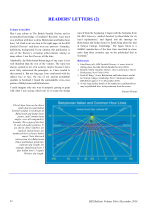
A tribute to the BSS Sundial Glossary for providing the necessary formulae to understand and reproduce the complex criss-cross patterns of Babylonian and Italian hours observed on a polyhedral Scottish dial. The writer provides a faithful reproduction of the hour lines.
Dials: Multi Faced, How Sundials Work, Mathematics of Dialling, The BSS and Members
March 2017
Page 37
Page 37
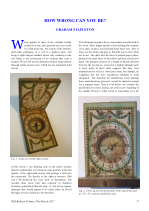
Analysis of wooden diptych sundials (late 18th/early 19th century, Southern Germany) that often only had hour lines delineated for a single latitude (typically 50°). The author calculates the errors (up to 20 minutes) when these dials are used at distant latitudes (e.g., 40° N or 54° N), even if the string gnomon is correctly reset.
Dials: Portable, How Sundials Work, Mathematics of Dialling
September 2017
Page 2
Page 2
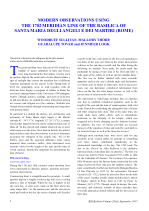
This article is based on a 2016 conference talk detailing modern observations of solar transits on Rome's 1702 meridian line. The purpose was to determine the obliquity of the ecliptic, length of the year, and time of vernal equinox. Analysis of 54 data points gathered between 1996 and 2015 confirmed that the obliquity has grown smaller since the line's construction.
Dials: Noon Lines, Historical Dials, How Sundials Work, Mathematics of Dialling
March 2016
Page 17
Page 17
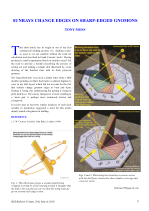
Discusses a common error made by beginners in sundial design concerning how sunrays change edges on sharp-edged gnomons at 6 am and 6 pm, in addition to the more widely known ‘noon gap’. Getting this aspect wrong results in incorrect dial layouts.
How Sundials Work, Mathematics of Dialling, Sundial Design & Layout
September 2016
Page 22
Page 22
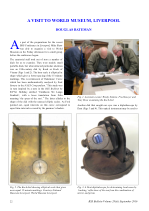
A report on a BSS visit to World Museum, Liverpool, to view their collection of dials. Highlights included an 18th-century Koch dial from Vienna featuring an elliptical scale for better spacing of 15-minute markings, and a Dent dipleidoscope, an instrument used for precisely determining apparent noon.
Dialling Tools, Dials: Portable, Historical Dials, How Sundials Work
December 2016
Page 2
Page 2
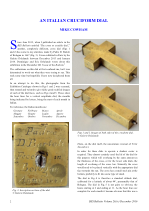
Analysis of a 1667 cruciform dial by Padre D. Bartoli of Bologna, calibrated for latitude 44°. The author deciphered its complex deliniations, concluding it displays equal hours, unequal hours, Italian hours, and Babylonian hours. It functions as a standard altitude dial, likely using the lid or cross bars as a shadow caster.
Dials: Portable, Dials: Unusual, Historical Dials, How Sundials Work
June 2015
Page 21
Page 21
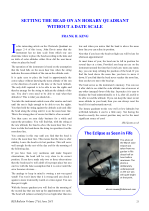
Addressing the lack of a date scale on the Chetwode Quadrant, this piece explains a practical method for setting the sliding bead on an horary quadrant string. The user relies on frequent observations around noon to refine the bead's position relative to the noon hour line.
Dialling Tools, How Sundials Work, Mathematics of Dialling
September 2015
Page 8
Page 8
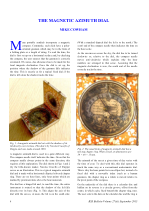
This article explores the design and function of magnetic azimuth dials, where the compass needle indicates the time. Using historical examples by Nicolas Crucefix and Charles Bloud, it details methods for calibration, dealing with magnetic declination, and construction techniques suitable for portable instruments.
Dialling Tools, Dials: Portable, How Sundials Work, Mathematics of Dialling
September 2015
Page 22
Page 22
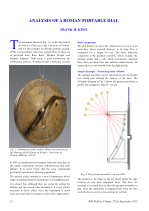
A novel analysis of a Roman portable altitude dial from Oxford’s Museum of the History of Science. It explores how the instrument determines unequal hours from solar altitude, discusses the underlying mathematical model, the use of latitude and declination scales, and provides an error analysis.
Dials: Portable, Historical Dials, How Sundials Work, Mathematics of Dialling
December 2015
Page 28
Page 28
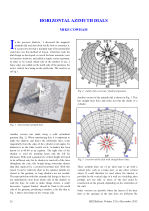
Discusses the construction and layout of horizontal azimuth dials, which use a vertical cylindrical gnomon instead of a polar-aligned one. Various decorative shapes and layouts are explored, noting the complexity of reading the time compared to normal horizontal dials.
Dials: Horizontal, How Sundials Work, Sundial Design & Layout, DIY Sundial Projects
March 2014
Page 8
Page 8
The article examines instances where sundials appear in Sir Arthur Conan Doyle’s Sherlock Holmes stories. Typically, the sundials function as atmospheric features or reference points for leaving messages. The adventure 'The Musgrave Ritual' stands out, as it involves Holmes employing trigonometry to calculate solar altitude and shadow length to solve a coded riddle.
Historical Dials, How Sundials Work
March 2014
Page 14
Page 14
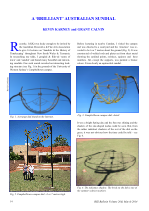
This article describes the Solar Chronograph II, a large equinoctial dial sculpture by Grant Calvin at the University of Western Sydney. The user tells time by lining up so their head shadow eclipses the star-shaped nodus, then turns to look at the nodus which brilliantly eclipses the sun. The design is intended as an educational tool promoting passive solar energy management and sustainable building design.
Construction Projects, Dials: Equatorial, How Sundials Work, Sundial Design & Layout
March 2014
Page 32
Page 32
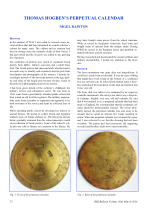
Research into a rare brass perpetual calendar attributed to Thomas Hogben (1702–1774), a surveyor and dialmaker from Kent. The instrument comprises three concentric disks engraved with dates, months, and astronomical signs, and features windows showing day length and sunrise/sunset times. Its construction around 1752 coincided with Britain's adopting the Gregorian calendar.
Dialling Tools, Historical Dials, How Sundials Work
September 2014
Page 14
Page 14
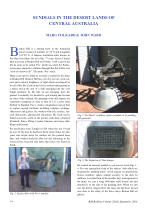
Discusses several unique sundials in Central Australia, including a large bronze armillary sphere made for artist Pro Hart, featuring an attached 400mm bronze ant, and 'Angels of Sun and Moon', a large sculpture at The Living Desert, Broken Hill, which also functions as a sundial and lunar dial.
Construction Projects, Dials: Armillary Sphere, Dials: Unusual, How Sundials Work
March 2013
Page 2
Page 2
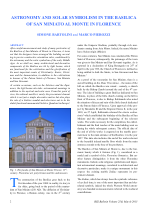
An in-depth study of how the Basilica of San Miniato al Monte was aligned to capture sunlight on key Christian feast days. The article explores the relationship between architecture, astronomy, and religious symbolism in medieval Florence.
Historical Dials, How Sundials Work, Mathematics of Dialling, Sundial Design & Layout
March 2013
Page 19
Page 19
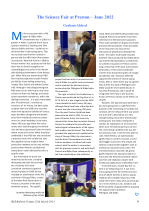
A short report on the BSS presence at a school science fair, describing the public response, educational displays, and promotion of sundial science to younger audiences.
How Sundials Work, The BSS and Members
March 2013
Page 29
Page 29
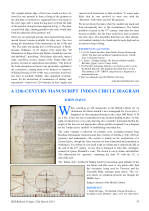
A study of a medieval manuscript containing a drawing of an Indian circle diagram. Davis analyses the geometrical principles behind its time-telling method and its significance in medieval astronomy.
Historical Dials, How Sundials Work, Mathematics of Dialling
March 2013
Page 48
Page 48
A discussion of an experimental holographic sundial design first described in 1990. The article explains how holography can replace the traditional gnomon and analyses its optical accuracy.
Dials: Unusual, How Sundials Work, Mathematics of Dialling, Sundial Design & Layout
June 2013
Page 2
Page 2
A philosophical and mathematical essay exploring the classical projections of the celestial sphere—orthographic, stereographic, and gnomic—and their relation to sundial design, astronomy, and the history of dialling geometry.
Dials: Analemmatic, Historical Dials, How Sundials Work, Mathematics of Dialling
June 2013
Page 7
Page 7
A study of references to sundials and gnomonics in Pliny the Elder’s *Natural History*, examining Roman understanding of solar geometry, planetary motion, and the evolution of timekeeping in the ancient world.
Historical Dials, How Sundials Work, Mathematics of Dialling
June 2013
Page 8
Page 8
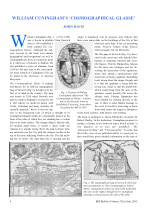
An analysis of William Cuningham’s 1559 book *The Cosmographical Glasse*, highlighting its astronomical diagrams, early depictions of sundials, and its significance for Renaissance scientific thought in England.
Historical Dials, How Sundials Work, Mathematics of Dialling
June 2013
Page 37
Page 37
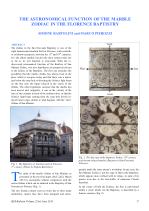
An analytical study of the marble zodiac design within the Florence Baptistry, explaining how it functions as an astronomical instrument marking the sun’s passage and key calendar dates.
Dials: Horizontal, Historical Dials, How Sundials Work, Mathematics of Dialling
September 2013
Page 12
Page 12
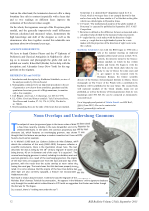
Examines the feature of noon overlaps in sundials, contrasting with the usual gnomon gap. A much earlier example than modern proprietary dials is described: an 18th-century bronze dial by engraver D Coster (dated 1715) with an unusual overhanging gnomon that results in overlapping hour scales at noon.
Dials: Horizontal, Historical Dials, How Sundials Work
September 2013
Page 15
Page 15
Response regarding the accuracy of garden sundials, stating that a correctly designed dial can display Solar Time to within one minute. The author argues that sundials should be trusted to tell their own accurate time, rather than attempting to match modern radio-controlled watches.
Equation of Time, How Sundials Work
September 2013
Page 32
Page 32
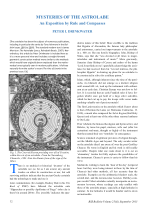
An exposition on the history and components of the astrolabe, including its two faces (sighting bar/calendar and matrix/rete/plates). The article details a geometric construction method using rule and compasses to lay out the template for the rete and the individual plates via stereographic projection.
Dialling Tools, Dials: Astrolabe, How Sundials Work, Mathematics of Dialling
September 2013
Page 40
Page 40
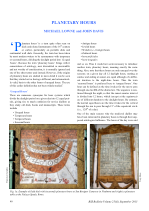
Detailed study differentiating ‘planetary hours’ from seasonal hours. Historically, planetary hours were defined by the time taken for 15-degree intervals of the ecliptic to rise (Sacrobosco’s definition), resulting in hours of unequal duration throughout the day, which are complex to delineate on sundials compared to the simpler seasonal definition.
Historical Dials, How Sundials Work, Mathematics of Dialling, Sundial Design & Layout
March 2012
Page 8
Page 8
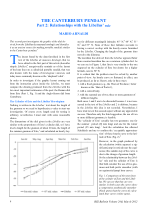
This second part of the article investigates the Canterbury pendant, a 10th-century portable sundial. It compares its graphic layout with the Libellus de mensura horologii and the Roman cylinder dial of Este, exploring the use of two gnomons for different seasons and their relationship to hour curves.
Dials: Portable, Historical Dials, How Sundials Work, Mathematics of Dialling
March 2012
Page 18
Page 18
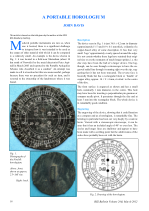
This article examines a medieval copper-based alloy device, found in Norfolk, which functioned as both a compass and a horologium. The fine engraving, including early Gothic lettering and 5° time subdivisions ("mileways"), suggests a 14th-century date and offers insights into medieval timekeeping and connections to local horology.
Dials: Portable, How Sundials Work, Historical Dials
March 2012
Page 23
Page 23
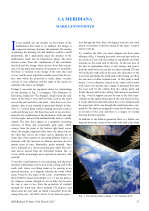
The author describes "La Meridiana," a house in Italy designed with a sundial as its stair tower. This indoor sundial uses projections and reflections onto north, west, and east walls, and the ceiling, to show time and date. The article highlights the mathematics, design, and extensive calibration process.
Construction Projects, How Sundials Work, Mathematics of Dialling, Sundial Design & Layout
March 2012
Page 28
Page 28
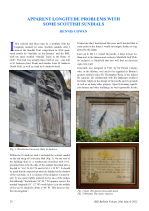
This article investigates "longitude problems" on Scottish sundials from 1877-1913, including those by famous architects. The author discovers that the inscribed "longitude" is actually the time difference from Greenwich, making it more user-friendly for time telling and correcting previous assumptions about design errors.
How Sundials Work, Historical Dials
March 2012
Page 36
Page 36
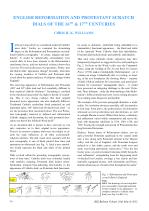
This article examines how English church dials changed during the Reformation, contrasting the colorful, symbolic Catholic 360° dials with the minimalistic, functional Protestant 180° and 90° scratch dials. It uses dial data to inform historical debate on the pace and spread of Protestantism across England.
Dials: Mass Dials, Historical Dials, How Sundials Work
March 2012
Page 42
Page 42
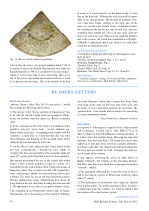
This section features letters from readers discussing various sundial topics. Peter Drinkwater discusses dial transmission and an Islamic scratch dial. Tony Wood offers insights into the progress of "scientific" sundials. John Moir describes "Suburban Reflections" from his front garden.
How Sundials Work, Historical Dials, The BSS and Members
March 2012
Page 43
Page 43
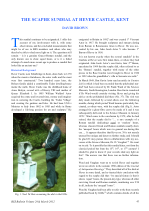
This article details the author’s investigation into the enigmatic scaphe dial at Hever Castle, often called the "Roman" sundial. It discusses its historical background, previous examinations by Ward and Vaughan, and the author's measurements and analysis, concluding it is likely an unworkable dial despite its ancient appearance.
How Sundials Work, Historical Dials, Dials: Scaphe
June 2012
Page 2
Page 2
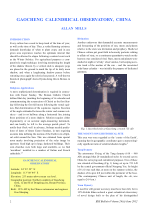
This article details the historical Gaocheng Calendrical Observatory in China, focusing on its construction in 1276 AD by Guo Shoujing, its role in calendrical observations for the Yuan Dynasty, and its design principles for measuring solstices and equinoxes using a monumental gnomon. It also describes the 'shadow-definer' device used for accuracy and the methods for orientation and timekeeping.
Dials: Noon Lines, Historical Dials, How Sundials Work, Mathematics of Dialling
June 2012
Page 20
Page 20
This article discusses the role of sundials in the GCSE Astronomy qualification as an introduction to 'sun time' versus 'clock time', the Equation of Time, and longitude effects. It highlights two popular Controlled Assessment tasks: using a shadow stick to determine local noon and longitude, and comparing sundial time with local mean time to assess accuracy.
How Sundials Work, Equation of Time
June 2012
Page 22
Page 22
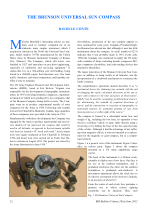
This article describes the Brunson Universal Sun Compass (Model 7637B), an elaborate US Army instrument developed in the 1950s. Its innovations included usability at all latitudes and a clockwork mechanism to counteract Earth's rotation, making it a valuable complement to magnetic/gyro-compasses for true azimuth determination in navigation and surveying.
Dials: Portable, How Sundials Work, Historical Dials
June 2012
Page 42
Page 42
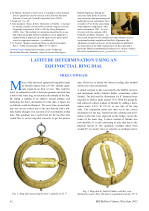
This article describes Gabriel Stokes' innovative 1735 design for equinoctial ring dials, which incorporated a direct readout declination scale for latitude determination. By setting the suspension point to the correct solar declination for the day, travellers could directly read their geographical latitude, simplifying a process that traditionally required calculations.
Dials: Portable, How Sundials Work, Historical Dials
September 2012
Page 2
Page 2
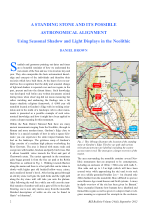
This article examines a 2-metre tall triangular monolith at Gardom’s Edge, Peak District, suggesting it was intentionally erected and astronomically aligned in the late Neolithic/early Bronze Age. It highlights how the stone's north-facing side would be illuminated during the summer, serving as a seasonal marker for ancient communities.
Dials: Unusual, Historical Dials, How Sundials Work, Sundial Design & Layout
September 2012
Page 8
Page 8
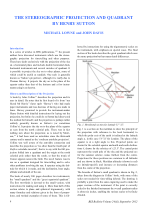
This article explores Henry Sutton's quadrant, which utilises a stereographic projection of the sky onto the equatorial plane, initially conceived by Thomas Harvey. It details the instrument's design, including scales for time-telling and other astronomical problems, and provides instructions for its use, such as finding the time at night using stars.
How Sundials Work, Mathematics of Dialling, Historical Dials
September 2012
Page 20
Page 20
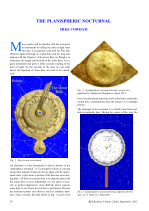
This article describes the planispheric nocturnal, an instrument for telling time at night by aligning a rotating star chart with actual stars. It functions as an alternative to a traditional nocturnal and can be found on the reverse of some quadrants, offering timekeeping to within 15 minutes without requiring Equation of Time correction.
Dialling Tools, How Sundials Work, Dials: Nocturnals
September 2012
Page 21
Page 21
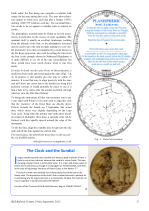
This brief piece features an early Netherlandish image, dating from the late 16th century, which combines a lantern clock and a sundial. It serves as a visual reminder that clocks merely indicate time, whereas sundials actively find time, subtly suggesting the clock's potential inaccuracy compared to the sundial.
Historical Dials, How Sundials Work
September 2012
Page 41
Page 41
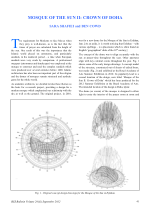
This article presents an architectural study for a solar dome, "Mosque of the Sun II: Crown of Doha" designed to align with the sun for prayer times and celestial events. It uses digital modeling and 3D printing, with the dome's solar orientation differing from the Mecca-aligned prayer room, allowing light to create a clock/calendar on the floor.
Dials: Unusual, How Sundials Work, Sundial Design & Layout, Construction Projects
December 2012
Page 20
Page 20
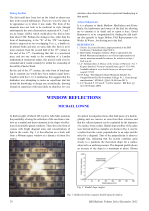
This article investigates the cross-shaped reflections from double-glazed windows, attributing them to the concavity of the glass panes. Optical analysis reveals radial slope profiles and contour maps, showing a central depression. The phenomenon is likely caused by a partial vacuum inside the units, bending the glass inwards, forming distinct V-shaped patterns on narrow windows.
Dials: Reflected, How Sundials Work
December 2012
Page 22
Page 22
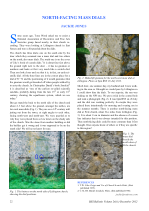
This article discusses mass dials on the north side of churches, specifically at Litlington and Firle in East Sussex. While a south-facing dial at Litlington is an early scientific dial, two north-facing mass dials, initially puzzling, were observed to work perfectly for evening use in summer, suggesting intentional placement.
Dials: Mass Dials, Dials: Vertical, Historical Dials, How Sundials Work
December 2012
Page 28
Page 28
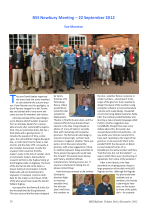
This report summarises the BSS Newbury Meeting, covering presentations on John Davis's "Mystery Welsh Sundial," Doug Bateman's "Romeo & Juliet Sundial," Kevin Karney's "Getting the Numbers Right" on dial layouts, and John Foad's project to put BSS Register dials online.
How Sundials Work, Mathematics of Dialling, Sundial Design & Layout, The BSS and Members
December 2012
Page 41
Page 41
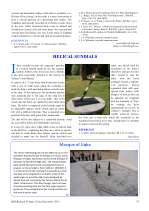
The article discusses helical sundials, particularly one made by Aylmer Astbury. These are a form of equatorial dial, with a brass strip helix marking hours via small holes or a terminator shadow. They can be adjusted for longitude and Equation of Time by rotating the helix on its axis, as explained in a 1992 Bulletin article.
Dials: Equatorial, Dials: Unusual, How Sundials Work, Sundial Design & Layout
March 2011
Page 6
Page 6
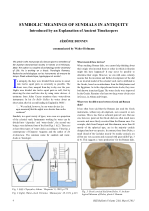
This article explores the symbolic meanings of sundials in antiquity, drawing on literary and epigraphical evidence from the Greco-Roman world. It also introduces ancient timekeepers, including clepsydra and various types of horologia, and discusses the differences between Greek and Roman dials.
How Sundials Work, Historical Dials
March 2011
Page 18
Page 18
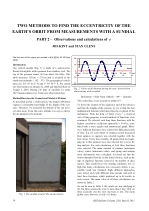
This second part details observations and calculations to determine Earth's orbit eccentricity using a sundial. It applies Ptolemy's geometrical model and an algebraic approach based on the Equation of Time, finding surprisingly accurate results despite the sensitivity of initial conditions.
Equation of Time, How Sundials Work, Mathematics of Dialling
March 2011
Page 34
Page 34
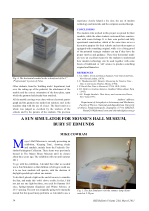
This article describes the creation of a motorised sun simulator for a museum exhibition, designed to demonstrate how sundials work by speeding up daylight duration. It features three lights for different seasons and allows visitors to test card sundial kits.
Construction Projects, Dialling Tools, How Sundials Work
March 2011
Page 43
Page 43
This article explores how artistic objectives and geographical latitude impose limits on sundial design. It provides examples like an 'Arrow of Time' dial and an 'Apple Tree' dial, illustrating how proportions and realism are affected by latitude, and introduces a 'geographically modified' armillary octahedron.
How Sundials Work, Sundial Design & Layout
June 2011
Page 2
Page 2
This article explores the rainbow as an alternative solar timekeeping phenomenon, discussing its complex optical properties, formation of primary and secondary bows, and the dispersion of light into colours. It also describes a rainbow dial instrument for time determination.
Dials: Unusual, How Sundials Work, Mathematics of Dialling, Sundial Design & Layout
June 2011
Page 36
Page 36
This article argues that medieval 'scratch dials' were serious timekeepers, not just symbolic. It describes their basic form, historical context of temporal hours, and connections to early Church observances and Islamic prayer times, asserting their utility at high latitudes.
Dials: Mass Dials, Historical Dials, How Sundials Work, Mathematics of Dialling
September 2011
Page 10
Page 10
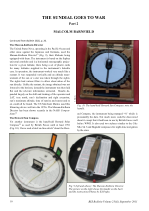
This is the second part of an article exploring the use of sundials and solar compasses in military contexts. It describes instruments like the Marean-Kielhorn Director, Howard Sun Compass, Evans-Lombe, Richards, and Micklethwait sun compasses used by Allied forces. It also details German sun compasses, particularly the C. Plath device used by Rommel's Afrika Korps, and the astrocompass, discussing their applications and limitations in wartime navigation.
Dials: Portable, How Sundials Work, Historical Dials
September 2011
Page 16
Page 16
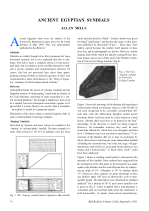
This article reviews ancient Egyptian timekeeping, debunking obelisks as gnomons and a Cairo Museum artifact as a sundial. It focuses on the ‘sloping’ or ‘inclined plane’ portable, seasonal-hour altitude dials, such as the Qantara dial, and earlier L-shaped 'shadow sticks' from the New Kingdom, discussing their construction, use, and the challenges in interpreting their time-telling functions.
Dials: Portable, Dials: Unusual, Historical Dials, How Sundials Work
September 2011
Page 20
Page 20
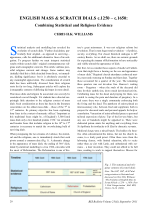
This article examines the evolution of English mass and scratch dials between c.1250 and c.1650, linking changes in their appearance to the Reformation. It argues that understanding these dials requires interpreting them within their contemporaneous religious and iconographic contexts, highlighting the dramatic shift from elaborate Catholic church decoration to Protestant minimalism, which significantly impacted dial design around 1500.
Dials: Mass Dials, Historical Dials, How Sundials Work
September 2011
Page 27
Page 27
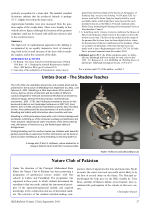
This report highlights a successful gnomonical science studies programme by the Nature Club of Pakistan in Lahore and Faisalabad schools with support from the BSS.
Dials: Horizontal, Dials: Equatorial, How Sundials Work, DIY Sundial Projects, The BSS and Members
September 2011
Page 34
Page 34
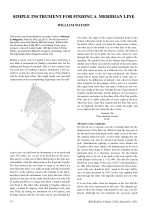
William Watson describes a new instrument for finding a meridian line to aid in sundial making, using two tubes aligned with Polaris and Capella. Michael Lowne comments on the necessity of accounting for Polaris's displacement from the true pole and the stars' right ascension difference for correct alignment, noting potential inaccuracies in Watson's original design and challenges in its use.
How Sundials Work, Mathematics of Dialling, Dialling Tools
September 2011
Page 45
Page 45
This second part examines the scales and uses of a 1658 horizontal quadrant by Henry Sutton, collaborating with John Collins. It details the matched sine and tangent scales for astronomical calculations, star positions for night-time finding, calendar tables for moon age and high water, and shadow/quadrat scales for measuring building heights. It also provides biographies of Collins, Dary, and Sutton, highlighting their roles in 17th-century London's mathematical community.
How Sundials Work, Mathematics of Dialling, Historical Dials
December 2011
Page 42
Page 42
This article addresses the difficulties of accommodating leap years on sundial calendars, particularly when showing the equation of time or solar declination. It explains how to design scales for precise readings despite the difference between tropical and civil years, and discusses the historical debate around which day (24th or 29th February) is the "extra" leap day. Practical design solutions are proposed.
Equation of Time, How Sundials Work, Mathematics of Dialling, Sundial Design & Layout
March 2010
Page 48
Page 48
An extension of a previous article on a photographer's sundial. This part adds a scale to indicate the sun's altitude and provides a new design for use at 54° N, which, together with the original 51.5° N dial, covers all of England.
DIY Sundial Projects, How Sundials Work, Sundial Design & Layout
June 2010
Page 18
Page 18
This paper introduces the horizontal quadrant, a less common but useful altitude sundial type, sharing its basic stereographic projection with the double horizontal dial. It discusses its history, including European precursors like Hartmann's compast and Apian's triens, and English developments by Delamain and Oughtred. The article describes the general form and known examples, detailing how it uses the sun's altitude to tell time.
How Sundials Work, Mathematics of Dialling, Historical Dials
September 2010
Page 10
Page 10
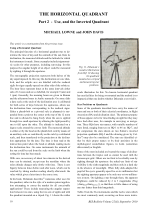
This article details the use of horizontal quadrants for time-finding and surveying, including a rare 'inverted' variant. It describes how to determine time from solar altitude and declination, and from stars at night, discussing the historical accuracy and limitations of these instruments.
How Sundials Work, Mathematics of Dialling, Historical Dials, Dials: Nocturnals
September 2010
Page 16
Page 16
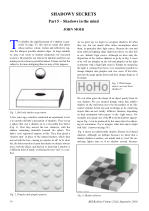
This article explores the psychological aspects of shadow perception, discussing how the mind interprets shadows, optical illusions, and perspective effects, as demonstrated by experiments with babies and examples of manipulated shadows or moon terminators.
How Sundials Work
September 2010
Page 32
Page 32
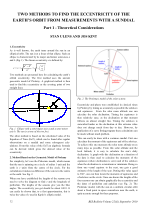
This article presents two theoretical methods to calculate the Earth's orbital eccentricity using sundial measurements. The first method uses the Ptolemaic geocentric model and season lengths; the second derives eccentricity from the Equation of Time by separating the part due to obliquity from the total.
Equation of Time, How Sundials Work, Mathematics of Dialling
September 2010
Page 35
Page 35
This section contains two letters: Maurice J. Kenn congratulates Michael Maltin on his 'Novel Meridian Finder' and discusses the dipleidoscope; Roger Bowling queries if anyone has seen Haidinger’s brushes and the perception of polarised light.
How Sundials Work, Dialling Tools
December 2010
Page 7
Page 7
This section includes letters from readers. Frans Maes describes a multi-faceted obelisk sundial in Schwäbisch Gmünd, Germany, similar to one previously discussed. Allan Mills and Michael Lowne provide detailed explanations and practical advice on how to observe the optical phenomenon known as 'Haidinger’s brush,' which appears due to polarized light in the blue sky.
Dials: Multi Faced, How Sundials Work
December 2010
Page 9
Page 9
This article is the second part of a series detailing the Selwyn College sundial, focusing on its numerical properties. It explains the criss-cross pattern of Babylonian and Italian hour-lines, their relationship with French hours, and the concept of 'extra daylight.' It also provides methods for setting out these hour-lines.
Dials: Unusual, How Sundials Work, Mathematics of Dialling, Sundial Design & Layout
December 2010
Page 17
Page 17
This article discusses the Benares Sundial, one of five equatorial sundial observatories built in India by astronomer prince Sawai Jai Singh II in the 18th century to rectify astrological errors. The authors also describe their work with stereoscopic images and an autocyclostereoscope for viewing 3D images without special glasses, including a 1902 stereograph of the Benares sundial.
Dials: Equatorial, How Sundials Work, Historical Dials
December 2010
Page 33
Page 33
This article explores how time was perceived and reckoned in Anglo-Saxon England, drawing on surviving sundials and manuscripts. It covers heathen time-reckoning based on natural cycles, the introduction of systematic time-reckoning by Christian missions (including the Julian calendar, horologia, and Canonical Hours), and later monastic and village time-marking methods like shadow-length horologia and mass-dials, which evolved until the advent of mechanical clocks.
Dials: Mass Dials, Historical Dials, How Sundials Work
December 2010
Page 42
Page 42
This second part of an article series establishes a method for age-ranking English mass and scratch dials (360°, 180°, and 90° types) from c.1250–c.1650. It uses cross-sectional analysis to demonstrate that 360° dials are the oldest, with their use ending around 1500 in favour of 180° and 90° types. The article also accounts for dial loss and regional adoption variations.
How Sundials Work, Historical Dials, Dials: Mass Dials
March 2009
Page 2
Page 2
This article explores alternative methods for measuring the sun's position, specifically focusing on a north-facing polarization sundial. It delves into the principles of polarized light from the sky, its application in sundial design using materials like 'Sellotape', and the construction of an experimental translucent equatorial dial that produces varying interference colours throughout the day.
Construction Projects, DIY Sundial Projects, Dials: Polar, How Sundials Work
March 2009
Page 13
Page 13
Maurice Kenn shares observations from Brisbane, Australia, contrasting the reliability of his universal equatorial 'coffee-time' sundial and heliochronometer with his UK radio-controlled clock. He notes the significant variation in local apparent noon relative to Eastern Standard Time in Brisbane.
Dials: Equatorial, Dials: Heliochronometer, How Sundials Work
March 2009
Page 14
Page 14
This article describes an electronic polarization sundial and sky photometer designed to measure the intensity and polarization of skylight. It uses a rotatable polar and a selenium photovoltaic cell to detect the solar meridian to within ±8 minutes of time and quantitatively assess the percentage of linear polarization in light from a selected area of the sky.
Dials: Polar, How Sundials Work, Construction Projects
March 2009
Page 37
Page 37
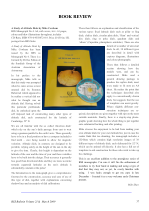
This review covers "A Study of Altitude Dials" by Mike Cowham (BSS Monograph No 4). It praises the monograph's comprehensive overview of altitude dials, including their construction, accuracy, and various types like pillar, chalice, and quadrant dials. The book also provides detailed construction guides, diagrams, and a CD-Rom with templates for readers to make their own dials.
How Sundials Work, Book Reviews, Sundial Design & Layout, DIY Sundial Projects
June 2009
Page 10
Page 10
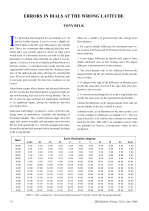
An analysis of the time-telling errors that occur when a horizontal or vertical non-declining sundial is used at a latitude different from its design latitude. The article provides tables and graphs illustrating the magnitude of these errors at different times of day and for different solar declinations.
Dials: Horizontal, Dials: Vertical, How Sundials Work, Mathematics of Dialling
June 2009
Page 41
Page 41
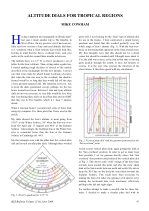
Explores the design of fixed-latitude altitude dials for use in tropical regions, specifically The Gambia (13.5° N). The article presents computer-generated plots for various types, including the horary quadrant and vertical plate dial, highlighting the unique behaviour of the hour lines as the sun passes overhead.
Dials: Portable, How Sundials Work, Sundial Design & Layout
September 2009
Page 10
Page 10
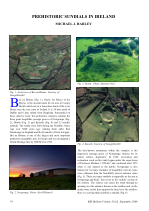
Explores potential prehistoric sundials within the megalithic passage tombs of Brú na Bóinne in Ireland, including Newgrange, Dowth, and Knowth. The article examines specific stone carvings, such as the 'Stone of the Seven Suns' and Kerbstones K7 and K15 at Knowth, discussing theories that they may be sundials or calendars.
Dials: Unusual, Historical Dials, How Sundials Work
September 2009
Page 20
Page 20
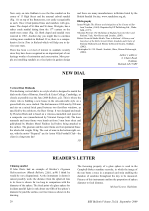
A letter responding to a previous article on Kircher’s 'Organum Heliocausticum'. The author argues that the instrument as depicted could not work because the focal length of the spherical lens is drawn incorrectly.
Dials: Unusual, How Sundials Work
September 2009
Page 46
Page 46
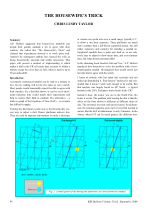
Re-evaluates A.P. Herbert's suggestion of turning a horizontal sundial to make it agree with mean time. While previously dismissed as inaccurate, this article presents a theoretical analysis and a practical implementation showing that, for UK latitudes, the 'trick' can keep the dial accurate to within a minute for most of the year.
Dials: Horizontal, Equation of Time, How Sundials Work, Mathematics of Dialling
December 2009
Page 5
Page 5
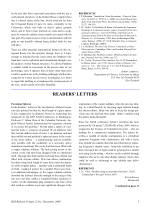
The first letter describes an innovative focusing sphere lens made of lucite and copper sulphate, designed for use in a sundial. The second letter confirms that Samuel Turner, a diallist, was also the sculptor of his own tombstone which features a direct west dial.
Dials: Unusual, How Sundials Work, Historical Dials
December 2009
Page 10
Page 10
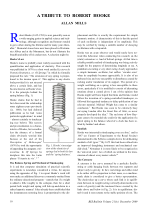
This article celebrates the genius of Robert Hooke, highlighting his key scientific contributions. It covers Hooke's Law and its application to timekeeping, his work on a universal joint for delineating sundials, and his pioneering (though unpublished) insights into the catenary arch. It proposes a sculptural memorial to Hooke.
How Sundials Work, Sundial Design & Layout, Historical Dials
March 2008
Page 14
Page 14
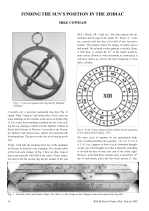
This article explains how to use Solar Course diagrams found on historical instruments, such as an Edmund Culpeper universal equinoctial ring dial and Italian quadrants, to determine the sun's position in the Zodiac. It details calculation methods, including adjustments for Old Style and New Style calendars, and notes rare instances of early Gregorian calendar pre-emption.
Dialling Tools, Historical Dials, How Sundials Work, Mathematics of Dialling
March 2008
Page 26
Page 26
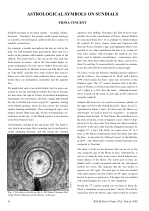
Discusses the historical use and modern relevance of astrological symbols on sundials to indicate dates like solstices and equinoxes, despite astronomical shifts like precession. It examines symbols for Zodiacal signs and those used on lunar volvelles, such as sextile, square, and trine, explaining their relation to moon phases and elongation.
Historical Dials, How Sundials Work, Sundial Design & Layout
March 2008
Page 31
Page 31
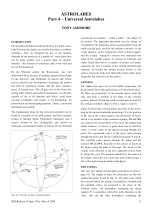
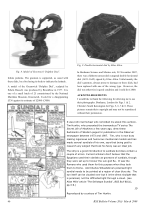
This fourth part of a series describes universal astrolabes, focusing on the Saphea, Rojas, and De la Hire projections. These instruments, developed from the 11th to 17th centuries, could be used at all latitudes, offering flexibility for astronomical and timekeeping purposes, despite the increasing complexity of their design.
Dials: Astrolabe, Historical Dials, How Sundials Work, Mathematics of Dialling
March 2008
Page 40
Page 40
Reproduces Tim Hunkin's 'Rudiments of Wisdom' cartoon strip on sundials from the Observer newspaper. It offers a concise overview of the development of sundials from the Egyptian obelisk, through to equal hours dials and modern developments, in cartoon form, even commenting on the need for adjustments due to the equation of time!
How Sundials Work, Historical Dials
September 2008
Page 112
Page 112
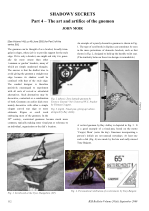
This article explores the artistic and innovative designs of gnomons, moving beyond simple functional brackets to decorative, contextual, or 'shadow-play' designs. It provides examples of gnomons incorporating visual puns, personal initials, and a novel method for designing a gnomon to cast a true profile shadow on a specific date and time.
DIY Sundial Projects, How Sundials Work, Sundial Design & Layout
September 2008
Page 130
Page 130
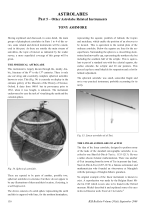
This part of the Astrolabes series covers instruments related to, but distinct from, planispheric astrolabes. It discusses the rare spherical and linear astrolabes, monumental and domestic astrolabe clocks, mariner's astrolabes (not true astrolabes), and various types of quadrants, including horary and astrolabe quadrants, detailing their history and use.
Dials: Astrolabe, Dialling Tools, Historical Dials, How Sundials Work
December 2008
Page 154
Page 154
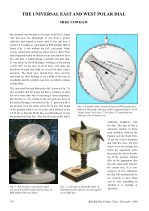
This article describes a portable universal East and West polar dial that is self-aligning and does not require a compass. It details its design, operation, and identifies limitations such as a two-hour gap around noon. It also explores improvements through hinged flaps and cylindrical designs, and relates it to other dial types like the double crescent dial.
Dials: Polar, Dials: Portable, How Sundials Work, Sundial Design & Layout
December 2008
Page 160
Page 160
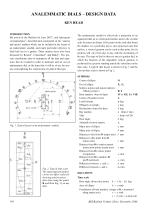
This article provides a summary of data and equations needed to delineate and set out analemmatic sundials. It discusses the projection of an equatorial dial onto a horizontal surface, using a vertical gnomon whose position varies with the sun's declination, and the calculation of sunrise and sunset markers using Lambert circles and Bailey Points.
Dials: Analemmatic, How Sundials Work, Mathematics of Dialling, Sundial Design & Layout
December 2008
Page 169
Page 169
A light-hearted alphabetical list of terms and concepts related to sundials and dialling. It covers various aspects from Apparent time to Zodiac, including types of dials, mathematical concepts, and references to the British Sundial Society and its members.
How Sundials Work, The BSS and Members
December 2008
Page 170
Page 170
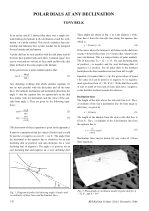
This article presents a method for designing polar sundials for any latitude and declination using four simple formulae. It explains that polar dials have a style parallel with the dial plane and parallel hour lines, and describes how to determine the angle of the equinox line and the sub-style hour angle.
Dials: Polar, How Sundials Work, Mathematics of Dialling, Sundial Design & Layout
March 2007
Page 9
Page 9
This section contains correspondence from readers. Chris Lusby Taylor discusses the use of Hooke’s joint for delineating declining and reclining dials, while Allan Mills replies regarding an error in a previous paper. Tony Ashmore suggests an interpretation for the 'Egyptian Face' design on a sundial pillar at Lord Tennyson's home, attributing it to Ptolemy.
Dials: Unusual, How Sundials Work, Mathematics of Dialling
March 2007
Page 10
Page 10
John Wall explores the hypothetical consequences if the Earth's rotation on its axis were reversed. He details impacts on sunrise/sunset directions, calendar year length, solar day duration, star progression, International Date Line adjustments, and time zones. The article also touches upon how sundials would still function with reversed numerals.
How Sundials Work
March 2007
Page 24
Page 24
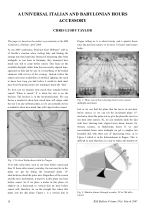
This paper introduces a simple accessory, a three-quarters CD, that can be used with existing horizontal sundials to signify Italian and Babylonian hours. It explains how these hour systems differ from conventional timekeeping and how the accessory allows us to read these hours, using the shadow of the CD.
Dials: Horizontal, How Sundials Work, Dialling Tools, DIY Sundial Projects
March 2007
Page 33
Page 33
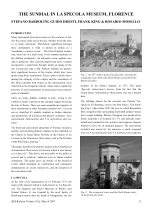
This paper describes the pinhole sundial in the Grand-Ducal Astronomical Observatory (La Specola) in Florence. It covers the observatory's history, the sundial's design as a string-gnomon meridian line, its restoration in 2005, and a comparison of measured zodiac point positions with calculated values. It highlights the instrument's historical importance for astronomical studies and calendar reform.
Dials: Noon Lines, Historical Dials, How Sundials Work, Restoration projects
March 2007
Page 46
Page 46
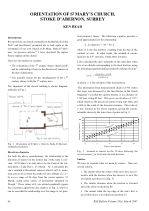
This article re-examines the orientation of St Mary’s Church, Stoke D’Abernon, considering the 7th-century Saxon church and its 13th-century chancel misalignment. It calculates sunrise azimuths for the Feast of the Annunciation, accounting for horizon elevation and atmospheric refraction, to explore the hypothesis that church alignment relates to sunrise on the patron saint's day.
Historical Dials, How Sundials Work
June 2007
Page 78
Page 78
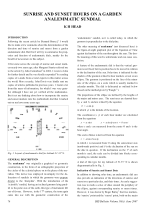
This article discusses the determination of sunrise and sunset directions and times using garden analemmatic sundials. It explains the dial's principles, the Bailey points for seasonal markers, and evaluates the accuracy of these markers, noting discrepancies and suggesting practical applications for garden dials despite minor errors.
Dials: Analemmatic, How Sundials Work, Mathematics of Dialling, Sundial Design & Layout
June 2007
Page 82
Page 82
This section contains reader correspondence. Fred Sawyer corrects an article on dual sundials, attributing the self-setting property to Vaulezard (1640) rather than Tuttell (1698). Mike Faraday asks for a website to track the terminator for sunrise times. Tony Wood clarifies the location and movement of the Ross-on-Wye pillar dial.
Dials: Analemmatic, How Sundials Work, Historical Dials
June 2007
Page 86
Page 86
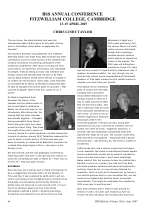
This report summarises the 2007 British Sundial Society Annual Conference in Cambridge. It highlights talks on calendar history, the Equation of Time, analemmatic sundials, astrolabes, and beehive sundialling. It also covers walking tours of Cambridge dials, including Pembroke and Queens' Colleges, and the Andrew Somerville Memorial Lecture on calendar accuracy.
Dials: Astrolabe, Historical Dials, How Sundials Work, The BSS and Members
June 2007
Page 91
Page 91
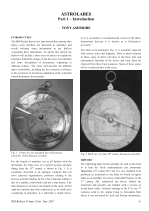
This is the first part of a series introducing astrolabes, describing them as two-dimensional analogue computers for solving spherical trigonometric problems and finding time. It covers their history from Greek origins through Arab development to European decline, and explains the principles of their design including the rete and engraved plates for different latitudes.
Dials: Astrolabe, Historical Dials, How Sundials Work, Mathematics of Dialling
June 2007
Page 95
Page 95
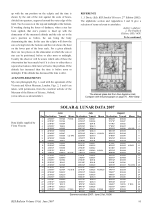
This entry provides a table of solar and lunar data for 2007, including daily declination and transit times, as well as moon phase information for June, July, and August.
How Sundials Work
September 2007
Page 102
Page 102
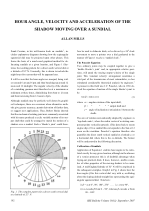
This paper applies Hooke's joint equation of motion to sundials to calculate the hour angle, angular velocity, and acceleration of the shadow. It provides formulas and graphs for a direct south vertical dial at 52° N latitude, showing how these parameters vary throughout the day, with angular velocity minima at noon/midnight and maxima at 6 am/pm.
How Sundials Work, Mathematics of Dialling
September 2007
Page 107
Page 107
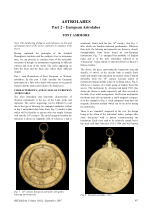
This second part details the characteristics and scales of European astrolabes. It covers the use of Latin script and numerals, simple throne designs (with some Flemish exceptions), and variable rete strapwork. The article also explains the zodiac/calendar scales, shadow squares for surveying, and three methods for determining unequal (planetary) hours found on these instruments.
Dials: Astrolabe, Historical Dials, How Sundials Work
September 2007
Page 114
Page 114
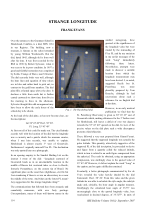
This article investigates a peculiar Pl. Long. inscription on the 1845 Hawkshead Grammar School sundial. Through extensive correspondence, Pl Long was identified as The Plane's Longitude referring to the hour angle in angular measure when the sun is directly over the style, rather than a geographical longitude.
Dials: Vertical, How Sundials Work, Sundial Design & Layout
September 2007
Page 128
Page 128
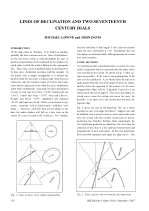
This article explores declination lines on sundials as conic sections and details methods for their delineation. It examines two 17th-century horizontal dials by Isaac Symmes (Science Museum, Oxford), noting errors in their declination lines and the presence of seasonal hours and lunar volvelles. A new graphical method for drawing declination lines is also presented.
Historical Dials, How Sundials Work, Mathematics of Dialling, Sundial Design & Layout
September 2007
Page 134
Page 134
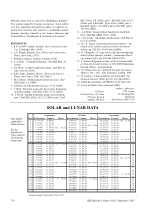
This entry provides a table of solar and lunar data for September, October, and November. It includes daily values for declination and transit times, as well as lunar quarter and new/full moon phases. This data is useful for sundial calibration and understanding celestial movements.
Equation of Time, How Sundials Work
December 2007
Page 146
Page 146
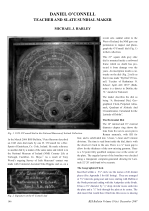
This article details an 1853 slate sundial by Daniel O’Connell, a teacher from Rathmines National School, Dublin, later of Shrule, Co. Mayo. The elaborate dial, now in the National Museum of Ireland, functions as a horizontal dial, geographical clock, perpetual almanac, quadrant of altitude, and circumferentor. It is considered a teaching aid and highlights O'Connell's master engraving skills.
Dials: Horizontal, How Sundials Work, Historical Dials
December 2007
Page 151
Page 151
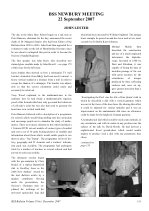
This report summarises the British Sundial Society's Newbury meeting, which began with a tribute to the late Dr. Margaret Stanier. Presentations included stained-glass sundials, mounting a vertical sundial with a TV bracket, mathematical proofs for hour lines, a schools programme for dialling, universal equinoctial ring dials, dipleidoscopes, dials with vertical gnomons, and hemispherical dials.
Dialling Tools, How Sundials Work, Sundial Design & Layout, The BSS and Members
December 2007
Page 164
Page 164
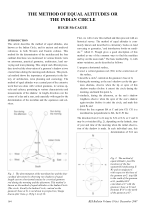
This article describes and historically surveys the method of equal altitudes, also known as the Indian Circle, used for determining the meridian and cardinal directions by observing a gnomon's shadow. It covers the practical steps, potential errors, mathematical analysis of shadow curves (conic sections), and its widespread use in ancient and medieval Eastern (India, China) and Western (Roman, early medieval Europe) cultures for architecture, town planning, and sacred rituals.
Historical Dials, How Sundials Work, Mathematics of Dialling, Sundial Design & Layout
December 2007
Page 172
Page 172
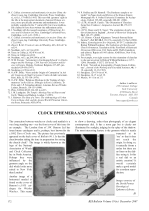
This article discusses the historical connection between clocks, watches, and sundials, referencing an example on the cover. It examines images from J.W. Benson Ltd catalogues featuring sundials, including a horizontal sundial with a truncated gnomon creating a nodus. The author speculates whether these depicted dials are real or artistic creations.
Dials: Horizontal, Historical Dials, How Sundials Work
February 2006
Page 6
Page 6
Drawing on Sappho's poem, this article explores the history of time measurement, from ancient astronomical principles to modern atomic clocks. It examines the evolution of the term 'hour,' different timekeeping systems (Babylonic, Italic, canonical, equal), and how celestial phenomena like moon phases and the Pleiades were interpreted to determine time and seasons.
How Sundials Work, Historical Dials, Dials: Nocturnals
June 2006
Page 91
Page 91
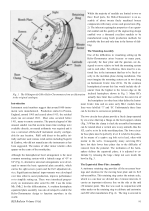
This first part of a review examines the design and accuracy of the Pilkington & Gibbs Helio-Chronometer, an equatorial sundial known for its mean time accuracy. It details the instrument's components, mounting assembly, sight screen system, and the mechanism for integrating the Equation of Time using a cam, and discusses factors affecting its long-term accuracy, such as wear and calibration.
Dials: Heliochronometer, Equation of Time, How Sundials Work, Sundial Design & Layout
September 2006
Page 132
Page 132
This research article investigates the theory that churches are aligned towards the sunrise on their patronal saint's feast day, based on a comprehensive survey of 1670 churches. The study considers factors like horizon elevation and calendar drift, concluding that the majority of churches consistently align towards true east, rather than their specific saint's day sunrise.
How Sundials Work, Historical Dials
September 2006
Page 140
Page 140
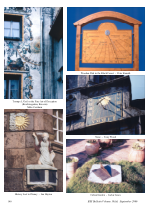
This article provides an update on the Horniman ceiling dial, a reflected sundial installed in a wooden building. It discusses ongoing monitoring and a recent recalibration due to timber movement. An innovative technique using a balloon to cast a shadow and make the light spot visible during low winter sun conditions is also highlighted.
Dials: Reflected, How Sundials Work
December 2006
Page 164
Page 164
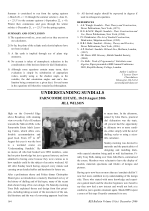
Jill Wilson reports on a successful weekend course on 'Understanding Sundials' at Farncombe Estate. The curriculum covered the history of dialling, fundamental theory, design principles, practical delineation using various tools, and the practicalities of installing dials, with a focus on wall declinations. Attendees, from beginners to experienced diallists, gained new insights and appreciation for sundials.
How Sundials Work, Mathematics of Dialling, Sundial Design & Layout, The BSS and Members
December 2005
Page 142
Page 142
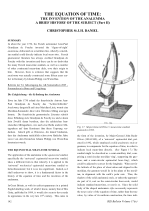
This part of the article discusses the history and application of the analemma in equinoctial sundials, particularly in Great Britain and the Netherlands. It details inventions by Major-General John Ryder Oliver, William Pilkington, and William Homan, and provides strong evidence suggesting Johann Philipp von Wurzelbau invented the analemma around 1716, predating Jean-Paul Grandjean de Fouchy.
How Sundials Work, Equation of Time, Historical Dials, Dials: Heliochronometer
December 2005
Page 155
Page 155
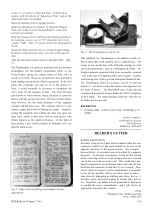
A reader poses a hypothetical question about the consequences for gnomonics if the Earth rotated in the opposite direction. He notes that sundial hour-line numerals would need to be reversed and invites other readers to submit lists of possible effects, offering a reward for the most comprehensive list.
How Sundials Work
December 2005
Page 159
Page 159
This review covers Tony Moss's PowerPoint CD-ROM "Sundial Presentations," which includes "Concepts for Students of Sundialling" and "Using and Understanding Sundials." It praises the CD for its clear, animated slides explaining basic sundial concepts, theory, alignment of gnomons, differences between clock and sun time, and the analemma, making it useful for beginners and lecturers.
Book Reviews, How Sundials Work, Mathematics of Dialling, Sundial Design & Layout
March 2004
Page 4
Page 4
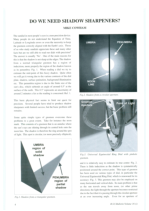
Explores methods to improve the precision of reading sundials, addressing the problem of the penumbra (fuzzy shadow) caused by the sun's finite disc. It discusses various gnomon designs, such as annular gnomons for noon marks, thin rod gnomons, and pinhole or taut wire gnomons, which create sharper shadows for more accurate time-telling.
Dials: Noon Lines, Dials: Portable, How Sundials Work, Sundial Design & Layout
September 2004
Page 91
Page 91
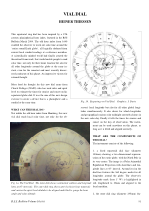
Description and design of an equatorial ‘vial’ ring dial that combines a planisphere with a sundial. Uses a spirit-level alidade and a rotating outer ring to read local apparent time for any longitude, and to estimate sunrise, sunset and the locus of solar midnight across longitudes.
Dials: Equatorial, How Sundials Work, Sundial Design & Layout
September 2004
Page 103
Page 103
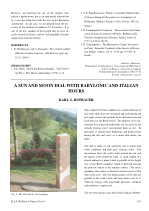
Description of a multi-plane stone dial ensemble that shows Babylonian and Italian hours by day and acts as a moon dial at night; discusses decorative Earth/moon motifs, orientation relative to local and Basel reference planes and how the lunar readout is used.
Dials: Horizontal, Dials: Unusual, How Sundials Work
December 2004
Page 146
Page 146
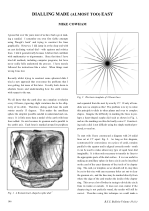
Practical method using a 24-hour equatorial template to transfer hour lines to arbitrary surfaces. Demonstrates template folding for latitude, a Cambridge horizontal example, spherical and heart-shaped scaphe dials, marking equinox/solstice lines and gives practical tips on template rigidity and common pitfalls.
DIY Sundial Projects, Dials: Scaphe, How Sundials Work, Sundial Design & Layout
March 2003
Page 3
Page 3
Analysis of John Constable’s paintings using principles of sundial geometry to determine whether the rainbows depicted are optically accurate and temporally consistent.
How Sundials Work
March 2003
Page 33
Page 33
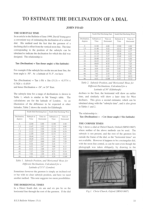
Method for determining the declination of a sundial using shadow observations and calculations, useful for dating or assessing alignment.
How Sundials Work, Mathematics of Dialling
December 2003
Page 148
Page 148
Analysis of a 1721 dial with unusual semicircular scales used to estimate sunrise and sunset times; includes mathematical reconstruction of how the dial may have been intended to work.
Dials: Horizontal, Historical Dials, How Sundials Work
March 2002
Page 7
Page 7
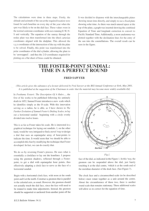
Explains the design of a novel sundial based on Samuel Foster's 17th-century concepts, with modern adaptations and detailed geometry, incorporating latitude, longitude, equation of time and daylight savings time adjustments.
Dials: Horizontal, How Sundials Work, Mathematics of Dialling
March 2002
Page 39
Page 39
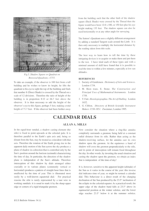
Explores dials intended to show the date rather than the time, by reading the shadow of an equinoctial ring on a scale on the stile.
Dials: Polar, Dials: Unusual, How Sundials Work
March 2002
Page 41
Page 41
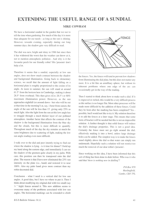
Suggests addition of vertical 'fences' to a horizontal dial to increase the legibility of the shadow for early and late hours.
How Sundials Work, Sundial Design & Layout
December 2002
Page 141
Page 141
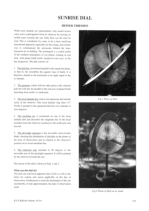
Description of an interactive, educational sundial model representing Earth and showing local apparent time, sunrise/sunset, solar declination, and more.
DIY Sundial Projects, Dials: Equatorial, How Sundials Work
February 2000
Page 3
Page 3
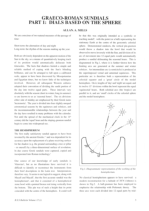
Explores early Greek and Roman hemispherical and hemicyclium sundials, their geometry, historical usage, and accuracy.
Dials: Hemispherical, Historical Dials, How Sundials Work, Mathematics of Dialling
June 2000
Page 64
Page 64
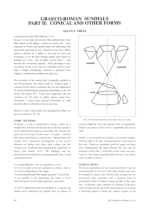
Continues an exploration of ancient sundials, focusing on conical types and their mathematical construction and historical context.
Dials: Scaphe, Historical Dials, How Sundials Work, Mathematics of Dialling
October 2000
Page 109
Page 109
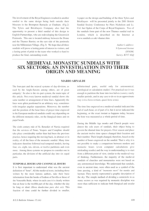
Explores the historical and liturgical rationale behind medieval six-sector sundials, their canonical hour divisions, and theological symbolism.
Dials: Mass Dials, Historical Dials, How Sundials Work, Mathematics of Dialling
October 2000
Page 142
Page 142
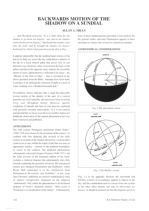
Explains the rare conditions under which a sundial shadow can appear to move backward, at specific dates and latitudes, including astronomical and observational factors.
How Sundials Work, Mathematics of Dialling
October 1999
Page 118
Page 118
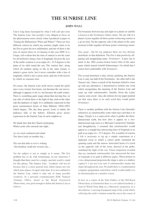
This article explores the 'Sunrise Line', defined as the boundary between day and night (the Terminator). The author dislikes the term 'Terminator' and proposes 'soloriensorbis' (sunrise semi-circle). It discusses how the line moves due to Earth's rotation and its appearance on a 2D map as a shallow 'S' shape. The article also touches on determining the first territory to greet the new millennium based on sunrise time, and queries how sundials perform at sunrise on mountaintops.
How Sundials Work
February 1998
Page 30
Page 30
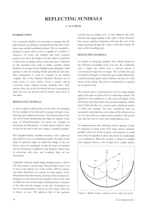
Describes novel non-shadow dials using reflectors. Parabolic and cylindrical forms generate bright caustic lines on a screen; hour indication follows motion of the cusp or inner edge. Includes formulae, constructional notes and an aperture version using a sundial curve.
DIY Sundial Projects, Dials: Reflected, How Sundials Work, Mathematics of Dialling
January 1997
Page 2
Page 2
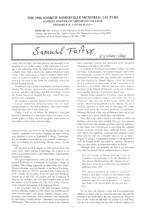
A detailed biographical and technical account of Samuel Foster, a 17th-century diallist, highlighting his innovations in dialling techniques, instruments, and his influence on later gnomonists. Explores historical context, plagiarism controversies, and posthumous publications.
How Sundials Work, Mathematics of Dialling
January 1997
Page 37
Page 37
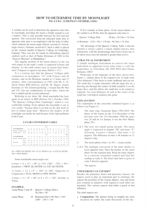
A method for telling time using moonlight and sundial principles. Explains necessary calculations, lunar phases, and adjustments for accuracy.
Dialling Tools, How Sundials Work
April 1997
Page 24
Page 24
An exploration of altitude dials designed for high-latitude locations, discussing their construction, adaptations, and challenges in time-telling under extreme solar conditions.
Dials: Portable, How Sundials Work, Sundial Design & Layout
July 1997
Page 10
Page 10
An article discussing the amount of actual sunshine received in a given year in Ipswich, England, compared to the theoretical maximum. It includes graphs of daily sunshine data from 1996 and notes how environmental factors like trees can affect a sundial's performance.
How Sundials Work
February 1996
Page 9
Page 9
An exploration of innovative sundial designs such as the Open Book and Conical types, combining mathematical precision with aesthetic appeal.
DIY Sundial Projects, How Sundials Work, Sundial Design & Layout
February 1996
Page 22
Page 22
Scientific explanation of the principles behind shadow movement and sundial timekeeping, with educational value.
How Sundials Work
June 1996
Page 10
Page 10
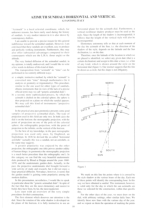
An in-depth exploration of azimuth sundials, comparing projection methods, construction techniques, and their advantages, with historical and modern examples.
Dials: Horizontal, Dials: Vertical, How Sundials Work, Mathematics of Dialling
June 1995
Page 45
Page 45
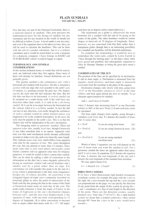
A discussion on simple and understated sundials, their form and function, with commentary on their aesthetic and scientific purity.
How Sundials Work, Sundial Design & Layout
February 1994
Page 8
Page 8
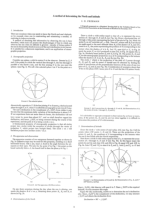
Describes a method using stereographic projection to determine true north and latitude from solar shadow observations. Includes theoretical explanation and practical setup.
How Sundials Work, Mathematics of Dialling
June 1994
Page 15
Page 15
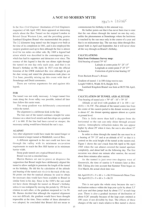
This short article investigates a persistent myth regarding the orientation of hour lines on sundials. The author examines the historical origins of the misconception and clarifies the mathematical and astronomical principles that debunk it, providing a concise lesson in accurate sundial theory.
How Sundials Work
June 1994
Page 22
Page 22
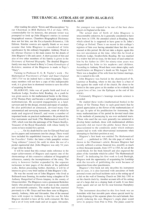
A scholarly exploration of the design and function of a unique astrolabe developed by the 16th-century English mathematician John Blagrave. The article explains its astronomical foundations, innovative features, and historical context, linking it to broader developments in Renaissance scientific instrumentation.
Dials: Astrolabe, Historical Dials, How Sundials Work
February 1993
Page 32
Page 32
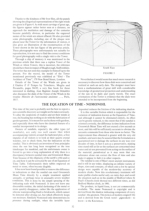
This tongue-in-cheek article introduces 'Nonomoil,' a new product designed to simplify sundial readings by reducing the friction of the shadow on the sundial surface, thus avoiding the discrepancies between sundial time and Greenwich Mean Time. It explains how this annual treatment enhances accuracy and avoids sarcastic comments from onlookers unfamiliar with the Equation of Time.
Dialling Tools, Equation of Time, How Sundials Work
February 1993
Page 36
Page 36
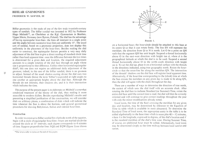
This paper elaborates on the theory and construction of bifilar sundials, a twentieth-century type invented by Hugo Michnik. It highlights their equiangular hour-lines, allowing direct reading of standard clock time by simple daily adjustment, and explains how time is indicated by the intersection of shadows from two horizontal threads.
Dials: Bifilar, Dials: Unusual, How Sundials Work, Mathematics of Dialling, Sundial Design & Layout
June 1993
Page 33
Page 33
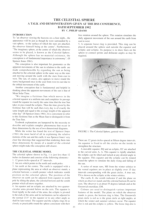
This article describes a three-dimensional model of the celestial sphere designed to clarify astronomical and gnomonic phenomena. It explains fundamental concepts like the apparent movements of the sun, mean solar time, and the components of the model, including great circles, axis, earth, and movable equator/ecliptic. The article demonstrates how the model illustrates the sun's rising and setting, and the factors contributing to the Equation of Time.
How Sundials Work
October 1993
Page 23
Page 23
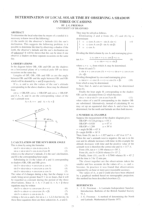
This article presents a geometric method for determining three unknowns (direction of North, latitude and today's solar declination) from three angular measurements of a vertical pole's shadow. It outlines the mathematical formulae and step-by-step calculations required to find the three unknowns.
How Sundials Work, Mathematics of Dialling
June 1992
Page 37
Page 37
This article describes the development of the 'Make a Sundial' educational book by a British Sundial Society group, initiated in response to the National Curriculum requiring primary children to understand and construct sundials. The book, produced using desktop publishing, offers projects for constructing sundials from common materials, suitable for various educational levels.
How Sundials Work, Book Reviews, DIY Sundial Projects, The BSS and Members
October 1992
Page 5
Page 5
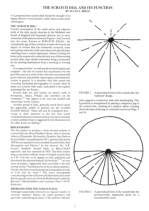
This article proposes that scratch dials, often found on old church walls, are effective "event markers" rather than precise timekeepers. It discusses their radial geometry, common south-facing position, and erosion due to acid rain. The article refutes theories about them being equal-hour sundials with bent gnomons, and explains their connection to seasonal hours and monastic prayer times.
Dials: Mass Dials, Historical Dials, How Sundials Work
October 1992
Page 25
Page 25
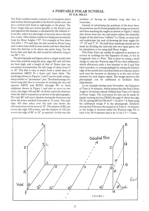
This article introduces a portable polar sundial design that overcomes the issue of an infinitely long dial face for extreme hour angles. It uses two end-styles, which cast shadows for forenoon and afternoon hours, respectively. The dial can be adjusted using a wedge to correct for the Equation of Time or longitude.
DIY Sundial Projects, Dials: Polar, Equation of Time, How Sundials Work
October 1992
Page 27
Page 27
This article explores hypothetical sundial behaviour on Uranus, where the planet's axis tilt is almost 90 degrees. At solstices, the sun would appear stationary overhead at the pole, and a rod gnomon would cast no shadow. As the sun moves, shadows would form circles, indicating a sidereal day, with significant changes in day length at solstices, leading to a "missing" solar day.
Dials: Unusual, How Sundials Work, Mathematics of Dialling
February 1991
Page 10
Page 10
Addresses the critical step of setting up an equal-hour sundial and suggests that aligning by observing Polaris, the pole star, can be a quicker and more accurate method. Simple tools like a peep-sight or telescope can be used for this purpose.
How Sundials Work, Dialling Tools
July 1991
Page 3
Page 3
This article, written in 1631, details using John Marr’s Hampton Court Dial. It explains determining celestial metrics like ascensionall difference, azimuth, amplitude, sun's altitude and declination, and Judaical hours. It also covers comparing unequal to equal hours, finding the day of the month, and predicting London Bridge tides via the dial's shadows, showcasing its comprehensive historical applications.
Historical Dials, How Sundials Work, Mathematics of Dialling, Sundial Design & Layout
July 1991
Page 8
Page 8
This article re-examines plane dials tilted from the horizontal, focusing on clarity, legibility, and environmental compatibility. It explains 'shadow regimes,' how tilt relates to equivalent latitude, and the impact on sun-shadow patterns. Key considerations include local horizons and the 'night factor'—periods where the dial cannot register time. It highlights the clarity of polar regime dials, despite seasonal limitations, for educational and aesthetic purposes.
Dials: Polar, How Sundials Work, Mathematics of Dialling, Sundial Design & Layout
July 1991
Page 13
Page 13
This essay explores the Northern Hemisphere bias in gnomonics and common perceptions, such as clockwise movements. The author describes his quest for Southern Hemisphere sundial information, noting the lack of specific literature and the 'anticlockwise' appearance of the sun and shadows there. He recounts finding an 'upside down' map of New Zealand, illustrating the profound difference in perspective for Southern Hemisphere dwellers.
How Sundials Work, The BSS and Members
October 1991
Page 3
Page 3
This text reproduced from 1631 continues John Marr's description of the Hampton Court sundial. It details how to determine various astronomical propositions, such as sunrise, sunset, day/night length, and the Sun's position, using the dial's concave surface and its markings. It also explains how to find the hour of the night by observing stars on the meridian.
Historical Dials, How Sundials Work
October 1991
Page 15
Page 15
This note provides succinct facts about hour angle sundials. It covers topics such as local time variations, the twelve-hour day at equinoxes, dial portability, effects of rotation, limitations of different dial types, gnomon orientation, and the daily and annual changes in sunrise/sunset times and the Equation of Time.
Equation of Time, How Sundials Work
October 1991
Page 24
Page 24
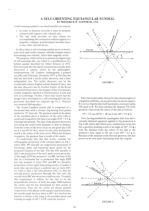
Fred Sawyer presents a self-orienting equiangular sundial, a modification of the Foster-Lambert hybrid dial, capable of correct orientation without external devices. It functions as both a solar clock and a solar compass, determining true celestial north. The design involves a V-shaped gnomon and two sets of hour-markings, allowing for simultaneous readings of Standard and Apparent time and a straightforward orientation process.
Dials: Foster-Lambert, How Sundials Work, Sundial Design & Layout
October 1991
Page 31
Page 31
Peter Drinkwater explores historical methods of time determination, focusing on the "Shadow Square" and "Instrumentum Horarum" found on astrolabes and quadrants. He discusses ancient shadow scales, like those from Palladius, and how they were used to estimate time by shadow length, noting the practical, though often imprecise, methods employed by medieval laborers and pilgrims without modern instruments.
How Sundials Work, Historical Dials
October 1991
Page 37
Page 37
J.A.F. de Rijk describes a new, simple, and more accurate latitude-independent sundial, building upon Freeman's 1978 solution. This type of sundial can indicate local apparent solar time without requiring knowledge of the observer's latitude. The article explains the mathematical principles, focusing on how the product sin(Az)cos(h) and sin(T)cos(δ) are obtained and combined to determine the time (T).
Dials: Unusual, How Sundials Work, Mathematics of Dialling, Sundial Design & Layout
February 1990
Page 4
Page 4
This article, an extract from The Observatory, proposes a method to improve the accuracy of observing shadows by precisely determining the boundary between the shadow and half-shadow using a piece of cardboard on a white screen. This technique can demonstrate the Earth's diurnal motion in seconds and accurately find the noontide shadow position to detect small changes in the Sun's altitude. The author speculates if a similar method was known in pre-telescope times, possibly in connection with structures like the Great Pyramid.
How Sundials Work
February 1990
Page 20
Page 20
This paper explores the concept of "regime angle" in sundials, defined as the angle between the style and the dial surface. It introduces the idea that the Earth itself acts as a "show case" for various shadow regimes and illustrates how shadow curves change with latitude, showing examples for locations from the North Pole to the South Pole. The article also features Mr. Woodford's "Amundsen" dial
Dials: Unusual, How Sundials Work, Mathematics of Dialling
June 1990
Page 17
Page 17
This article explains the construction and practical application of Lambertian Circles in analemmatic dials. These circles, plotted from a specific centre through the foci of the hour point ellipse, determine the times of sunrise and sunset for any given day, applicable across different latitudes.
Dials: Analemmatic, How Sundials Work, Mathematics of Dialling
October 1990
Page 26
Page 26
This article, presented in a question-and-answer format, describes a didactic hemispherical sundial that models the Earth's relationship to the sun. It explains how the shadow of a bead indicates date and time, distinguishes it from ancient Greek dials, and clarifies why it needs occasional adjustment about its axis to display clock time.
Dials: Hemispherical, Equation of Time, How Sundials Work
October 1990
Page 31
Page 31
This article humorously discusses a correspondence in The Times concerning an April Fool proposal to turn Nelson's Column and Trafalgar Square into a giant sundial commemorating the Battle of Trafalgar. The correspondence critiques the impracticality of such a design based on gnomonic principles, while also providing historical details on timekeeping during the battle.
Dials: Horizontal, Historical Dials, How Sundials Work