- Home
- /
- Sundial Encyclopaedia
- /
- September 2011
September 2011
The articles link to the specific page in a PDF optimised for speed. If you want the whole issue, you can download it here, but the files from earlier years can be quite large.
September 2011
Page 1
Page 1
This issue contains the report of our highly successful annual conference at Wyboston Lakes. That nearly 20% of the membership managed to attend must reflect highly on the keenness of our members – and the reputation of the event – especially when a significant number live overseas. The issue, together with the June one, presents written versions of some of the papers presented during the weekend.
The BSS and Members
September 2011
Page 2
Page 2
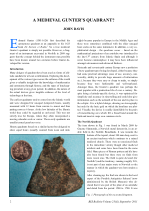
This article discusses the excavation of a quadrant fragment in Norfolk in 2009, initially misidentified as an astrolabe plate. Further investigation suggests it's a hybrid device combining features of a quadrans vetus and a Gunter's quadrant, leading to questions about its medieval origins despite Gunter's later development of his eponymous instrument.
Dials: Portable, Dials: Unusual, Historical Dials
September 2011
Page 7
Page 7
This review covers 'The Ancient Sundials of Scotland' by Dennis Cowan, describing it as a beautiful picture book illustrating Scottish dials like Obelisk, Lectern, Multi-faceted, Mercat Cross, Globe, Church, and House Dials. The book highlights Scotland's unique 17th & 18th-century dial traditions, influenced by the Calvinist world and the Netherlands.
September 2011
Page 8
Page 8
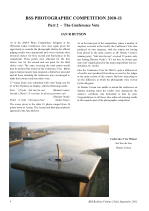
This article details the results of the British Sundial Society's 2010-11 Photographic Competition's 'Conference Vote' segment. Delegates at the Wyboston Lakes conference had the opportunity to vote for their favourite photographs, with Dennis Cowan's 'Sail into the sun' winning, and Dariusz Oczki's 'It’s not fair, he always gets more sun' coming in second.
The BSS and Members
September 2011
Page 10
Page 10
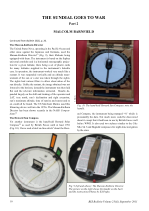
This is the second part of an article exploring the use of sundials and solar compasses in military contexts. It describes instruments like the Marean-Kielhorn Director, Howard Sun Compass, Evans-Lombe, Richards, and Micklethwait sun compasses used by Allied forces. It also details German sun compasses, particularly the C. Plath device used by Rommel's Afrika Korps, and the astrocompass, discussing their applications and limitations in wartime navigation.
Dials: Portable, How Sundials Work, Historical Dials
September 2011
Page 15
Page 15
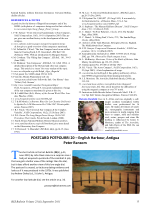
This short article shares a postcard of a low-angle sundial at English Harbour, Antigua, previously discussed by John Davis. The author notes that the postcard, likely from the 1970s, offers another view of this dial, and references a related article about another low-latitude dial.
Dials: Horizontal, Historical Dials
September 2011
Page 16
Page 16
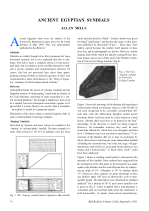
This article reviews ancient Egyptian timekeeping, debunking obelisks as gnomons and a Cairo Museum artifact as a sundial. It focuses on the ‘sloping’ or ‘inclined plane’ portable, seasonal-hour altitude dials, such as the Qantara dial, and earlier L-shaped 'shadow sticks' from the New Kingdom, discussing their construction, use, and the challenges in interpreting their time-telling functions.
Dials: Portable, Dials: Unusual, Historical Dials, How Sundials Work
September 2011
Page 20
Page 20
This article examines the evolution of English mass and scratch dials between c.1250 and c.1650, linking changes in their appearance to the Reformation. It argues that understanding these dials requires interpreting them within their contemporaneous religious and iconographic contexts, highlighting the dramatic shift from elaborate Catholic church decoration to Protestant minimalism, which significantly impacted dial design around 1500.
Dials: Mass Dials, Historical Dials, How Sundials Work
September 2011
Page 22
Page 22
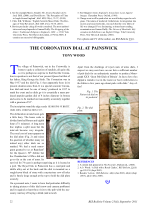
This article describes a souvenir Coronation dial in Painswick, commemorating King George VI's coronation in May 1937. The bronze garden dial, 8 inches in diameter, features a gnomon of 52° and the royal coat of arms. Its location at The Royal Oak pub and its 74-year survival are noted, along with the author's personal challenges in photographing it.
Dials: Horizontal, Historical Dials
September 2011
Page 23
Page 23
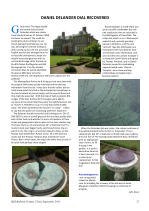
This report details the recovery of a stolen large double horizontal dial by Daniel Delander from Stanford Hall, thanks to Polish dialling enthusiast Maciej Lose. The dial, catalogued as DH-17, SRN 3607, is a high-quality instrument with Equation of Time scales and geographical place names. The article also mentions Delander's apprenticeship under Thomas Tompion, suggesting close working relationships between notable clockmakers.
Equation of Time, Historical Dials, Dials: Double Horizontal
September 2011
Page 24
Page 24
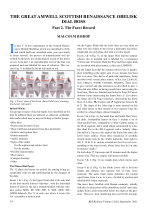
This article, the second part of an examination of the Great Amwell Scottish Renaissance Obelisk Dial Boss, details the archaeological record and incised marks found on its planar and scaphe dial facets. It identifies ten types of marks, including hour lines, solstice/equinox lines, numerals, and place names, discussing the sophisticated design and stonecutting, and determining an optimum latitude of around 55.5° N.
Dials: Multi Faced, Historical Dials
September 2011
Page 27
Page 27
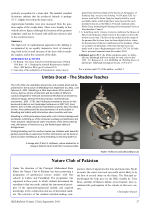
This piece announces an exhibition in Moedling, Austria, from September 2011 to February 2012, focusing on time and sundials. The exhibition features models of sundials from Johannes Gaupp's 'Gnomonica Mechanica Universalis' (1665-1738), symbolistic pictures by Ernst Steiner, and documentation of wall sundials in Moedling.
Dials: Vertical, Dials: Unusual
September 2011
Page 27
Page 27
This report highlights a successful gnomonical science studies programme by the Nature Club of Pakistan in Lahore and Faisalabad schools with support from the BSS.
Dials: Horizontal, Dials: Equatorial, How Sundials Work, DIY Sundial Projects, The BSS and Members
September 2011
Page 28
Page 28
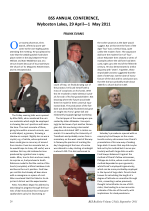
This report summarises the British Sundial Society's highly successful 2011 annual conference at Wyboston Lakes, attended by nearly 20% of its members. It covers various presentations, including Allan Mills on sun's position, Tony Moss on dial manufacture, Johan Wikander on a Norwegian soapstone dial, Fred Sawyer on Jean Picard's large dial layouts, and John Davis on the diffusion of scientific dials.
Historical Dials, Mathematics of Dialling, Sundial Design & Layout, The BSS and Members
September 2011
Page 34
Page 34
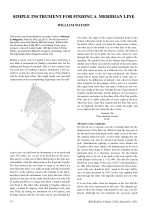
William Watson describes a new instrument for finding a meridian line to aid in sundial making, using two tubes aligned with Polaris and Capella. Michael Lowne comments on the necessity of accounting for Polaris's displacement from the true pole and the stars' right ascension difference for correct alignment, noting potential inaccuracies in Watson's original design and challenges in its use.
How Sundials Work, Mathematics of Dialling, Dialling Tools
September 2011
Page 35
Page 35
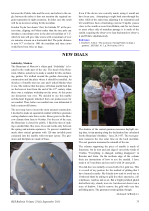
Aleksandr Boldyrev describes the creation of an equatorial sundial for the Rosarium of Sokolniky Park in Moscow. Utilizing an antique piece of Italian marble, the dial features three brass gnomons: one for daylight saving time, one for true solar time, and one for solar azimuth. The dial is designed to operate from spring to autumn equinoxes.
Construction Projects, Dials: Equatorial, Sundial Design & Layout
September 2011
Page 36
Page 36
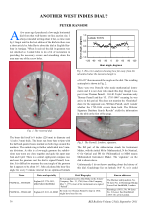
Peter Ransom discusses a 9-inch brass horizontal dial, signed 'Parnell, London,' which he acquired online. The dial, optimized for a latitude of approximately 16.05° N (suggesting a potential link to Guadeloupe), features hours from 6 am to 6 pm, half and quarter-hour marks, and a central compass rose. The gnomon was detached upon acquisition and later restored.
Dials: Horizontal, Restoration projects, Historical Dials
September 2011
Page 37
Page 37
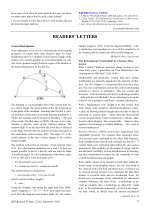
This section compiles several letters from readers. Michael Lowne provides a complex formula for calculating shadow length from gnomon angle. Chris Williams praises Peter Drinkwater's article on scratch dials, linking them to medieval manuscripts. Peter Drinkwater responds on the transmission of scratch dial technology and the function of water clocks. David Young corrects a historical detail about BSS conference venues.
Dials: Mass Dials, Historical Dials, Mathematics of Dialling, The BSS and Members
September 2011
Page 38
Page 38
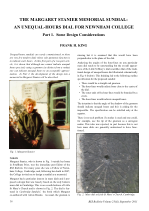
This article details the initial design considerations for a memorial sundial for Margaret Stanier at Newnham College, Cambridge. Frank King proposes an unequal-hours dial with a straight-rod gnomon, loosely based on a historic mass dial. He explores the challenges of accurately indicating unequal hours with a gnomon, discussing celestial sphere projections and a 'critical angle of dip' to improve precision.
Construction Projects, Dials: Mass Dials, Mathematics of Dialling, Sundial Design & Layout
September 2011
Page 44
Page 44
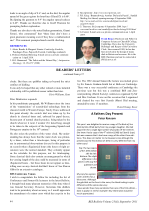
Peter Ransom describes receiving a copy of Mrs. Alfred Gatty's 'The Book of Sun Dials' (1872 first edition) from his daughter. He notes the physical differences between this copy and his other 1872 edition, particularly in cover colour and tooling, and speculates on further variations.
Book Reviews
September 2011
Page 45
Page 45
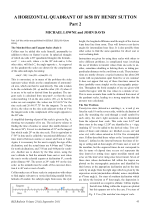
This second part examines the scales and uses of a 1658 horizontal quadrant by Henry Sutton, collaborating with John Collins. It details the matched sine and tangent scales for astronomical calculations, star positions for night-time finding, calendar tables for moon age and high water, and shadow/quadrat scales for measuring building heights. It also provides biographies of Collins, Dary, and Sutton, highlighting their roles in 17th-century London's mathematical community.
How Sundials Work, Mathematics of Dialling, Historical Dials
September 2011
Page 48
Page 48
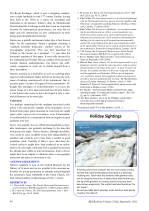
This short entry presents a photo of a declining, reclining sundial from Cavtat, Croatia, seen during a holiday. It suggests the dial likely uses the tip of the gnomon as a nodus and that the lines might have been drawn empirically, as the shadow of the gnomon does not align with the hour lines. The motto translates to 'Do not touch'.
Dials: Unusual, Sundial Design & Layout