- Home
- /
- Sundial Encyclopaedia
- /
- Frank King
Frank King
March 2023
Page 25
Page 25
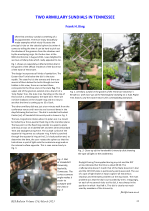
Compares two armillary dials seen during a NASS conference tour. The first, at the Governor’s Residence, is exquisite and highly symbolic. The second, at Vanderbilt University, uses a unique method where a spot of light shines through the equatorial ring onto an analemma plate to indicate the time.
Dials: Armillary Sphere, Dials: Equatorial, Dials: Unusual, Equation of Time
March 2023
Page 26
Page 26
Summary of the Society's 2022 activities, including holding the York conference and Newbury meeting, maintaining strong finances, and detailing public benefit submissions to the Charity Commissioners. Projects included restoration advice, pro bono design work, and the continued growth of the Fixed-Dial Register.
Construction Projects, Restoration projects, The BSS and Members
September 2023
Page 1
Page 1
Discusses the reproduction of the BSS Conference sundial “examination” questions and answers in this issue, noting that no one achieved more than half marks at the Conference. It also mentions the lead article on the Medieval Rule of Erfurt, two articles on magnetic compasses, two articles on horizontal sundials with multiple gnomons, the 2023 Photographic Competition winners, and details about a Zoom event.
The BSS and Members
September 2023
Page 12
Page 12
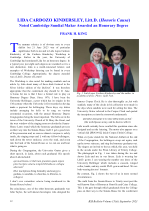
Reports on Lida Lopes Cardozo Kindersley, a renowned letterer and sundial maker, being awarded an honorary Doctor of Letters degree (Litt.D.) by the University of Cambridge on the summer solstice, 21 June 2023. The article notes her work on sundials, including those at Selwyn and Pembroke Colleges, and the inscription on the Corpus Clock.
Sundial Design & Layout, The BSS and Members
September 2023
Page 25
Page 25
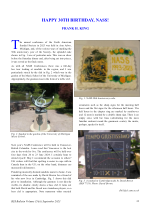
Reports on the North American Sundial Society’s (NASS) 30th Anniversary Conference held in Ann Arbor, Michigan, featuring a commemorative cake and a bus tour. The author notes a sundial in the University of Michigan Music School garden with a gnomon shaped as a treble clef, and mentions a music-themed bass clef dial by David Brown.
The BSS and Members
September 2023
Page 34
Page 34
Reports on the inaugural quarterly BSS Sundial Zoom Event, inspired by Martins Gills and intended to review articles in the latest Bulletin. The event featured introductory comments by authors David Coffeen, Geoff Thurston, and Graham Stapleton, and proved successful despite initial timing uncertainties.
The BSS and Members
September 2023
Page 35
Page 35
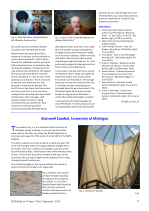
Describes a cylindrical sundial (Dial 1085 in the NASS Registry) located in a stairwell of the University of Michigan Energy Institute, seen during the NASS Conference bus tour. The nodus is formed by the centre of the eight radial arms supporting the skylight, and the markings include a toposcope.
Dials: Cylindrical, Dials: Unusual, Sundial Design & Layout
December 2023
Page 1
Page 1
The editorial introduces the lead articles of the issue, including an important double horizontal sundial by Elias Allen's apprentice George Cooke, an intriguing equatorial dial, a 19th-century provincial dial, and pieces on ancient time reckoning and scratchings on church walls. It also wishes readers a Happy Christmas.
The BSS and Members
December 2023
Page 30
Page 30
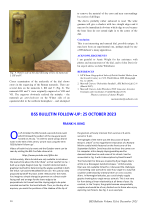
A report on the second BSS Zoom event (renamed 'BSS Bulletin Follow-up'). The event included discussions on the Erfurt Rule and a demonstration of chiselling during the restoration of a Melvin sundial, alongside a theoretical look at converting solar azimuth to solar hour angle for different latitudes.
Dialling Tools, How Sundials Work, Restoration projects, The BSS and Members
September 2022
Page 1
Page 1
Discusses the deaths of Chris Daniel and Tony Wood, noted BSS members. Provides updates on Society changes, including Fred Sawyer becoming a second Patron and Ben Jones taking on the role of Nominated Trustee. Also notes the final instalment of Dennis Cowan's series on Thomas Ross.
The BSS and Members
December 2022
Page 1
Page 1
Discussion of the death of HM the Queen, the Newbury Meeting talks, commemorative sundials, and introduces Werner Riegler's lead article on adapting tide prediction machines to calculate the Equation of Time.
Equation of Time, The BSS and Members
March 2021
Page 1
Page 1
Customarily, this first issue incorporates the Trustees' Annual Report and Accounts. There are several articles, including David Brown's restoration report on a large polyhedral sundial and notes on the late Jill Wilson's work concerning Masonic symbols.
The BSS and Members
June 2021
Page 37
Page 37
Report on the British Sundial Society's successful virtual conference held via Zoom in April 2021, featuring three noted North American speakers. Talks covered Zarbula and Potey dials in the French Alps, a highly customized ceiling reflection sundial by Woody Sullivan, and Fred Sawyer's theoretical work on Hybrid Peaucellier azimuthal dials designed to eliminate the noon gap.
Dials: Reflected, Mathematics of Dialling, Sundial Design & Layout, The BSS and Members
September 2021
Page 20
Page 20
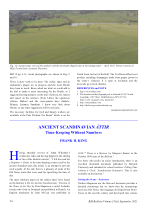
A guide to the ancient Scandinavian system of time-keeping using "áttir" (eighths of the horizon) and landmarks known as daymarks. It explains the Old Norse terminology (middag, miðnætti, undorn) and discusses why this non-numerical system was suitable for high latitudes where unequal hours were unviable.
How Sundials Work, Mathematics of Dialling, Historical Dials
December 2021
Page 6
Page 6
Congratulates the German Fachkreis Sonnenuhren on its 50th anniversary (1971–2021), noting it is the world's longest-established national sundial society. Mentions a commemorative book and conference, and early members like René Rohr, along with historical difficulties communicating with East German diallists.
Historical Dials, The BSS and Members
December 2021
Page 20
Page 20
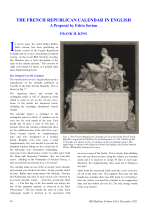
Outlines Fabio Savian’s proposal for an English edition of the French Republican Calendar, providing solar declination and EoT values. Explains the calendar’s structure (décades, 30-day months) and its philosophical anti-religious origins, evidenced by the calendar's iconography, including a discarded sundial and using names like 'Dog' for Christmas Day.
Equation of Time, Historical Dials
March 2020
Page 40
Page 40
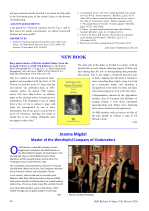
Reports that noted BSS member Joanna Migdal was installed as the 2020 Master of the Worshipful Company of Clockmakers on 28 January. In her speech, she referred to famous sundial makers and former Masters, Elias Allen and Henry Wynne. Two other BSS members attended the Installation Dinner.
The BSS and Members
June 2020
Page 1
Page 1
This piece discusses the disruptive consequences of the COVID-19 pandemic, including the cancellation of the BSS Conference in York and operational difficulties faced due to the closure of the University of Cambridge. It acknowledges John Davis for stepping in to handle the publication of the June Bulletin.
September 2020
Page 23
Page 23
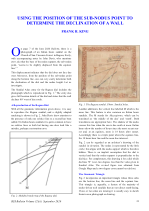
Presents a gnomonic method using the ratio of the horizontal distance between the sub-nodus point, the noon line, and the equinox line to determine a wall's declination. The technique, illustrated using the Ragusa dial, also allows calculation of the nodus height for a vertical dial.
Dialling Tools, Dials: Vertical, How Sundials Work, Mathematics of Dialling
September 2020
Page 38
Page 38
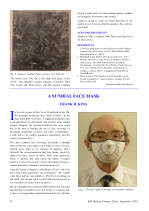
Describes the author's personal DIY project of printing a working stereographic sundial, calculated for his latitude, onto a face mask. Details the construction of a gnomon using a ball-point pen refill and a push pin, and the complexities of reading the time while wearing it.
DIY Sundial Projects, Dials: Portable, Dials: Unusual, Sundial Design & Layout
September 2020
Page 40
Page 40
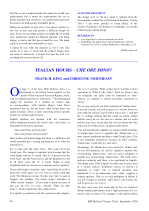
Explains the Italian terminology for 'Italian hours' (e.g., "ore italiche") and the two historical systems based on sunset. These are "ora italica comune" (geometric sunset) and "ore italiche da campanile" (half an hour after sunset, marked by the Angelus bell).
How Sundials Work, Mathematics of Dialling, Historical Dials
December 2020
Page 28
Page 28
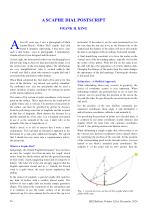
A commentary on Mark Lennox-Boyd's scaphe dial article, providing an alternative, simpler mathematical derivation for plotting points on the spherical surface using horizon coordinates (altitude and azimuth). It also explores the design geometry, showing how the appearance of the dial markings changes based on the ratio of the sphere radius to the rim radius.
Dials: Scaphe, How Sundials Work, Mathematics of Dialling, Sundial Design & Layout
December 2020
Page 31
Page 31
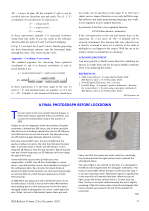
A brief note describing a visit to the Stock Exchange noon mark on 29 February 2020 (a leap year), managing to capture a photograph despite heavy rain. The spot of light aligned with the special thin strip for 29 February, marking GMT noon.
Dials: Vertical, Dials: Noon Lines
December 2020
Page 41
Page 41
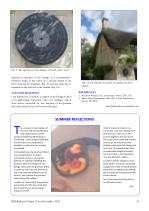
A short piece describing the author’s process of checking the delineation of a simple horizontal sundial by rotating it in the sun to confirm the shadow direction. The text is accompanied by an unusual photograph caught by a "stray click" showing a reflection in sunglasses.
Dials: Horizontal, How Sundials Work, Sundial Design & Layout
December 2020
Page 42
Page 42
A Beginner’s Guide to Delineation: deriving the Lennox-Boyd ‘y’ formula using a gnomonic tetrahedron
An explanation of Mark Lennox-Boyd's 'y' formula (the length of the shadow of the gnomon nodus from the gnomon root). The formula is derived using spherical trigonometry simplified into four interconnected right-angled triangles forming a 'gnomonic tetrahedron'. This methodology is presented as a helpful tool for novice diallists learning delineation.
Dialling Tools, How Sundials Work, Mathematics of Dialling, Sundial Design & Layout
March 2019
Page 13
Page 13
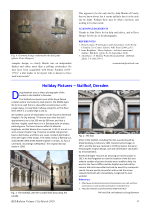
Features photographs of the sundial in the Stallhof courtyard, Dresden, a restored Baroque declining vertical dial destroyed in 1945. It was restored in 1976 and includes a ball nodus, constant-declination lines, Zodiac signs, and the motto *MORS CERTA HORA INCERTA*.
Dials: Vertical, Historical Dials, Mottoes
March 2019
Page 41
Page 41
Reports on the Society reaching its 30th anniversary and maintaining core activities. Highlights successful infrastructure maintenance (Bulletin, website, registers), the publication of the first national Mass Dial Register, and progress on the Biographical Index. Notes the retirement of David Brown and the passing of Jill Wilson, and thanks volunteers.
The BSS and Members
June 2019
Page 1
Page 1
Notes that this issue features an extensive report on the BSS 30th Anniversary Conference in Bath. Highlights include the unveiling of David Brown's refurbished armillary dial and the special anniversary cake. Also mentions erudite articles by Ortwin Feustel and Martin Jenkins, and laments the recent deaths of several distinguished diallists and members.
The BSS and Members
June 2019
Page 6
Page 6
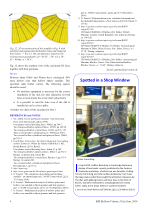
Describes a large slate sundial with a gilded gnomon and flame-like hour lines displayed in a Cambridge bookshop. The dial had originally been intended for a smithy in Buckinghamshire that had subsequently burned down before installation.
Dials: Vertical
September 2019
Page 14
Page 14
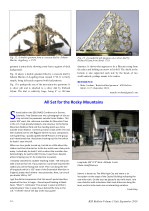
The author recounts finding a brass strip outside Union Station in Denver, Colorado, marking 105° west longitude, the reference meridian for Mountain Time. He explains to an assembled tour group that this longitude corresponds to Mountain Time being seven hours behind the time in the U.K.
Mathematics of Dialling, The BSS and Members
September 2019
Page 36
Page 36
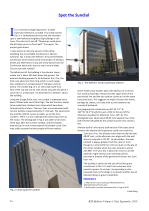
This piece describes a very large, difficult-to-spot sundial located high on the south-east face of the Alfred A. Arraj United States Courthouse in Denver, Colorado. The dial, declining 48.08° east, is estimated to be 38 feet wide by 19 feet high, uses stainless steel strips for furniture, and demonstrates the building’s green credentials.
Construction Projects, Dials: Vertical, Sundial Design & Layout
March 2018
Page 7
Page 7
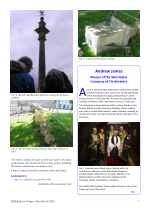
Reports that BSS member Andrew James was installed as Master of the Worshipful Company of Clockmakers on 23 January. Notes that other BSS members, Joanna Migdal and Keith Scobie-Youngs, also hold positions within the Company as Renter Warden and a Court Assistant.
The BSS and Members
March 2018
Page 14
Page 14
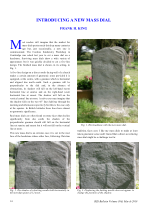
Describes the creation of a new, five-line mass dial cut into the west face of a headstone in East Anglia. The dial declines 14° south of due west. The author discusses the gnomonic challenges of such an orientation and demonstrates that using a horizontal, north-south aligned gnomon allows the shadow to align with the vertical noon line.
Dials: Mass Dials, Sundial Design & Layout
March 2018
Page 20
Page 20
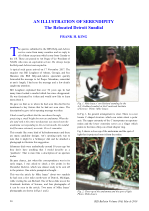
Details the remarkable coincidence where a BSS Help-and-Advice query regarding a missing sundial seen fifty years prior coincided with the typesetting of an article detailing that very instrument. The dial, an A.N. Goddard heliochronometer (designed by Victor E. Edwards) using an aperture nodus and analemma, was moved approximately 15 miles north from a Detroit factory to the Cranbrook Institute of Science.
Dials: Heliochronometer, Historical Dials
March 2018
Page 33
Page 33
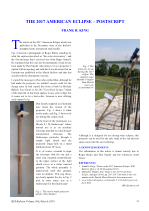
A correction and postscript clarifying the designer and constructor of a solar projector used during the 2017 American Eclipse. The device was constructed by Don Snyder based on a design by Michael Bakich. It uses a finderscope to project the image and an alignment peg that serves as a temporary gnomon.
Construction Projects, Dialling Tools
March 2018
Page 36
Page 36
An overview of the Society's activities supporting the advancement of gnomonic education. Highlights include extensive outreach (lectures, school workshops), advice to professional bodies (e.g., Buckingham Palace, Royal Observatory Greenwich), maintenance of the national sundial database, and the healthy financial status of the BSS. Membership numbers and age distribution are discussed as a cause for concern.
The BSS and Members
June 2018
Page 48
Page 48
Official documentation of the Annual General Meeting held in Norwich. Graham Stapleton and Chris Williams were re-elected as charity trustees. Independent Examiners Ltd was appointed to examine the 2018 annual statement of accounts.
The BSS and Members
December 2018
Page 37
Page 37
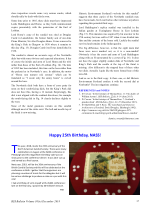
Reports on the successful celebrations, including a magnificent cake, for the 25th anniversary of the North American Sundial Society (NASS) held at their Pittsburgh conference. Notes the upcoming 30th anniversary of the BSS in 2019.
The BSS and Members
March 2017
Page 1
Page 1
The editorial notes that this issue contains three reviews, including a description of the New York 'Time and Cosmos' exhibition. It encourages BSS members to submit articles or short items on sundial themes for publication. The issue also includes the annual Trustees’ Report and Accounts, a requirement due to the Society becoming a Charitable Incorporated Organisation.
March 2017
Page 8
Page 8
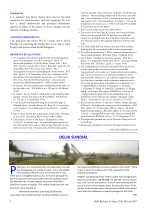
A large sundial in Delhi is reported to be one of the largest scientifically accurate sundials in the world, although the author expresses doubt regarding this claim. Access to the site is difficult due to its location in a complex of flyovers, and poor air quality often means the dial rarely sees the sun.
Dials: Horizontal, Dials: Unusual
June 2017
Page 2
Page 2
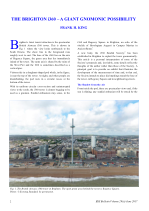
This article explores the irresistible temptation to use Brighton's vertical i360 tower as the gnomon for an azimuthal sundial. It details the i360 Sundial Society's proposals to mark time paths and date paths on the built-up, sloping ground of Regency Square using specially-made bricks.
Construction Projects, Dials: Unusual, Sundial Design & Layout
June 2017
Page 33
Page 33
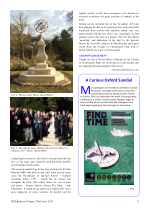
A short, humorous piece noting a poster seen by conference delegates advertising the Oxford Museum of the History of Science. The author pointed out that the poster designer should have checked what a sundial looks like.
The BSS and Members
September 2017
Page 1
Page 1
This editorial encourages conference speakers and attendees of Newbury meetings to submit articles to the Bulletin for the benefit of all members. It also reminds members that holiday photographs of sundials, such as those featured in 'A Missed Opportunity', can be developed into published articles.
The BSS and Members
December 2017
Page 1
Page 1
The editorial notes reports on talks from the Newbury Meeting, particularly those by John Davis and Ian Butson, which were expanded into full articles. It reports the death of Frank Evans and mentions a time-related exhibition on 'The Clockwork Universe' in Pavia, Italy, which runs until 23 December.
The BSS and Members
December 2017
Page 5
Page 5
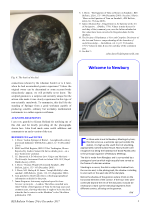
Features a photograph and description of a vertical fibreglass sundial, the handiwork of David Pawley, situated high on the south front of Sundial House near the Newbury train station.
Dials: Vertical, The BSS and Members
December 2017
Page 8
Page 8
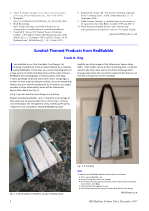
Notes that the company RedBubble prints photographs on various products (like throw pillows and tote bags), many of which feature images of sundials, such as the Paternoster Square Noon Mark.
Dials: Noon Lines
December 2017
Page 18
Page 18
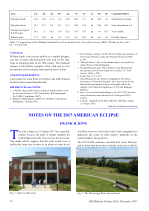
A report on the observation of the total solar eclipse of 21 August 2017, held during the NASS conference at Jefferson Barracks, Missouri. Methods of observation, including a kitchen strainer, a reflection instrument, and Bill Gottesman's ingenious Eclipse Sundial, telling the time by the angle of the line between the sun's horns, are described.
Dials: Unusual, The BSS and Members
December 2017
Page 21
Page 21
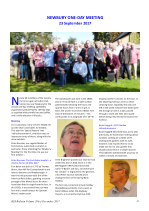
A detailed report on the BSS one-day meeting, summarising talks on topics including the Fort Belan sundial, DIY heliochronometers, multi-centre delineation, promotion via social media, the astronomical Culpeper dial, the Gnomonical Universal Nomograph (GUN), and the mechanical generation of the Equation of Time using equation clocks.
Dials: Heliochronometer, Equation of Time, Historical Dials, The BSS and Members
December 2017
Page 37
Page 37
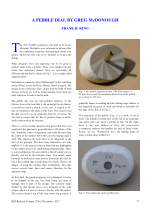
Describes a single-sided equatorial sundial, made from a pebble, that was given to delegates at the 2017 NASS Conference. The gnomon features a crescent cut-out as a memento of the solar eclipse, and time is read from the leading edge shadow falling on sandblasted alternate gaps.
Dials: Equatorial, Dials: Portable, Dials: Unusual, The BSS and Members
March 2016
Page 1
Page 1
A circa 1913 Francis Barker gnomon, which was severely twisted and bent, required straightening. The author commissioned Mark Clarke, an expert who usually works on historic aircraft components at the Imperial War Museum Duxford, to straighten the piece, finding the task straightforward given his experience.
Historical Dials, Restoration projects
March 2016
Page 31
Page 31
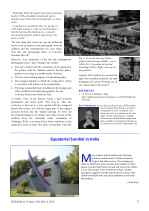
A brief note on an equatorial sundial located on the campus of the University at Pune, India. This variant of the famous large Indian masonry dials was constructed in concrete and steel in the 1980s.
Dials: Equatorial
June 2016
Page 1
Page 1
This issue covers the Liverpool Conference, including accounts of the talks, awards, and photographic competition. It announces that Christine Northeast’s article "‘The Moving Sundial of Ardrossan’" was the ‘Most Enjoyed Article 2015’. The editorial team encourages readers to submit new articles, especially those detailing historical interests or new sundial construction projects.
The BSS and Members
September 2016
Page 21
Page 21
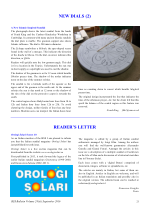
Describes a new 500 mm marble horizontal sundial designed with Islamic influences for a tropical location. Features include a low gnomon angle, a Mihrab-inspired carved Ω shape showing Qibla (direction to Mecca), and Babylonian/Italian hour lines to help Muslim users determine prayer times (Dhuhur and Maghrib).
Construction Projects, Dials: Horizontal, Dials: Unusual, Sundial Design & Layout
September 2016
Page 31
Page 31
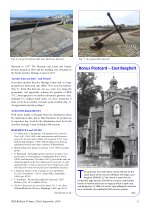
A brief note accompanying a postcard of the dial (SRN 0312) located on the south porch of St Mary the Virgin church, East Bergholt. The church is noted for its unique bell cage where the bells are rung without ropes.
Historical Dials
September 2016
Page 32
Page 32
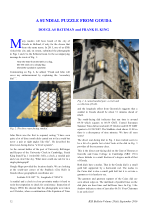
Analysis of a pair of canted vertical dials on the Stadhuis in Gouda, Holland, focusing on a direct east-facing nodus dial. Although the direct south-facing dial shows minor discrepancies with the clock time, the east-facing dial's parallel lines meant to be constant-declination curves are considered seriously suspect and likely the result of bad restoration.
Dials: Vertical, Historical Dials
September 2016
Page 36
Page 36
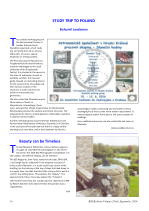
Features a photograph submitted by Margaret Ribchester (whose obituary appears on page 10) for the 2016 Photographic Competition. The image captures the 18th-century dial (SRN 0194) at Sizergh Castle, noted for its beautiful setting, and its apparent lack of hour lines.
Historical Dials, The BSS and Members
December 2016
Page 1
Page 1
The editorial notes the Newbury Meeting report and upcoming articles. It welcomes submissions and wishes readers well for the New Year. It also announces two full-page advertisements and highlights articles concerning Mrs Crowley and BSS Monograph 11, which features astonishing quality photographs of mass dials in Somerset.
Book Reviews, The BSS and Members
December 2016
Page 37
Page 37
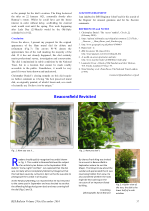
A brief follow-up noting that the foliage obscuring the Beaconsfield sundial, which had been cleared in April, had regrown significantly by September 2016, covering half of the dial. The issue was brought to the attention of the local Mayor.
Historical Dials
December 2016
Page 41
Page 41
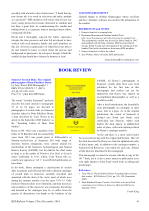
Review of BSS Monograph 11, 'Somerset Scratch Dials: The original photographs of Dom Ethelbert Horne' by Tony Wood. The monograph reproduces 53 pages of astonishing quality photographs of mass dials taken by Horne between 1911 and 1915, complementing his 1917 catalogue.
Book Reviews, Dials: Mass Dials, Historical Dials
June 2015
Page 21
Page 21
Addressing the lack of a date scale on the Chetwode Quadrant, this piece explains a practical method for setting the sliding bead on an horary quadrant string. The user relies on frequent observations around noon to refine the bead's position relative to the noon hour line.
Dialling Tools, How Sundials Work, Mathematics of Dialling
June 2015
Page 46
Page 46
A report outlining the Society’s activities, including celebrating the Silver Jubilee, improving the website interface (Bridol operational), holding educational workshops at Cheney School, implementing the CIO status change, and acknowledging member participation.
The BSS and Members
September 2015
Page 7
Page 7
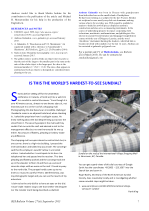
An account of the author's difficult and adventurous attempt to photograph a 40-metre-wide sundial located on the roof of the International Village Shopping Mall in Vancouver, BC, Canada. Few people, including local residents and staff, are aware of the dial's existence.
Dials: Unusual
September 2015
Page 22
Page 22
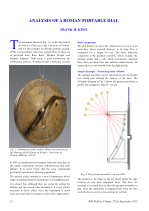
A novel analysis of a Roman portable altitude dial from Oxford’s Museum of the History of Science. It explores how the instrument determines unequal hours from solar altitude, discusses the underlying mathematical model, the use of latitude and declination scales, and provides an error analysis.
Dials: Portable, Historical Dials, How Sundials Work, Mathematics of Dialling
September 2014
Page 2
Page 2
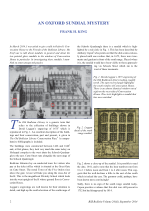
An investigation into two painted glass sundials in the windows of Convocation House at the Old Bodleian Library in Oxford, focusing on their history, appearance, dating, and the discovery that the south dial is incorrectly installed, facing the wrong way.
Dials: Vertical, Historical Dials, Restoration projects, Sundial Design & Layout
September 2011
Page 38
Page 38
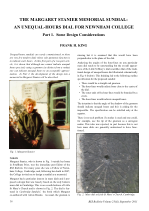
This article details the initial design considerations for a memorial sundial for Margaret Stanier at Newnham College, Cambridge. Frank King proposes an unequal-hours dial with a straight-rod gnomon, loosely based on a historic mass dial. He explores the challenges of accurately indicating unequal hours with a gnomon, discussing celestial sphere projections and a 'critical angle of dip' to improve precision.
Construction Projects, Dials: Mass Dials, Mathematics of Dialling, Sundial Design & Layout
December 2011
Page 42
Page 42
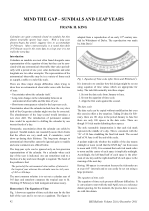
This article addresses the difficulties of accommodating leap years on sundial calendars, particularly when showing the equation of time or solar declination. It explains how to design scales for precise readings despite the difference between tropical and civil years, and discusses the historical debate around which day (24th or 29th February) is the "extra" leap day. Practical design solutions are proposed.
Equation of Time, How Sundials Work, Mathematics of Dialling, Sundial Design & Layout
December 2011
Page 47
Page 47
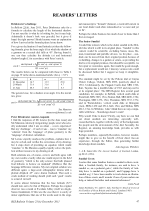
This section contains letters from readers discussing various sundial topics. These include formulae for horizontal shadow length, a query about the oldest scientific sundial in the British Isles, sundials in family crests, proposed organisational changes within the BSS, and the historical transmission of scratch dials and water-clock functionality. It highlights ongoing member engagement and research interests.
Mathematics of Dialling, Historical Dials, The BSS and Members, Mottoes
September 2010
Page 2
Page 2
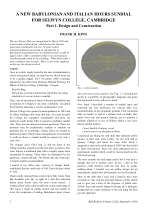
This article details the design and construction of a new elliptical slate sundial for Selwyn College, Cambridge, indicating both Babylonian and Italian hours. It discusses the selection of the site, the unique nodus design, precise surveying for wall parameters, and the process of setting out and cutting the dial with inscriptions.
Construction Projects, Dials: Vertical, Mathematics of Dialling, Sundial Design & Layout
December 2010
Page 9
Page 9
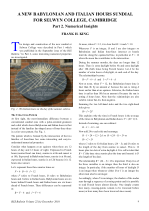
This article is the second part of a series detailing the Selwyn College sundial, focusing on its numerical properties. It explains the criss-cross pattern of Babylonian and Italian hour-lines, their relationship with French hours, and the concept of 'extra daylight.' It also provides methods for setting out these hour-lines.
Dials: Unusual, How Sundials Work, Mathematics of Dialling, Sundial Design & Layout
March 2007
Page 33
Page 33
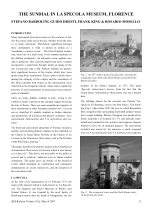
This paper describes the pinhole sundial in the Grand-Ducal Astronomical Observatory (La Specola) in Florence. It covers the observatory's history, the sundial's design as a string-gnomon meridian line, its restoration in 2005, and a comparison of measured zodiac point positions with calculated values. It highlights the instrument's historical importance for astronomical studies and calendar reform.
Dials: Noon Lines, Historical Dials, How Sundials Work, Restoration projects
December 2007
Page 173
Page 173
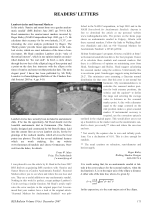
This section contains various letters from readers. Frans W. Maes discusses Lambert circles and seasonal markers on analemmatic sundials. Roger Bailey provides corrections and recommendations for seasonal markers. Frank King confirms a relationship for seasonal marker distance. Ken Head replies to Maes and Bailey. John Lester solves the mystery of a partial sundial motto. Malcolm Barnfield describes the making of a noon cannon sundial.
Dials: Analemmatic, Sundial Design & Layout, DIY Sundial Projects, The BSS and Members
March 2004
Page 14
Page 14
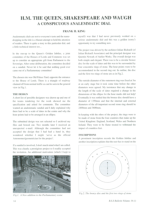
This article details the design and construction of an analemmatic sundial for the Queen's Golden Jubilee, located in Old Palace Yard, opposite the House of Lords. It covers the challenges of designing for a cambered surface, the selection of stone from UK countries, the prominent Shakespearean inscription, and the intricate process of determining the scale of dates for the dial.
Construction Projects, Dials: Analemmatic, Sundial Design & Layout
March 2001
Page 16
Page 16
The design and installation of the Pembroke College Wall Dial, emphasizing an uncluttered design and prominent nodus for clear time estimation. It highlights a unique coincidence for Cambridge students cycling past, aligning with lecture times. The article details the construction process, including the sealing of the mounting assembly and the replacement of missing stone, ensuring durability. It also mentions AT&T Research Laboratory's digital camera monitoring for shadow detection.
Construction Projects, Dials: Vertical