- Home
- /
- Sundial Encyclopaedia
- /
- Sue Manston
Sue Manston
March 2023
Page 20
Page 20
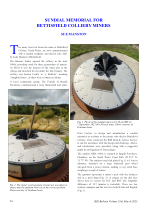
Describes the stainless-steel memorial sundial (SRN 8340) commissioned to honour miners who died at Bettisfield Colliery. The BSS Help & Advice Service assisted the artist with design and calculations. The dial features a miner’s pick gnomon mounted on a salvaged industrial gear wheel.
Construction Projects, Sundial Design & Layout, The BSS and Members
December 2023
Page 10
Page 10
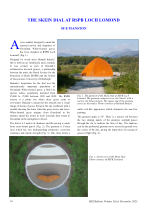
A report on a 6.3-metre diameter horizontal sundial/art installation at RSPB Loch Lomond, designed by Hannah Imlach, which marks the migration windows of Greenland White-fronted geese. The gnomon is formed by the slit between two sheets of Corten steel with piercings that give the impression of migrating geese in flight, and coloured bands mark the Autumn and Spring arrival/departure periods.
Construction Projects, Dials: Horizontal, Dials: Unusual, Sundial Design & Layout
December 2023
Page 28
Page 28
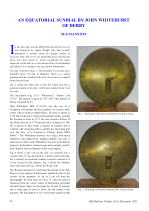
Describes an interesting and possibly unique equatorial sundial acquired by Annie Wright, signed "Whitehurst" "Derby" and "1761" (Lat: 53D: 00M). The dial features two centres of delineation, hour lines marked from 4 am to 8 pm, solstice lines on the gnomon, and some engraving errors.
Dials: Equatorial, Dials: Portable, Dials: Unusual, Historical Dials, Sundial Design & Layout
March 2022
Page 34
Page 34
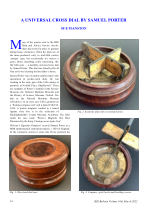
Description of a unique portable, universal cross dial made by Samuel Porter, a London mathematical instrument maker (c. 1824). The dial, found in a clearance, features a pivoted cross for latitude setting, a 16-point compass, spirit levels, and an Equation of Time table printed inside the lid.
Dialling Tools, Dials: Portable, Equation of Time, Historical Dials
September 2022
Page 32
Page 32
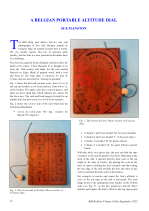
Examines a challenging 18th-century portable altitude dial from Belgium, made of painted wood. The article discusses the function of its sunrise and hour scales and proposes possible, albeit fiddly, methods of operation using a cord and bead, given the likely absence of a gnomon or alidade.
Dials: Portable, How Sundials Work
December 2022
Page 22
Page 22
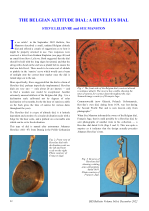
Follow-up article suggesting the previously discussed small Belgian altitude dial is a rare Hevelius dial, possibly a unique wooden example using the time of sunrise as a proxy for solar declination. Analysis shows deliberate geometric simplification in its layout.
Dials: Portable, Dials: Unusual, Historical Dials, Sundial Design & Layout
December 2022
Page 40
Page 40
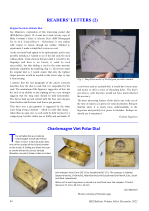
Brief description of a small portable dial made by Charlemagne Viet (fl. 1673-95) in Blois, France. It features two polar dials and a folding arc to set the latitude for 16 listed cities.
Dials: Polar, Dials: Portable, Historical Dials
March 2021
Page 31
Page 31
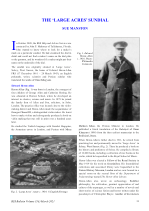
An investigation into the maker of a horizontal brass dial (1907) from 'Large Acres', the home of Edward Heron-Allen. Based on the decorative features, gnomon shape, Equation of Time ring layout, and specific wording, the evidence suggests the dial was custom-made by Francis Barker & Son.
Dials: Horizontal, Historical Dials, Mottoes
March 2021
Page 42
Page 42
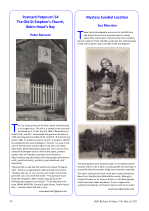
A query to members seeking help identifying the location of old family photographs. The location is a park or public garden, possibly in south-east London, featuring an armillary sphere sundial on a pedestal, which is currently unlisted in the Fixed Dial Register.
Dials: Armillary Sphere, The BSS and Members
June 2021
Page 20
Page 20
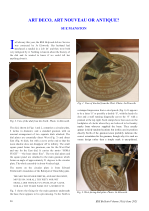
Analyzes a highly unusual circular sundial featuring separate curved direct West and East dials. The investigation, based on numerals and a foundry mark, suggests it might be a custom-made dial by Francis Barker & Son, possibly derived from their 'Antique' model (c. 1907). Concludes the dial incorporates elements of both Art Deco and Art Nouveau styles.
Dials: Vertical, Dials: Unusual, Sundial Design & Layout, Historical Dials
June 2021
Page 31
Page 31
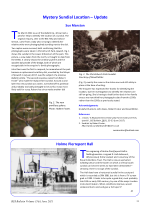
Provides an update identifying the location of a sundial pictured in old family photographs as Christchurch Park, Ipswich. The dial was an armillary sphere. Notes that a 2017 replacement armillary dial was stolen and replaced again by maker Robert Foster.
Restoration projects, Historical Dials, Dials: Armillary Sphere
September 2021
Page 17
Page 17
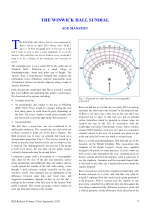
Details the project to convert a 30-foot telegraph pole at Winwick Hall into a large, highly visible outdoor sundial. The final design employs the vertical pole's shadow to cast time on 18-metre radius winter and summer arcs, prioritising fun and visibility over high accuracy for walkers.
Construction Projects, Dials: Unusual, Dials: Vertical
September 2020
Page 36
Page 36
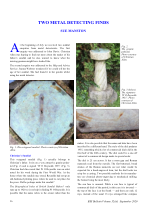
Reports on two sundial finds by metal detectorists. The first is an octagonal horizontal dial signed ‘W O Reynolds 1935’ with the motto 'Sole orto spes; decedente pax'. The second is a square dial inscribed 'Raymond Surrey', possibly made by a clockmaker.
Dials: Horizontal, Historical Dials, Mottoes
March 2019
Page 12
Page 12
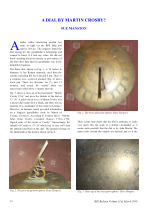
Investigates a 1766 brass horizontal sundial found via the BSS Help and Advice Service. Although signed 'Martin Crosby', the latitude (53° 30ʹ) suggests the maker was likely John Martin of Great Crosby, Liverpool, a known clockmaker. The dial is notable for its minute-interval 'vernier' transversals and pierced gnomon.
Dials: Horizontal, Historical Dials, Sundial Design & Layout
September 2019
Page 15
Page 15
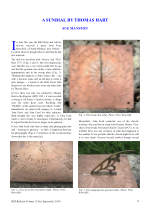
The article details the investigation into a dial inscribed 'Jwade' and 'Thos. Hart 1773', which was found to be the genuine article stolen from All Saints’ Church in Iwade. The investigation concurrently identified eight other similar dials (like one at Wilton House Museum) bearing the 20th-century “Brazen-Faced Old Optimist” motto, believed to be later replicas.
Dials: Horizontal, Historical Dials, Restoration projects
December 2019
Page 22
Page 22
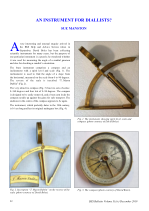
An investigation into a 19th-century brass instrument by T. Mason Dublin, combining a compass and an inclinometer, whose purpose is uncertain. The author reviews several possibilities for its use, such as adjusting a sundial's latitude or measuring gnomon angles, but ultimately suggests it was more likely intended for surveying or geological measurements.
Dialling Tools, Historical Dials
September 2018
Page 8
Page 8
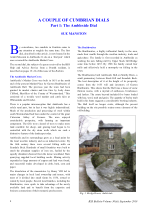
Details an octagonal brass sundial (c. 1651) now in the Armitt Museum, Ambleside. Originally belonging to Gawen Braithwaite, the dial post bears the inscription ‘GB’ and the motto ‘VITA VT HERBA’. Analysis of the punched numerals, hatched segments, and metallurgy suggests it is a very early dial, likely made by a goldsmith or silversmith, G. Hayton.
Dials: Horizontal, Historical Dials
September 2018
Page 19
Page 19
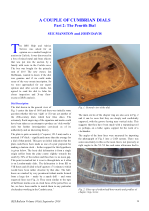
Describes a 1695 brass horizontal dial bought at auction in Carlisle, designed for latitude 54°. The florid motto ‘Ut Hora Sic Vita’ and signature Lawrance Swarbricke, an excise officer in Penrith, suggest he customized a dial commissioned from a clockmaker. Metallurgical analysis reveals a mid-zinc leaded brass composition typical of the period.
Dials: Horizontal, Historical Dials
December 2018
Page 18
Page 18
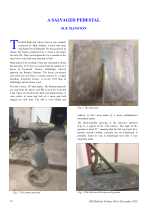
Describes a 1675 brass horizontal dial found atop a broken, ornate pedestal in Edinburgh. The dial, designed for London's latitude (51°), features a 17th-century thick-and-thin pierced gnomon. The date appears genuine, though the pedestal is likely later.
Dials: Horizontal, Historical Dials
December 2018
Page 43
Page 43
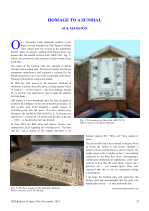
Details the creation of a large marble mosaic floor in Arsenal FC's hospitality space, Dial Square, referencing the club's birthplace and the original Dial Arch sundial (1886). The BSS was consulted regarding the original sundial's missing numeral 'VII', confirming it was likely due to space constraints.
Historical Dials, Sundial Design & Layout
September 2017
Page 28
Page 28
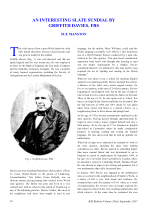
This biography recounts the life of actuary Griffith Davies, FRS, who won a silver medal in 1820 for a complex slate sundial. His 27-inch square horizontal dial, designed for London, displayed 14 different pieces of information, including time in London and Pekin, sun altitude/azimuth, and the Equation of Time.
Dials: Horizontal, Historical Dials
December 2017
Page 12
Page 12
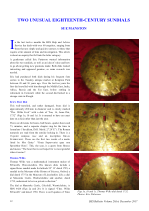
Investigates two antique dials: a damaged brass horizontal dial signed by Thomas Wilks and dated 1732, featuring a Jerusalem time ring and Horace motto; and an unsigned, rare, early 18th-century horizontal dial believed to be part of a declinatory instrument.
Dialling Tools, Dials: Horizontal, Dials: Unusual, Historical Dials
June 2012
Page 46
Page 46
This section contains three letters from readers. Peter Drinkwater discusses a Canterbury pendant, questioning Arnaldi’s gnomon positions. Frank Coe references a Chichester Sun Compass. Sue Manston points out a potential error in the 'waxing' and 'waning' engravings on the Balliol Moondial's gnomon, to which David Harber responds confirming the mistake.
Dials: Portable, Dials: Unusual
December 2012
Page 28
Page 28
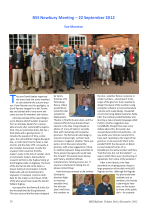
This report summarises the BSS Newbury Meeting, covering presentations on John Davis's "Mystery Welsh Sundial," Doug Bateman's "Romeo & Juliet Sundial," Kevin Karney's "Getting the Numbers Right" on dial layouts, and John Foad's project to put BSS Register dials online.
How Sundials Work, Mathematics of Dialling, Sundial Design & Layout, The BSS and Members
December 2011
Page 47
Page 47
This section contains letters from readers discussing various sundial topics. These include formulae for horizontal shadow length, a query about the oldest scientific sundial in the British Isles, sundials in family crests, proposed organisational changes within the BSS, and the historical transmission of scratch dials and water-clock functionality. It highlights ongoing member engagement and research interests.
Mathematics of Dialling, Historical Dials, The BSS and Members, Mottoes