- Home
- /
- Sundial Encyclopaedia
- /
- September 2019
September 2019
The articles link to the specific page in a PDF optimised for speed. If you want the whole issue, you can download it here, but the files from earlier years can be quite large.
September 2019
Page 1
Page 1
The editorial notes that the September issue is thinner than normal, mentions the highest recorded UK temperature (38.7° C) in Cambridge on 25 July, and highlights recurring themes like follow-up articles, Latin mottoes, the shortest day, and a saga resulting from a query to the Help and Advice Service.
September 2019
Page 2
Page 2
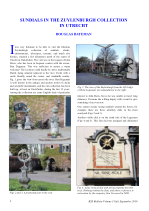
This article details a visit to the privately owned Zuylenburgh collection in Oud-Zuilen, Utrecht, which includes sundials, clocks, and scientific instruments. Highlights include a vertical dial by Pieter de Ruiter, several armillary dials, and portable dials by notable makers such as J. Smith, W. & S. Jones, Elias Allen, Thomas Wright, and Humfrey Cole.
Dials: Vertical, Dials: Portable, Historical Dials, Dials: Armillary Sphere
September 2019
Page 7
Page 7
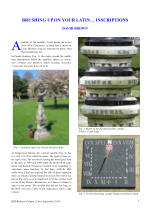
This piece examines Latin mottoes found on sundials visited during the 2019 BSS Conference in Bath. It provides translations for inscriptions on the Parade Gardens armillary sphere, Kingswood School’s vertical and analemmatic dials, and the Pilkington & Gibbs heliochronometer, ending with a challenge regarding the Royal Victoria Park cross dial inscription.
Dials: Analemmatic, Dials: Heliochronometer, Dials: Vertical, Mottoes
September 2019
Page 10
Page 10
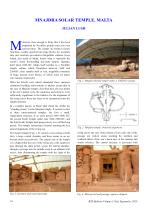
The article discusses the Neolithic Mnajdra temple complex in Malta, which flourished between 3600 and 2500 BC. The structure incorporates features marking key points in the sun’s annual cycle, aligning the rising sun at the equinoxes and solstices. This precision suggests Mnajdra may be the earliest known structure marking all four significant points in the solar cycle.
Historical Dials, How Sundials Work
September 2019
Page 12
Page 12
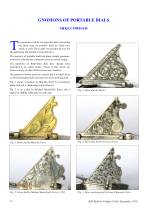
This survey focuses on the ornate gnomons used on attractive portable dials made for gentlemen. Examples are provided from various makers, including Michael Butterfield, Pierre Sevin, Nicholas Lemaindre, and Richard Glynn, showcasing finely fretted, gilt, and engraved designs on small silver or brass horizontal and inclining dials.
Dials: Portable
September 2019
Page 14
Page 14
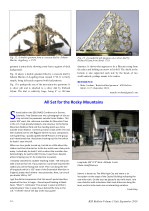
The author recounts finding a brass strip outside Union Station in Denver, Colorado, marking 105° west longitude, the reference meridian for Mountain Time. He explains to an assembled tour group that this longitude corresponds to Mountain Time being seven hours behind the time in the U.K.
Mathematics of Dialling, The BSS and Members
September 2019
Page 15
Page 15
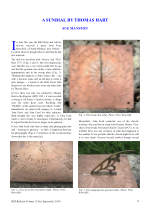
The article details the investigation into a dial inscribed 'Jwade' and 'Thos. Hart 1773', which was found to be the genuine article stolen from All Saints’ Church in Iwade. The investigation concurrently identified eight other similar dials (like one at Wilton House Museum) bearing the 20th-century “Brazen-Faced Old Optimist” motto, believed to be later replicas.
Dials: Horizontal, Historical Dials, Restoration projects
September 2019
Page 19
Page 19
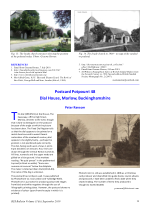
This entry describes a nineteenth-century vertical dial (SRN 0501) by Edwin Clark at Dial House, Marlow. The dial declines to the west, showing 1 pm to 8 pm, with gilded lines on a blue ground, and features the mottoes “Ne quid pereat” and “Horas non numero nisi serenas”.
Dials: Vertical, Historical Dials, Mottoes
September 2019
Page 20
Page 20
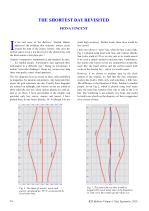
This follow-up article explains, using an astronomical perspective, why the earliest sunset and latest sunrise do not coincide exactly with the shortest day. The discrepancy arises because the Equation of Time causes the 'noon' line, measured by local mean time, to wander relative to the 12h line, shifting the symmetry of the sunrise and sunset curves.
Equation of Time, How Sundials Work, Mathematics of Dialling
September 2019
Page 21
Page 21
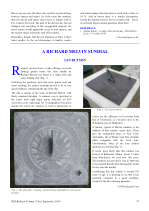
A description of a recently recovered slate sundial by Richard Melvin, typical of his finely engraved work. The dial includes an EoT correction scale, a compass rose, 70 geographical locations, and four smaller corner dials indicating times in New York, Alexandria, Isle of Borneo, and New Zealand.
Dials: Unusual, Equation of Time, Historical Dials
September 2019
Page 22
Page 22
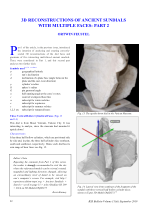
This article continues the analysis of ancient multi-faced sundials using 3D reconstructions. It examines a dial from the Musei Vaticani with three vertical hollow cylindrical faces and a combination dial from Herculaneum featuring vertical hollow cylindrical and spherical faces. Analysis includes calculation based on geographical latitude and declination lines.
Dials: Hemispherical, Dials: Multi Faced, Historical Dials, Mathematics of Dialling
September 2019
Page 27
Page 27
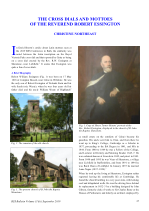
A detailed analysis of the Reverend R.W. Essington (1818–1907) and his enthusiasm for cross dials. It documents the three cross dials he erected at Shenstone and Newquay, discussing their mottoes and inscriptions, and provides strong evidence linking him to the design or erection of the cross dial in the Royal Victoria Park Botanical Gardens in Bath.
Dials: Unusual, Historical Dials, Mottoes
September 2019
Page 33
Page 33
This letter comments on the study of the shortest day, noting that Claudius Ptolemy wrote about the 'Inequality in the Days' around 150 AD in "The Almagest". Ptolemy correctly identified the two causes—the Solar Anomaly (Eccentricity Effect) and the variation in Meridian crossing (Obliquity Effect)—demonstrating extraordinary precision in calculating the Equation of Time effects.
How Sundials Work, Mathematics of Dialling, Equation of Time
September 2019
Page 34
Page 34
The author investigates a sunken rhombic dodecahedron sundial found in Leitholm. Initially theorised to be the missing multi-faced dial described by Thomas Ross at Lee Castle, this theory was later refuted by evidence showing that broken pieces of the original Lee Castle dial still existed elsewhere in 1984. The Leitholm and Lee Castle dials are likely by the same maker.
Dials: Cube, Dials: Multi Faced, Historical Dials
September 2019
Page 36
Page 36
This piece describes a very large, difficult-to-spot sundial located high on the south-east face of the Alfred A. Arraj United States Courthouse in Denver, Colorado. The dial, declining 48.08° east, is estimated to be 38 feet wide by 19 feet high, uses stainless steel strips for furniture, and demonstrates the building’s green credentials.
Construction Projects, Dials: Vertical, Sundial Design & Layout