- Home
- /
- Sundial Encyclopaedia
- /
- March 2015
March 2015
The articles link to the specific page in a PDF optimised for speed. If you want the whole issue, you can download it here, but the files from earlier years can be quite large.
March 2015
Page 1
Page 1
This issue has been prepared by the Chairman, Christine Northeast, and Bill Visick. They acknowledge assistance from John Davis, mention the issue is back to normal length, and note that several articles are being held over until June.
The BSS and Members
March 2015
Page 2
Page 2
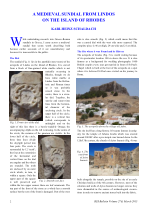
Analysis of a medieval sundial, inaccessible to the public, found in the store-room of the acropolis of Lindos on Rhodes. Carved from white marble, the dial features a circular design with three time lines dividing daylight into four parts. Based on similarity to English examples and the four-division structure unique to Latin Europe, the article suggests Frankish influence and dates its creation to the 14th century for use by the Hospitallers.
Dials: Unusual, Dials: Vertical, Historical Dials
March 2015
Page 5
Page 5
Details the design and construction of a new elliptical vertical dial crafted from grey Burlington slate for a private commission in Wales.
Dials: Vertical, Sundial Design & Layout, Construction Projects
March 2015
Page 6
Page 6
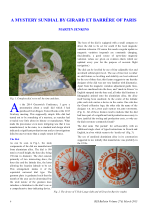
An investigation into a portable equatorial universal dial manufactured using anodized aluminium alloy, potentially dating from the late 1930s or early 1940s, or perhaps post-1960. Research reveals the involvement of the designer T.H. de Lange (W.G. ten Houte de Lange) and the publishing house Girard et Barrère. The dial's rarity and design anomalies suggest it may be a pre-production prototype run.
Dials: Equatorial, Dials: Portable
March 2015
Page 10
Page 10
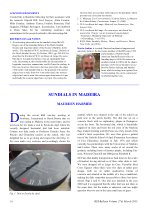
A report surveying several sundials encountered across Madeira. These include David Brown's horizontal slate dial at Escola da Apel, two less impressive dials in Red Cross Square, a horizontal W. Page & Co. dial at Liceu de Jaime Moniz, a large analemmatic dial on the Funchal seafront, a direct south vertical dial by Sampaio E Mello, and a Brookbrae horizontal dial in Palheiro Gardens.
Dials: Analemmatic, Dials: Horizontal, Dials: Vertical, Historical Dials
March 2015
Page 13
Page 13
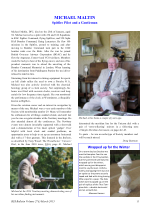
An obituary for Michael Maltin, DFC (1920–2014), a retired RAF pilot (Spitfires and Lancasters) and a very early member of the BSS (Membership No. 29). His interests included accurate timekeeping, navigation by the sun, and electrical horology. He actively assisted with gnomonic projects, including determining the meridian for the enormous Woodchester ‘Unicorn’ Dial.
The BSS and Members
March 2015
Page 14
Page 14
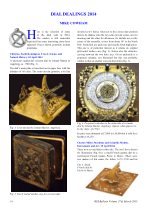
A compilation of interesting sundials sold at auction throughout 2014. Notable lots include a universal equinoctial crescent dial by Johann Martin of Augsburg (ca. 1700), a small French garden dial by Pierre le Maire, a magnetic compass dial by William Fraser, a vertical slate dial by Bianchi, and a significant double horizontal dial by Henricus Wynne (ca. 1667/8).
Dials: Double Horizontal, Dials: Portable, Dials: Vertical, Historical Dials
March 2015
Page 17
Page 17
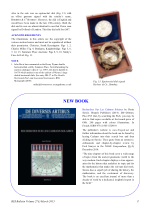
An announcement and review of Denis Savoie’s book, *Recherches Sur Les Cadrans Solaires* (2014). The work is praised for its extensive coverage of gnomonic topics, ranging from the ancient world to the modern, and for seamlessly integrating the history and underlying mathematics of dial work.
Book Reviews, Mathematics of Dialling, Historical Dials
March 2015
Page 18
Page 18
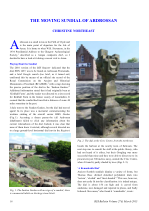
A detailed history and examination of a unique Scottish polyhedral sundial, made by Robert Weir for the Kirkhall estate in 1795. The massive sandstone dial, which originally featured complex adjustable metal apparatus, was moved multiple times by the local council, first to the Sunken Garden and subsequently to the Civic Centre.
Dials: Multi Faced, Dials: Unusual, Historical Dials
March 2015
Page 25
Page 25
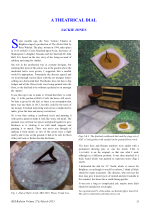
Description of the process of designing and constructing a horizontal sundial to be used as a prop in a theatrical production of "The Herbal Bed", set in the garden of Hall’s Croft in 1613. The dial, based on the Hall’s Croft original, was crafted from painted cardboard for the stage set and accurately delineated for the latitude of Brighton.
Dials: Horizontal, DIY Sundial Projects, Mottoes
March 2015
Page 26
Page 26
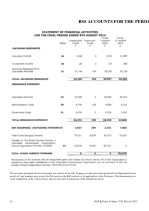
This entry refers to extracts from the British Sundial Society's accounts for the period covering the changeover from the 'old' Society to the 'new' Society. The full report, prepared by Independent Examiners Ltd., is available to members online or upon application to the Treasurer.
The BSS and Members
March 2015
Page 28
Page 28
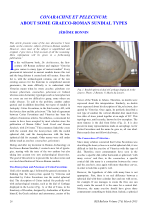
A specialized study proposing a revised classification of Graeco-Roman sundial types based on literary sources (Vitruvius, Cetius Faventinus) and archaeological evidence, including newly identified examples.
Dials: Unusual, Sundial Design & Layout, Historical Dials, Dials: Scaphe
March 2015
Page 32
Page 32
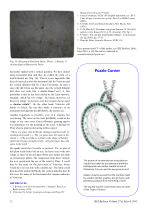
A light-hearted challenge featuring a photograph of an emeralds-set-into-platinum ring dial, designed by Ana de Costa with gnomonic guidance from Frank King. Readers are asked to identify two major errors introduced into the image by an excessive use of Photoshop.
Dials: Portable
March 2015
Page 33
Page 33
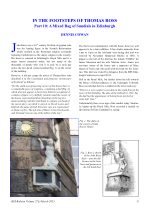
The tenth installment surveying Edinburgh's sundials mentioned by Thomas Ross. Highlights include the restored two-faced vertical dial on John Knox's House and the multi-faceted Huntly House dial (a copy of a 1732 Archibald Handasyde dial). Other dials reviewed are found at West Kirk, Corstorphine Church, Liberton House, Hudson Cottage, and Brighton Park in Portobello.
Dials: Multi Faced, Dials: Vertical, Historical Dials, Restoration projects
March 2015
Page 38
Page 38
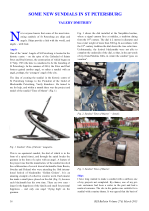
A description of three contemporary sundials installed in or around St Petersburg in 2014. These include the equatorial 'Time of Master' dial, constructed by multiple blacksmiths and featuring an angel on a spire; the 'Sailing vessel' dial based on the frigate Standart; and the 'Dandelion or nothing is forever' dial, designed by a 12-year-old following a children's competition.
Construction Projects, Dials: Equatorial, Dials: Unusual, Sundial Design & Layout
March 2015
Page 41
Page 41
Report detailing a long research trip (4250 km) to record five historical sundials in South Africa. The dials documented include the two vertical dials at Cape Town Castle (1787); the 1828 octagonal horizontal dial at Leliefontein, notable for its Etruscan numbering; and the 1831 horizontal slate dial at the Kuruman Mission station.
Dials: Horizontal, Dials: Vertical, Historical Dials, Mottoes
March 2015
Page 45
Page 45
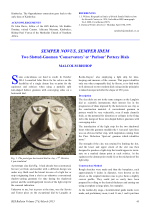
An article detailing the construction of two prototype horizontal pottery dials using a tent-shaped hollow gnomon with a slot. The design is inspired by the rare 18th-century Langlois dial, using a traversing light strip for time measurement during obscured hours and for seasonal indication relative to a fixed datum point. The dials are deemed successful, despite the material's crudity.
Construction Projects, DIY Sundial Projects, Dials: Horizontal, Dials: Unusual
March 2015
Page 51
Page 51
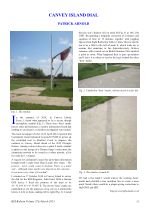
An investigation into an incomplete modern sundial/sculpture located in Canvey Island, Essex, found to have unlabelled 'hour' marks. The piece was part of an ambitious 2012 project intended to be a giant 8-metre sculpture resembling a Thames barge mast. It was never fully completed, and its accuracy is questioned, suggesting the need for professional restoration.
Construction Projects, Dials: Unusual
March 2015
Page 52
Page 52
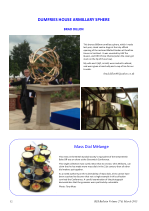
A short piece describing the bronze 800mm armillary sphere made by the author in 2014. The sphere was installed at Dumfries House in Scotland and was unveiled by HM The Queen and HRH Prince Charles during the official opening of the restored Walled Garden.
Construction Projects, Dials: Armillary Sphere