- Home
- /
- Sundial Encyclopaedia
- /
- March 2009
March 2009
The articles link to the specific page in a PDF optimised for speed. If you want the whole issue, you can download it here, but the files from earlier years can be quite large.
March 2009
Page 1
Page 1
Robin M Catchpole was awarded the prize for the best article by a new author for his article ‘The Solar Pyramid’ published in the June 2008 edition. There were a variety of high-quality candidates. Both Russian members of the society have contributed articles to this bulletin.
The BSS and Members
March 2009
Page 2
Page 2
This article explores alternative methods for measuring the sun's position, specifically focusing on a north-facing polarization sundial. It delves into the principles of polarized light from the sky, its application in sundial design using materials like 'Sellotape', and the construction of an experimental translucent equatorial dial that produces varying interference colours throughout the day.
Construction Projects, DIY Sundial Projects, Dials: Polar, How Sundials Work
March 2009
Page 7
Page 7
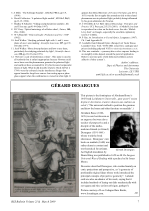
This piece discusses Gérard Desargues (1591-1661), a French mathematician and engraver known for his work on conic projections and perspective, which introduced key concepts of projective geometry. His book on sundials (1640) was theoretical, but his disciple Abraham Bosse published a more accessible version in 1643.
Book Reviews, Mathematics of Dialling, Historical Dials
March 2009
Page 8
Page 8
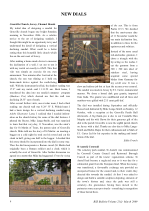
This section features descriptions of three new sundial projects. Eddie French details the creation of a vertical declining dial in Grouville Church, Jersey, Channel Islands. Bradley Dillon describes the construction of a large horizontal cemetery park sundial in St Austell. There is also an account of Valery Dmitriev's "Angel playing a harp" sundial in St Petersburg.
Dials: Horizontal, Dials: Vertical, Construction Projects
March 2009
Page 10
Page 10
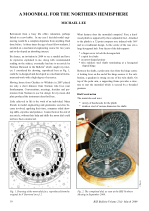
This article details the design and construction of a mechanical moondial for the Northern Hemisphere. It explains the components, materials used and the intricate etching process for the dial plate. The article also provides instructions for setting up the instrument, determining the moon's phase using Golden Numbers, and calculating time by the moon's apparent direction.
Sundial Design & Layout, Construction Projects, DIY Sundial Projects
March 2009
Page 13
Page 13
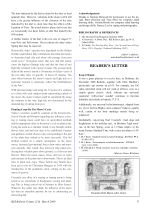
Maurice Kenn shares observations from Brisbane, Australia, contrasting the reliability of his universal equatorial 'coffee-time' sundial and heliochronometer with his UK radio-controlled clock. He notes the significant variation in local apparent noon relative to Eastern Standard Time in Brisbane.
Dials: Equatorial, Dials: Heliochronometer, How Sundials Work
March 2009
Page 14
Page 14
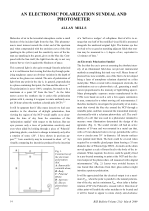
This article describes an electronic polarization sundial and sky photometer designed to measure the intensity and polarization of skylight. It uses a rotatable polar and a selenium photovoltaic cell to detect the solar meridian to within ±8 minutes of time and quantitatively assess the percentage of linear polarization in light from a selected area of the sky.
Dials: Polar, How Sundials Work, Construction Projects
March 2009
Page 16
Page 16
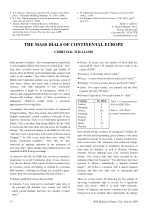
This review examines the status of mass dial recording in Continental Europe, noting that while British dials are well-surveyed, Continental efforts have historically been less intensive. It compiles evidence from various countries, highlighting the widespread geographical presence of mass dials, including on Orthodox churches.
Historical Dials, Dials: Mass Dials
March 2009
Page 18
Page 18
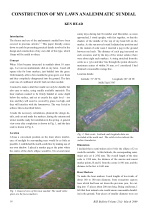
This article provides practical details for designing and constructing a durable lawn analemmatic sundial using readily available materials. It covers establishing the north-south line, calculating dimensions, making hour markers from tree-trunk lengths, crafting a date scale from timber, and ensuring precise installation for accurate solar timekeeping.
Dials: Analemmatic, Sundial Design & Layout, Construction Projects, DIY Sundial Projects
March 2009
Page 20
Page 20
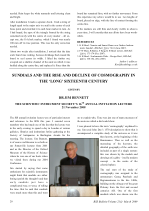
This is a report on the Scientific Instrument Society's 16th annual invitation lecture by Dr Jim Bennett, titled "Sundials and the Rise and Decline of Cosmography in the ‘Long’ Sixteenth Century". The lecture explored how sundials were integral to cosmography, a comprehensive study of the universe during the Renaissance, covering both celestial and terrestrial measures.
Historical Dials
March 2009
Page 22
Page 22
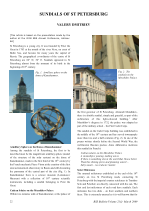
This article explores the history of sundials in St Petersburg, Russia, from the early 18th century. It describes various notable examples, including the armillary sphere on the Kunstkammer, the double sundial on the Menshikov Palace, solar milestones, and dials in Peterhof, Gatchina, Pavlovsk Park, and Demidov’s manors, as well as modern additions.
Dials: Horizontal, Dials: Vertical, Historical Dials, Dials: Armillary Sphere
March 2009
Page 27
Page 27
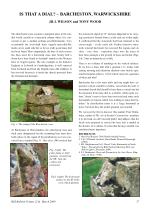
This article describes the discovery of a unique sundial carved into the base of a former churchyard cross at Barcheston, Warwickshire. The stonework was trimmed to a 52° slope on the south side, with recessed flat regions revealing traces of hour lines. It is classified as a large horizontal in stone with a notably wide gnomon.
Dials: Horizontal, Dials: Unusual, Historical Dials
March 2009
Page 28
Page 28
This article details the design and robust construction of an analemmatic sundial installed in the paving of an embankment in Shelkovo, Russia. It covers the use of AutoCAD for design, creating plaster-of-Paris and beeswax models, the ceramic mould casting process for bronze elements, and building substantial concrete foundations to ensure durability against vandalism and weathering.
Dials: Analemmatic, Sundial Design & Layout, Construction Projects
March 2009
Page 31
Page 31
This article describes a unique Equation of Time (EoT) chart found in Nottingham, featuring straight lines for EoT values in whole minutes plotted against a non-linear calendar date axis. Dated possibly to the 1830s or 1840s, it differs from typical "Watch Faster / Watch Slower" scales.
Mathematics of Dialling, Equation of Time, Historical Dials
March 2009
Page 32
Page 32
This article reviews notable sundials and scientific instruments seen in sales throughout 2008. Highlights include an 18th-century horizontal dial by Richard Hintonn, a French silver string gnomon dial, a gilt inclining dial by Chapotot, a rare 16th-century Nuremberg star-shaped polyhedral dial, an ivory diptych dial by Lienhart Miller, a Butterfield universal equinoctial ring dial, and a Gunter quadrant by Nathanaell Heighemore.
Dials: Horizontal, Dials: Multi Faced, Dials: Portable, Historical Dials
March 2009
Page 36
Page 36
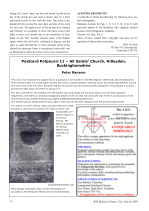
This entry describes a scaphe dial carved into a buttress at All Saints' Church, Hillesden, Buckinghamshire, recorded as SRN 5016. The dial is a quarter sphere with a motto and the date "1601 Georg De Fraisne" inscribed. It features full and half-hour divisions and has undergone some restoration since the postcard image.
Historical Dials, Dials: Scaphe
March 2009
Page 37
Page 37
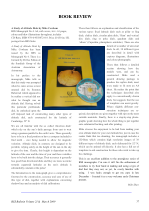
This review covers "A Study of Altitude Dials" by Mike Cowham (BSS Monograph No 4). It praises the monograph's comprehensive overview of altitude dials, including their construction, accuracy, and various types like pillar, chalice, and quadrant dials. The book also provides detailed construction guides, diagrams, and a CD-Rom with templates for readers to make their own dials.
How Sundials Work, Book Reviews, Sundial Design & Layout, DIY Sundial Projects
March 2009
Page 38
Page 38
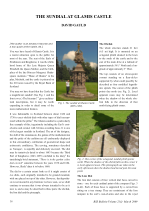
This article describes the magnificent 21-foot high Glamis Castle sundial in Scotland, tentatively dated around 1683. It is an elaborate obelisk dial featuring 84 time-recording faces, lion dials for cardinal points, and a complex \pineapple\ (stellar rhombicuboctahedron) with numerous declining and reclining faces. The article also discusses its Equation of Time inscription and possible mathematical contributions by James Gregory.
Dials: Multi Faced, Mathematics of Dialling, Sundial Design & Layout, Equation of Time, Historical Dials
March 2009
Page 42
Page 42
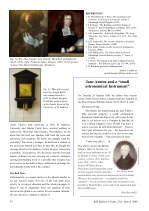
This article refers to a letter from Jane Austen to her brother in 1805, mentioning a small astronomical Instrument believed to be a compass and sundial, found among their late father's possessions. The exact type of sundial is unknown, but it highlights the historical significance and potential value of such instruments.
Dials: Portable, Historical Dials
March 2009
Page 43
Page 43
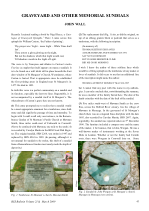
This article explores sundials used as memorials, discussing their historical significance from Roman times. It details numerous examples, including tombstone dials, pillar-mounted dials in churchyards (e.g., St Mawnan's, Dryburgh Abbey), and war memorials. The article highlights epitaphs, theft incidents, and the symbolic connection between sundials and the passage of time.
Dials: Unusual, Historical Dials, Mottoes
March 2009
Page 48
Page 48
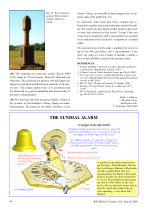
This entry describes an inventive "Ye Sundyal Alarme Bafic Modelle" and a "Deluxe modelle" The basic model uses sunlight focused by a cylindrical lens to heat a copper ball, melting wax that triggers a mousetrap and a bell. The deluxe version also lights a fire for a morning posset, offering a creative, if anachronistic, take on sundial functionality.
Dials: Unusual, DIY Sundial Projects