- Home
- /
- Sundial Encyclopaedia
- /
- September 2010
September 2010
The articles link to the specific page in a PDF optimised for speed. If you want the whole issue, you can download it here, but the files from earlier years can be quite large.
September 2010
Page 1
Page 1
This is our 75th edition! To mark this occasion, the cover colour has been changed, for this issue only, to blue. Never fear, the famous BSS sunny yellow will be back next time. Perhaps we will repeat this change for the 150th issue, so that your bookshelves will have markers to show our progress.
September 2010
Page 1
Page 1
This entry is a poem about a sundial, personifying it as a timeless object that shuns modern technology and relies only on the sun, telling its story 'e'er time begun'.
September 2010
Page 2
Page 2
This article details the design and construction of a new elliptical slate sundial for Selwyn College, Cambridge, indicating both Babylonian and Italian hours. It discusses the selection of the site, the unique nodus design, precise surveying for wall parameters, and the process of setting out and cutting the dial with inscriptions.
Construction Projects, Dials: Vertical, Mathematics of Dialling, Sundial Design & Layout
September 2010
Page 8
Page 8
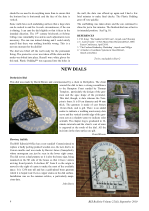
This section describes two new sundials: a 50 cm diameter slate horizontal dial by David Brown for a client in Derbyshire, resembling the Hampton Court sundial and featuring a nodus and coat of arms; and a Carrera marble house sign sundial by Harriet James for the BSS Editorial Office.
Construction Projects, Dials: Horizontal, Sundial Design & Layout
September 2010
Page 9
Page 9
This is a review of 'Time Reckoning in the Medieval World – A study of Anglo-Saxon and Early Norman Sundials' by D. Scott & M. Cowham. The monograph is praised for its comprehensive cataloguing of 75 early dials and its nuanced approach to their context, challenging previous interpretations of dating and timekeeping systems.
Book Reviews, Dials: Mass Dials, Historical Dials
September 2010
Page 10
Page 10
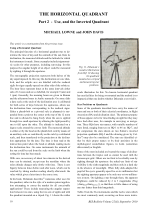
This article details the use of horizontal quadrants for time-finding and surveying, including a rare 'inverted' variant. It describes how to determine time from solar altitude and declination, and from stars at night, discussing the historical accuracy and limitations of these instruments.
How Sundials Work, Mathematics of Dialling, Historical Dials, Dials: Nocturnals
September 2010
Page 16
Page 16
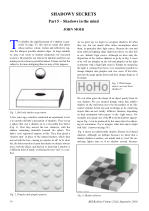
This article explores the psychological aspects of shadow perception, discussing how the mind interprets shadows, optical illusions, and perspective effects, as demonstrated by experiments with babies and examples of manipulated shadows or moon terminators.
How Sundials Work
September 2010
Page 18
Page 18
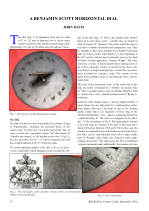
This article describes a small horizontal dial by Benjamin Scott, believed to have been made for Lochnaw Castle, Scotland. It features transversals for minute resolution, an Equation of Time ring, and specific gnomon supporters, linking Scott to John Rowley and discussing its provenance.
Dials: Horizontal, Equation of Time, Historical Dials
September 2010
Page 23
Page 23
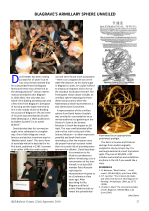
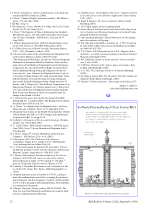
This article reports on the unveiling of a bronze armillary sphere by David Harber, created to celebrate his lineage to the distinguished 16th-century mathematician and diallist John Blagrave. The sphere represents Blagrave's 'Mathematical Jewel' and was unveiled at the Science Museum in South Kensington.
Construction Projects, Historical Dials, Dials: Armillary Sphere
September 2010
Page 24
Page 24
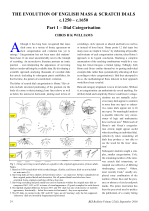
This article addresses the problematic categorisation of English mass and scratch dials from c.1250-c.1650, proposing a new threefold classification (360°, 180°, and 90° dials) based on surviving evidence of scratching and pock marks, intended to reflect genuine differences in original appearance and facilitate statistical analysis.
Dials: Mass Dials, Historical Dials, Sundial Design & Layout
September 2010
Page 26
Page 26
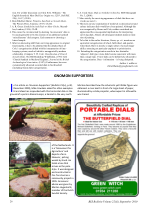
This note describes a horizontal sundial in the Netherlands with a pole-style gnomon shaped as a farm labourer holding a hoe, designed and constructed in Cor-Ten steel as a community project.
Construction Projects, Dials: Horizontal, Dials: Unusual, Sundial Design & Layout
September 2010
Page 27
Page 27
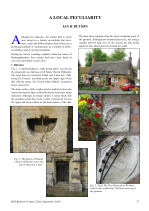
This article describes three scaphe dials found in close proximity in Buckinghamshire: one at All Saints Church, Hillesden (1601); one at The Five Elms pub in Weedon; and another at The Manor House, Creslow. It discusses their designs, orientations, and potential local influence.
Dials: Scaphe, Historical Dials, Sundial Design & Layout
September 2010
Page 29
Page 29
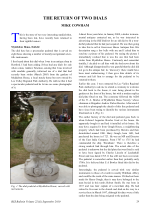
This article recounts the recovery and return of two sundials: a pedestal with carved navigational instruments, stolen from Myddelton House and later reunited with a replica dial plate; and an early Celtic sundial from Tywyn, moved inside its church.
Historical Dials, Restoration projects, The BSS and Members
September 2010
Page 31
Page 31
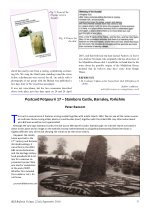
This article features a postcard from March 1932 depicting a living sundial with Roman numerals and lines laid out using plants or bushes, located at Wentworth Castle, Stainborough, and seeks information about the initials 'BW' visible on it.
Dials: Unusual, Historical Dials
September 2010
Page 32
Page 32
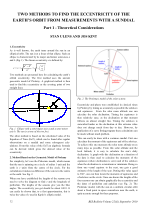
This article presents two theoretical methods to calculate the Earth's orbital eccentricity using sundial measurements. The first method uses the Ptolemaic geocentric model and season lengths; the second derives eccentricity from the Equation of Time by separating the part due to obliquity from the total.
Equation of Time, How Sundials Work, Mathematics of Dialling
September 2010
Page 35
Page 35
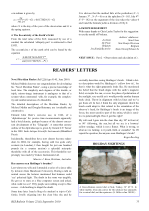
This section contains two letters: Maurice J. Kenn congratulates Michael Maltin on his 'Novel Meridian Finder' and discusses the dipleidoscope; Roger Bowling queries if anyone has seen Haidinger’s brushes and the perception of polarised light.
How Sundials Work, Dialling Tools
September 2010
Page 35
Page 35
This entry briefly describes a Greco-Roman conical dial at Side, Turkey, made of white marble with day curves for the solstices but unusually lacking those for the equinoxes.
Dials: Hemispherical, Historical Dials
September 2010
Page 36
Page 36
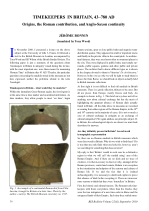
This article investigates the presence and influence of Roman timekeepers in Britain from 43-780 AD, noting the scarcity of archaeological finds compared to other Roman provinces. It explores historical, cultural, and military evidence, including a mosaic depiction and rudimentary sundial objects, and briefly discusses the obscure origins of Saxon dials.
Dials: Mass Dials, Dials: Unusual, Historical Dials
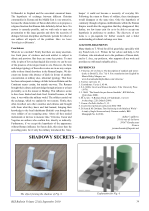
September 2010
Page 40
Page 40
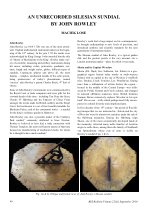
This article describes an unrecorded octagonal brass horizontal sundial by John Rowley (early 18th century), commissioned for the Neidhardt von Spattenbrunn family in Silesia. It details the dial's features, engraving styles, geographical rings, and discusses the possibility of it being a royal gift, while also comparing its gnomon to one by Thomas Tompion.
Dials: Horizontal, Historical Dials, Sundial Design & Layout
September 2010
Page 46
Page 46
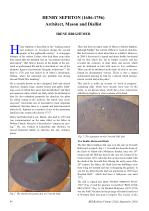
This article examines Henry Sephton, an 18th-century Liverpool architect and mason, as a significant provincial diallist. It describes several dials attributed to him, including signed double horizontal dials at Croxteth Hall and Knowsley Hall, a horizontal dial at Ince Blundell Hall, vertical dials on churches, and two globe dials, highlighting his characteristic transversals and artistic style.
Dials: Horizontal, Construction Projects, Historical Dials, Dials: Double Horizontal