- Home
- /
- Sundial Encyclopaedia
- /
- Dials: Scaphe
Dials: Scaphe
September 2021
Page 36
Page 36
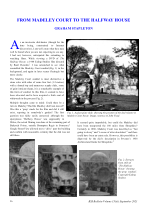
Investigates a distinct cube sundial seen in the film "The Halfway House". The prop was a copy of the famous Madeley Court sundial. Close analysis confirmed it was a non-functional copy, likely based on a Wills’s cigarette card from 1928, and it was broken up after filming.
Dials: Multi Faced, Historical Dials, Dials: Cube, Dials: Scaphe
March 2020
Page 26
Page 26
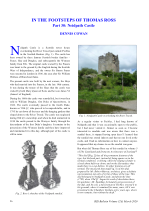
Focuses on the lectern-type sundial originally from Neidpath Castle. The article recounts the dial's history, noting it was saved by a gardener in 1795 and eventually returned to the castle in 1961. The dial is unusual as it is oblong and features a sloping hemi-cylinder ending halfway down with a cup-hollow underneath. It includes descriptions of the multiple faces, incorporating sunken, reclining, and proclining dials.
Dials: Multi Faced, Dials: Scaphe, Dials: Unusual, Historical Dials
June 2020
Page 44
Page 44
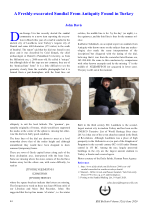
Reports on the March 2020 excavation of a marble "hemicyclium" sundial in the ancient city of Laodikeia, Turkey. The dial features Greek inscriptions for the winter solstice, equinox, and summer solstice, though its exact dating (Hellenistic vs. Roman era) is still debated.
Dials: Hemispherical, How Sundials Work, Historical Dials, Dials: Scaphe
December 2020
Page 16
Page 16
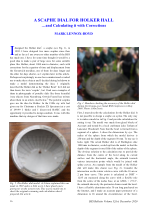
The author details the design and calculation of the Holker Hall scaphe dial (a spherical bowl dial). He explains the trigonometric formulae, derived using his 'y' formula, necessary for plotting points on the curved surface using distance and azimuth. He also proposes making a pair of large scaphe dials incorporating corrections for the Equation of Time (EoT) and longitude displacement.
Construction Projects, Dials: Scaphe, Equation of Time, Mathematics of Dialling
December 2020
Page 28
Page 28
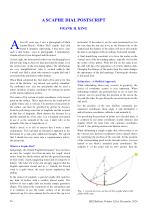
A commentary on Mark Lennox-Boyd's scaphe dial article, providing an alternative, simpler mathematical derivation for plotting points on the spherical surface using horizon coordinates (altitude and azimuth). It also explores the design geometry, showing how the appearance of the dial markings changes based on the ratio of the sphere radius to the rim radius.
Dials: Scaphe, How Sundials Work, Mathematics of Dialling, Sundial Design & Layout
June 2019
Page 2
Page 2
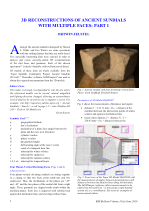
Analyses ancient multi-faced and scaphe marble sundials catalogued by Gibbs and Winter, using 3D models and software (GOM Inspect) to measure parameters for reconstruction. Focuses on dials with planar-vertical deviating faces, hollow spherical faces (scaphe), and hollow conical faces, detailing the geometrical reconstruction and function of hour lines.
Dials: Multi Faced, Dials: Scaphe, Historical Dials
December 2018
Page 30
Page 30
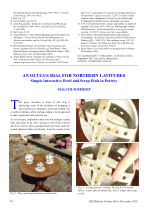
Describes creating miniature equatorial ‘oculus’ or ‘finger’ dials in pottery, inspired by ancient spherical dials. These interactive dials are read by blocking the sun hole with a finger to align the light spot on the vertical datum line, suitable for educational use.
Construction Projects, Dials: Portable, Dials: Scaphe, Dials: Unusual
March 2017
Page 12
Page 12
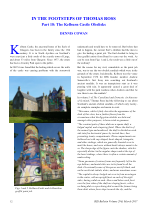
A study of two historical Scottish obelisk sundials at Kelburn Castle. The article describes the typical obelisk structure (shaft, bulged capital, tapering finial, multiple sinkings including scaphe dials). It notes the first dial's 1707 date and wrought-iron vane restoration, and the deteriorated state of the second dial, whose capital and finial have broken off.
Dials: Multi Faced, Dials: Scaphe, Historical Dials
December 2016
Page 22
Page 22
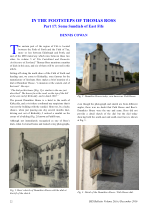
Covers six historical sundials in East Fife documented by Thomas Ross. Examples include the Path House dial (formerly Dunnikier House), the Muckle Yett dial with seven faces including scaphe dials, and cube dials at Kellie Castle (1722) and St Mary’s College (1664).
Dials: Cube, Dials: Multi Faced, Dials: Scaphe, Historical Dials
March 2015
Page 28
Page 28
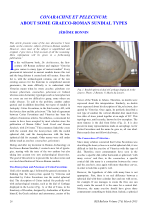
A specialized study proposing a revised classification of Graeco-Roman sundial types based on literary sources (Vitruvius, Cetius Faventinus) and archaeological evidence, including newly identified examples.
Dials: Unusual, Sundial Design & Layout, Historical Dials, Dials: Scaphe
March 2014
Page 2
Page 2
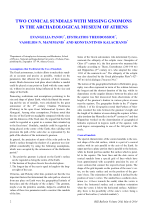
This paper analyses two ancient Greek conical sundials (3156 and 3157) recovered from the Dionysus Theatre. Since their gnomons are lost, geometric characteristics are used, alongside an assumed obliquity of the ecliptic, to calculate their geographical latitude and gnomon length. The calculated design latitudes (33° to 36°) suggest they may have been looted from other Mediterranean regions, rather than being built specifically for Athens (37° 58΄).
Dials: Scaphe, Dials: Unusual, Historical Dials, Mathematics of Dialling
June 2014
Page 32
Page 32
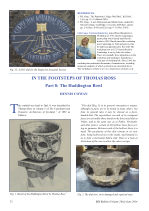
Details the rediscovery of the Haddington Bowl, a unique 17th-century facet-headed dial described by Thomas Ross in 1892. It is a vase-form dial hollowed out to form an internal horizontal dial, featuring cup-hollows (scaphes) and faces acting as gnomons, despite suffering severe damage.
Dials: Scaphe, Dials: Unusual, Historical Dials, Restoration projects
December 2013
Page 22
Page 22
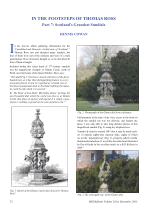
Explores four magnificent 17th-century Scottish sundials documented by Thomas Ross: the complex multi-faced dials at Glamis Castle (stellar rhombicuboctahedron), Drummond Castle (obelisk, 1630), Holyroodhouse Palace (polyhedral, 1633), and the fountain/dial at Dundas Castle (lectern type, 1623).
Dials: Multi Faced, Dials: Scaphe, Historical Dials, Sundial Design & Layout
March 2012
Page 43
Page 43
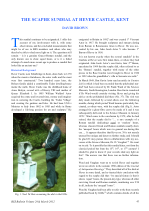
This article details the author’s investigation into the enigmatic scaphe dial at Hever Castle, often called the "Roman" sundial. It discusses its historical background, previous examinations by Ward and Vaughan, and the author's measurements and analysis, concluding it is likely an unworkable dial despite its ancient appearance.
How Sundials Work, Historical Dials, Dials: Scaphe
June 2012
Page 36
Page 36
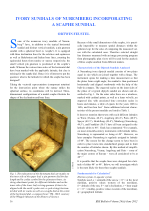
This article analyses the scaphe sundial component found in Nuremberg ivory diptych sundials. It uses vectorial representation and measured photographic distances to determine the intended latitude for three examples, concluding that Reinmann and Miller's scaphes were likely designed for 49° latitude, and Lesel's for 48°, primarily for Nuremberg.
Dials: Scaphe, Historical Dials, Mathematics of Dialling, Sundial Design & Layout
June 2012
Page 44
Page 44
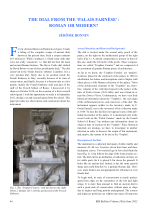
This article investigates a spherical sundial in the 'Palais Farnèse', Rome, questioning its Roman origin due to its perfect state of conservation and lack of gnomon hole. It hypothesises the dial is an 18th or 19th-century copy of a Roman original, potentially with a symbolic rather than functional purpose related to the palace's 'Trophées Farnèse' compositions about Time.
Dials: Scaphe, Dials: Unusual, Historical Dials, Restoration projects
September 2012
Page 28
Page 28
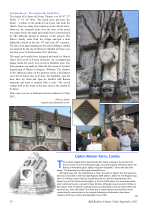
This entry describes a multiple scaphe dial at Upton Manor Farm, tentatively attributed to Edmund Gunter, featuring 29 or 30 individual dials crafted from Ketton stone. Located in an orchard, the property was once owned by Bishop Thomas Dove and is noted for its complex, original delineation.
Dials: Multi Faced, Dials: Scaphe, Historical Dials
September 2012
Page 33
Page 33
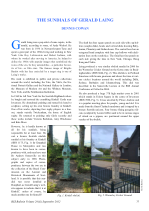
This article highlights the sundial works of pop artist Gerald Laing, known for at least four large sculptural pieces. These include two Scottish obelisk sundials, a 37ft market cross in Inverness, and "Axis Mundi" in Edinburgh, often featuring complex gnomonics and graphical representations of the Equation of Time.
Dials: Multi Faced, Sundial Design & Layout, Equation of Time, Dials: Scaphe
March 2010
Page 28
Page 28
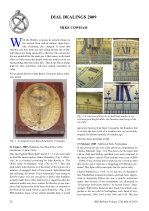
A review of sundials sold at auction in 2009. Notable items include a gilt brass compendium by Charles Whitwell dated 1608, a Panorganon by Joseph Wells, a Gunter's quadrant by Henry Wynne, and a silver Butterfield dial by Pierre le Maire.
Dials: Portable, Dials: Scaphe, Historical Dials, Dials: Nocturnals
September 2010
Page 27
Page 27
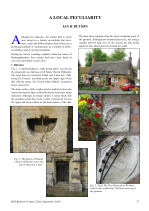
This article describes three scaphe dials found in close proximity in Buckinghamshire: one at All Saints Church, Hillesden (1601); one at The Five Elms pub in Weedon; and another at The Manor House, Creslow. It discusses their designs, orientations, and potential local influence.
Dials: Scaphe, Historical Dials, Sundial Design & Layout
March 2009
Page 36
Page 36
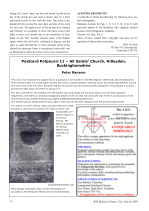
This entry describes a scaphe dial carved into a buttress at All Saints' Church, Hillesden, Buckinghamshire, recorded as SRN 5016. The dial is a quarter sphere with a motto and the date "1601 Georg De Fraisne" inscribed. It features full and half-hour divisions and has undergone some restoration since the postcard image.
Historical Dials, Dials: Scaphe
March 2008
Page 12
Page 12
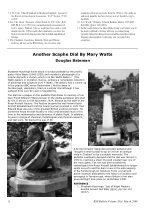
Describes a scaphe dial by potter Mary Watts, similar to one in the Watts Gallery. This particular dial, located in Farnborough, Hampshire, serves as a memorial to aviation pioneer Edward T. Busk, who died in 1914. It was moved in 1970 and is now housed at the Farnborough Air Sciences Trust.
Dials: Scaphe, Historical Dials
December 2008
Page 159
Page 159
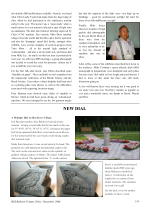
This piece describes a new multiple dial created by Alex Boldyrev for Shevelkovo Village. Carved from Crimean limestone, it features an equatorial dial's upper half and a south-facing scaphe dial in Greek style. It incorporates owls symbolizing Athena and a reconstructed historical mistake in its design, with gnomons made from cold-hammered copper rods.
Dials: Multi Faced, Dials: Equatorial, Sundial Design & Layout, Dials: Scaphe
September 2007
Page 112
Page 112
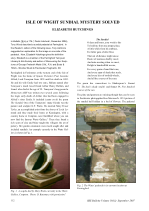
This article solves the mystery of a sundial pedestal at Farringford, Alfred, Lord Tennyson's home. It was designed by Mary Seton Watts, wife of the painter G.F. Watts, likely as a memorial for Tennyson and his wife Emily. The pedestal features carvings related to Tennyson's poem The Sundial and a motto.
Historical Dials, Mottoes, Dials: Scaphe
June 2006
Page 63
Page 63
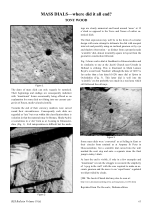
This article explores the indistinct end of mass dials, discussing "transitional" forms that bridge medieval and scientific dials. It notes the appearance of numerals (Roman, Hindu-Arabic, or dot form) around the circumference of later mass dials, indicating a shift towards 12 o'clock noon, and touches on conversions to scientific dials.
Dials: Mass Dials, Dials: Scaphe, Historical Dials, Sundial Design & Layout
September 2006
Page 138
Page 138
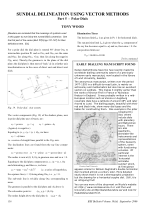
The discovery of a previously unknown early Italian manuscript (1477-1505) at Lund University, Sweden, is announced. Predating works by Oronce Finé and Nicholaus Kratzer, this anonymous manuscript contains significant sections on astronomy, mathematics, and sundials, featuring various dial types, including a horizontal scaphe sundial.
Book Reviews, Historical Dials, Dials: Scaphe
December 2004
Page 146
Page 146
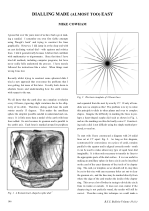
Practical method using a 24-hour equatorial template to transfer hour lines to arbitrary surfaces. Demonstrates template folding for latitude, a Cambridge horizontal example, spherical and heart-shaped scaphe dials, marking equinox/solstice lines and gives practical tips on template rigidity and common pitfalls.
DIY Sundial Projects, Dials: Scaphe, How Sundials Work, Sundial Design & Layout
February 2000
Page 12
Page 12
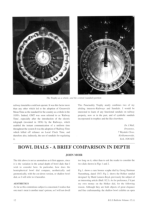
Compares aesthetics and function of deep hemispherical vs shallow bowl sundials, including gnomonic differences and delineation methods.
Dials: Hemispherical, Dials: Scaphe, Sundial Design & Layout
June 2000
Page 64
Page 64
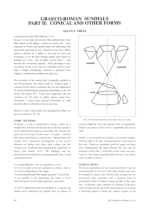
Continues an exploration of ancient sundials, focusing on conical types and their mathematical construction and historical context.
Dials: Scaphe, Historical Dials, How Sundials Work, Mathematics of Dialling
February 1999
Page 14
Page 14
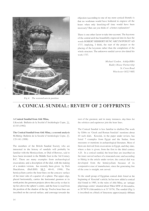
This review discusses two papers on conical sundials, a less familiar type compared to the hemicyclium. It focuses on a conical dial found at Abu Mina, Egypt, dating from the 1st to 3rd century A.D., analyzing its construction, accuracy, and challenging previous interpretations of its markings.
Book Reviews, Sundial Design & Layout, Historical Dials, Dials: Scaphe
February 1999
Page 48
Page 48
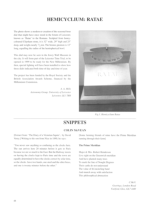
This article describes a modern re-creation of a Roman hemicyclium dial, sculpted from Clipsham stone, now located in Leicester's Jewry Wall Museum. Funded by the Royal Society and British Association Awards Scheme, it will be part of the Leicester Time Trial, set to open in 1999.
Construction Projects, Dials: Scaphe
June 1999
Page 87
Page 87
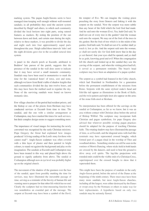
This article describes a rare eyelet-hole scaphe sundial discovered at a Roman villa in Carthage, dating to 1st century AD or later. It details the marble artefact's exterior, including oak-leaf decoration and a fixing wedge, and its highly polished interior with seven non-concentric curves and eleven hour lines. Unique inscriptions in Greek and Latin Julian month names, including 'Augustus' (dating it after 9 BC), and zodiac signs mark its exceptional nature.
Dials: Scaphe, Dials: Unusual, Historical Dials
June 1999
Page 99
Page 99
This tribute remembers Lieut. Commander Richard "Dick" Andrewes, a BSS member known for his wartime naval service, mathematical degree, and enthusiasm for dialling. He designed a unique dial for his home and an analemmatic dial for a conservation centre. He is particularly remembered for delineating a scaphe dial at the Horniman Museum, ingeniously overcoming its organic shape by using a marble to find the bowl's lowest point.
Dials: Analemmatic, Dials: Scaphe, The BSS and Members
October 1999
Page 139
Page 139
This article surveys 214 fixed sundials in the former SFR Yugoslavia, now divided into multiple new states. It highlights a Roman spherical dial from Sremska Mitrovica, the oldest Serbian sundial at Studenica Monastery (12th century), and the horizontal dial at Belgrade Observatory. It notes the scarcity of sundials in Macedonia and Bosnia and Herzegovina due to Turkish reign, and discusses Italian-influenced medieval stone dials on the Croatian Adriatic coast, including one in Dubrovnik with both contemporary and old Italian hour scales.
Dials: Horizontal, Dials: Portable, Dials: Scaphe, Dials: Vertical, Historical Dials
June 1998
Page 40
Page 40
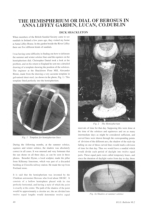
This article describes a hemispherical sundial, or 'hemispherium,' located in the author's garden, reputedly invented by Berosus around 300 BC. It details the successful process of delineating the solstice and equinox lines using a custom-made template and explains the dial's function in dividing daylight into 'temporary hours'.
Construction Projects, Dials: Hemispherical, Dials: Scaphe, Sundial Design & Layout
October 1997
Page 8
Page 8
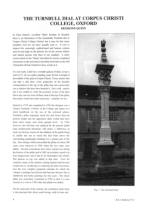
This article describes the Turnbull Dial at Corpus Christi College, Oxford, a 26-foot pillar featuring a total of 27 dials. Designed in 1579-1583 by Charles Turnbull, it includes a principal south-facing dial, a perpetual calendar, tables for planetary years and lunar months, and moon-time corrections. The dials use the old unequal hour system, and the pillar has undergone several restorations.
Dials: Multi Faced, Dials: Scaphe, Historical Dials, Restoration projects
February 1996
Page 34
Page 34
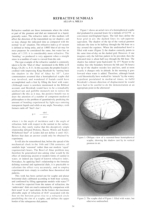
A look at sundials that use lenses and refraction to tell time, particularly medieval concepts like the Dial of Ahaz.
Dials: Scaphe, Dials: Unusual
October 1995
Page 19
Page 19
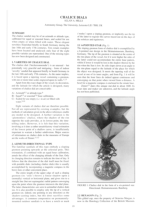
An overview of dials shaped like chalices, often used in ceremonial contexts or churches. The article discusses their optical characteristics, historical references, and functional design when filled with water for increased visibility.
Dials: Scaphe
February 1993
Page 28
Page 28
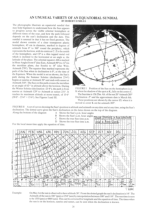
This article describes an unusual equatorial sundial without a fixed gnomon, featuring a transparent plastic hemisphere. It illustrates the Sun's apparent path and declination throughout the year, explaining how to determine sun time, altitude, azimuth, and declination on any given date using this instrument.
Dials: Equatorial, Dials: Scaphe, Sundial Design & Layout
October 1992
Page 37
Page 37
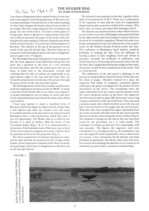
This article describes the Holker Dial, a large shallow bowl sundial made of Burlington slate, sited at Holker Hall. Designed by Mark Lennox-Boyd, it is a projection of Berossos' hemispherium onto a shallow bowl, marked with 15-minute divisions, zodiacal signs, and a combined table for correcting for longitude offset and Equation of Time. The article details the challenging production process by Burlington Slate, involving computer-calculated polar coordinates for engraving and the moving of massive stone objects.
Construction Projects, Dials: Hemispherical, Dials: Scaphe, Mathematics of Dialling, Sundial Design & Layout
June 1990
Page 14
Page 14
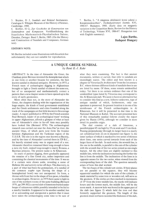
This article describes the 1975 discovery of a unique Greek sundial slab at Ai Khanoum, Afghanistan. Dating between 325 and 145 B.C., this polar dial, designed to indicate temporary hours, represents an evolutionary advancement in ancient gnomonics, despite a discrepancy between its marked latitude and discovery site.
Dials: Polar, Historical Dials, Dials: Scaphe
October 1990
Page 12
Page 12
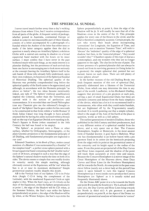
This article discusses various forms of spherical sundials, from simple painted stone spheres to the ancient concave hemisphere (Scaphe or Hemicycle) and the later, less effective, convex hemisphere. It also explores the projection of spherical coordinates onto a plane, linking them to the discovery of the analemmatic dial.
Dials: Hemispherical, Historical Dials, Dials: Scaphe, Dials: Armillary Sphere