- Home
- /
- Sundial Encyclopaedia
- /
- Dials: Portable
Dials: Portable
March 2023
Page 6
Page 6
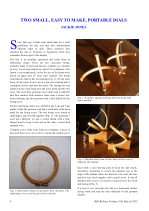
Details how to construct two accessible types of small, portable sundials. The first is an armillary equatorial dial made from embroidery hoops. The second is an altitude card dial, also known as a Capuchin dial, which uses a thread and bead mechanism. Both projects demonstrate less traditional dial types requiring minimal skill.
DIY Sundial Projects, Dials: Armillary Sphere, Dials: Equatorial, Dials: Portable
June 2023
Page 2
Page 2
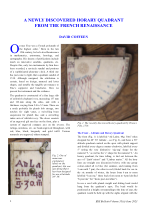
Details the discovery of an ivory horary quadrant by Oronce Fine, dated 1518, designed for 48° 30ʹ latitude. The quadrant features straight hour lines and an elaborate carved leather case bearing the coat of arms of Michel Boudet, Fine’s protector. It is noted as being remarkably similar to the quadrant seen in Holbein’s "Les Ambassadeurs".
Dials: Portable, Mathematics of Dialling, Dialling Tools, Historical Dials
June 2023
Page 8
Page 8
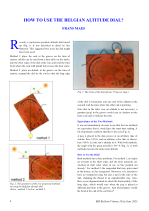
Reviews two methods suggested by Sue Manston for operating a portable altitude dial (a Hevelius dial). Geometric analysis confirms the two methods are equivalent, but practical tests suggest Method 1, using the shadow of a gnomon parallel to the short edge, is feasible for determining the time with 10–15 minutes accuracy.
Dials: Portable, How Sundials Work
September 2023
Page 9
Page 9
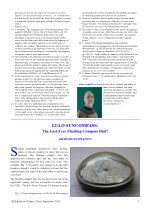
Examines the Li-Lo Suncompass, a floating compass dial made in Great Britain in the mid-1940s, possibly the last of iteration of its type. It discusses its plastic construction, dual time scales (Winter Time and Summer Time), the Li-Lo brand's history (owned by P.B. Cow & Co.), and its origin as the German 'Rüter Uhr' developed in 1945.
Dials: Portable, Dials: Unusual, Historical Dials
September 2023
Page 18
Page 18
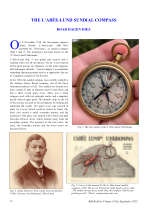
Details the history, design, and use of the Norwegian L’Abée-Lund Uhrkompas, patented in 1914. This brass, portable instrument was marketed using the figure of a red ant and includes scales for determining time based on solar azimuth, corrected for magnetic declination, longitude (8¾° east), and Equation of Time for a design latitude of 60° north.
Dials: Portable, Dials: Unusual, Historical Dials
September 2023
Page 26
Page 26
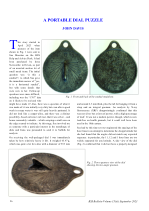
Investigates a heavy, pewter portable horizontal dial medallion, initially thought to be silver, dated “1707” with a gnomon angle of 38°. XRF analysis confirmed it as lead-heavy pewter. Detective work revealed the reverse side used a modified die from an 1855 Paris Exposition Universelle medal, making the 1707 date false.
Dials: Horizontal, Dials: Portable, Historical Dials
December 2023
Page 28
Page 28
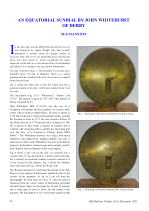
Describes an interesting and possibly unique equatorial sundial acquired by Annie Wright, signed "Whitehurst" "Derby" and "1761" (Lat: 53D: 00M). The dial features two centres of delineation, hour lines marked from 4 am to 8 pm, solstice lines on the gnomon, and some engraving errors.
Dials: Equatorial, Dials: Portable, Dials: Unusual, Historical Dials, Sundial Design & Layout
March 2022
Page 2
Page 2
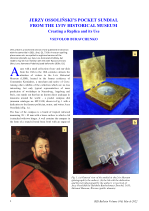
An analysis of a unique 17th-century pocket compass dial (MT-1838) from the Lviv Historical Museum, dedicated to Jerzy Ossoliński and designed by Oswald Krüger in 1644. It features both horizontal and azimuthal scales. The author and associates created two functional replicas for customers in Ukraine, adapting the design for modern latitudes.
Construction Projects, Dials: Portable, Dials: Unusual, Historical Dials
March 2022
Page 34
Page 34
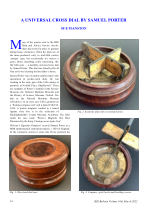
Description of a unique portable, universal cross dial made by Samuel Porter, a London mathematical instrument maker (c. 1824). The dial, found in a clearance, features a pivoted cross for latitude setting, a 16-point compass, spirit levels, and an Equation of Time table printed inside the lid.
Dialling Tools, Dials: Portable, Equation of Time, Historical Dials
June 2022
Page 8
Page 8
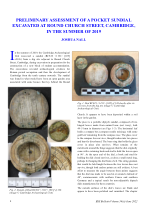
A portable diptych sundial made of animal bone, recovered during excavation in Cambridge, is assessed. It is estimated to be a 17th-century continental import, likely French or German, based on design flourishes and the latitude (48°) for which it was calculated. The dial uses a missing string gnomon and features a horizontal leaf with a compass box.
Dials: Portable, Historical Dials
June 2022
Page 9
Page 9
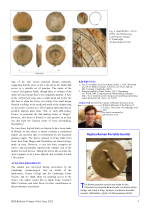
A brief entry noting a replica of a Roman portable sundial created by Vsevolod Buravchenko for the Chairman. Further design analysis is directed toward a previous Bulletin article published in 2015.
Construction Projects, Dials: Portable, Historical Dials
September 2022
Page 29
Page 29
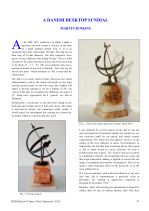
Examines a small, mass-produced equatorial desktop sundial made of brass and onyx alabaster, inscribed with a Danish motto. Concludes the dial was likely a commercial giftware product from the 1950s to 1970s, possibly manufactured in India.
Dials: Equatorial, Dials: Portable, Mottoes
September 2022
Page 32
Page 32
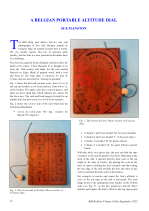
Examines a challenging 18th-century portable altitude dial from Belgium, made of painted wood. The article discusses the function of its sunrise and hour scales and proposes possible, albeit fiddly, methods of operation using a cord and bead, given the likely absence of a gnomon or alidade.
Dials: Portable, How Sundials Work
December 2022
Page 8
Page 8
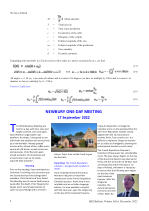
Report on the BSS Newbury meeting held shortly after the Queen's death, covering various talks including the French Republican calendar, Kings Langley Human Sundial, The Wonder Box Sundial, and several sundial restoration and creation projects.
Dials: Portable, Historical Dials, Restoration projects, The BSS and Members
December 2022
Page 22
Page 22
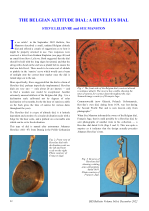
Follow-up article suggesting the previously discussed small Belgian altitude dial is a rare Hevelius dial, possibly a unique wooden example using the time of sunrise as a proxy for solar declination. Analysis shows deliberate geometric simplification in its layout.
Dials: Portable, Dials: Unusual, Historical Dials, Sundial Design & Layout
December 2022
Page 25
Page 25
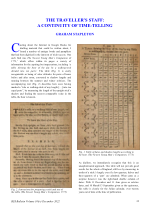
Explores 18th-century printed tables intended for travellers to estimate time using solar altitude and a divided walking stick. The calculations were based on Julian calendar dates and approximated the latitude of Coventry, prioritising simplicity over accuracy.
Dialling Tools, Dials: Portable, Historical Dials
December 2022
Page 30
Page 30
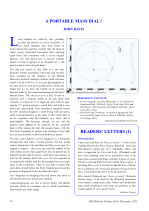
Examines a rare lead disc found by a metal detectorist, which is 78mm in diameter. The design, featuring equi-angular spots, suggests it may be a portable unequal-hour mass dial designed for a rod gnomon.
Dials: Mass Dials, Dials: Portable, Dials: Unusual, Historical Dials
December 2022
Page 31
Page 31
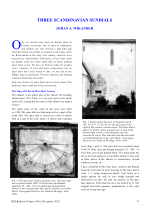
Investigates three Scandinavian dials: the reworked Tingvoll Church Mass Dial (Norway, ca. 1200/1660-70), the ivory Falsterbo sundial (Sweden, ca. 1500), and the soapstone Vardøhus Sundial (Norway, 16th/17th C), discussing octaval and unequal hours.
Dials: Vertical, Dials: Portable, Historical Dials, Dials: Mass Dials
December 2022
Page 40
Page 40
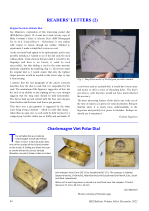
Commentary on the Belgian Portable Altitude Dial, suggesting that using the time of sunrise as a proxy for declination is an interesting, layperson-friendly feature.
Dials: Vertical, Dials: Portable, Dials: Unusual
December 2022
Page 40
Page 40
Brief description of a small portable dial made by Charlemagne Viet (fl. 1673-95) in Blois, France. It features two polar dials and a folding arc to set the latitude for 16 listed cities.
Dials: Polar, Dials: Portable, Historical Dials
June 2021
Page 19
Page 19
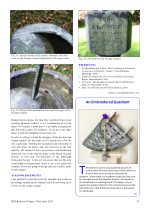
Describes a quadrant made by Iona Isaac as a lockdown project. It is an equal-hour quadrant, embroidered and delineated for Cambridge, based on historical instruments associated with Richard II in the British Museum.
Dials: Portable, DIY Sundial Projects
June 2021
Page 44
Page 44
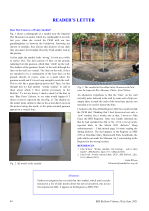
A reader discusses an unusual sundial near the Imperial War Museum, featuring hour lines on the ground that continue vertically up a wall. The author models the dial, hypothesizing that it functions like a giant diptych pocket dial or that the vertical markings are merely endpoints for the hour lines, noting its history in the Fixed Dial Register.
Dials: Portable, Dials: Unusual, How Sundials Work, Sundial Design & Layout
September 2021
Page 38
Page 38
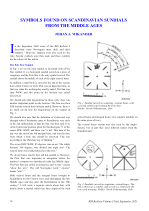
Examines secular symbols used on Scandinavian sundials from the Middle Ages. Discussed symbols include the Pole Star, the Sun, a cock, and those relating to the farmer's life (like the axe). The article also analyses runic letters, such as the K-rune, used as noon marks or numerals, reflecting the mixed octaval and unequal hour systems.
Dials: Mass Dials, Dials: Portable, Historical Dials
December 2021
Page 25
Page 25
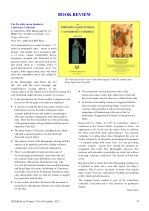
Review of John Davis's Monograph No. 14, The Portable Saxon Sundial at Canterbury Cathedral. The monograph comprehensively covers the unique, small silver-and-gold Saxon portable dial, including its materials analysis, historical links to figures like King Edgar, and the ongoing debate regarding the exact method required for suspending and reading the gnomon.
Book Reviews, Dials: Portable, Historical Dials
March 2020
Page 21
Page 21
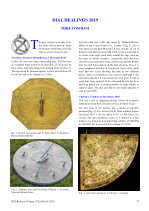
Reviews notable sundials sold at auction in 2019, including an octagonal brass double horizontal dial by Elias Allen (£3,300) and a multiple slate dial by Richard Melvin (£900). The highest price was £731,250 for a medieval astrolabe quadrant. Other items included a silver Butterfield dial, Augsburg dials by Vogler and Müller, and modern reproductions.
Dials: Astrolabe, Dials: Double Horizontal, Dials: Portable, Historical Dials
March 2020
Page 29
Page 29
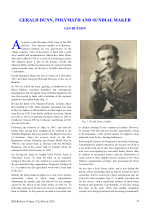
A biography of Gerald Raymond Dunn (1917–2002), detailing his military career, farming attempts, and later ventures, including tracing unclaimed estates and inventing the Cruiserfix solar navigator. He undertook metalwork training and became a sundial maker, specializing in equinoctial ring dials. He also supplied a simple solar compass for a Sahara expedition.
Construction Projects, Dials: Equatorial, Dials: Portable, The BSS and Members
June 2020
Page 2
Page 2
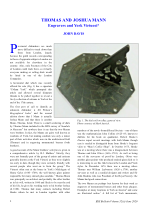
This article researches the work of late 17th-century York artisans Thomas and Joshua Mann, who, though primarily known for architecture and engraving, were also notable sundial makers. The article details several of their horizontal, vertical, and portable dials.
Dials: Horizontal, Dials: Vertical, Dials: Portable, Historical Dials
June 2020
Page 43
Page 43
Reviews two books: "Time of Our Lives: Sundials of the Adler Planetarium" by Sara J. Schechner, cataloguing nearly 500 dials; and "Mathematical Instruments in the Collections of the Bibliothèque Nationale de France" by Anthony Turner et al., featuring 138 instruments including five sundials and nocturnals.
Dials: Portable, Book Reviews, Dials: Nocturnals
September 2020
Page 10
Page 10
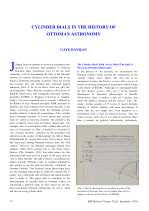
Explores the terminology and history of cylinder dials ("al-ustuwana", "‘Asâ-yı Mûsâ") in the Ottoman Empire, where they were less common than astrolabes. Introduces two Ottoman manuscripts and discusses two surviving cylinder dials from the 18th and 19th centuries, both calculated for the latitude of Istanbul (41°).
Dials: Portable, How Sundials Work, Mathematics of Dialling, Historical Dials
September 2020
Page 26
Page 26
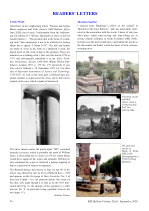
Anthony Turner clarifies that a portable dial signed J Mann 1679 should not be attributed to Joshua Mann. John Foad compares the association of the Thornton sundial with stocks to a similar instance in Ripley, North Yorkshire.
Dials: Portable, Historical Dials
September 2020
Page 27
Page 27
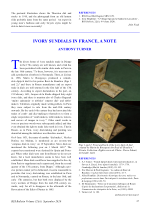
Examines the manufacture and export of ivory sundials in France, historically linked to Dieppe. Provides evidence for production in Rouen during the first half of the 17th century and mentions a notable diptych dial made in Lisieux in 1598.
Dials: Portable, Historical Dials
September 2020
Page 29
Page 29
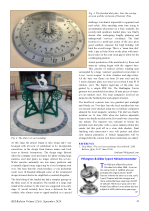
Notes that a rare, early Type 6 Tropical Pilkington & Gibbs Heliochronometer, featuring a strong base covering 90° of latitude, was offered for sale in 1996.
Dials: Heliochronometer, Dials: Portable, Historical Dials
September 2020
Page 38
Page 38
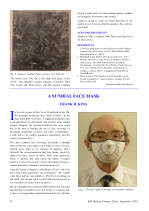
Describes the author's personal DIY project of printing a working stereographic sundial, calculated for his latitude, onto a face mask. Details the construction of a gnomon using a ball-point pen refill and a push pin, and the complexities of reading the time while wearing it.
DIY Sundial Projects, Dials: Portable, Dials: Unusual, Sundial Design & Layout
March 2019
Page 14
Page 14
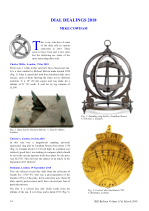
Summarises notable sundials sold at auction in 2018. Items include a slate dial by Richard Melvin, a universal equinoctial ring dial by Jonathan Sisson, a 1553 vertical disc dial, an astronomical compendium by Ulrich Klieber (1571), an eight-pointed star dial by Hans Felt, and a previously unrecorded double horizontal dial by Elias Allen (c. 1630).
Dials: Double Horizontal, Dials: Portable, Historical Dials
June 2019
Page 13
Page 13
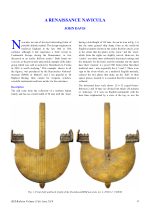
Studies a rare, previously unrecorded Renaissance portable altitude sundial (navicula), acquired by the Bayerisches Nationalmuseum. The brass instrument is ship-shaped and follows the medieval English tradition but uses later numerals. Metallurgical analysis reveals a standard brass alloy, and its engraved date table aligns with 15th-century manuscripts.
Dials: Portable, Historical Dials
September 2019
Page 2
Page 2
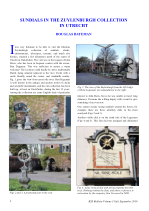
This article details a visit to the privately owned Zuylenburgh collection in Oud-Zuilen, Utrecht, which includes sundials, clocks, and scientific instruments. Highlights include a vertical dial by Pieter de Ruiter, several armillary dials, and portable dials by notable makers such as J. Smith, W. & S. Jones, Elias Allen, Thomas Wright, and Humfrey Cole.
Dials: Vertical, Dials: Portable, Historical Dials, Dials: Armillary Sphere
September 2019
Page 12
Page 12
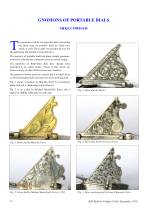
This survey focuses on the ornate gnomons used on attractive portable dials made for gentlemen. Examples are provided from various makers, including Michael Butterfield, Pierre Sevin, Nicholas Lemaindre, and Richard Glynn, showcasing finely fretted, gilt, and engraved designs on small silver or brass horizontal and inclining dials.
Dials: Portable
December 2019
Page 10
Page 10
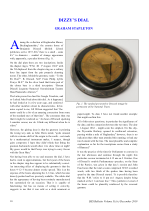
Analysis of a small, peculiar sundial presented to Benjamin Disraeli in 1862 by Philip Lybbe Powys. The article discusses its Latin motto and strange configuration (reversed gnomon). It concludes the dial was likely a customised desk ornament rather than a functional timepiece, relating its creation to Powys's attempts to curry favour during his troubled years.
Dials: Portable, Dials: Unusual, Historical Dials, Mottoes
March 2018
Page 16
Page 16
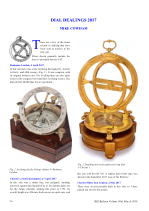
A summary of sundial-related items sold at auction in 2017, including prices achieved. Noteworthy sales include an inclining dial by G. Adams, a rare universal equinoctial ring dial pre-1752, a horizontal garden dial by George Adams Senior featuring an Equation of Time scale, and a sophisticated declinatory dial by R. Glynne.
Dials: Horizontal, Dials: Portable, Historical Dials
March 2018
Page 34
Page 34
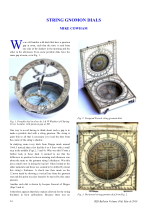
Investigates string gnomon dials, especially those from Dieppe (c. 1660), and their calibration methods. The author suggests that makers intentionally offset the hour lines by the thickness of the string so that the user could read the time from the leading edge of the shadow, circumventing the need for a gnomon gap at noon.
Dials: Portable, Historical Dials, Sundial Design & Layout
June 2018
Page 20
Page 20
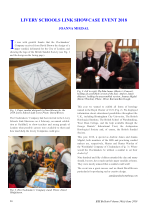
Report on the Worshipful Company of Clockmakers' event aimed at showing young Londoners career paths in horology. BSS member David Brown designed a paper sundial featuring the BSS logo, which was distributed to the 950 attending children, many of whom were amazed that a sundial could work.
DIY Sundial Projects, Dials: Portable
June 2018
Page 28
Page 28
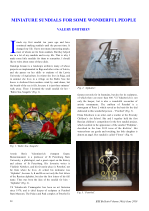
The author describes creating seven miniature sundials as gifts for people who assisted him in his life or gnomonic projects. Examples include 'Peterhof' for an art historian, 'The Swallow' for a supportive official, and 'White Angel', a copy of the dial at his parents' grave.
Construction Projects, Dials: Portable, Dials: Unusual
September 2018
Page 12
Page 12
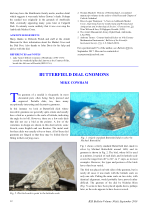
Examines the ornate, hinged gnomons of portable Butterfield dials (usually silver or brass), typically featuring a bird whose bill acts as the latitude pointer. Variations in design are illustrated, including non-bird supporters such as a lion, dolphin, leaf, or swan, spanning French, English, and one Russian example.
Dials: Portable, Historical Dials, Sundial Design & Layout
December 2018
Page 7
Page 7
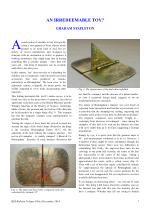
Investigates a small, folding brass horizontal dial stamped 'Birmingham Patent 1875' similar to examples found in many collections. Analysis confirms the gnomon angle is 45° but the hour lines are grossly incorrect for Birmingham’s latitude (52°), leading to the conclusion that this antique object is functionally useless and an irredeemable 'toy'.
Dials: Portable, Historical Dials, Sundial Design & Layout
December 2018
Page 30
Page 30
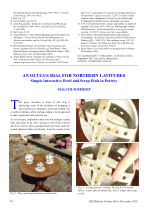
Describes creating miniature equatorial ‘oculus’ or ‘finger’ dials in pottery, inspired by ancient spherical dials. These interactive dials are read by blocking the sun hole with a finger to align the light spot on the vertical datum line, suitable for educational use.
Construction Projects, Dials: Portable, Dials: Scaphe, Dials: Unusual
March 2017
Page 22
Page 22
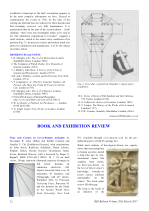
Review of the book *Time and Cosmos in Greco-Roman Antiquity*, resulting from a world-class exhibition at the Institute for the Study of the Ancient World. The book features scholarly papers on ancient time measurement, including sundials, water clocks, and portable sundials, and is considered a core reference source.
Book Reviews, Dials: Portable, Historical Dials
March 2017
Page 32
Page 32
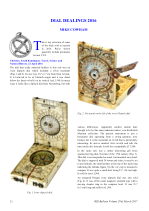
A selection of notable dials sold at auction in 2016. Highlights include a Flemish ivory diptych dial with a silver nocturnal (1590, sold for £17,500), a standing ring dial, a noon gun, an inclining dial by Benjamin Martin, and a silver Butterfield dial featuring Napoleon on the reverse.
Dials: Nocturnals, Dials: Portable, Dials: Unusual, Historical Dials
March 2017
Page 37
Page 37
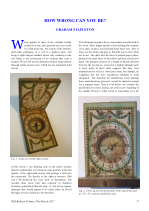
Analysis of wooden diptych sundials (late 18th/early 19th century, Southern Germany) that often only had hour lines delineated for a single latitude (typically 50°). The author calculates the errors (up to 20 minutes) when these dials are used at distant latitudes (e.g., 40° N or 54° N), even if the string gnomon is correctly reset.
Dials: Portable, How Sundials Work, Mathematics of Dialling
June 2017
Page 15
Page 15
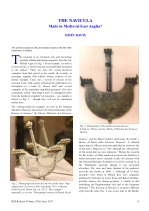
This article examines the navicula, a rare portable altitude dial from the late Middle Ages. It suggests the dial is uniquely English and likely originated in East Anglia, based on geographical links to known examples and associated English manuscripts.
Dials: Portable, Dials: Unusual, Historical Dials
June 2017
Page 48
Page 48
This short entry references John Lester's presentation at the Oxford Conference, showcasing his delightful collection of wooden portable sundials.
DIY Sundial Projects, Dials: Portable
September 2017
Page 17
Page 17
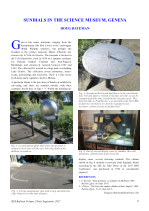
This visits the Geneva Science Museum, which displays instruments related to astronomy and surveying. External exhibits include a conventional globe dial, a large analemmatic dial, and an unusual horizontal altitude dial. Indoor displays feature quadrants, altitude dials, and a navicula portable dial purchased in 1993.
Dials: Analemmatic, Dials: Portable, Dials: Unusual, Historical Dials
September 2017
Page 33
Page 33
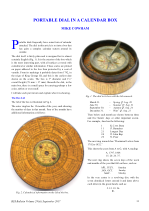
A description of an unsigned portable horizontal dial set in a 3-inch diameter box, likely dating from 1792. The box exterior is covered in detailed printed calendrical information, including Dominical Letters, Easter calculations, and a world time ring listing places and distances from London.
Dials: Portable, Historical Dials
September 2017
Page 41
Page 41
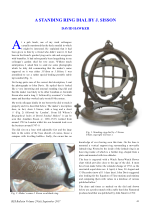
This reports on a rare portable standing ring dial by 'J. Sisson, London', likely Jonathan Sisson (c. 1690–1747). The high-quality brass dial includes latitude and hour rings, alidades, and a Watch Faster/Slower chart on the base. The chart's data matches John Flamsteed's 1702 tables, suggesting the dial was made before the 1730s.
Dials: Portable, Dials: Unusual, Equation of Time, Historical Dials
September 2017
Page 47
Page 47
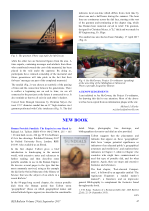
A review of Richard J.A. Talbert’s 2017 book, *Roman Portable Sundials: The Empire in your Hand*. The book describes the 16 known ‘geographical’ portable dials from the Roman period, which feature place names and latitude figures. It discusses their potential significance in understanding the educated public's geographical awareness and worldviews.
Book Reviews, Dials: Portable
December 2017
Page 37
Page 37
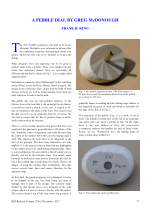
Describes a single-sided equatorial sundial, made from a pebble, that was given to delegates at the 2017 NASS Conference. The gnomon features a crescent cut-out as a memento of the solar eclipse, and time is read from the leading edge shadow falling on sandblasted alternate gaps.
Dials: Equatorial, Dials: Portable, Dials: Unusual, The BSS and Members
March 2016
Page 6
Page 6
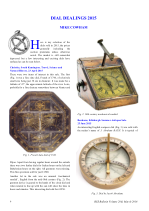
A selection of sundials sold at auction during 2015. Featured dials include a French slate dial (1746), an English mechanical dial, a compass dial by J. Abraham Bath, an ivory crucifix dial with concealed cavities, a horizontal dial by R. Glynne, and a silver Butterfield dial.
Dials: Portable, Historical Dials
September 2016
Page 22
Page 22
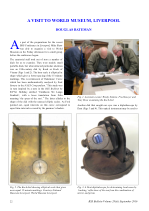
A report on a BSS visit to World Museum, Liverpool, to view their collection of dials. Highlights included an 18th-century Koch dial from Vienna featuring an elliptical scale for better spacing of 15-minute markings, and a Dent dipleidoscope, an instrument used for precisely determining apparent noon.
Dialling Tools, Dials: Portable, Historical Dials, How Sundials Work
December 2016
Page 2
Page 2
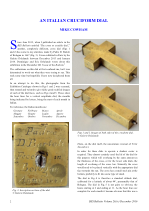
Analysis of a 1667 cruciform dial by Padre D. Bartoli of Bologna, calibrated for latitude 44°. The author deciphered its complex deliniations, concluding it displays equal hours, unequal hours, Italian hours, and Babylonian hours. It functions as a standard altitude dial, likely using the lid or cross bars as a shadow caster.
Dials: Portable, Dials: Unusual, Historical Dials, How Sundials Work
December 2016
Page 42
Page 42
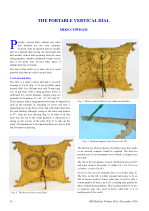
Examines two unusual portable vertical dials. The first is a c. 1600 gilt brass south dial calibrated for five latitudes, featuring a string gnomon and lunar time calculations on the reverse. The second is a small square pillar dial (c. 1567, likely Ulrich Schniep) showing two declining vertical dials and planetary hour tables.
Dials: Portable, Dials: Unusual, Historical Dials
March 2015
Page 6
Page 6
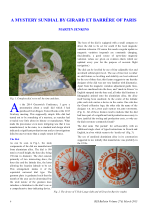
An investigation into a portable equatorial universal dial manufactured using anodized aluminium alloy, potentially dating from the late 1930s or early 1940s, or perhaps post-1960. Research reveals the involvement of the designer T.H. de Lange (W.G. ten Houte de Lange) and the publishing house Girard et Barrère. The dial's rarity and design anomalies suggest it may be a pre-production prototype run.
Dials: Equatorial, Dials: Portable
March 2015
Page 14
Page 14
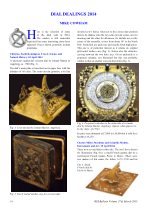
A compilation of interesting sundials sold at auction throughout 2014. Notable lots include a universal equinoctial crescent dial by Johann Martin of Augsburg (ca. 1700), a small French garden dial by Pierre le Maire, a magnetic compass dial by William Fraser, a vertical slate dial by Bianchi, and a significant double horizontal dial by Henricus Wynne (ca. 1667/8).
Dials: Double Horizontal, Dials: Portable, Dials: Vertical, Historical Dials
March 2015
Page 32
Page 32
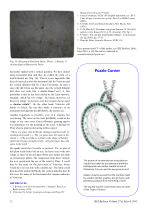
A light-hearted challenge featuring a photograph of an emeralds-set-into-platinum ring dial, designed by Ana de Costa with gnomonic guidance from Frank King. Readers are asked to identify two major errors introduced into the image by an excessive use of Photoshop.
Dials: Portable
June 2015
Page 2
Page 2
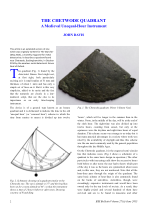
This article describes a small, rare horary quadrant found near Chetwode, Buckinghamshire, in 2014. It is identified as a *quadrans vetustissimus*, designed for unequal hours, likely dating from the mid-13th century or later, and includes a shadow square.
Dials: Portable, Historical Dials, Mathematics of Dialling
June 2015
Page 18
Page 18
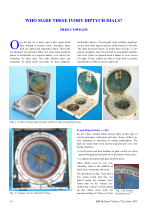
The author seeks identification for a distinctive type of unsigned ivory French diptych dials, c. 1620, characterized by blue and gold painting, town lists, and compass declinations suggesting 7° eastwards. They resemble Dieppe dials but may originate elsewhere in Normandy or Paris.
Dials: Portable, Historical Dials
September 2015
Page 8
Page 8
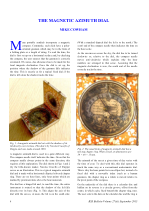
This article explores the design and function of magnetic azimuth dials, where the compass needle indicates the time. Using historical examples by Nicolas Crucefix and Charles Bloud, it details methods for calibration, dealing with magnetic declination, and construction techniques suitable for portable instruments.
Dialling Tools, Dials: Portable, How Sundials Work, Mathematics of Dialling
September 2015
Page 20
Page 20
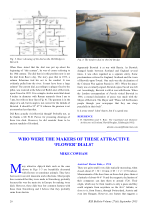
Investigates small ivory diptych dials decorated with flowers or animals, dating to around 1720, possibly originating from Austria (latitude 46.6° N). Details common features, such as the style of the numeral '2', and suggests they were made for ladies due to their size and decoration.
Dials: Portable, Historical Dials, Sundial Design & Layout
September 2015
Page 22
Page 22
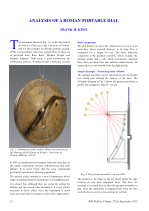
A novel analysis of a Roman portable altitude dial from Oxford’s Museum of the History of Science. It explores how the instrument determines unequal hours from solar altitude, discusses the underlying mathematical model, the use of latitude and declination scales, and provides an error analysis.
Dials: Portable, Historical Dials, How Sundials Work, Mathematics of Dialling
September 2015
Page 42
Page 42
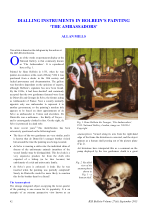
Analysis of the dialling and astronomical instruments depicted in Hans Holbein's 1533 painting, ‘The Ambassadors’. Instruments covered include the torquetum, shepherd’s dial, universal equatorial dial, horary quadrant, and polyhedral dial, noting potential artistic inaccuracies.
Dialling Tools, Dials: Equatorial, Dials: Portable, Historical Dials
December 2015
Page 21
Page 21
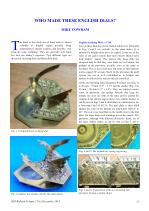
Investigates several unsigned English brass dials, suggesting they might originate from the same provincial workshop around 1740. Discusses similarities between inclining dials and oval Butterfield dials, noting manufacturing irregularities in an octagonal dial.
Dials: Portable, Mathematics of Dialling, Historical Dials
December 2015
Page 48
Page 48
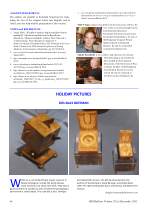
Features photographs of sundials encountered during a visit to the clock museum at La Chaux-de-Fonds in Neufchatel. Specific examples shown include an 18th-century cube dial by D. Beringer and 17th and 18th-century pocket dials.
Dials: Multi Faced, Dials: Portable
March 2014
Page 22
Page 22
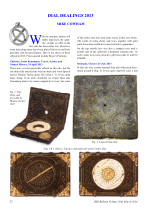
This review covers noteworthy sundials sold at auction in 2013. Highlights include a valuable ebony and ivory diptych dial by Thomas Tucher (1612, £20,000) and a fine late 17th-century silver dial by Henry Wynne (£6,875). Other instruments featured were a declinatory dial by Nicholas Bion and an oval Butterfield-type dial by Choizy.
Dialling Tools, Dials: Portable, Historical Dials
June 2014
Page 8
Page 8
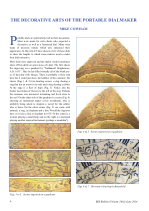
Explores the rich decoration found on portable dials, often made of precious metals or ivory for wealthy clients. Examples include engraved hunting scenes, decorative lettering, book-form dials, and symbolic imagery like 'Old Father Time' and 'The Green Man'. Decoration frequently featured coloured waxes and detailed engraving.
Dials: Portable, Historical Dials, Mottoes, Sundial Design & Layout
June 2014
Page 40
Page 40
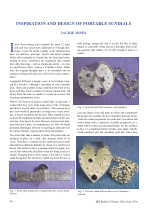
Details the process of creating contemporary silver portable sundials, combining jewellery techniques with accurate gnomonics. The article describes various forms—polar, necklace, and box dials—and unique methods used to achieve decorative surface finishes, such as using sandpaper or wire wool in rolling mills.
Construction Projects, DIY Sundial Projects, Dials: Portable, Sundial Design & Layout
September 2014
Page 40
Page 40
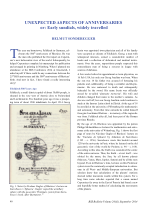
Links the 500th anniversary of Rheticus' birth (Copernicus's publisher) to early sundials. Discusses a lost coloured stone gnomon ordered by Bishop Giese from Nicholas Kratzer in London (c. 1520), and Georg Hartmann’s ivory cross dial (1541) now in the British Museum, suggesting Hartmann’s paper cut-out cruciform dial (1529) may be the earliest of its type.
Dials: Portable, Construction Projects, Historical Dials
March 2013
Page 41
Page 41
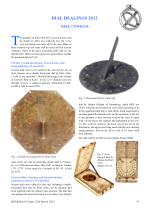
A review of sundials sold at major auction houses during 2012. It lists significant instruments, their makers, sale prices, and remarks on market trends in dial collecting.
Dials: Double Horizontal, Dials: Portable, Historical Dials, The BSS and Members
June 2013
Page 48
Page 48
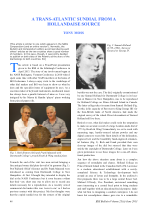
A historical investigation into a sundial design that travelled between Holland and America, tracing its manufacture, inscriptions, and stylistic influences.
Dials: Horizontal, Dials: Portable, Historical Dials
September 2013
Page 25
Page 25
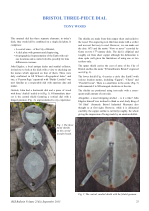
Examination of an intriguing three-piece artefact from 1675, attributed to R Smurthwaite, Bristol, possibly an amateur work. It consists of the Bristol Coat of Arms shield, a vertical dial with a hinged gnomon, and a topographical representation of the Earth with overseas locations, suggesting a possible nautical link.
Dials: Portable, Dials: Unusual, Dials: Vertical, Historical Dials
September 2013
Page 27
Page 27
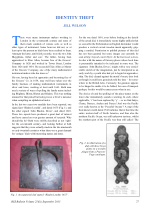
Investigates two pseudo-antique sundials recently reported, falsely signed with variations of the 17th-century maker name Bladon and dated 1610 and 1655. Examination of features, mottoes (one invented in 1860), and catalogue evidence strongly suggests they were manufactured much later, possibly by Pearson Page, as fake antique pieces.
Dials: Equatorial, Dials: Portable, Historical Dials, Mottoes
September 2013
Page 29
Page 29
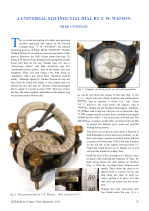
Description of a nice precision portable equatorial dial, circa 1880, by T.W. Watson. It is designed for use in both hemispheres and includes specialized chapter ring and compass card layouts, featuring both an Equation of Time chart and a separate map of Isogonic Lines for 1877 for precise time setting.
Dialling Tools, Dials: Equatorial, Dials: Portable, Equation of Time
December 2013
Page 2
Page 2
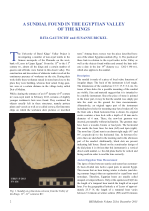
Describes a vertical direct south sundial made of ochre limestone found in workmen's huts in the Valley of the Kings, dated to the late 19th dynasty (ca. 1202–1190 BC). It discusses its dimensions, features, and the low precision inherent in ancient Egyptian temporal hours and canonical design.
Dials: Portable, Dials: Vertical, Historical Dials, Mathematics of Dialling
December 2013
Page 52
Page 52
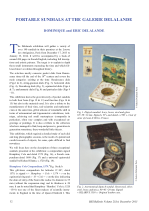
Previews an exhibition of over 140 pocket dials (Renaissance to late 18th century) held in Paris. It describes three exceptional examples: a complex Humphrey Cole gilt-brass compendium (1579), a French diptych compendium (1608), and a universal equinoctial sundial by Richard Glynne (c.1720).
Dials: Equatorial, Dials: Portable, Historical Dials
March 2012
Page 8
Page 8
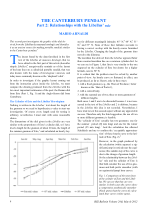
This second part of the article investigates the Canterbury pendant, a 10th-century portable sundial. It compares its graphic layout with the Libellus de mensura horologii and the Roman cylinder dial of Este, exploring the use of two gnomons for different seasons and their relationship to hour curves.
Dials: Portable, Historical Dials, How Sundials Work, Mathematics of Dialling
March 2012
Page 13
Page 13
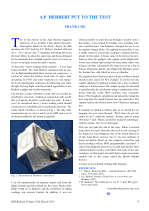
The author tests A.P. Herbert's idea of using a sundial "in reverse" for navigation during a flight to Australia in 1975. He describes making his own "sun clock" and recounts an encounter with a pilot familiar with Francis Chichester's navigation methods, highlighting the practical challenges of such a device.
Dials: Portable, Dials: Unusual, Sundial Design & Layout, DIY Sundial Projects, Historical Dials
March 2012
Page 18
Page 18
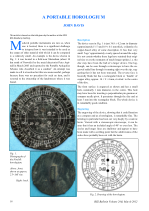
This article examines a medieval copper-based alloy device, found in Norfolk, which functioned as both a compass and a horologium. The fine engraving, including early Gothic lettering and 5° time subdivisions ("mileways"), suggests a 14th-century date and offers insights into medieval timekeeping and connections to local horology.
Dials: Portable, How Sundials Work, Historical Dials
March 2012
Page 39
Page 39
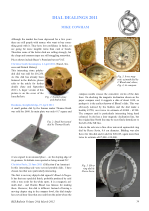
This article reports on sundial sales and auction results from 2011, noting strong sales for higher-quality dials despite a depressed market. It details several interesting pieces, including a stone polyhedral dial, ivory diptych dials, equinoctial ring dials, quadrants, and a double horizontal dial.
Dials: Portable, Historical Dials
June 2012
Page 8
Page 8
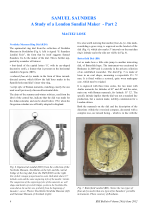
This is the second part of a study on London sundial makers named Samuel Saunders. It identifies and attributes several equinoctial ring dials, a Butterfield dial, a plane table, and other instruments based on distinctive engraving styles and features.
Dials: Portable, Historical Dials
June 2012
Page 18
Page 18
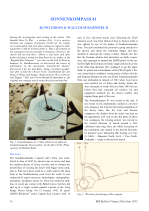
This addendum describes the German Sonnenkompass 41, issued to the Sonderkommando Dora unit in North Africa during WWII. Based on an analemmatic sundial, it featured removable dial plates for different latitudes and seasons, including German Summer Time adjustments. Despite its design, field reports deemed it unsuitable for desert use due to gnomon issues, leading to its obscurity.
Dials: Analemmatic, Dials: Portable, Historical Dials
June 2012
Page 22
Page 22
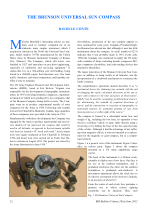
This article describes the Brunson Universal Sun Compass (Model 7637B), an elaborate US Army instrument developed in the 1950s. Its innovations included usability at all latitudes and a clockwork mechanism to counteract Earth's rotation, making it a valuable complement to magnetic/gyro-compasses for true azimuth determination in navigation and surveying.
Dials: Portable, How Sundials Work, Historical Dials
June 2012
Page 24
Page 24
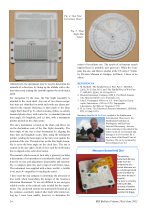
This entry briefly describes a working Butterfield dial made from components of a Pocket Meccano set. It was created as a challenge for Noel Ta' Bois while he was in hospital and is now held by the BSS.
DIY Sundial Projects, Dials: Portable
June 2012
Page 42
Page 42
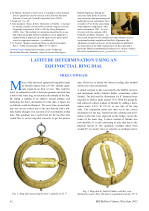
This article describes Gabriel Stokes' innovative 1735 design for equinoctial ring dials, which incorporated a direct readout declination scale for latitude determination. By setting the suspension point to the correct solar declination for the day, travellers could directly read their geographical latitude, simplifying a process that traditionally required calculations.
Dials: Portable, How Sundials Work, Historical Dials
June 2012
Page 46
Page 46
This section contains three letters from readers. Peter Drinkwater discusses a Canterbury pendant, questioning Arnaldi’s gnomon positions. Frank Coe references a Chichester Sun Compass. Sue Manston points out a potential error in the 'waxing' and 'waning' engravings on the Balliol Moondial's gnomon, to which David Harber responds confirming the mistake.
Dials: Portable, Dials: Unusual
September 2012
Page 40
Page 40
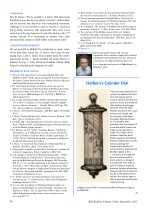
This entry describes a drawing of a cylinder (or shepherd's) dial by Hans Holbein the Younger, dating from 1532-1543. It is speculated that the image depicts a real dial either made by or planned by Nicholas Kratzer, Holbein's contemporary and Henry VIII's horologist. The drawing's cut-out nature and right-to-left month inscription are notable features.
Dials: Portable, Historical Dials, Sundial Design & Layout
December 2012
Page 40
Page 40
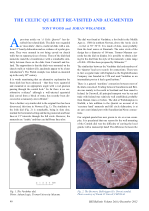
This article revisits the Celtic Quartet of medieval mass dials, noting their unusual carving on separate stones. It introduces a newly discovered, similar slate dial from Vardøhus, Norway, dated 1480–1550, expanding the Quartet to six or seven examples and highlighting historical maritime trade connections between the regions where these dials are found.
Dials: Horizontal, Dials: Portable, Historical Dials, Dials: Mass Dials
March 2011
Page 39
Page 39
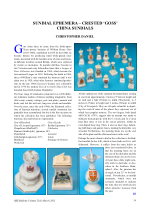
This article describes a collection of miniature crested 'Goss' china sundial ornaments produced from the 1880s. These decorative horizontal dials, typically featuring local heraldic arms, were collected as souvenirs and are now considered rare treasures, despite often having incorrect hour-line delineations.
Dials: Horizontal, Dials: Portable, Dials: Unusual, Historical Dials
March 2011
Page 41
Page 41
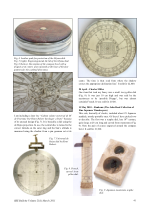
This article reviews notable sundials and related instruments sold at auction in 2010, including a silver pocket compass dial by Richard Glynne, a double inclining string gnomon dial by Jacques Le Maire, Japanese scaphe dials, and an ivory and silver compass dial by Elias Allen.
Dials: Portable, Dials: Unusual, Historical Dials
June 2011
Page 20
Page 20
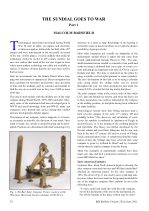
This article explores the military use of solar compasses, particularly during World War II, for navigation in unmapped desert terrains. It describes several models, including the Burt, Abrams, Cole Universal, Bagnold, and Union Observatory sun compasses, highlighting their principles and operational advantages.
Dials: Analemmatic, Dials: Portable, Dialling Tools, Historical Dials
September 2011
Page 2
Page 2
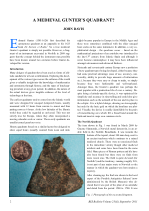
This article discusses the excavation of a quadrant fragment in Norfolk in 2009, initially misidentified as an astrolabe plate. Further investigation suggests it's a hybrid device combining features of a quadrans vetus and a Gunter's quadrant, leading to questions about its medieval origins despite Gunter's later development of his eponymous instrument.
Dials: Portable, Dials: Unusual, Historical Dials
September 2011
Page 10
Page 10
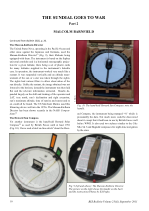
This is the second part of an article exploring the use of sundials and solar compasses in military contexts. It describes instruments like the Marean-Kielhorn Director, Howard Sun Compass, Evans-Lombe, Richards, and Micklethwait sun compasses used by Allied forces. It also details German sun compasses, particularly the C. Plath device used by Rommel's Afrika Korps, and the astrocompass, discussing their applications and limitations in wartime navigation.
Dials: Portable, How Sundials Work, Historical Dials
September 2011
Page 16
Page 16
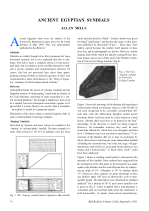
This article reviews ancient Egyptian timekeeping, debunking obelisks as gnomons and a Cairo Museum artifact as a sundial. It focuses on the ‘sloping’ or ‘inclined plane’ portable, seasonal-hour altitude dials, such as the Qantara dial, and earlier L-shaped 'shadow sticks' from the New Kingdom, discussing their construction, use, and the challenges in interpreting their time-telling functions.
Dials: Portable, Dials: Unusual, Historical Dials, How Sundials Work
December 2011
Page 2
Page 2
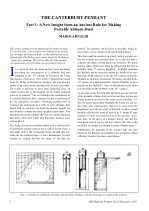
This article summarises the author's attempt to create a clear and correct edition of an ancient text, previously attributed to Bede, on constructing an altitude dial. The findings provide new insight into the famous ‘Canterbury pendant’ and suggest it was made more correctly than previously believed. The text describes a pendant altitude dial, possibly hexagonal, working like a cylinder dial, with specific dimensions and a calendar system.
Construction Projects, Dials: Portable, Historical Dials, Mathematics of Dialling
March 2010
Page 21
Page 21
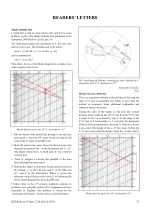
A collection of letters from readers. Topics include a simpler graphical method for using the John Marke altitude dial, a discussion on the nomenclature of mass dials, the 'Sun Position Compass', and the historical connection between clockmakers and dialmakers.
Dials: Mass Dials, Dials: Portable, Mathematics of Dialling, The BSS and Members
March 2010
Page 28
Page 28
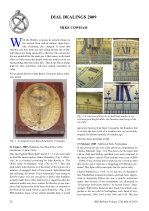
A review of sundials sold at auction in 2009. Notable items include a gilt brass compendium by Charles Whitwell dated 1608, a Panorganon by Joseph Wells, a Gunter's quadrant by Henry Wynne, and a silver Butterfield dial by Pierre le Maire.
Dials: Portable, Dials: Scaphe, Historical Dials, Dials: Nocturnals
June 2010
Page 52
Page 52
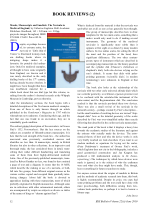
This is a review of Catherine Eagleton's book, 'Monks, Manuscripts and Sundials: The Navicula in Medieval England,' which emerged from her doctoral research. The book focuses on the rare medieval navicula, or 'Little ship of Venice,' detailing known examples and newly uncovered 15th-century manuscripts that describe its making and use. It reveals that the navicula was likely more common than previously thought and predates other universal altitude dials.
Book Reviews, Dials: Portable, Historical Dials
March 2009
Page 32
Page 32
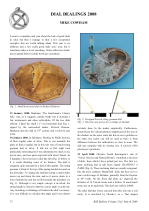
This article reviews notable sundials and scientific instruments seen in sales throughout 2008. Highlights include an 18th-century horizontal dial by Richard Hintonn, a French silver string gnomon dial, a gilt inclining dial by Chapotot, a rare 16th-century Nuremberg star-shaped polyhedral dial, an ivory diptych dial by Lienhart Miller, a Butterfield universal equinoctial ring dial, and a Gunter quadrant by Nathanaell Heighemore.
Dials: Horizontal, Dials: Multi Faced, Dials: Portable, Historical Dials
March 2009
Page 42
Page 42
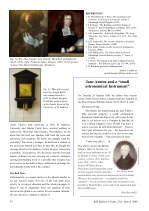
This article refers to a letter from Jane Austen to her brother in 1805, mentioning a small astronomical Instrument believed to be a compass and sundial, found among their late father's possessions. The exact type of sundial is unknown, but it highlights the historical significance and potential value of such instruments.
Dials: Portable, Historical Dials
June 2009
Page 41
Page 41
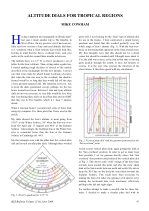
Explores the design of fixed-latitude altitude dials for use in tropical regions, specifically The Gambia (13.5° N). The article presents computer-generated plots for various types, including the horary quadrant and vertical plate dial, highlighting the unique behaviour of the hour lines as the sun passes overhead.
Dials: Portable, How Sundials Work, Sundial Design & Layout
September 2009
Page 2
Page 2
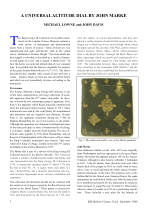
Describes a unique universal altitude dial made by John Marke, possibly for Robert Boyle, now in the London Science Museum. The article details the instrument's provenance, its physical characteristics, and its complex operation as a combined clinometer and sundial. It provides an in-depth analysis of the mathematical principles involved and its potential accuracy.
Dials: Portable, Dials: Unusual, Historical Dials, Mathematics of Dialling
December 2009
Page 17
Page 17
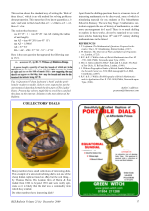
This brief feature highlights a universal inclining dial by the London firm Thomas Harris & Son from a member's collection. The dial is noted as a genuine antique from the 19th-century firm of opticians, rather than a modern replica, and an appeal is made for other members to share their interesting dials.
Dials: Portable, Historical Dials, The BSS and Members
March 2008
Page 2
Page 2
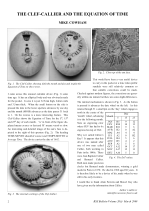
Describes an unusual 1842 pocket calendar device called the Clef-Callier, named after one of two Parisian clockmakers, which shows the Equation of Time for the 5th, 15th, and 25th day of each month. It also displays the month and date, with corrections generally within one minute of modern figures.
Dials: Portable, Equation of Time
March 2008
Page 13
Page 13
A collection of letters. Graham Stapleton suggests new glossary terms; John Moir corrects a previous 'Almost Sundial' entry; Ken Head clarifies how to use analemmatic dials; George White discusses the Bath Tompion dial and its uncertain link to the Pump Room clock.
Dials: Analemmatic, Dials: Portable, Historical Dials
March 2008
Page 38
Page 38
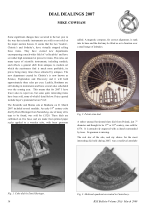
Reports on sundial sales at major auction houses in 2007, noting a shift away from scientific instruments by Christie's and Sotheby's. It details sales at Bonhams, including a 19th-century cube dial, a 17th/18th-century Polish slate dial, and a medieval astrolabe quadrant found in Canterbury. Other notable sales include portable dials by Edm. Culpeper and a double crescent dial by Johann Martin.
Dials: Portable, Historical Dials, Dials: Cube, Dials: Double Horizontal
June 2008
Page 50
Page 50
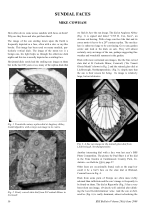
This article explores the depiction of faces on sundials, primarily smiling suns on vertical dials and replica horizontal dials, as well as moon faces and other figures like angels. It showcases various examples from Britain and Europe, discussing their symbolism and design variations.
Dials: Portable, Dials: Vertical, Historical Dials, Sundial Design & Layout
September 2008
Page 152
Page 152
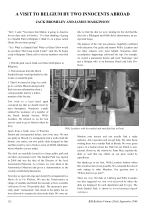
Jack Bromily and Jim Marginson recount their trip to Belgium to visit the Sundial Park in Genk. Guided by a Dutch Sundial Society member, they explored the park's tastefully located dials and visited the Astronomical Museum. They also visited La Musée de la Vie Wallone in Liège, which houses over 150 portable dials.
Dials: Portable, Historical Dials, Dials: Noon Lines
December 2008
Page 154
Page 154
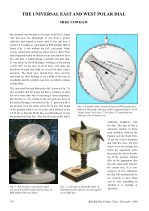
This article describes a portable universal East and West polar dial that is self-aligning and does not require a compass. It details its design, operation, and identifies limitations such as a two-hour gap around noon. It also explores improvements through hinged flaps and cylindrical designs, and relates it to other dial types like the double crescent dial.
Dials: Polar, Dials: Portable, How Sundials Work, Sundial Design & Layout
March 2007
Page 15
Page 15
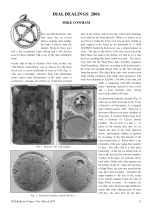
This article reviews sundial sales and auctions from 2006, highlighting notable items such as a 1545 book with an early gold sundial, a perpetual calendar from around 1700, and a brass horary quadrant by Tho: Poole. It also mentions a standing ring dial, a Butterfield dial, and a rare Henry Sutton quadrant with 'New Style' dating.
Dials: Portable, Historical Dials
December 2007
Page 176
Page 176
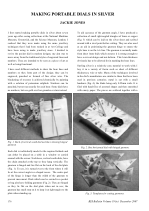
Jackie Jones describes her process of making portable sundials in silver, applying jewellery techniques learned at Art College. Her aim is to create modern, artistic, yet functional pocket dials. She details methods for showing hour lines, blackening recesses, and designing folding gnomons. The article also covers working with sterling silver, hallmarking, achieving different surface textures, and future plans for transparent enamel panels.
Construction Projects, DIY Sundial Projects, Dials: Portable, Sundial Design & Layout
February 2006
Page 22
Page 22
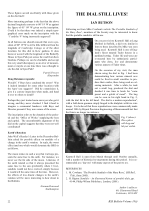
This article highlights the ongoing use of portable sundials, observed during a visit to Kentwell Hall. A re-enactor demonstrated a modern reproduction, similar to those found on the Mary Rose, to tell time within a Tudor setting. The piece celebrates the enduring relevance and practical application of these historical timekeeping instruments.
Dials: Portable, Historical Dials
February 2006
Page 28
Page 28
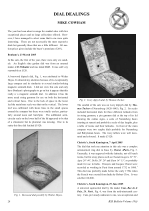
This article reviews notable sundial sales from 2005 auctions and catalogues. Featured items include diptych dials, astronomical ring dials, universal minute dials, and quadrants. The author also discusses a recognised forgery and provides insights into instrument collecting.
Dials: Equatorial, Dials: Portable, Historical Dials
December 2006
Page 159
Page 159
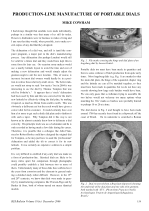
The article reveals that sundial were often produced in batches or using templates to save time and cost. Evidence of this includes manufacturers reusing delineation designs, employing techniques like tilting dial plates to correct for different latitudes, and the presence of matching marks and "prick marks" on components of portable and ivory dials. This suggests a more standardised manufacturing process for many dials, especially from places like Augsburg, Nuremberg, and France.
Dials: Portable, Sundial Design & Layout
December 2006
Page 180
Page 180
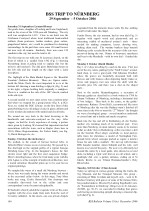
This multi-author report details the British Sundial Society's visit to Nürnberg, exploring historical sundials on sites like St Lawrence church (1502), the Fembo House, and various multi-faced dials in Rothenberg. The trip also included visits to St Rochus Cemetery, where gravestones of famous dial makers feature classical diptych dials.
Dials: Multi Faced, Dials: Portable, Historical Dials, The BSS and Members
June 2005
Page 52
Page 52
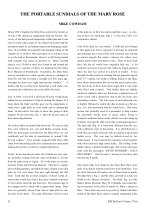
Examines eight 16th-century wooden portable sundials recovered from the Mary Rose warship. Describes their construction, provenance, decoration, and probable origin in Nuremberg, with insights into use aboard ship and wider trade networks.
Dials: Portable, Historical Dials
December 2005
Page 154
Page 154
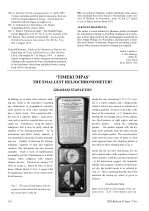
This article introduces the "Timekumpas," a small, cigarette-lighter-sized equatorial dial patented in 1926. While it lacks precision due to its size, it is notable for being a universal instrument designed to allow for latitude, longitude, equation of time, and magnetic variation, making a "noble effort" to create a sophisticated, portable standard time indicator.
Dials: Equatorial, Dials: Heliochronometer, Dials: Portable, Historical Dials
March 2004
Page 4
Page 4
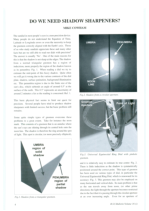
Explores methods to improve the precision of reading sundials, addressing the problem of the penumbra (fuzzy shadow) caused by the sun's finite disc. It discusses various gnomon designs, such as annular gnomons for noon marks, thin rod gnomons, and pinhole or taut wire gnomons, which create sharper shadows for more accurate time-telling.
Dials: Noon Lines, Dials: Portable, How Sundials Work, Sundial Design & Layout
March 2004
Page 27
Page 27
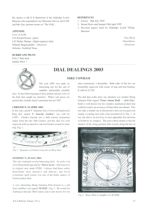
This article reviews notable sundial sales from 2003, highlighting various portable dials sold at auctions like Sotheby's and Christie's. It features different types of dials, including Butterfield dials, Universal Equinoctial Ring dials, String Gnomon dials, Miner's Dials, and a rare Elizabethan compass dial, discussing their features, makers, and sale prices.
Dials: Astrolabe, Dials: Portable, Historical Dials
September 2004
Page 124
Page 124
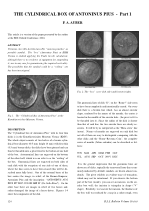
Analysis of the small Roman bronze ‘cylindrical box’ with pierced disks in Vienna; interprets the object as a portable/rolling sundial (viatoria pensilia), applies Padre Secchi calculations and discusses mounting/suspension possibilities and function.
Dials: Portable, Dials: Unusual, Historical Dials
December 2004
Page 143
Page 143
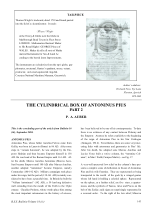
Concluding analysis of the Roman cylindrical portable dial/box. Examines iconography, construction hypotheses (lateral hole or pivot gnomon), latitude and use-mode limitations, accuracy concerns and comparisons with related museum pieces; concludes it is plausibly a status object with limited gnomonic precision.
Dials: Portable, Dials: Unusual, Historical Dials
March 2002
Page 32
Page 32
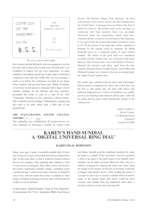
Describes a simple sundial formed purely by the hands, giving approximate time and direction towards north.
DIY Sundial Projects, Dials: Portable, Dials: Unusual
June 2002
Page 76
Page 76
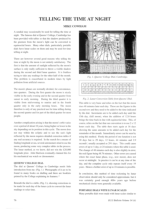
Explores historical and modern approaches to determining time after sunset using nocturnals and other devices.
Dials: Vertical, Dials: Portable, Dials: Astrolabe, Historical Dials, Dials: Nocturnals
June 2002
Page 81
Page 81
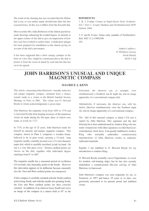
Examines a rare compass designed by Harrison, with discussion of its function and potential sundial applications.
Dialling Tools, Dials: Portable
September 2002
Page 104
Page 104
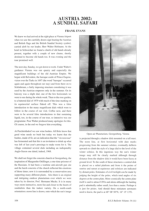
Travelogue of the BSS tour of Austria led by Walter Hofmann, visiting monasteries, public dials, and craftspeople; rich in descriptions of painted and sculptural dials.
Dials: Portable, Dials: Unusual, Dials: Vertical, The BSS and Members
December 2001
Page 135
Page 135
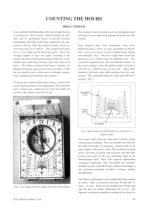
This article details ancient timekeeping systems, including Babylonian hours from sunrise, Italian hours from sunset, and the Arabs' midnight-start 24-hour day. It also explores Japanese unequal hours, divided into 12 'tokis', noting their abandonment in 1873 for international time. The evolution of numerals on sundials, from early European to Arabic and stylised forms, is also discussed.
Dials: Portable, Historical Dials, Sundial Design & Layout
December 2001
Page 158
Page 158
This section reviews two books. The first, a reprint of T.W. Cole's 'Origin and Use of Church Scratch-Dials,' covers mass dials and their history. The second reviews Hester Higton's 'Sundials: An Illustrated History of Portable Dials,' praised for its lavish illustrations and historical context of various portable dial types. While generally well-received, factual errors regarding dial functionality and minor layout issues are noted in Higton's work.
Book Reviews, Dials: Mass Dials, Dials: Portable, Historical Dials
February 1999
Page 19
Page 19
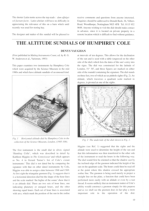
This paper examines two unusual altitude sundials by Humphrey Cole from the Science Museum, one from 1568-1569 and another from 1574. It analyzes their unique gnomon operation for measuring sun height and reading hours, suggesting a new sub-section in sundial classification for Cole's distinctive horizontal plate altitude dials.
Dials: Portable, Sundial Design & Layout, Historical Dials
February 1999
Page 25
Page 25
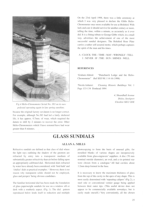
This article introduces refractive sundials made from transparent solids like glass, specifically glass paperweight sundials for window sills. The nodus is an 'aperture' on the top of the paperweight, casting a spot on a dial card on the bottom, with a more compact pattern than in air.
Dials: Horizontal, Dials: Portable, Dials: Unusual, Sundial Design & Layout, DIY Sundial Projects
October 1999
Page 139
Page 139
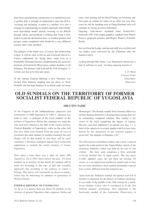
This article surveys 214 fixed sundials in the former SFR Yugoslavia, now divided into multiple new states. It highlights a Roman spherical dial from Sremska Mitrovica, the oldest Serbian sundial at Studenica Monastery (12th century), and the horizontal dial at Belgrade Observatory. It notes the scarcity of sundials in Macedonia and Bosnia and Herzegovina due to Turkish reign, and discusses Italian-influenced medieval stone dials on the Croatian Adriatic coast, including one in Dubrovnik with both contemporary and old Italian hour scales.
Dials: Horizontal, Dials: Portable, Dials: Scaphe, Dials: Vertical, Historical Dials
February 1998
Page 10
Page 10
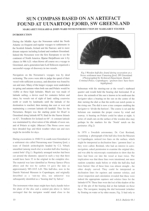
Introduces a reconstructed sun compass inspired by a Greenland find and sets it in Norse navigation: maintaining latitude by noon Sun and Polaris, with practical insights on use at high latitudes and during seasons when both Sun and star are visible.
Dials: Portable, Historical Dials
February 1998
Page 46
Page 46
Argues for re-evaluation of Roman portable dials: forms, readings and classification, urging fresh analysis of surviving pieces and their interpretation.
Dials: Portable, Historical Dials
October 1998
Page 30
Page 30
This article explores two types of ancient Egyptian sundials: L-shaped shadow clocks and sloping sundials. It discusses their religious and practical contexts, refutes the 'crossbar hypothesis' for shadow clocks, and traces the evolution of these instruments through hieroglyphs. The article concludes that these devices served as symbolic representations rather than accurate time-keepers.
Dials: Portable, Historical Dials
April 1997
Page 2
Page 2
An in-depth guide to beginning a collection of portable sundials, discussing types from wooden diptychs to Butterfield dials, with practical advice on acquisition, authenticity, and the joy of collecting these intricate timekeepers.
Dials: Portable
April 1997
Page 24
Page 24
An exploration of altitude dials designed for high-latitude locations, discussing their construction, adaptations, and challenges in time-telling under extreme solar conditions.
Dials: Portable, How Sundials Work, Sundial Design & Layout
July 1997
Page 40
Page 40
The article describes the mathematics and construction of an altitude ring dial, including diagrams for delineation and discussion of its limitations.
Construction Projects, Dials: Portable, Mathematics of Dialling
October 1997
Page 21
Page 21
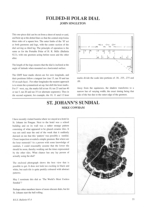
This article introduces a one-piece polar dial that can be cut from metal or card and folded to form a square box. Its outer limbs serve as gnomons and legs, with one gnomon for before noon and another for after. The design ensures the dial is inclined at the angle of latitude, and it operates on the same principle as the portable polar dial, with considerations for GMT hour marks at different longitudes.
DIY Sundial Projects, Dials: Polar, Dials: Portable
October 1997
Page 31
Page 31
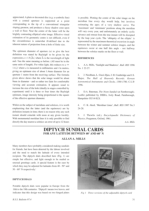
This article describes how to make adjustable diptych sundials from card, acting as a modern, lightweight version of antique portable diptych dials. It explains the principle of two hinged plates with a taut string gnomon, a built-in compass, and the "theorem of the sundial" for adjusting to various latitudes (40-50° N and 50-60° N) by tilting the entire instrument.
DIY Sundial Projects, Dials: Portable, Sundial Design & Layout
February 1996
Page 30
Page 30
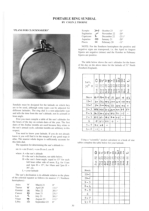
Description of a compact, transportable ring dial and its operation, with construction details.
Construction Projects, Dials: Portable
June 1996
Page 16
Page 16
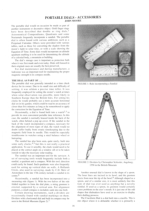
Examines the features and design variations of historical portable sundials, discussing integrated instruments, storage cases, and accessories like compasses and perpetual calendars.
Dialling Tools, Dials: Portable, Historical Dials
October 1996
Page 2
Page 2
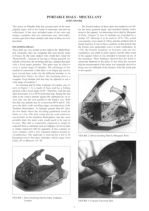
A concluding article in a series about portable dials, detailing lesser-known types such as inclining dials, universal dials, compass dials, cube dials, and novelty items like walking stick dials, with historical context and examples.
Dials: Cube, Dials: Portable, Historical Dials
October 1996
Page 25
Page 25
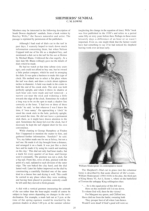
An article about simple portable sundials used by shepherds, exploring their historical use, practicality, and variations in design.
Dials: Portable
February 1995
Page 9
Page 9
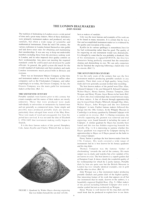
An extensive account of portable sundial makers active in London from the 16th to 19th centuries, including guild affiliations, types of dials made, and notable individuals with examples of their work.
Dials: Portable, Historical Dials
February 1995
Page 15
Page 15
Proof of the Accuracy of the Capuchin and Regiomontanus Dials using the Polar Triangle of Navigation
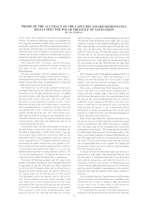
A mathematical demonstration using spherical trigonometry to prove the timekeeping accuracy of the Capuchin and Regiomontanus portable sundials, complete with diagrams and derivations.
Dials: Portable, Mathematics of Dialling
June 1995
Page 4
Page 4
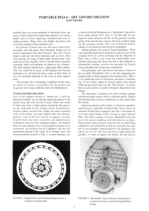
A richly illustrated exploration of the decorative aspects of portable sundials, focusing on French and English craftsmanship, including engravings, ivory work, and use of precious metals and symbolic imagery.
Dials: Portable, Historical Dials
June 1995
Page 36
Page 36
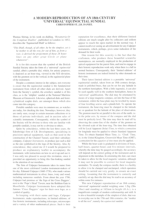
An article about recreating historical sundials using modern methods, reflecting on the balance between authenticity, materials, and function.
Dials: Equatorial, Dials: Portable, Restoration projects
June 1995
Page 39
Page 39
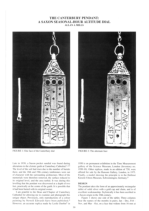
A detailed study of a multi-faced pendant dial designed to tell time on multiple surfaces, including its design, layout, and astronomical considerations.
Dials: Portable, Dials: Unusual, Historical Dials
October 1995
Page 12
Page 12
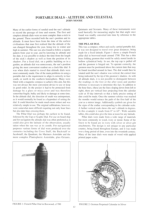
An illustrated survey of various historical portable sundials that use altitude and celestial methods for timekeeping. Examples include pillar dials, Regiomontanus dials, navicula, scaphe dials, and quadrants, with details on their materials, construction, and principles of operation.
Dials: Portable, Historical Dials
February 1994
Page 3
Page 3
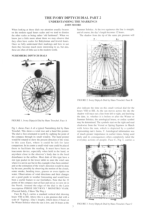
In-depth examination of historical ivory diptych sundials, particularly from Nuremberg and Dieppe, their markings, functions, and astrological and calendrical components.
Dials: Portable, Historical Dials
February 1994
Page 17
Page 17
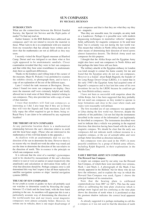
Explores the history, theory, and military use of sun compasses, including detailed designs used by British forces and analogies with sundial mechanics.
Dials: Portable, Mathematics of Dialling
June 1994
Page 7
Page 7
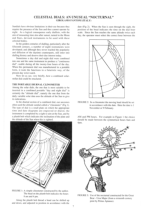
This article explores early timekeeping devices designed for night use, especially nocturnals, which rely on the stars. The main focus is on an unusual 18th-century portable nocturnal made in Granada by Cecyl Yode, with reversed hour scales likely referencing Sirius and Vega. The piece blends astronomy, craftsmanship, and mystery.
Dials: Portable, Historical Dials
June 1994
Page 11
Page 11
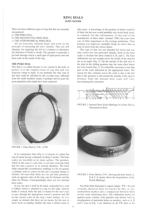
A comprehensive study of three classic types of ring dials: poke dials, equinoctial ring dials, and astronomical ring dials. The article examines their mechanical function, historical development, geographical usage, and craftsmanship, with detailed illustrations and commentary on their strengths and limitations in practical sundialling.
Dials: Equatorial, Dials: Portable, Historical Dials
June 1994
Page 42
Page 42
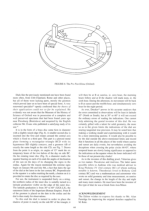
A historical overview of portable timekeeping devices in Roman times, such as ring dials and folding dials. The article discusses their construction, inscriptions, and cultural significance, providing archaeological context and interpretations of surviving examples.
Dials: Portable, Historical Dials
October 1994
Page 14
Page 14
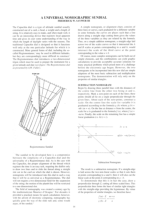
This article explores the history and characteristics of sundials produced in Augsburg, Germany, particularly from the 17th century onwards. It notes Augsburg's reputation for metalworking and clockmaking, which influenced the development of ornate and complicated early sundials. The article describes the mass production of "universal equinoctial dials" from around 1700, their common design, and the incorporation of compasses and latitude lists for European towns. It also highlights finer versions made by Johann Martin and Johann Willebrand, including unique "crescent dials" and "string gnomon dials," and provides a list of known Augsburg sundial makers.
Dials: Equatorial, Dials: Portable, Historical Dials
October 1993
Page 16
Page 16
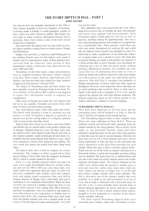
This article discusses the history and characteristics of ivory diptych dials, originating in the 15th-16th centuries from places like Dieppe and Nuremberg. It describes their construction, materials (often ivory or bone), built-in compasses, and typical markings for various faces, noting how magnetic declination aids dating and distinguishing authentic dials from modern replicas or forgeries.
Dials: Portable, Historical Dials
February 1992
Page 23
Page 23
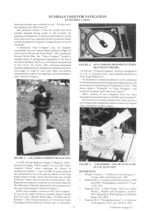
This article highlights the useful adoption of sundials for navigation in the 20th century, particularly in situations where magnetic compasses were unreliable. It cites examples like Admiral Byrd's "Sun Compass" for polar flights and the "Astro-Compass" used in RAF aircraft during WWII. It also mentions Brigadier Ralph A. Bagnold's "Sun-Compass" for desert exploration and Gerald Dunn's "Cruiserfix" for yachtsmen, demonstrating the sundial's value as a navigation tool.
Dials: Portable
February 1992
Page 36
Page 36
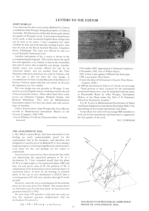
This section contains several letters. H.R. Mills provides mathematical formulae for an analemmatic dial, J.G. Freeman describes the bifilar sundial with two horizontal wires, and Alex Monroe encloses a photograph of his portable equatorial dial. M.J. Cowham contributes notes on John Worgan's work, highlighting a distinctive English Rose design on his instruments.
Dials: Analemmatic, Dials: Bifilar, Dials: Equatorial, Dials: Portable
June 1992
Page 3
Page 3
This lecture explores the practical aspects of 16th and 17th-century navigation, highlighting the crucial role of sundials and similar instruments for determining time at sea. Mariners used celestial observations for latitude, magnetic compasses for direction, and various tools like traverse boards, sand-glasses, nocturnals, astrolabes, and cross-staves for navigation and timekeeping.
Dialling Tools, Dials: Portable, Historical Dials, Dials: Nocturnals
June 1992
Page 17
Page 17
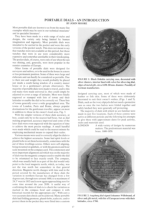
This introduction to portable sundials describes them as early pocket watches, popular in sunnier regions of Europe, offering an affordable alternative to unreliable mechanical watches. It covers various designs, materials, and geographical manufacturing centres like London, Paris, Dieppe, Augsburg, and Nuremburg. The article also discusses their alignment aids, particularly magnetic compasses, and dating by magnetic variation.
Dials: Portable, Historical Dials
June 1992
Page 19
Page 19
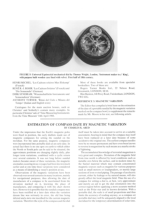
This article explains how magnetic compass deviation, which varies over time and location, can be used to estimate the date of manufacture for portable sundials incorporating compasses. It discusses historical records of magnetic variation and how these can be compared with the deviation marked on a compass bowl. Local conditions affecting magnetic fields, and the need for accurate observations are noted.
Dials: Portable, Historical Dials
October 1992
Page 18
Page 18
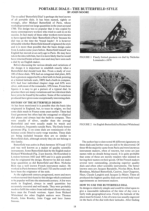
This article describes the popular "Butterfield Dial," named after Michael Butterfield of Paris (c. 1700), though the design's origin might be English. Typically octagonal, silver or brass, with a bird-supported gnomon and built-in compass, it was a decorative status symbol for international travellers. Despite criticism for its small compass and cluttered face, it remained popular, inspiring many copies and variations.
Dials: Portable, Historical Dials, Sundial Design & Layout
June 1990
Page 12
Page 12
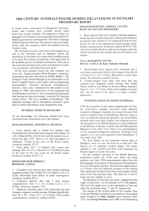
This preliminary report details the discovery of small bone/ivory pocket sundials during archaeological excavations in Hungarian fortresses, castles, and cloisters. It describes specific finds from Buda, Diosgyor, Poganyszentpeter, and Tata, discussing their Nuremburg origins and magnetic variation markings.
Dials: Portable, Historical Dials