- Home
- /
- Sundial Encyclopaedia
- /
- October 1993
October 1993
The articles link to the specific page in a PDF optimised for speed. If you want the whole issue, you can download it here, but the files from earlier years can be quite large.
October 1993
Page 1
Page 1
This section reports on activities of the Dutch Sundial Society "De Zonnewijzerkring", including an anniversary exhibition and plans for a meridian line in Utrecht. It also covers a discussion on Stonehenge, a mechanical sundial by A.J.M. van den Beld, and a continuation of M.J. Hagen's list of Netherlands sundials, alongside English abstracts from the Spanish "Analemma" Bulletin.
The BSS and Members
October 1993
Page 2
Page 2
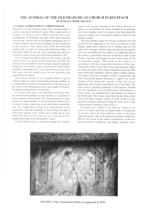
This article details the restoration of a unique astronomical chronogram sundial in Rouffach, France, dating from the early 17th century. It describes the fresco's depiction of planetary orbits based on Ptolemy and Tycho Brahe, highlighting challenges in deciphering faded inscriptions and the astrological significance of a lunar eclipse on the original dial's date in 1617.
Dials: Unusual, Dials: Vertical, Historical Dials, Restoration projects, Sundial Design & Layout
October 1993
Page 6
Page 6
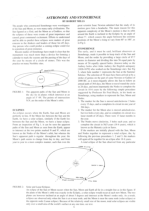
This article explores how Stonehenge served as an ancient astronomical observatory for predicting eclipses and tracking the Sun and Moon. It explains the monument's design, including 56 Aubrey holes, which allowed tracking of the Sun's annual path, the Moon's 28-day cycle, and the 18.6-year Metonic cycle of the lunar nodes for eclipse prediction.
Historical Dials, Mathematics of Dialling
October 1993
Page 8
Page 8
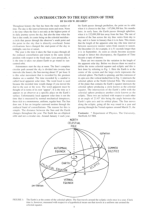
This article explains the Equation of Time, the difference between local apparent solar time (sundial time) and mean solar time (clock time). It details the two astronomical reasons for this variation: Earth's elliptical orbit causing the Sun's speed to change, and the Sun's apparent motion along the ecliptic rather than the celestial equator.
Equation of Time, Mathematics of Dialling
October 1993
Page 12
Page 12
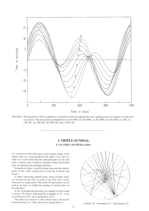
This article describes a unique sundial designed with three styles intersecting at a single point, allowing for the reading of various lines on the dial plane, including azimuth and astrological houses. An example dial is illustrated, delineated for latitude 52° with inclination and declination of 45°, demonstrating how different styles can indicate solar time or other phenomena.
Dials: Unusual, Sundial Design & Layout
October 1993
Page 13
Page 13

This article explores using spreadsheet programs to design and create shepherds' dials, simplifying the complex calculations and plotting involved. It details the process of determining the sun's altitude using a mathematical formula and setting up a spreadsheet to generate the necessary data for plotting hour lines on a cylindrical dial, facilitating DIY dial construction.
DIY Sundial Projects, Dialling Tools, Dials: Cylindrical, Mathematics of Dialling
October 1993
Page 16
Page 16
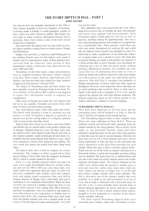
This article discusses the history and characteristics of ivory diptych dials, originating in the 15th-16th centuries from places like Dieppe and Nuremberg. It describes their construction, materials (often ivory or bone), built-in compasses, and typical markings for various faces, noting how magnetic declination aids dating and distinguishing authentic dials from modern replicas or forgeries.
Dials: Portable, Historical Dials
October 1993
Page 20
Page 20
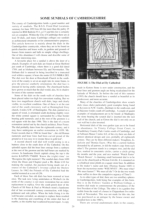
This article surveys various sundials across Cambridgeshire, including church wall dials, horizontal garden dials, and armillary spheres. It highlights specific examples, discussing their dates, inscriptions, restoration efforts, and the materials used. The text also notes the ongoing loss of old dials due to weathering but also the creation of new commemorative ones.
Dials: Armillary Sphere, Dials: Horizontal, Dials: Mass Dials, Dials: Multi Faced, Dials: Vertical, Historical Dials
October 1993
Page 22
Page 22
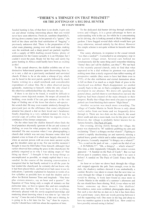
This light-hearted article describes the joys and frustrations of "dial hunting," including the excitement of discovering new dials and the disappointment of finding none. It shares anecdotes of interacting with the public who are often unaware of sundial functions and recounts challenges like obscured views and misidentified "sundials," emphasising the dedicated hunter's passion.
The BSS and Members
October 1993
Page 23
Page 23
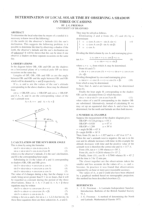
This article presents a geometric method for determining three unknowns (direction of North, latitude and today's solar declination) from three angular measurements of a vertical pole's shadow. It outlines the mathematical formulae and step-by-step calculations required to find the three unknowns.
How Sundials Work, Mathematics of Dialling
October 1993
Page 24
Page 24
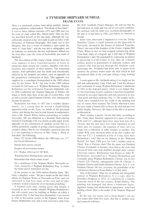
This article tells the story of a sundial from the Neptune Shipyard in Walker, Newcastle-on-Tyne, founded by J. Wigham Richardson in 1860. It traces the dial's history, its motto, and its eventual restoration. The article highlights Richardson's skill as a geometrist and the involvement of his partner, Denham Christie, and describes the dial's characteristics and its journey to the Trinity Maritime Centre.
Dials: Vertical, Historical Dials, Restoration projects
October 1993
Page 26
Page 26
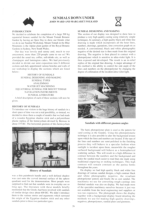
This article details an Open Day showcasing a large equatorial bronze sundial for Mount Tomah Botanic Garden in Australia. It describes various sundial types displayed, including analemmatic dials, and techniques for high-quality sundial design and casting using photopolymer. The article covers historical sundials, navigation instruments, and methods for making accurate hour lines and gnomons, celebrating the spread of gnomonic knowledge.
Construction Projects, Sundial Design & Layout
October 1993
Page 31
Page 31
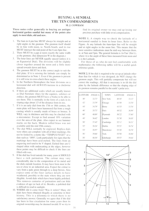
This article provides ten commandments for buying antique horizontal garden sundials, with points also applicable to other dials. It advises on checking gnomon alignment, hour line spacing, and the correct gnomon angle for latitude. The article also discusses material characteristics, identifying replica dials, and ethical considerations regarding origin, including reference tables for latitude and hour line angles.
Historical Dials, Mathematics of Dialling, Sundial Design & Layout
October 1993
Page 32
Page 32
This article explores the rapid deterioration of ancient sundials in the British Isles, attributing decay to factors like stone quality and water-induced damage. It discusses examples like the Bewcastle Cross sundial and the importance of protection and restoration. The article highlights the British Sundial Society's aims in cataloguing and preserving historical artefacts to prevent their complete loss.
Dials: Mass Dials, Historical Dials, Restoration projects, The BSS and Members
October 1993
Page 39
Page 39
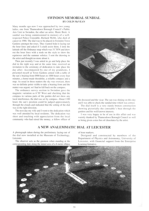
This article describes the design of a horizontal dial commissioned in memory of a police constable and placed in Swindon Town Gardens. The author details the process of laying out hour lines and setting up in the absence of sunshine. It also describes the installation of an analemmatic sundial at Leicester, a photograph shows the preliminary layout, with the observer acting as the gnomon, demonstrating the dial's function in determining time.
Dials: Analemmatic, Dials: Horizontal, Sundial Design & Layout
October 1993
Page 40
Page 40
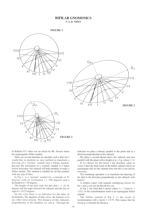
This article presents a general method to transform a 'normal' sundial layout into a bifilar sundial, suitable for all flat dials, not limited to equiangular hour lines. It explains how to calculate thread heights for the resulting sundial drawing.
Dials: Bifilar, Mathematics of Dialling, Sundial Design & Layout
October 1993
Page 41
Page 41
This section reviews "Cardrans Solaires des Alpes" by Pierre Putelat and Paul Gagnaire, illustrating 116 vertical sundials, and "Oronce Fine's Second Book of Solar Horology" by Peter I. Drinkwater, covering portable instruments like quadrants and astrolabe-based dials, offering insight into 16th-century timekeeping.
Book Reviews
October 1993
Page 42
Page 42
This section contains letters from readers, including a discussion on "Neolithic Astronomy" and Stonehenge, suggesting early warning systems for climate change. It also features "Errors" pointing out misconceptions in a previous bulletin, and comments on "A Japanese Sundial", "Kircher's Sunflower Clock", and "Kratzer's 'Polyhedral' Sundial", along with a poem about rainbows.
The BSS and Members
October 1993
Page 44
Page 44
This section notes the positive response to a sundial article in 'Practical Gardening' and the increase in BSS membership enquiries. It announces details for the Annual General Meeting and Conference at Urchfont Manor, including a memorial lecture. It also outlines a week-long sundial-themed holiday in Ireland and reports on a stolen sundial from Helmingham Hall, which has since been recovered.
The BSS and Members