- Home
- /
- Sundial Encyclopaedia
- /
- September 2016
September 2016
The articles link to the specific page in a PDF optimised for speed. If you want the whole issue, you can download it here, but the files from earlier years can be quite large.
September 2016
Page 1
Page 1
Congratulates Sue Manston for completing the challenging crossword puzzle, the solution for which is in this issue. It notes the wide variety of articles, including significant historical research and reports on dials found during members' travels. The team encourages readers to submit new information or photographs of sundials encountered.
The BSS and Members
September 2016
Page 2
Page 2
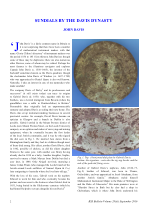
Investigates two horizontal sundials made by the instrument makers Gabriel Davis (c. 1820) and John Davis (c. 1850) of Derby. The article compares their engraving styles and uses X-ray fluorescence (XRF) and thickness profiling to analyse the metallurgy of the plates, revealing differences in casting and manufacturing technology between the two periods.
Dials: Horizontal, Historical Dials
September 2016
Page 6
Page 6
A poem about a sick child named Owain, who constructs a temporary paper-circle sundial on the grass using a broken bean stick and fragments of stone. The piece describes the child calculating the time using the slow finger of light.
September 2016
Page 7
Page 7
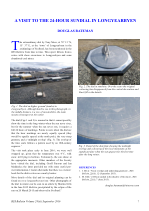
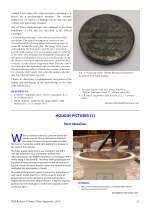
A report on a visit to the unusual 24-hour sundial designed by Tony Moss in Longyearbyen, Svalbard (78° N). Key features noted include the steep gnomon, nearly equally spaced hour lines, and a ‘midnight overlap’.
Dials: Horizontal, Dials: Unusual, Historical Dials
September 2016
Page 8
Page 8
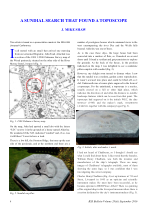
Following an enquiry about a suspected sundial marked on a 1909 map in the Wirral, the author found a pillar topped by a modern 'garden centre' dial. Underneath was a 1945 bronze toposcope (showing directions of visible geographic features) made by Chadburns of Liverpool, likely a gift for William E. Corlett, the company’s solicitor, following the relocation of the bombed factory.
Dials: Horizontal, Historical Dials
September 2016
Page 10
Page 10
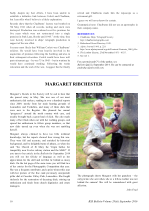
An obituary for Margaret Ribchester, a much-loved, enthusiastic dial seeker who contributed over a hundred accurate and historically rich reports to the BSS Register since 2009, mainly from Lancashire and Yorkshire. She was a frequent contributor to the Photographic Competition, winning a prize this year.
The BSS and Members
September 2016
Page 11
Page 11
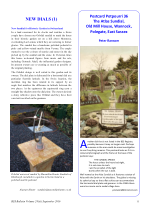
Description of the installation of an Orbdial universal sundial, made by Macmillan Hunter Sundials, in a historic garden above Montreux, Switzerland. The design features a meridian ring that was rotated to compensate for the difference in latitude between its Scottish delineation and its final Swiss location.
Construction Projects, Dials: Unusual, Sundial Design & Layout
September 2016
Page 11
Page 11
Examines a postcard image of the ‘Atlas Sundial’, unlisted in the BSS Register. It features a statue of Atlas supporting a horizontal dial plate on his shoulders. The pedestal carries the motto: “The hours unless the hours be bright, It is not mine to mark”.
Dials: Horizontal, Historical Dials, Mottoes
September 2016
Page 12
Page 12
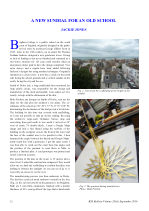
Details the successful construction and installation of a large, square, gold-leafed vertical sundial (1860 mm square) on the newly completed gatehouse tower of Brighton College. The dial was delineated 24° west of south and manufactured by Smith of Derby, utilizing modern materials and techniques.
Construction Projects, Dials: Vertical, Sundial Design & Layout
September 2016
Page 14
Page 14
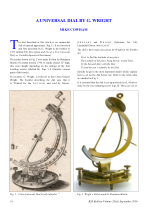
A detailed analysis of an equinoctial dial, or Portable Equatorial Instrument, invented by G. Wright in 1781 and manufactured by Benjamin Martin (c. 1790). The precise instrument uses spirit levels and latitude arcs to find latitude, time (by sun/stars), and the sun’s azimuth.
Dials: Equatorial, Historical Dials
September 2016
Page 17
Page 17
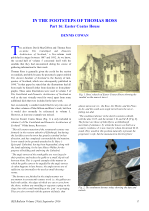
Examines a multi-faceted dial on the south-west angle turret of Easter Coates House (1615), Edinburgh, which Thomas Ross briefly mentioned. The author confirms a horizontal dial face on the upper surface, suggesting the dial is original to the building, despite it possibly containing repurposed stones.
Dials: Multi Faced, Dials: Vertical, Historical Dials, Restoration projects
September 2016
Page 21
Page 21
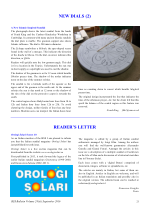
Describes a new 500 mm marble horizontal sundial designed with Islamic influences for a tropical location. Features include a low gnomon angle, a Mihrab-inspired carved Ω shape showing Qibla (direction to Mecca), and Babylonian/Italian hour lines to help Muslim users determine prayer times (Dhuhur and Maghrib).
Construction Projects, Dials: Horizontal, Dials: Unusual, Sundial Design & Layout
September 2016
Page 21
Page 21
Informs members that the Italian sundial magazine *Orologi Solari* has released its tenth free online issue, continuing the legacy of earlier Italian gnomonics publications. It states that articles in English are welcome and may be published in both Italian and the original version.
The BSS and Members
September 2016
Page 22
Page 22
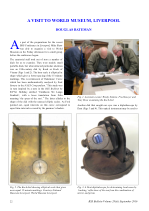
A report on a BSS visit to World Museum, Liverpool, to view their collection of dials. Highlights included an 18th-century Koch dial from Vienna featuring an elliptical scale for better spacing of 15-minute markings, and a Dent dipleidoscope, an instrument used for precisely determining apparent noon.
Dialling Tools, Dials: Portable, Historical Dials, How Sundials Work
September 2016
Page 23
Page 23
Describes a modern horizontal ‘Flat Sundial’ installed in 2011 outside the Nautical Museum of Crete in Chania. The pedestal provides Equation of Time corrections in six languages, though the author notes the original elegant gnomon appears to have been damaged and replaced by a simpler version.
Dials: Horizontal, Historical Dials
September 2016
Page 24
Page 24
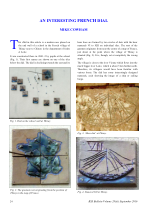
Analysis of a modern, east-declining vertical dial mounted on a school wall in Thizay, France, constructed in 2001–2 by pupils. The hour numerals feature artistic images of sailing barges copied from 15th-century graffiti found on nearby church walls, although the gnomon is incorrectly set.
Dials: Unusual, Dials: Vertical
September 2016
Page 26
Page 26
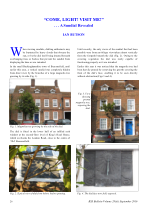
Reports on a vertical dial (SRN 6098) at King’s Head House, Beaconsfield, previously obscured by a large magnolia tree that has now been severely pruned. Although revealed, the dial is incorrectly delineated as direct south-facing, causing it to read 20–30 minutes earlier than true solar time for the wall's 14° east declination.
Dials: Vertical, Historical Dials
September 2016
Page 27
Page 27
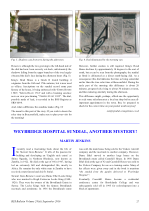
A search for a potentially high-quality sundial gifted to Weybridge Hospital in 1956 from Caenshill House, formerly owned by the wealthy Dame Ethel Locke King. The dial is currently unrecorded in the BSS Register, and its existence and whereabouts are requested from members.
Historical Dials
September 2016
Page 28
Page 28
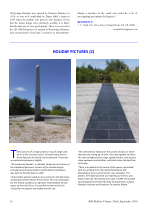
Features photographs of a large horizontal sundial/calendar built in 1995 on Parnidis Dune, Lithuania. The obelisk-style gnomon, originally 12 metres high, was knocked down by a hurricane in 1999. The steps leading up to noon signify hours, equinoxes and solstices.
Dials: Horizontal, Sundial Design & Layout
September 2016
Page 29
Page 29
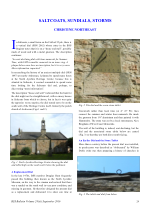
Investigation into a vertical dial (SRN 2062) found on the Heritage Centre wall in Saltcoats. The current dial is a canted, south-facing replacement (by Douglas Hunt) of an older, storm-damaged dial, commemorating the church's turbulent history of being rebuilt multiple times after violent storms.
Dials: Vertical, Historical Dials, Restoration projects
September 2016
Page 31
Page 31
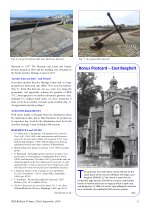
A brief note accompanying a postcard of the dial (SRN 0312) located on the south porch of St Mary the Virgin church, East Bergholt. The church is noted for its unique bell cage where the bells are rung without ropes.
Historical Dials
September 2016
Page 32
Page 32
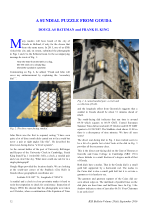
Analysis of a pair of canted vertical dials on the Stadhuis in Gouda, Holland, focusing on a direct east-facing nodus dial. Although the direct south-facing dial shows minor discrepancies with the clock time, the east-facing dial's parallel lines meant to be constant-declination curves are considered seriously suspect and likely the result of bad restoration.
Dials: Vertical, Historical Dials
September 2016
Page 33
Page 33
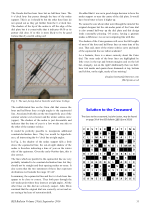
Provides the complete solution to the challenging crossword puzzle, which was set by John Lester and featured in the previous issue of the Bulletin.
The BSS and Members
September 2016
Page 34
Page 34
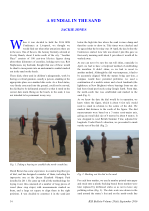
Describes the construction of a large, temporary 6x4 metre analemmatic sundial marked out in the sand at Crosby Beach, Liverpool, utilizing one of Antony Gormley’s cast-iron statues as the gnomon. The team had to use satnav and landmarks to establish the meridian due to the lack of sun.
Construction Projects, Dials: Analemmatic, Sundial Design & Layout, The BSS and Members
September 2016
Page 36
Page 36
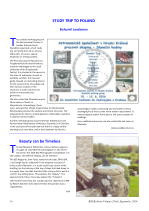
Report on a study trip to Poland organised by the Astronomical Society in Hradec Králové (Czech Republic), focusing on sundials and gnomonics. Visits included the Przypkowskich Museum, an observatory with programs for blind people, and the Silesian Planetarium which features a large courtyard sundial.
The BSS and Members
September 2016
Page 36
Page 36
Features a photograph submitted by Margaret Ribchester (whose obituary appears on page 10) for the 2016 Photographic Competition. The image captures the 18th-century dial (SRN 0194) at Sizergh Castle, noted for its beautiful setting, and its apparent lack of hour lines.
Historical Dials, The BSS and Members